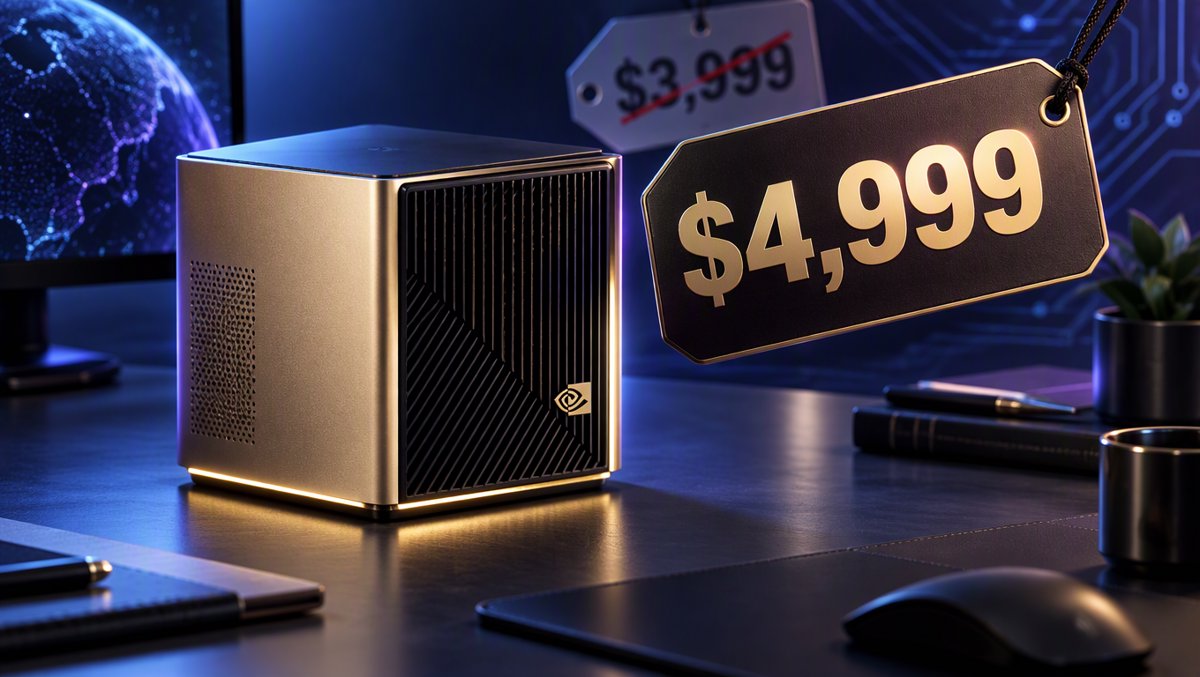
"Local AI is becoming more useful by the token," NVIDIA's blog says — and apparently, so is watching the memory bill.
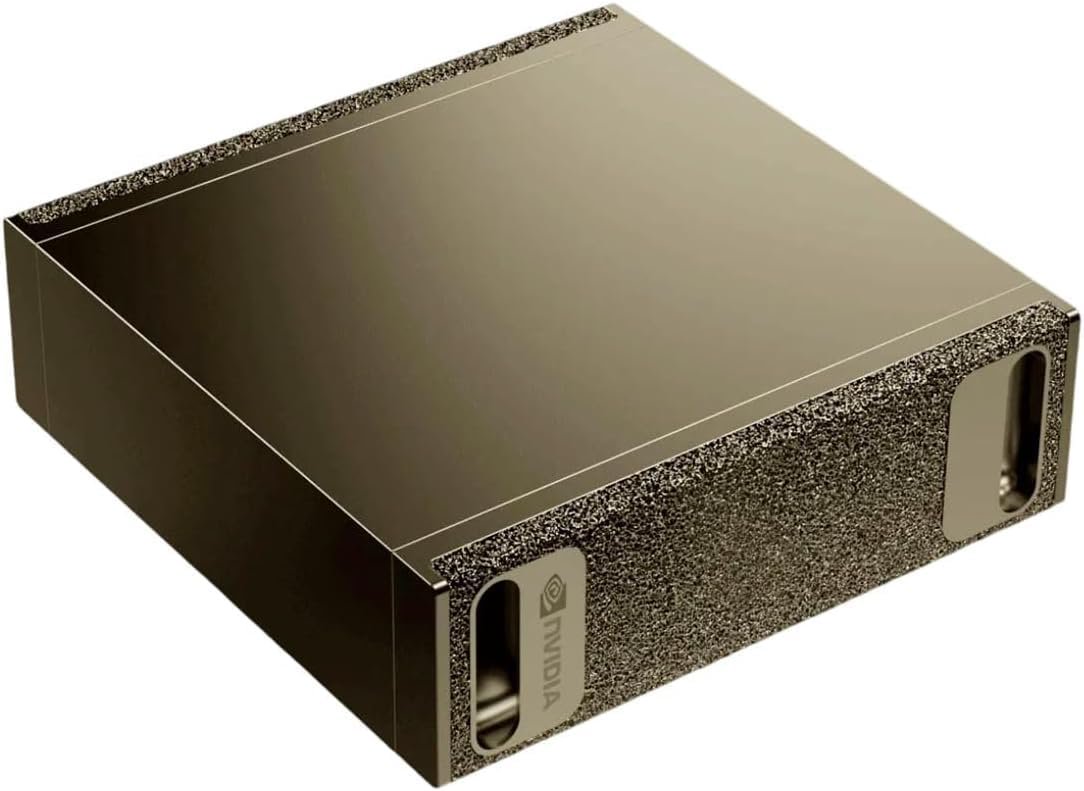
On October 2, NVIDIA quietly did something that would have been unthinkable 18 months ago: it announced a cheaper DGX Spark. The new 64GB configuration lands Friday, October 23, from Acer, ASUS, Dell, Gigabyte, HP and MSI — starting at $4,999.
The only problem? That's exactly what the 128GB model cost when it launched. And that model now sells for thousands more.
The pitch is clean and honestly pretty compelling. The 64GB Spark keeps the same GB10 Grace Blackwell Superchip, the same DGX OS, and the same full NVIDIA AI software stack as the flagship — it just trims unified memory in half. NVIDIA says that's still enough to run models up to 100 billion parameters entirely on your desk, privately, with no cloud bill.
NVIDIA even has a creator win ready: Blender gets a prebuilt installer soon, and a "Sync Model Launcher" arriving at month's end will let you one-click Qwen3.8 27B (single or clustered) and wire it into OpenCode.
In early 2025, the DGX Spark Founders Edition — with 128GB of unified memory and 4TB of storage — launched at $3,999.
Today, that same 128GB Founders Edition lists around $6,950 direct, having climbed steadily all summer. On Amazon at the time of writing, third-party DGX Spark listings sit at $9,699.90 and even $10,991 — roughly double the machine's original sticker.
So the "new, more accessible" Spark is:
Welcome to the memory tax. Component costs — LPDDR5X and SSDs especially — have been climbing all year, and the whole local-AI category has been repricing around it. GMKtec's own Amazon store now opens with a note that "prices [are] increasing monthly" because of RAM and SSD costs. Apple pulled its $4,000 512GB Mac Studio upgrade option outright. NVIDIA isn't an outlier here; it's following the market it helped create.
The spec sheet is genuinely impressive for something the size of a paperback:
| Spec | DGX Spark |
|---|---|
| Chip | GB10 Grace Blackwell Superchip (1 PFLOP FP4) |
| CPU | 20-core Arm (10× Cortex-X925 + 10× Cortex-A725) |
| Memory | 64GB LPDDR5x unified (128GB on flagship) · up to 273 GB/s |
| Storage | 2TB NVMe (flagship: 4TB) |
| Networking | ConnectX-7, 200Gb/s, cluster-ready |
| Power | ~240W |
| Size | 150 × 150 × 50.5 mm · ~1.2 kg |
It runs headless, boots to models in minutes, and — per one Amazon reviewer with four of them clustered — is "great for clustering" while being "not all that fast on the CPU or GPU for the money." That's the honest summary of the whole product line.
This is where NVIDIA's math gets interesting. Two 64GB units linked over a QSFP cable pool their memory to 128GB and expand support to 200B-parameter models, with twice the memory bandwidth and — in NVIDIA's own Qwen 3.8 27B test — up to 1.7× the performance of a single unit.
Two 64GB Sparks = 128GB of pooled memory for $9,998.
One 128GB Founders Edition today = roughly $6,950.
So clustering is a scaling path, not a discount. If you only ever needed 128GB, the single box is still cheaper — when you can find one at list price. The cluster pitch is really for people whose work will grow, and who'd rather add a second $4,999 brick than buy a $20,000 workstation GPU.
Steve asked for real-time comparisons, so here's what the shelf actually says today (US Amazon, Oct. 2):
| System | Memory | Amazon price (live) | The honest read |
|---|---|---|---|
| NVIDIA DGX Spark 128GB FE | 128GB @ 273 GB/s | $9,699.90 (4.4★, 110 ratings) | CUDA-native; steep third-party markup over the ~$6,950 list |
| Apple Mac Studio (M5 Max) | 36GB base, up to 512GB | $2,449 (36GB/512GB) | Far higher bandwidth (~819 GB/s on Ultra) — wins token generation |
| GMKtec EVO-X2 (Ryzen AI Max+ 395) | 128GB unified | $3,649.99 (4.3★, 91 ratings) | The value king; 122B models at ~15 tok/s per owners |
| AMD Ryzen AI Halo Dev Platform | 128GB | ~$3,999 (list) | The official AMD answer; LCD-lit, Windows-first |
The pattern is clear: you are paying a premium for CUDA. An AMD mini-PC gives you the same 128GB unified memory for roughly a third less; an Apple Studio gives you dramatically more memory bandwidth for less than half. What neither gives you is NVIDIA's software stack, TensorRT-LLM, NCCL, and deployment parity with the datacenter GPUs your production code already targets.
Here's the number that humbles every "desk supercomputer": 273 GB/s of memory bandwidth. That's the ceiling. Dense models live or die on it.
Real-world reports put DGX Spark around 60 tok/s on gpt-oss-120b — genuinely useful — but only ~2.7 tok/s on dense Llama 3.1 70B, because a dense model has to stream all its weights through the pipe for every token. Apple Silicon, with triple the bandwidth, laps it on dense inference. NVIDIA wins hard on prefill and compute-heavy work; Apple wins on decode.
Which is exactly why the 64GB SKU exists: it's not about raw speed, it's about what fits. NVIDIA's own reviewers call it "not designed for speed, but for fat throughput."
NVIDIA's new DGX Spark isn't a price cut — it's a product-line rebalancing. It gives the platform a lower entry sticker while quietly letting the flagship float up to where the memory market pushed it. If you need CUDA and 100B models on your desk, $4,999 on Oct. 23 is a legitimate door back in. If you mostly need memory and bandwidth to run big dense models, the AMD mini-PC or an Apple Studio still does more for less — and always did.
The desk supercomputer era is real. It's just that the era's price tag now moves with the RAM market, not the silicon curve.
Sources: NVIDIA Blog ("NVIDIA DGX Spark 64GB Gives Developers More Ways to Build and Scale Local AI," Oct. 2, 2026) · NVIDIA DGX Spark product page · Amazon US real-time listings (DGX Spark 128GB FE/B0FWJ16CCH; GMKtec EVO-X2/B0F53MLYQ6; Apple Mac Studio M5; fetched Oct. 2, 2026) · NVIDIA Developer Forums price-change thread · CG Magazine, Digital Citizen, pi3g price trackers · Reddit r/LocalLLaMA and r/nvidia price threads · owner benchmarks and reviews cited above.