Effective Immediately: Jensen Huang Is Out, Colette Kress Has Two Jobs, and Nvidia Never Wrote a Succession Plan

Effective Immediately: Jensen Huang Is Out, Colette Kress Has Two Jobs, and Nvidia Never Wrote a Succession Plan
Published: November 12, 2026 | Reading Time: ~10 minutes | Channel: techminute
At 13:52 UTC on Thursday, Nvidia's board issued a press release whose most important words were not about AI at all. They were three words buried in the first sentence: "effective immediately."
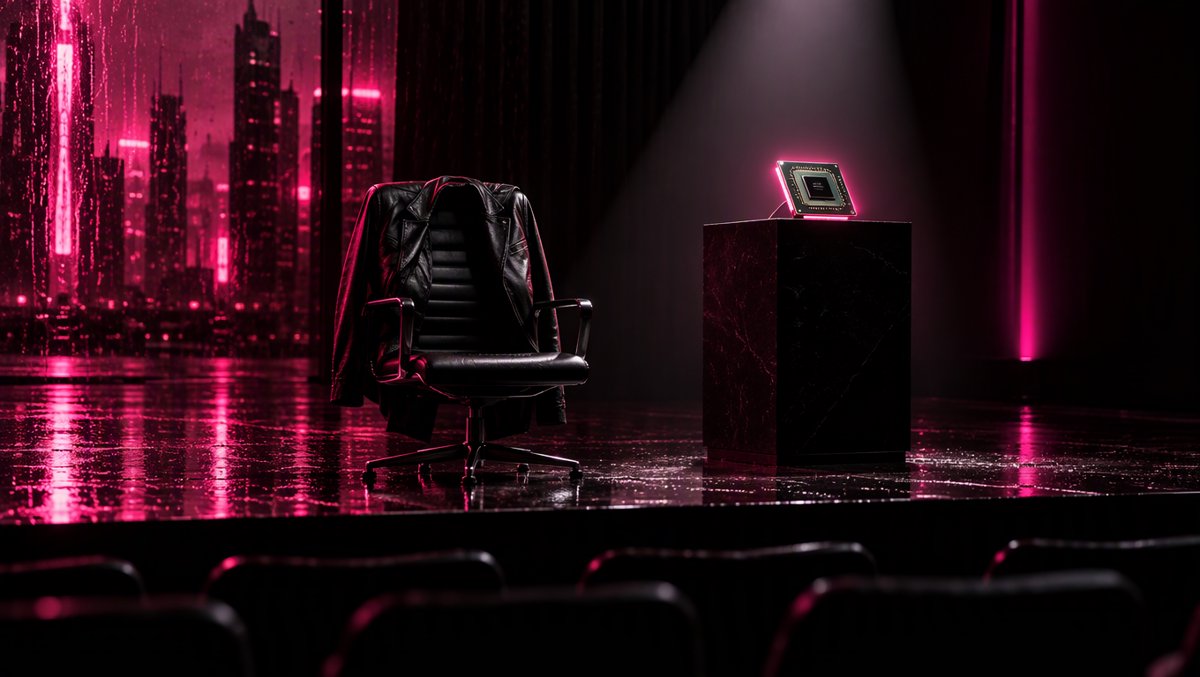
Jensen Huang — co-founder, 33-year CEO, the leather-jacketed personification of the entire AI boom — resigned as President, Chief Executive Officer, and member of the board of Nvidia, the company he started in 1993 and built into a company CNBC valued at roughly $4 trillion before this week's collapse. Colette Kress, the company's CFO of thirteen years, is now Interim Chief Executive Officer while remaining Chief Financial Officer — two of the hardest jobs in technology, held by one person, simultaneously. Harvey C. Jones, a director since the company's founding, becomes the first Chair of the Board in Nvidia's 33-year history. There was no quote from Huang in the announcement. There was no explanation, either.
The market's verdict came fast. Nvidia's stock plunged more than 13% at the open on Thursday — on pace, CNBC noted, for its worst day since January 2025 — dragging the company below $4 trillion in market cap. By 10:02 AM ET, the stock sat at $160.68, down 7.51% on the session with a intraday range of $148.80–$163.10 and roughly 300 million shares already traded. For context: Nvidia closed Wednesday at $173.73, down from a closing high of $239.24 on October 6. That's about $2 trillion of market value erased since the October peak, and more than $740 billion lost since Friday's close alone — a figure TechCrunch's morning tally put at over $855 billion as the damage compounded.
This is not the scandal story — we covered the affair and the spy allegation on November 9. This is the story that came after: the machine Nvidia built over three decades just demonstrated it could remove its founder in under 72 hours. Now everyone gets to find out whether the machine runs without him.
The Context: A Founder With Almost No Power, Running a Company With Almost No Plan B
The most surprising fact in this saga is not that Huang is gone. It's how easy it always was for Nvidia's board to fire him.
As TechCrunch detail-checks confirm, Huang owned only about 3.5% of Nvidia's shares — he was the single largest personal shareholder, but unlike nearly every other Silicon Valley founder-CEO, he held no supervoting shares. There was no founder-protective share class, no "Jensen can't be removed" clause. The board had the legal power to vote him out at any time, since 1993. It simply never had a reason to use it until this week.
What it didn't have, by every account, was a plan for the day after. Huang famously ran a radically flat organization — around 60 direct reports, per TechCrunch. There was no heir apparent and no publicly known succession plan. Two of his children hold executive roles at the company, but neither was anointed. The CEO search the board announced Thursday will consider "internal and external candidates" — corporate-speak for: nobody in the building has been designated as the future.
That's an astonishing posture for a company that sits at the center of the global AI economy. But it was also characteristic. Huang's Nvidia was not an org chart; by most descriptions it was an extension of one person's judgment, from chip roadmaps to the $99 billion investment portfolio to the leather jacket itself. When your CEO is the company's chief strategist, chief salesperson, chief diplomat in Washington, and chief cheerleader on stage at every GTC keynote, succession planning looks like an admission of mortality. Nvidia, until Tuesday, apparently preferred not to think about it.
The Four-Day Timeline: From Apology to Vacancy
For readers who followed the scandal coverage, here is the compressed sequence of how a CEO disappeared inside one week, reconstructed from NVIDIA's own newsroom posts, CNBC's live blog, and TechCrunch's regulatory-filing reporting:
- Sunday, Nov 8: Huang apologizes company-wide for being "unfaithful to my wife," acknowledging an affair with Alice Huang, a businesswoman at Megaspeed — a Chinese company that is also an Nvidia customer. He provides no details. U.S. intelligence officials, per reporting CNBC attributes to the New York Times, believe Alice Huang was a Chinese intelligence operative; Megaspeed is reportedly under investigation over $2 billion worth of export-controlled Nvidia GPUs smuggled into China. Jensen Huang denied compromising national security or Nvidia secrets. The board announces it will hire an outside investigator. Nvidia also posts "A Message to Our Company" and a board statement that Sunday.
- Monday/Tuesday, Nov 9–10: The independent members of the board announce they have retained Joon H. Kim — former acting U.S. Attorney for the Southern District of New York — and his firm Wachtell, Lipton, Rosen & Katz to conduct a "thorough and independent investigation" (NVIDIA newsroom, Nov 10). Tuesday's statement confirms the hire.
- Wednesday, Nov 11: The New York Times reports — via CNBC's live blog — a second affair, this one with Kimberly Powell, Nvidia's Vice President of Healthcare and, critically, one of Huang's direct reports. Later that afternoon, the Times and other outlets report the board met to discuss the company's future. Per TechCrunch, the regulatory filing shows the board accepted Huang's resignation on Wednesday.
- Thursday, Nov 12, ~13:52 UTC: The announcement. Huang resigns as President, CEO, and director, effective immediately. Kress takes both roles. Jones becomes the first-ever Chair. Q3 FY2027 earnings remain scheduled for Tuesday, November 17, with results at approximately 1:20 p.m. PT and the call at 2 p.m. PT.
Note what the press release does not say. It does not say the investigation found anything — Wachtell's review is presumably days old, not finished. It does not say Huang was forced out versus resigned voluntarily (though a founder offering "effective immediately" resignation hours after a board meeting, while two affairs including one with a direct report dominate the front pages, reads a certain way). And it notably denies Huang the customary farewell quote. The closest the release comes to warmth is the board's own sentence: "Jensen's contributions to NVIDIA are profound."
Under the Hood: Who Actually Has the Keys Now
Colette Kress — the interim with the balance sheet
Kress is not a placeholder in the conventional sense. She joined Nvidia in September 2013 and has run its finance organization through the entire transformation from gaming-chip vendor to the supplier of effectively every serious AI training run on Earth. Before Nvidia: nearly 25 years in finance at Cisco and Microsoft, per the company's own release.
She is also, functionally, the person who knows where all the bodies and all the balance-sheet commitments are buried. Because under Huang, Nvidia didn't just sell chips — it financed an entire industry's ability to buy them. As of the end of Q2, TechCrunch tallies the exposure at: $99 billion in investments plus $25 billion of commitments, and $36 billion in cloud-service commitments where Nvidia helps finance the GPUs and data centers its customers buy, often taking payment in compute or revenue share. Direct equity plays include $2 billion into CoreWeave (January), $2 billion into Nebius (March), $30 billion into OpenAI, $10 billion into Anthropic, backing for Mira Murati's Thinking Machines Lab tied to at least 1 GW of Vera Rubin systems, $3.5 billion into MediaTek for custom silicon, and — most structurally dizzying — up to $105 billion in credit guarantees for an OpenAI data center campus in Ohio.
Every one of those arrangements was personally negotiated in an ecosystem where, as executive recruiter Jeff Christian told CNBC, "He's Mr. AI. He speaks for the industry. He's connected financially to everybody either through partnerships, or through lending the money to buy chips." Kress now owns that web's day-to-day maintenance while running a permanent-CEO search she is also, implicitly, a candidate in.
Board chair Harvey Jones's endorsement in the release was pointed: "Colette has helped lead NVIDIA through a period of extraordinary growth and has a deep understanding of our business, customers, operations and financial position… we expect the company's operations, customer commitments and product roadmap to continue without interruption." Her own statement promised to build on "the extraordinary foundation Jensen created over the last 33 years."
Harvey Jones — the first chair, 33 years late
That Jones is Nvidia's first-ever Chair of the Board in 2026 tells you everything about the old governance model. A technology executive and venture investor (managing partner at Square Wave Ventures, per TechCrunch) who served as CEO and Executive Chairman of Synopsys, Jones has sat on Nvidia's board since 1993 — the founding class. The company that defined modern corporate dominance ran for three decades with no independent chair, no separation between founder and board leadership, and apparently no documented succession. The new structure — independent chair, dual-hatted interim, external search — is Nvidia retroactively installing the governance it skipped while printing the most valuable product in history.
Dan Ives of Yorkville Ives & Co. told CNBC the interim role will likely last "about a year," and that "to steady the ship, she's the one. But longer term, probably someone from the outside. You need someone that's been on the global stage." Jim Cramer, on the same morning, was more emphatic: Kress is "absolutely the one that you need right now."
By the Numbers: The Market Reprices a Founder
| Metric | Value | Source |
|---|---|---|
| NVDA last trade (10:02 AM ET, Nov 12) | $160.68 (-13.05, -7.51%) | Live quote |
| Intraday range | $148.80 – $163.10 | Live quote |
| Open plunge | >13% — worst pace since Jan 2025 | CNBC |
| Wednesday close vs Oct 6 closing high | $173.73 vs $239.24 | CNBC |
| Market value lost since October peak | ~$2 trillion | CNBC |
| Lost since Friday's close | >$740B (CNBC) / >$855B+ (TechCrunch, early tally) | Both, different snapshots |
| Stock down over past month | >23% | Tom's Hardware |
| Long arc | Up ~14x since ChatGPT launched (late 2022) | CNBC |
| Q2 balance-sheet exposure | $99B investments + $25B commitments + $36B cloud commitments | TechCrunch |
The reverberations mapped Nvidia's gravitational field with brutal precision. Nvidia's rivals popped on the news — AMD up about 3%, Broadcom up more than 5%, Qualcomm up about 1% — while the supply chain sagged with it: Intel, Marvell, and Micron each fell more than 2%, and the iShares Semiconductor ETF dropped about 1% (CNBC). The neoclouds, whose business models are levers on Nvidia's own financing, got hammered hardest: CoreWeave sank nearly 12%, Nebius fell 17% (it also reported Q3 results beating expectations alongside disappointing guidance), and IREN dropped 8%.
Community pulse, for texture: by mid-morning UTC, Hacker News had three separate front-page threads running simultaneously — the Reuters live blog at 217 points with 96 comments, the BBC's live coverage at 104 points with 44 comments, and NBC News' writeup at 38 points (community-sourced; points shift by the minute). The comment-section mood split neatly between good riddance (moral), this is catastrophic for AI (macro), and — evergreen, from the Tom's Hardware forum regulars — maybe gamers finally get some GPUs.
What This Changes
1. The AI industry loses its single spokesperson. Huang wasn't just a CEO; he was the industry's roving ambassador — the May trip to China alongside President Trump, the August All-In Summit moment where he took Trump's speakerphone call live on stage ("I'm with you all the way"), the standing role as de facto voice of U.S. AI policy. Nobody else can wear that jacket. The next person who tries inherits a Washington that just got measurably less friendly: Democrats are positioned to take both houses of Congress with Nvidia investigations promised, and Senator Elizabeth Warren — in line to lead Senate Banking — released a statement within the hour: "Jensen Huang's decision to resign does not absolve him, other executives, or the company as a whole of responsibility for putting our national security at risk," while demanding Commerce Secretary Howard Lutnick and Under Secretary Jeffrey Kessler explain why export-control loopholes remain open, and calling for the AI Overwatch act to give Congress oversight of advanced chip exports.
2. The financing web gets a stress test. Nvidia's circular money machine — invest in the customer, finance the purchase, count the revenue — depended on a single relationship-holder with every counterparty. U.S. Trade Representative Jamieson Greer, minutes before the announcement, tried to wall off the macro story: "the reality is the AI buildout, data centers, the next industrial revolution — that's happening," while acknowledging "we remain concerned" and that the U.S. wants the "crown jewels to remain in U.S. hands or in the hands of our allies." Whether the $105 billion OpenAI guarantee, the CoreWeave and Nebius backstops, and the Thinking Machines gigawatt deal get renegotiated on colder terms under an interim CEO is now a live question.
3. Competitors smell blood. AMD +3% and Broadcom +5% on Nvidia's worst day since the dead-cat January 2025 selloff is the market explicitly pricing in share-shift and procurement diversification. Every enterprise GPU roadmap review scheduled for next week just got reopened.
4. Even Elon wants him. Before the resignation, Musk posted on X that it "would be an honor" to hire Huang, endorsing investor Gavin Baker's argument that the board should have waited for the investigation. SpaceX — which announced in August it would become an Nvidia-exclusive Vera Rubin shop for its data-center buildout — is one of Nvidia's largest customers, and Musk and SpaceX did not respond to CNBC's request for comment after the resignation. Whether Huang lands at a rival, a customer, or nowhere is now the most-watched free-agent storyline in tech.
⚠️ Limitations & Caveats
- The investigation has no public findings. Wachtell Lipton was retained days ago. The board has not stated that its inquiry produced anything; what we know is the sequence of events, not a causal ruling. Huang has denied compromising national security or Nvidia secrets, and no public evidence has adjudicated the "spy" question — that framing reflects U.S. intelligence officials' belief as reported by the New York Times and relayed by CNBC.
- The second affair is reporting, not adjudicated fact. The Kimberly Powell reporting is the New York Times' (via CNBC); the alleged GTC-hotel footage and NDA offer details come from Tom's Hardware and should be treated as allegations.
- Intraday numbers are moving targets. Every percentage in this piece was captured mid-session on November 12 between roughly 6:10 AM PST and 10:02 AM ET; the open (down 13%+) and the 10:02 reading (-7.51%) differ, and the CNBC-versus-TechCrunch market-cap-loss gap ($740B vs $855B) is a snapshot-timing artifact, not a disagreement.
- "Worst day since January 2025" was an as-of-writing characterization from CNBC, before the closing bell.
- Nobody has explained the resignation mechanism. The release says "resigned"; the filing says the board "accepted" it Wednesday. Whether Huang was offered a choice is unknown.
🎯 The Bottom Line
Nvidia spent 33 years building the most important company in technology while skipping the two boring institutions that keep companies alive past their founders: a chair, and a succession plan. This week it retrofitted both in 48 hours, at a cost of roughly $2 trillion in market value and the industry's only universal spokesperson. Colette Kress holding the CFO and CEO offices simultaneously is either the steadiest possible hand on the tiller — the person who knows every commitment in that $99 billion web — or proof of how thin the bench really is. Tuesday's earnings call, with results due approximately 1:20 p.m. PT on November 17, will be the first public stress test of an Nvidia that has to speak for itself.
📚 Sources
- NVIDIA Newsroom — "NVIDIA Announces CEO Transition" (Nov 12, 2026): official board announcement — resignation effective immediately, Kress interim CEO while remaining CFO, Harvey C. Jones first-ever Chair, CEO search internal + external, earnings Nov 17. https://nvidianews.nvidia.com/news/nvidia-announces-ceo-transition
- NVIDIA Newsroom — "Statement From the Independent Members of the NVIDIA Board" (Nov 10, 2026): retention of Joon H. Kim and Wachtell, Lipton, Rosen & Katz for the independent investigation. https://nvidianews.nvidia.com/news/statement-from-the-independent-members-of-the-nvidia-board
- CNBC — "Nvidia CEO Jensen Huang resigns, Colette Kress named interim chief: Live updates" (Nov 12, 2026): timeline, Alice Huang/Megaspeed spy allegations, Powell affair per NYT, board meeting, market reaction, Warren/Greer/Ives/Musk statements, neocloud and semiconductor moves. https://www.cnbc.com/2026/11/12/nvidia-jensen-huang-ceo-live-updates.html
- TechCrunch — "Nvidia's Jensen Huang resigns, chipmaker names CFO Colette Kress as interim CEO" (Nov 12, 2026): regulatory filing (board accepted resignation Wednesday), 3.5% stake / no supervoting rights, 60 direct reports, no succession plan, full AI financing-web accounting ($99B/$25B/$36B, CoreWeave, Nebius, OpenAI, Anthropic, Thinking Machines, MediaTek, $105B Ohio guarantees). https://techcrunch.com/2026/11/12/nvidias-jensen-huang-resigns-chipmaker-names-cfo-colette-kress-as-interim-ceo/
- Tom's Hardware — "Nvidia CEO Jensen Huang resigns in the wake of multiple affairs, Chinese spy allegations" (Nov 12, 2026): two-affair framing, Megaspeed $2B smuggling investigation context, GTC hotel footage/NDA allegation, Kress and Jones backgrounds, >23% monthly decline. https://www.tomshardware.com/tech-industry/nvidia-confirms-jensen-huang-has-resigned-as-ceo-colette-kress-executive-vice-president-and-chief-financial-officer-appointed-interim-ceo
- Hacker News (Algolia API) — community pulse: three simultaneous front-page threads (Reuters live blog 217 pts/96 comments; BBC live 104 pts/44 comments; NBC News 38 pts). https://hn.algolia.com/api/v1/search?query=nvidia%20huang%20resigns&tags=story
All claims verified against Gold-tier sources (NVIDIA's own newsroom releases) and Silver-tier sources (CNBC, TechCrunch, Tom's Hardware). Every source URL was scraped and confirmed accessible on November 12, 2026; Forbes' companion piece was 403-blocked and its unverified claims were excluded. Live stock figure from real-time quote data (NVDA $160.68, -7.51% at 10:02 AM ET, Nov 12, 2026). Last verified: November 12, 2026.