Dummies Guide to Your Restaurant Business in Canada (2026)


Dummies Guide to Your Restaurant Business in Canada (2026)
Key Takeaways
- According to Square Canada (2026), opening a restaurant in Canada costs $250,000–$1,000,000 depending on concept, size and location.
- According to Statistics Canada (2026), food services and drinking places sales totalled $101.4 billion in 2025, up 5.6% from 2024.
- According to Restaurants Canada (2026), 6 in 10 operators reported weaker profitability in 2025 than in 2024.
- According to the Government of Canada's Canadian Industry Statistics portal (2026), 57.7% of restaurants are profitable, with an average profit margin of roughly 8% among profitable ones.
- According to Dalhousie University (2026), Canada is expected to lose roughly 4,000 restaurants on a net basis in 2026.
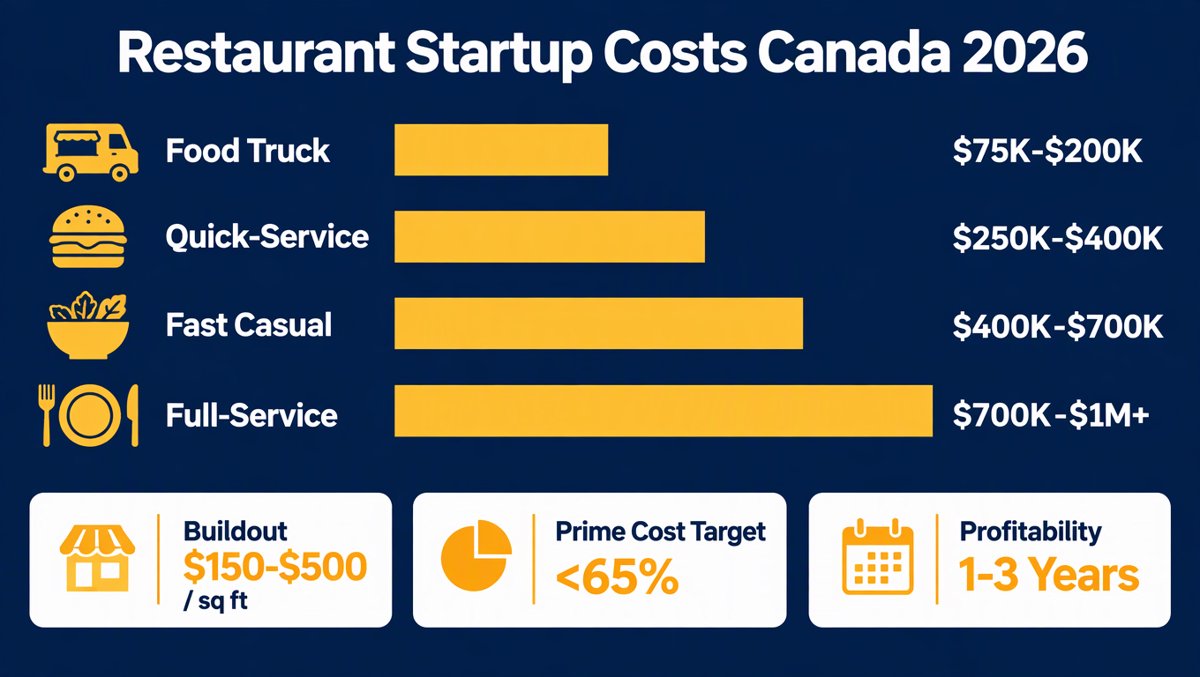
The answer in 30 seconds: Budget $250,000–$400,000 for a quick-service start, $400,000–$700,000 for fast casual, and $700,000–$1,000,000+ for full-service — with buildout at $150–$500 per square foot as the biggest swing factor and a 1–3 year runway to consistent profitability.
Step 1: Pick Your Concept — The Type Decides the Budget
Your restaurant business concept is the first and biggest cost decision. Square Canada's 2026 breakdown, citing 360 Restaurant Consultant, puts quick-service at $250,000–$400,000, fast casual at $400,000–$700,000, and full-service at $700,000–$1,000,000+ — while a food truck starts far lower at $75,000–$200,000. Toronto and Vancouver sit at the high end because buildout, equipment, staffing and reserves all scale up in major metros.
The practical rule: write down the menu first, then price the room. A limited menu with a small footprint keeps equipment, staffing and buildout inside the quick-service band. Every extra station — a bar, a second oven line, a full dining room — moves the number toward the next tier.
| Concept | Typical startup cost (CAD) | What drives it |
|---|---|---|
| Food truck | $75,000–$200,000 | Vehicle, kitchen fit-out, permits, commissary fees |
| Quick-service | $250,000–$400,000 | Lease deposit, basic kitchen, limited seating, POS |
| Fast casual | $400,000–$700,000 | Larger kitchen, design, seating, online ordering |
| Full-service | $700,000–$1,000,000+ | Dining room, bar, ventilation, liquor licence, working capital |
Step 2: Cost It Honestly — Where the Money Actually Goes
The buildout is the swing factor. Square Canada reports construction at $150 per square foot for a basic buildout to over $500 per square foot for high-end, with interior design and buildout running $85–$500 per square foot — a 600-square-foot space alone lands between $51,000 and $300,000. A full commercial kitchen setup runs $10,000–$50,000, and marketing startup typically takes $10,000–$30,000.
Three costs hide in plain sight. Lease terms demand 1 to 3 months of rent as a deposit, and buying a commercial property needs a down payment of at least 20% (BDC). Permits and licences run from hundreds to thousands of dollars — use the federal BizPal tool to list exactly what your city and province require. Insurance for most restaurants lands around $1,000–$5,000 per year.
This guide is informational only. Verify costs, licence fees and lease terms with your accountant, lawyer and municipal/provincial registry before committing capital.
Step 3: Know the Benchmarks — Food, Labour, Prime Cost
Restaurants are won or lost on three percentages. Net profit margins typically run 3%–9% (Vanta Insights, 2024 data), while Lightspeed (2025) puts food plus labour at 55%–65% of turnover — above 70% is a warning sign. Statistics Canada data shows ingredients at nearly 36% of total operating expenses for the subsector, and DoorDash Canada (2026) derives a gross margin of about 65.6% before labour and overhead from 2024 food services data.
Labour is the other lever. Square Canada puts labour at 25%–35% of revenue, and Canada-specific benchmarks from 911 Chef Eric (2026) put fast casual at 22%–28%, casual dining at 28%–35% and full service at 30%–38%. The average hourly wage in Canada's food service sector was $19.15 in 2024 (Statistics Canada), so a 10-person team working 25–35 hours a week each costs roughly $20,700–$29,000 per month in payroll. An executive chef averages $67,346 per year in Canada (Indeed).
Watch the prime-cost rule: if food cost plus labour cost crosses 65% of sales, fix it before spending on anything else. A worked example from Waitery Canada (2026) shows $80,000 in monthly sales at a 64% prime cost leaving only a 4.75% operating margin — that is the entire game in one line.
Step 4: Survive the First Year — The Real Failure Numbers
Ignore the "90% of restaurants fail in year one" myth. Datassential (2025) traces that claim to a range starting as low as 17%, and US Bureau of Labor Statistics data puts first-year closure at 14%–17% — a US figure, cited here only to correct the myth. The Canada-specific warning is different: Dalhousie University (2026) expects the country to lose roughly 4,000 restaurants on a net basis in 2026 after about 7,000 closures the prior year, as cost pressure meets softer guest counts.
The pressure is real. Restaurants Canada (2026) reports 6 in 10 operators had weaker profitability in 2025 than in 2024, and its 2026 outlook expects real (inflation-adjusted) foodservice sales to decline 1.1% after growing 2.4% in 2025. Against that backdrop, ISED's Canadian Industry Statistics portal counts 65,071 businesses in NAICS 7225 (full-service and limited-service restaurants) — plenty of room to compete, and plenty of exits if costs drift.
The survival playbook from the data: keep prime cost under 65%, hold utilities in check (Square Canada notes monthly utility costs can exceed $2,000 depending on size and equipment), and budget maintenance at 1%–2% of annual sales. Square Canada's guidance puts consistent profitability 1 to 3 years after opening — your working capital must cover that runway.
Step 5: Open — The Checklist Owners Actually Use
Work the sequence in order: concepts and menu first, then location and lease, then permits via BizPal, then buildout and kitchen, then hiring and training, then a marketing launch budget of $10,000–$30,000 aimed at repeat visits through loyalty and email rather than one-time discounts. Square Canada's startup planning advice is blunt: buy only the equipment your menu actually uses, pick an integrated POS instead of stacking subscriptions, and favour durable design over statement pieces.
💬 Want the working version? Subscribe free — Saturday toolkit PDFs by email. Have a question about your startup budget? Chat with Peter — bring your concept and your city.
🏁 THE VERDICT

A Canadian restaurant business is a $250K–$1M commitment where food cost, labour and prime cost decide everything. If you choose a small-footprint concept, hold prime cost under 65% of sales, and fund a 1–3 year runway, the math works — 57.7% of operators are profitable. Next step: lock your concept tier first, then price the space against the $150–$500/sq ft buildout range before signing anything.
Frequently Asked Questions
How much does it cost to open a restaurant in Canada? Square Canada (2026), citing 360 Restaurant Consultant, puts the range at $250,000–$1,000,000 depending on concept. Quick-service starts near $250,000; full-service in Toronto or Vancouver can exceed $1 million once buildout, equipment and reserves are included.
What is a good profit margin for a restaurant in Canada? Vanta Insights (2026) cites net margins of 3%–9%, while the Canadian Industry Statistics portal reports about 8% among profitable restaurants. Prime cost — food plus labour — should stay between 55% and 65% of sales.
How long does it take for a restaurant to become profitable in Canada? Square Canada (2026) puts the timeline at 1 to 3 years to consistent profitability. Rent, labour costs, food cost control and how fast guest demand builds after opening all move that date.
How many restaurants are there in Canada? ISED's Canadian Industry Statistics portal counts 65,071 businesses in NAICS 7225 as of September 2026. Statistics Canada reported food services and drinking places sales of $101.4 billion in 2025, up 5.6% from 2024.
What kills most new restaurants in Canada? Restaurants Canada (2026) found 6 in 10 operators had weaker profitability in 2025 than in 2024, with food and labour costs the top challenges. Dalhousie University (2026) forecasts roughly 4,000 net restaurant losses in 2026.
📚 SOURCES
- Square Canada (2026) — Restaurant startup costs in Canada: https://squareup.com/ca/en/the-bottom-line/starting-your-business/restaurant-start-up-costs
- Statistics Canada, The Daily (2026) — Food services and drinking places, annual 2024: https://www150.statcan.gc.ca/n1/daily-quotidien/260309/dq260309a-eng.htm
- Statistics Canada, The Daily (2026) — Food services and drinking places, December 2025: https://www150.statcan.gc.ca/n1/daily-quotidien/260225/dq260225d-eng.htm
- ISED Canadian Industry Statistics, NAICS 7225 (2026): https://ised-isde.canada.ca/app/ixb/cis/performance/rev/7225
- DoorDash Canada (2026) — Average restaurant profit margin in Canada: https://merchants.doordash.com/en-ca/blog/restaurant-profit-margin
- Vanta Insights (2026) — Restaurant profit margins: https://vantainsights.com/insights/restaurant-profit-margins
- Vanta Insights (2026) — Restaurant startup costs: https://vantainsights.com/insights/restaurant-startup-costs
- Lightspeed (2025) — The complete guide to restaurant profit margins: https://www.lightspeedhq.com/blog/complete-guide-to-restaurant-profit-margins/
- Waitery Canada (2026) — Restaurant margins in Canada: https://waitery.ca/resources/restaurant-profit-margin-canada/
- 911 Chef Eric (2026) — Restaurant labor cost benchmarks in Canada: https://911cheferic.com/restaurant-labor-cost-benchmarks-canada/
- Restaurants Canada (2026) — 2025 foodservice sales and 2026 outlook: https://www.restaurantscanada.org/2025-foodservice-sales-buffered-by-gst-holiday-as-rising-operating-costs-and-tariffs-cut-into-profits-restaurants-brace-for-more-obstacles-in-2026/
- Datassential (2025) — Restaurant failure rate: https://datassential.com/resource/restaurant-failure-rate/
- Agri-Food Analytics Lab / Dalhousie University (2026) — Canada poised to lose 4,000 restaurants in 2026: https://agrifoodanalyticslab.substack.com/p/canada-is-poised-to-lose-4000-restaurants
- IBISWorld Canada (2026) — Full-Service Restaurants industry analysis: https://www.ibisworld.com/canada/industry/full-service-restaurants/1677/