Dummies Guide to Starting an Ecommerce Business in Canada (2026)


Dummies Guide to Starting an Ecommerce Business in Canada (2026)
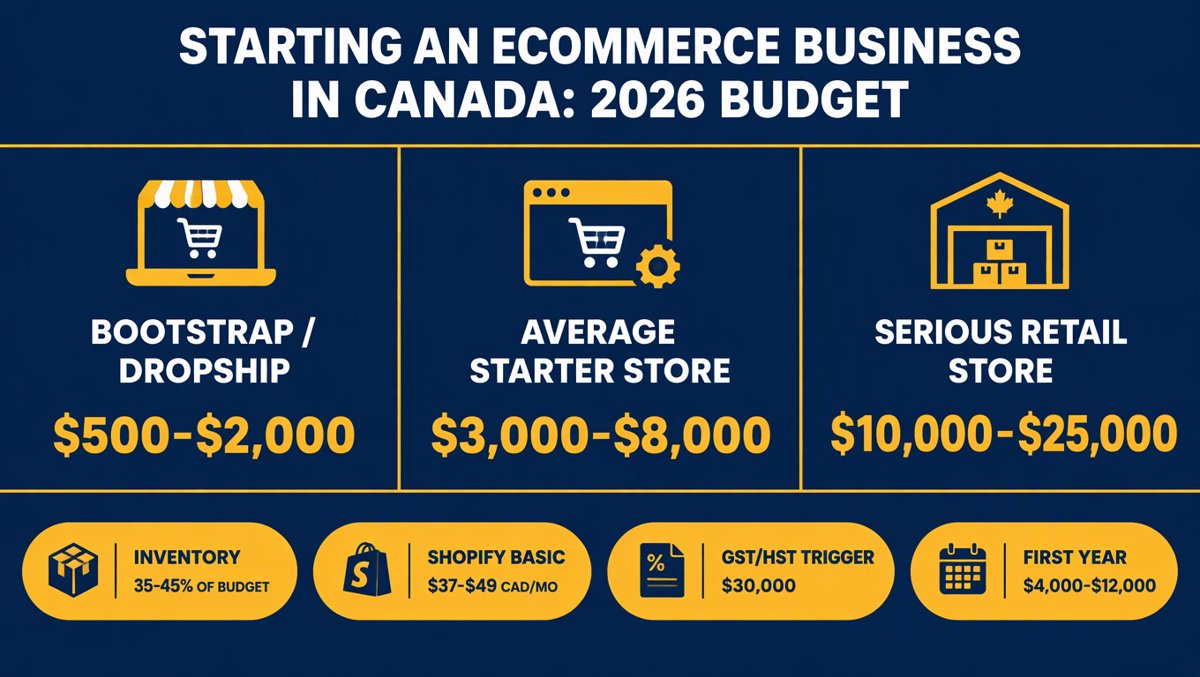
You can launch an ecommerce business in Canada for $500–$2,000 CAD, but the realistic starter budget is $3,000–$8,000 — and you should plan $4,000–$12,000 for the first year. Inventory eats 35–45% of that budget, and the single biggest risk isn't competition — it's running out of cash. This guide is the plain-language version: what to do, in what order, with real numbers at every step.
The three launch budgets
| Scenario | What you're doing | Total startup cost (CAD) |
|---|---|---|
| Bootstrap / dropshipping | No inventory, organic marketing, free tools | $500 – $2,000 |
| Average starter store | Shopify + small inventory + some ads + a few apps | $3,000 – $8,000 |
| Serious retail store | Larger SKU range, regular ads, hired help | $10,000 – $25,000+ |
Source: SAL Accounting, a Toronto CPA firm that builds budgets for Canadian founders. Most people asking "how much do I need?" belong in the middle row. First-year running costs add $150–$600 CAD per month on top.
Step 1 — Pick your model (this decision sets your margins)
| Metric | Dropshipping | Own inventory |
|---|---|---|
| Upfront cost | $500–$3,200 | $3,500–$38,000+ |
| Gross margin | 15–40% | 55–70% |
| Net margin | 10–20% | 18–26% |
| Revenue needed for $5K/mo profit | ~$25,000–$50,000 | ~$19,000–$28,000 |
| Time to profitability | 3–6 months | 6–12 months |
Dropshipping means the supplier ships directly to your customer — you never touch the product. You keep less per sale, but you risk almost nothing. Holding inventory earns roughly double the net margin but ties up cash for months. The proven middle path: dropship to test, then move your winners to inventory — merchants who make that switch see net margin gains of 10–15 percentage points (Talk Shop 2026 analysis, citing TrueProfit and Omnisend benchmarks).
Step 2 — Register before you sell
- Business registration: $0–$200. Start as a sole proprietor — it's the cheapest structure, and you can incorporate later when the store earns real money.
- GST/HST: you must register once your worldwide sales pass $30,000 in four consecutive calendar quarters (or in a single quarter). Registration is free. The trap: your first big sales spike can cross the line before you notice, and the collected tax is money you can't spend.
- US sales trigger economic nexus at $100,000 in sales or 200 transactions per state — relevant the moment you ship south.
Step 3 — Set up the store without overpaying
| Shopify plan (CAD) | Monthly | Annual (per month) |
|---|---|---|
| Starter (social selling only) | — | $7 |
| Basic (most new stores) | $49–$51 | $37–$38 |
| Grow | $132 | $99 |
| Advanced | $517 | $389 |
Two rules save real money. First, use Shopify Payments as your processor: third-party gateways (PayPal, Stripe) trigger an extra Shopify surcharge of +2% on the Basic plan — roughly $500–$2,000 in avoidable first-year fees. Second, keep the app bill near zero at launch: free themes like Dawn are genuinely usable, and most founders need only $30–$150/month in apps. Domain runs $15–$25/year.
Step 4 — Stock it (carefully)
Inventory is 35–45% of a typical starter budget ($2,000–$4,000 on the $3,000–$8,000 plan; the wider retail range runs $2,000–$25,000). Don't buy deep. Validate demand with samples and small batches first — unsold stock is the silent killer of first-year stores.
Step 5 — Price for shipping from day one
Shipping costs $5–$15 per order in Canada (Shopify's Canada Post discounts on the Basic plan cut that meaningfully — small parcels commonly land around $8–$15 after discount). Build it into your product price. In a 2025 survey of 3,161 store owners, 64% named shipping delays their single biggest pain point — choose suppliers who can actually deliver, not just the cheapest quote.
Step 6 — Market with a budget you can survive
Most beginners spend $500–$1,000/month on marketing, with paid ads alone at $300–$1,500. The working rule: spend 15–25% of your expected sales on marketing, start with $10–$20/day ad tests, and only scale what converts. Organic-first (SEO, social content) costs $0 and is slower — fine if capital is the constraint.
Why most stores die (and what this checklist prevents)
The failure math is brutal and specific:
| Fact | Number | Source |
|---|---|---|
| Ecommerce businesses failing in year one (UK registry) | 70% | Companies House via Your Ecommerce Accountant |
| All-business average failure, year one | 30% | same dataset |
| US small businesses failing year 1 / by year 5 | 20% / 50% | US BLS |
| Fail because there's no market need | 42% | CBInsights founder poll |
| Fail because they ran out of cash | 29% | CBInsights |
| Fail from cash-flow problems generally | 82% | WifiTalents 2026 dataset |
Read that table as an instruction: the #1 cause of death is demand nobody validated, the #2 is cash that ran out. Every step above — small inventory batches, the $30K tax threshold marked on your calendar, apps cancelled monthly — exists to keep you out of those two buckets. The Canadian market itself is big enough: retail e-commerce sales hit C$43.4 billion in 2023 (Statistics Canada), the market is valued at US$41.79 billion in 2025 heading to US$66.89 billion by 2030 (US trade.gov), mobile accounts for 40% of online transactions, and Canada ranks 9th-largest ecommerce market globally. Demand isn't the problem. Cash discipline is.
🏁 The Verdict

Budget $3,000–$8,000, launch as a sole proprietor on Shopify's Basic plan with Shopify Payments, and treat your first 90 days as a paid experiment — not a grand opening. This playbook is for first-time Canadian founders. Your next step: pick your model (Step 1), and cap inventory at 35–45% of budget until real sales tell you to buy more.
Informational only — verify tax and registration steps with your accountant and the CRA before filing anything.
📚 Sources
- SAL Accounting — Cost to Start an E-commerce Business in 2026
- SAL Accounting — Shopify Pricing in Canada: The Real Cost
- Talk Shop — Ecommerce vs Dropshipping: Full Comparison 2026 (citing Shopify, TrueProfit 2026, Omnisend 2026, Statrys 2026)
- Statistics Canada via Gitnux — Canada e-commerce sales C$43.4B, 2023 · StatCan monthly retail e-commerce table 20-10-0056-03
- trade.gov — Canada eCommerce Country Commercial Guide (Apr 2026)
- GFS — Fast Facts: eCommerce in USA and Canada
- Startups Magazine — 7 in 10 ecommerce businesses fail in their first year (Companies House / Your Ecommerce Accountant)
- Jobera — Small Business Failure Statistics 2026 (US BLS, CBInsights)
- WifiTalents — Small Business Failure Rate 2026
- Expert Market CA + Avada — Shopify pricing cross-check · Canada hidden costs
💬 Want the working version? Subscribe free — Saturday toolkit PDFs by email.
💬 Chat with Peter: https://www.nxplace.com/x/business-beats?go=chat