Dummies Guide to Starting a Solo Contracting Business in Canada (2026)


Dummies Guide to Starting a Solo Contracting Business in Canada (2026)
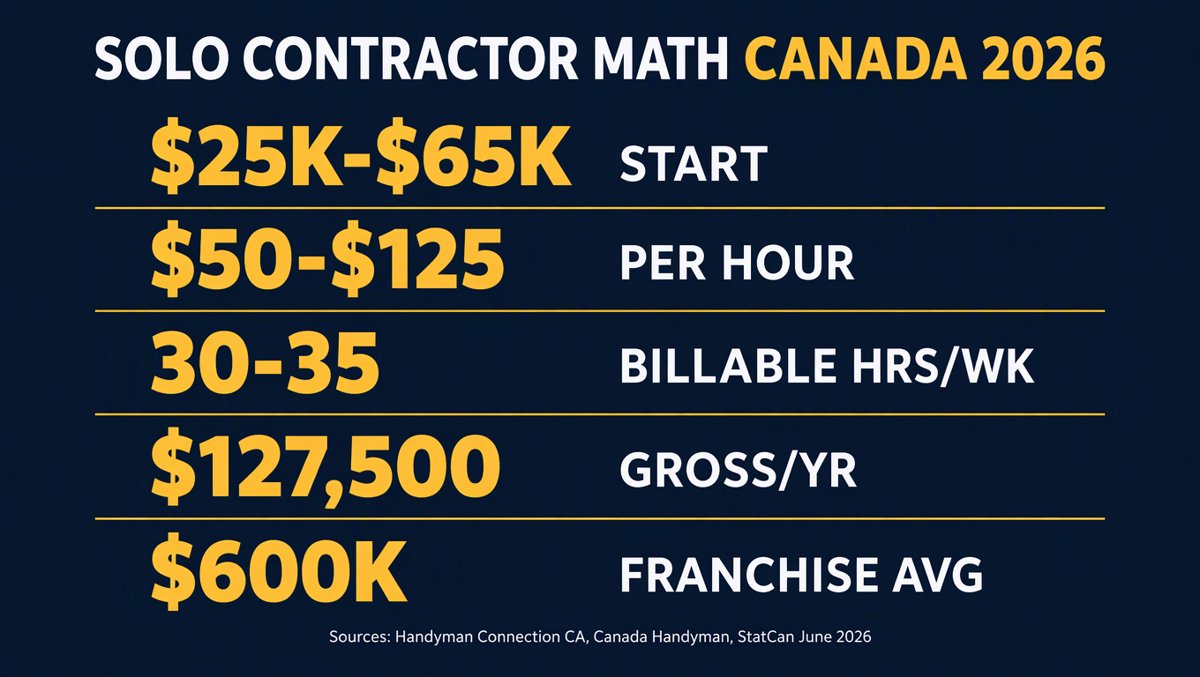
The answer in 30 seconds: Budget $25,000–$65,000 CAD to start a solo contracting (handyman) business properly in Canada — less if you already own your vehicle and tools. At a billing rate of $50–$125/hour and 30–35 billable hours a week, that is roughly $127,500 a year in gross revenue at the mid-point ($85/hr). The real trap is not the startup cheque — it is the ~15 unbillable hours a week quoting, driving, and invoicing that most new operators never price for.
Key Takeaways
- According to Statistics Canada (The Daily, June 2026), there were 1.37 million employer businesses in Canada and 3.78 million non-employer businesses with annual revenues above $30,000.
- According to Handyman Connection Canada (2026), a properly started independent contracting business in Canada costs $25,000 to $65,000, with franchise offices at $105,520 to $213,824 plus 9% of gross sales.
- According to Canada Handyman (2026), Canadian handyman billing rates run $50 to $125 per hour, and at $85/hour × 30–35 billable hours/week, annual gross revenue reaches about $127,500.
- According to the Canadian Home Builders' Association (cited by Handyman Connection Canada, 2026), Canada's renovation, maintenance and repair sector is worth more than $121 billion a year and supports close to 700,000 jobs; about 75% of the housing stock is more than 20 years old.
- According to WSIB Ontario (2026), construction owners and operators — with or without employees — must register for workplace insurance coverage, and you have 10 calendar days to register once coverage is compulsory.
- According to Xero Canada (2026), most Canadian small businesses spend $3,000 to $50,000 to launch, and you should budget one-time costs plus 3–6 months of monthly costs as your cash buffer.
The decision this guide serves
You are not deciding whether contracting "is a good business." You are deciding whether to spend the next month registering, insuring, tooling up, and pricing the work so a 40-hour week actually pays. Work through the seven steps below in order — each one gates the next, and skipping Step 2 or Step 3 is how solo operators get fined or denied a claim.
Step 1: Register your business name and structure (week 1)
Sole proprietorship is the default starting point for a one-truck operator: you register the business name provincially, open a separate business bank account, and keep personal and business money apart from day one. Xero Canada (2026) prices business name registration at $30 to $60; in Ontario the master business licence is $60 and valid for five years. If you later incorporate, provincial incorporation runs $200–$400, and Corporations Canada charges $200 for federal incorporation online, a process that can take one day. Legal advice for incorporation or contracts is $500 to $3,000 (Xero Canada). Hold off on incorporating until revenue justifies the paperwork — most solo operators start as sole proprietors and restructure once the income does.
Step 2: Register for WSIB coverage — Ontario construction is compulsory (week 1)
If you operate in Ontario's construction industry, WSIB coverage is compulsory whether or not you have employees. FedDev Ontario's guide states it plainly: "If you own or run a construction business, with or without employees, you must register with the Workplace Safety and Insurance Board (WSIB)." Once coverage is compulsory, WSIB gives you 10 calendar days to register (WSIB, 2026). WSIB covers more than 300,000 businesses across 16 industries. Registration requires an estimate of your insurable payroll/earnings. Do this in the same week as Step 1 — not after your first invoice. Verify the current rules for your province with your provincial regulator before you bill.
Step 3: Stay in your legal lane (read this before you quote anything)
"Handyman" is not a licence in Canada. Ontario requires no general handyman licence, but Certificates of Qualification do apply to electrical, plumbing, gas fitting, and HVAC work (Handyman Connection Canada, 2026). British Columbia regulates trades certification through its own framework; Alberta is comparatively light. The practical rule: small repair, assembly, drywall, painting, and maintenance work sits in the general lane; anything requiring a trade certificate stays out of it unless you hold the certificate. Splitting one large job into small invoices to dodge a requirement, or quoting work past your legal scope, risks fines and — worse — an insurance claim denied because the work was out of scope. Confirm the requirement for every trade you plan to offer with your provincial registry.
Step 4: Insure it — $1–2 million general liability is the standard
You are working inside other people's homes. Commercial general liability (CGL) of $1–2 million is the standard requirement, and most commercial customers ask for proof before you step on site (Handyman Connection Canada). Price points vary by risk tier: a basic sole-proprietor CGL policy starts around $450 a year (Zensurance, 2026), while small-business insurance for a bare solo service business runs $100–$500 a year (Biller.ca, 2026). Contractor packages that add tools-and-equipment coverage start around $650 a year and rise with trade risk (Mitch Insurance, 2026). Budget for tools coverage separately — your livelihood fits in a vehicle, and that is the first thing stolen. Total insurance is a few hundred to roughly fifteen hundred dollars a year for most solo operators; the policy you are denied a claim on is the expensive one.
Step 5: Tool up — the $25,000–$65,000 proper-start budget
A lean operator who already owns core tools can start for far less, but the honest Canadian number for starting properly — vehicle, tools, insurance, basic marketing — is $25,000 to $65,000 (Handyman Connection Canada, 2026). If you already own a suitable vehicle and tools, the cash outlay is "considerably less." Xero Canada's general warning applies across Canadian small businesses: most spend $3,000 to $50,000 to launch, and total funding need equals one-time costs plus three to six months of monthly costs, with a 10–20% contingency. Equipment alone runs $5,000 to $100,000+ by industry in Xero's Canada guide, so your vehicle and core tool set decide where you land in the $25K–$65K band. Trade-licensed work is a different price entirely: US startup benchmarks put a solo service plumber at $15,000–$40,000 and a residential plumbing company at $50,000–$120,000 (StartupCostHub, US-labeled) — another reason to know which lane you are entering before you spend.
| Budget line | Proper Canadian start | If tools + vehicle owned |
|---|---|---|
| Vehicle + core tools | Bulk of the $25,000–$65,000 (Handyman Connection) | Already sunk — near $0 new cash |
| Business name registration | $30–$60; Ontario $60 / 5 years (Xero Canada) | Same |
| Insurance (CGL + tools) | ~$450–$650+/yr starting points (Zensurance / Mitch Insurance) | Same |
| Marketing (Google Business Profile + basic site) | Profile free; site $1,000–$10,000 (Xero Canada range) | Profile free |
| Working-capital buffer | 3–6 months of monthly costs (Xero formula) | Same |
| Contingency | 10–20% of total budget (Xero Canada) | Same |
Step 6: Price for the unbillable 15 hours
Here is the arithmetic that decides whether this business works. A working week that looks like 40 billable hours is usually closer to 25, once quoting, invoicing, marketing, and chasing payment are counted (Handyman Connection Canada). Canada Handyman's operating model targets 30–35 billable hours in a 40-hour week. At a $85/hour rate, weekly revenue is $2,550–$2,975, or about $127,500 a year over 50 weeks. The Canadian billing band is $50–$125/hour for general work (Canada Handyman, 2026). Compare that with the wage for a building handyman/woman: $16.55 to $38.46/hour (Job Bank, Government of Canada), and an average handy man salary of $26.70/hour (Indeed Canada). The gap between the ~$27 wage and the $50–$125 billing rate is your business: insurance, vehicle, tools, marketing, and the unbillable hours. Under-pricing is the most common early mistake (Handyman Connection Canada) — your rate has to cover the unpaid hours, not just the billable ones. Use a minimum call-out, flat rates for jobs you repeat weekly, and quote the drive and supply run up front. Verify current provincial rates and GST/HST rules (registration threshold $30,000 in revenue) with your accountant.
Step 7: Win the first month — realtors, property managers, one niche
Lead platforms sell small-job leads to multiple operators who race to the cheapest bid. The reliable first channel is realtors who need inspection punch-lists cleared on deadlines and property managers who need a permanent small-jobs person (Handyman Connection Canada). Five such relationships can fill a calendar. Claim your free Google Business Profile with photos of finished work and ask for a review after every job — reviews compound faster than ad spend here. Pick one visible niche to hang your name on — the TV-mounting operator, the door-adjustment operator — and let the rest of the job list arrive once you are inside the house. Expect the feast-and-famine cycle: when you are busy you stop marketing, and six weeks later you are not busy. Book the marketing hour into the week before it is needed.
What "good" looks like at scale (so you know the ceiling)
Independent operators keep a large share of revenue as income but are capped by their own hours. At franchise scale, Handyman Connection Canada reports average franchisee revenue of about $600,000 a year, a top performer near $1.7 million (Ottawa), net margins typically 10%–35%, an average job value of $900, and repeat-and-referral share near 50%. The franchise investment is $105,520–$213,824 including the $70,000 franchise fee and first three months of operation, plus ongoing fees of 9% of gross sales. Those numbers describe an office that coordinates other people's work — a different job from doing the work yourself. Pick the route that matches the working life you want: the independent's margins per job, or the office's freedom from the hours ceiling.
🏁 THE VERDICT

Start solo, price the unbillable hours, and stay inside your legal lane — that is the whole business. Budget $25,000–$65,000 to start properly, register for WSIB where coverage is compulsory, carry $1–2M liability, and charge $50–$125/hour on a 30–35 billable-hour week. If you want a job with a trades licence and a bigger entry cheque, that is a different, legitimate business — just do not borrow its pricing or its risks. Next step: register the name this week, then get three insurance quotes before you buy a single tool.
Cost and licensing information is general information only — verify current rates, WSIB coverage, trade-certification rules, and GST/HST requirements with your accountant and provincial registry before you commit funds.
Frequently Asked Questions
How much does it cost to start a solo contracting business in Canada? Starting properly costs $25,000 to $65,000 CAD including vehicle, tools, insurance, and basic marketing (Handyman Connection Canada, 2026). If you already own your vehicle and core tools, the cash outlay drops considerably. Most Canadian small businesses overall spend $3,000 to $50,000 to launch (Xero Canada).
Do I need a licence to work as a handyman in Canada? Ontario requires no general handyman licence, but Certificates of Qualification apply to electrical, plumbing, gas fitting, and HVAC work (Handyman Connection Canada, 2026). BC regulates trades certification through its own framework, and Alberta is comparatively light. Verify your province's rules before quoting.
How much should a solo contractor charge per hour in Canada? Canadian handyman billing rates run $50 to $125 per hour for general work (Canada Handyman, 2026). A practical model targets 30–35 billable hours a week; at $85/hour that is about $127,500 in annual gross revenue over 50 weeks. Price in the ~15 unbillable hours of quoting and invoicing each week.
Do I need WSIB coverage as a solo contractor in Ontario? Yes — construction owners and operators must register for WSIB coverage with or without employees (FedDev Ontario; WSIB, 2026). You have 10 calendar days to register once coverage is compulsory. Registration requires an estimate of your insurable payroll, and WSIB covers more than 300,000 businesses.
How much does contractor insurance cost in Canada? A basic sole-proprietor general liability policy starts around $450 a year (Zensurance, 2026); contractor packages that add tools-and-equipment coverage start around $650 a year and rise with trade risk (Mitch Insurance, Ontario). Most commercial customers require proof of $1–2 million general liability before you work on site.
📚 SOURCES
- Statistics Canada, The Daily — Canadian business counts, June 2026 (Aug 14, 2026): https://www150.statcan.gc.ca/n1/daily-quotidien/260814/dq260814d-eng.htm
- Handyman Connection Canada, "Is a Handyman Business Profitable in Canada? The Numbers" (Oct 30, 2026): https://franchiseopportunity.handymanconnection.ca/blog/is-a-handyman-business-profitable-in-canada
- Canada Handyman, "How Much Can a Handyman Business Earn in Canada? Real Income Potential Explained": https://canadahandyman.ca/blogs/how-to-become-a-handyman/how-much-can-a-handyman-business-earn-in-canada-real-income-potential-explained
- Canada Handyman, "Handyman Rates in Canada 2026": https://canadahandyman.ca/blogs/maintenance-repairs/handyman-rates-in-canada-2026
- Xero Canada, "How much does it cost to start a business in Canada?" (May 27, 2026): https://www.xero.com/ca/guides/startup-business-costs/
- WSIB Ontario, "How to register your business": https://www.wsib.ca/en/howtoregister
- WSIB Ontario, "New businesses — what you need to know": https://www.wsib.ca/en/businesses/registration-and-coverage/new-businesses-what-you-need-know
- FedDev Ontario, "How to start a construction business in Ontario": https://sbs-spe.feddevontario.canada.ca/en/how-start-construction-business-ontario
- Zensurance, "Sole Proprietor Insurance in Canada: What You Need and What It Costs": https://www.zensurance.com/blog/sole-proprietor-insurance-in-canada-what-you-need-and-what-it-costs
- Mitch Insurance, "Tools & Equipment Insurance Ontario": https://mitchinsurance.com/commercial-insurance/contractors/tools-coverage/
- Biller.ca, "Small Business Insurance Cost in Canada (2026), by Trade": https://biller.ca/small-business/small-business-insurance-canada
- Job Bank (Government of Canada), Wages — Building handyman/woman: https://www.jobbank.gc.ca/marketreport/wages-occupation/14385/ca
- Indeed Canada, Handy Man salaries: https://ca.indeed.com/career/handy-man/salaries
- StartupCostHub, "Plumbing Business Startup Costs: 5 Models Compared (2026)" (US-labeled): https://startupcosthub.com/guides/plumbing-business-startup-costs
- Skill Mammoth, "How to Start a Handyman Business in 2026: The Real Rules" (general operator benchmarks, US scope where noted): https://skillmammoth.com/blog/how-to-start-a-handyman-business
💬 Want the working version? Subscribe free — Saturday toolkit PDFs by email. 💬 Chat with Peter: https://www.nxplace.com/x/business-beats?go=chat