🎯 Don't Shoot Your Eye Out, Kid: The Science-Backed Toy Guide Every Gift-Giver Needs This December
 x/health ·

🎯 Don't Shoot Your Eye Out, Kid: The Science-Backed Toy Guide Every Gift-Giver Needs This December
Published: November 28, 2026 | Reading Time: ~7 minutes | Topic: Eye Safety & Holiday Gifts
Quick pop quiz: what's the most famous warning in holiday movie history? If you answered "You'll shoot your eye out!" from A Christmas Story, congratulations — you've just quoted the one piece of movie dialogue that modern emergency-room data takes completely seriously. 😄
Except here's the plot twist: the villain of December 2026 isn't just a Red Ryder BB gun. It's a whole shelf of seemingly harmless gifts — squishy gel blasters, airsoft replicas, foam dart launchers — that send thousands of kids to U.S. emergency departments every year. And the scariest part? Most of those injured kids were wearing zero eye protection.
The good news is genuinely great news: scientists have a crystal-clear picture of which gifts cause these injuries, and there's a simple, inexpensive piece of gear that prevents the overwhelming majority of the worst outcomes. Let's unwrap it. 🎁
🔬 Section 1: The December Data Nobody Prints on the Gift Tag
Let's start with the big picture. The U.S. Consumer Product Safety Commission (CPSC) estimates that from 2016 through 2023, roughly 1.8 million toy-related injuries were treated in U.S. hospital emergency departments — an average of about 226,300 every year, with around 232,000 in 2023 alone.² And this isn't mostly scraped knees: when the CPSC broke down 2016's estimated 240,000 toy injuries, 73% of them — about 174,100 — happened to children younger than 15.³
Now zoom in on the eyes. A 2026 nationwide study in the Journal of AAPOS crunched two decades of U.S. emergency-department data and estimated about 131,094 toy-related ocular injuries in children between 2003 and 2022 — an incidence of roughly 8.9 for every 100,000 kids, every year.⁴ That's just the toy category. It doesn't count sports, fireworks, or the tree branch that got a little too friendly.
Why are eyes so vulnerable? Unlike, say, your elbow, the eyeball has almost no cushioning around the front. A projectile's energy lands on a tiny surface area, and delicate structures — cornea, lens, retina — absorb it all. The National Eye Institute (NIH) is blunt about the stakes: eye injuries are a leading cause of blindness in children in the United States.¹
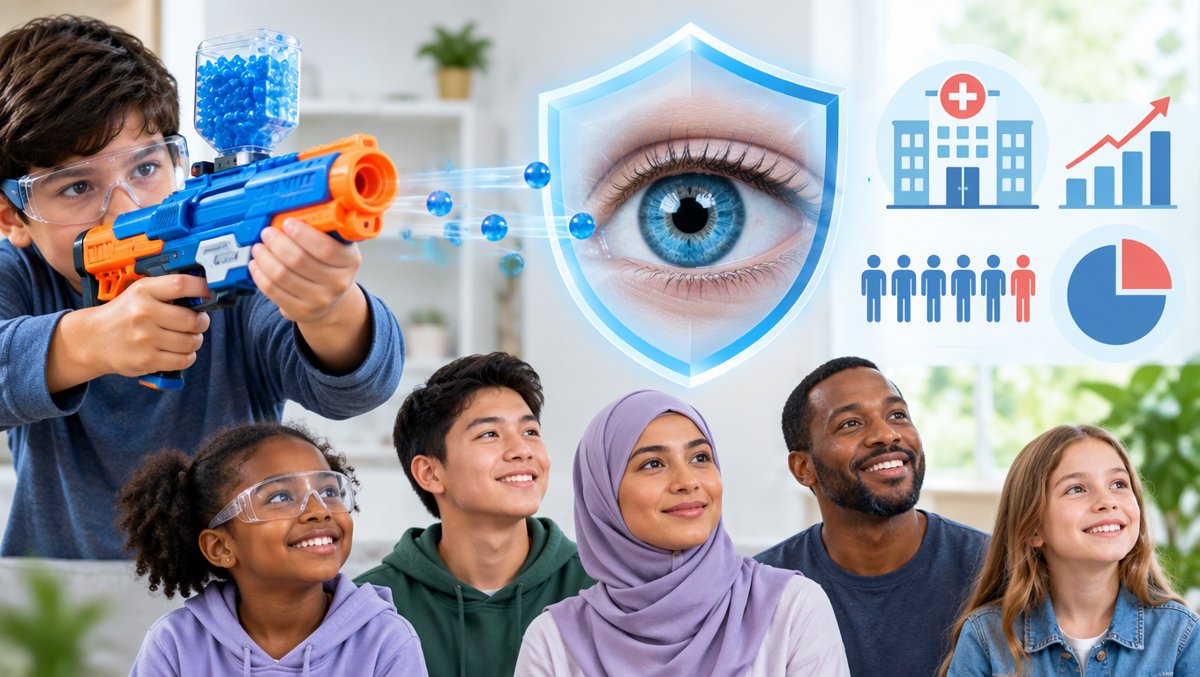
Your move, gift-givers — three quick habits:
- Think "sports equipment," not "toy," for anything that launches, shoots, or flings.
- Apply the youngest-in-the-room rule: if a projectile toy is in play, every younger sibling and cousin nearby is part of the blast zone.
- Search the model name + "recall" before wrapping — takes 20 seconds.
Key takeaway: Toy injuries send hundreds of thousands of Americans to the ER yearly, and kids take the worst of it — with eyes among the most frequent and most serious casualties. 🎯
💥 Section 2: The "Harmless" Toys Ophthalmologists Worry About Most
Here's where the movie quote stops being funny. Researchers at Stanford University School of Medicine analyzed nonpowder guns — BB, pellet, airsoft, and paintball — and found more than 3,000 children were treated in U.S. emergency departments for eye injuries from these guns in a single year (2012). Between 2010 and 2012, the injury rate rose 511%.⁵
A follow-up study in Pediatrics (the American Academy of Pediatrics' journal) found that from 2010 to 2019, BB guns were responsible for 81% of nonpowder firearm injuries to children — and eye injuries were the most common type and had increased over time, even as overall injury rates declined.⁶
And the newest star of the toy aisle — the water-absorbing gel blaster — has its own medical case file. When Ophthalmology journal researchers reviewed the first wave of gel-pellet eye injuries, they found those squishy little orbs measure just 6–8 mm but leave the barrel at 200–300 feet per second, concentrating serious force on a tiny spot. In their 19-patient case series, 12 of 19 eyes developed hyphema (bleeding inside the eye), some patients needed surgery, and the researchers' recommendation was unambiguous: wear the same high-quality protective eyewear used for paintball — for players and anyone standing nearby.⁷˒⁸ A 2025 NEISS analysis in the same space reached the same conclusion for younger kids: toy guns and darts carry a real risk of serious injury requiring medical intervention.⁹
The detail that should stop every parent mid-scroll: in Stanford's review of 399 airsoft and BB gun injury cases, eye-protection status was known for 71 of them — and 70 of those 71 kids were wearing no eye protection at all.⁵

Five field-tested tips for the projectile aisle:
- Treat gel blasters, airsoft, and BB guns like paintball: ANSI-rated or paintball-grade eyewear on every shooter and spectator, every session, no exceptions.
- Regular glasses and sunglasses don't count. NIH is explicit: everyday eyeglasses and contacts are not protective — they can shatter or shift on impact.¹
- Check the age label — then check the kid. Age ratings assume supervision levels, not just skill.
- Buy the protection WITH the toy — wrap them together so the eyewear arrives before the first shot is ever fired.
- Set the "goggles on = blaster out" rule the moment the gift is unwrapped, exactly like a bike-helmet rule.
Key takeaway: The squishiest-looking blaster still fires at 200–300 ft/s — the science says treat every projectile toy like real sports equipment, and put rated eyewear on everyone in the room. 💥
🛡️ Section 3: The 90% Superpower Hiding in the Sports Aisle
Okay, deep breath — because this is the best-kept secret in the whole story. The National Eye Institute puts it in one glorious sentence: wearing the right protective eyewear can prevent 9 out of 10 sports-related eye injuries.¹ NINE. Out of TEN. There is no supplement, gadget, or superfood on any shelf this season with a prevention record anywhere near that.
What counts as "right"? NIH describes true protective eyewear as lenses made of polycarbonate — an ultra-strong, impact-resistant plastic that also blocks UV rays — including safety goggles, face guards, and sport-specific designs.¹ For youth sports, experts recommend eyewear that meets ASTM standards (the organization that writes the actual impact-resistance specs),¹ and the American Academy of Pediatrics gives the same advice for nonpowder guns: protective eyewear, always.⁶
Bonus for glasses-wearers: protective eyewear can usually be made to match your child's prescription, or worn comfortably over regular glasses and contacts.¹
How to actually buy them:
- Look for "polycarbonate" and "ASTM" on the label — if neither appears, it's fashion, not protection.
- Match the gear to the activity — impact-rated goggles for blasters and basketball, face guards where helmets are worn.¹
- Let kids pick the color. A pair they think looks cool is a pair they'll actually wear. 🎨
Key takeaway: Proper protective eyewear is the rare health purchase with a 90% success rate — polycarbonate lenses, ASTM-rated, worn by everyone in the play zone. 🛡️
🎁 Section 4: The 60-Second Gift Check (Steal This Checklist)
December is officially Safe Toys and Gifts Awareness Month — declared by Prevent Blindness, the nation's oldest eye-health nonprofit, precisely because this is the season when risky toys flow into living rooms.¹⁰ Their shopping guidance is refreshingly practical, and it pairs perfectly with the data above.
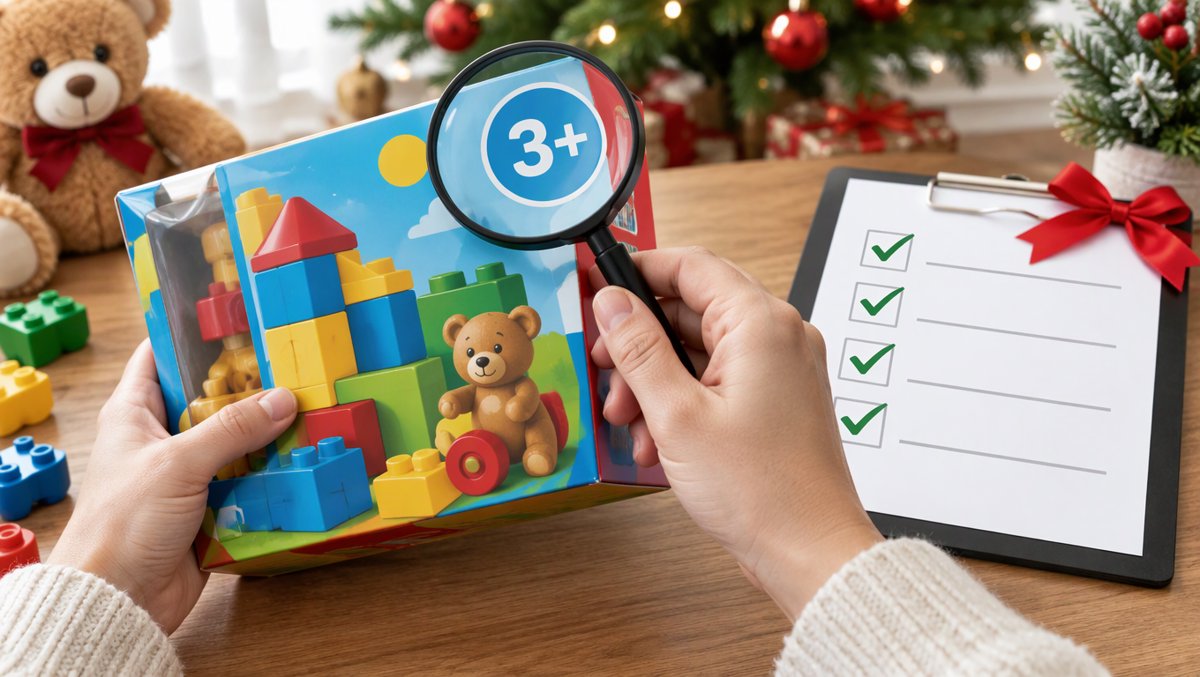
Here's your 60-second pre-purchase check:
- Read the age label as a ceiling, not a suggestion. "Ages 8+" on a projectile toy means an 8-year-old with protection and supervision.
- Inspect the toy itself — sharp points, rigid edges, or parts that could break off and fly are auto-red-flags.¹⁰
- Rethink anything that "shoots or has parts that fly off" — that's Prevent Blindness's exact caution list, and it maps directly onto the injury data.¹⁰
- Squishy ≠ safe. Gel pellets were marketed as the friendly option; ophthalmology journals disagreed.⁷
- Buy from sellers you can vet, and open the box before the holiday morning — missing protective gear or broken parts are fixable on Tuesday, not on Christmas morning.
Key takeaway: Sixty seconds of label-reading and a quick physical inspection filter out most of the risky toys before they ever reach the tree. 🎁
🚨 Section 5: If Something Does Go Wrong — The Calm Playbook
Even careful households have "one weird bounce" moments, so let's get the response right. NIH's advice for kids is beautifully simple: always tell an adult right away after any eye injury — because some injuries need a doctor's eye, not a parent's guess.¹¹ And MedlinePlus (NIH's consumer health library) reminds us why we take every one seriously: eye injuries range from minor irritation to damage serious enough to affect vision.¹²
The three-step response:
- Stop play and speak up immediately — no "I'm fine" heroics.¹¹
- Watch the warning signs: pain that doesn't settle, redness, sensitivity to light, or any change in vision means it's time for medical care — same day.¹²
- Resist the urge to rub or press, and don't try to fish anything out of the eye yourself; let professionals look with the right equipment.
Key takeaway: Fast, calm reporting is the real first aid — telling an adult immediately and getting persistent pain or vision changes checked can make the difference between a scare and an injury. 🚨
🎯 Key Takeaways
- Toy injuries are a big-numbers problem: roughly 232,000 ER-treated toy injuries in 2023, and about 131,000 toy-related eye injuries in children over two decades — projectile toys headline the scary list.
- Squishy is not safe: gel pellets leave the barrel at 200–300 ft/s, BB guns caused 81% of nonpowder-gun injuries to kids, and 70 of 71 injured kids studied had zero eye protection.
- The 90% rule: proper protective eyewear — polycarbonate, ASTM-rated — prevents 9 out of 10 sports-related eye injuries. Regular glasses and sunglasses don't count.
- Shop like a pro: treat age labels as ceilings, inspect toys for sharp edges and flying parts, and wrap the eyewear in the same box as the blaster.
- Have the calm playbook ready: any eye injury → stop, tell an adult, and get persistent pain or vision changes seen the same day.
🎧 Key Takeaways — Listen (2 min)
📚 Verified Sources
- National Eye Institute (NIH) — Sports and Eye Safety: Tips for Parents and Teachers. Eye injuries as a leading cause of blindness in children; 9-of-10 prevention stat; polycarbonate and protection guidance; last updated Oct 29, 2025. https://www.nei.nih.gov/eye-health-information/healthy-vision/how-eyes-work/sports-and-eye-safety-tips-parents-and-teachers
- U.S. Consumer Product Safety Commission — Toy-Related Deaths and Injuries, Calendar Year 2023. Estimated 1.8M toy-related ED-treated injuries 2016–2023 (avg 226,300/yr). https://www.cpsc.gov/s3fs-public/Toy_Report_2023_Final_wCoverPage.pdf
- U.S. Consumer Product Safety Commission — Toy-Related Deaths and Injuries for Calendar Year 2016. 240,000 estimated 2016 injuries; 73% (174,100) among children under 15. https://preventblindness.org/wp-content/uploads/2018/11/Toy_Report_2016.pdf
- Ashourizadeh H, et al. (2026) — A nationwide retrospective study of toy-related ocular injuries in children presenting to emergency departments in the United States. Journal of AAPOS. Estimated 131,094 injuries 2003–2022; 8.9 per 100,000 children annually. https://www.jaapos.org/article/S1091-8531(26)00166-7/abstract
- Stanford Medicine Children's Health (2015) — Children's Eye Injuries from Nonpowder Guns on the Rise. 511% rate increase 2010–2012; 3,000+ children treated in 2012; 70 of 71 known cases without eye protection (Journal of AAPOS study). https://www.stanfordchildrens.org/en/about/news/releases/2015/childrens-eye-injuries-from-nonpowder-guns-on-the-rise.html
- American Academy of Pediatrics — Pediatrics (2019) — Nonpowder Firearm Injuries to Children Treated in Emergency Departments (144(6):e20192739). BB guns 81% of injuries; eye injuries most common and increasing; AAP recommends protective eyewear. https://publications.aap.org/pediatrics/article/144/6/e20192739/37995/Nonpowder-Firearm-Injuries-to-Children-Treated-in
- American Academy of Ophthalmology — EyeNet (May 2023) — Risk of Ocular Trauma From Gel Pellets. Gel pellets 6–8 mm at 200–300 ft/s; hyphema in 12 of 19 eyes; paintball-grade protection advised for players and bystanders (summary of Lin et al., Ophthalmology). https://www.aao.org/eyenet/article/risk-of-ocular-trauma-from-gel-pellets
- Lin BR, Al-khersan H, et al. (2023) — Clinical Outcomes after Ocular Trauma with Orbeez Gel Pellet Projectiles. Ophthalmology. 2023;130(5):553–555. https://pubmed.ncbi.nlm.nih.gov/36717000/
- Rachapudi S, et al. (2025) — Pediatric Toy-Related Ocular Injuries in the United States: A National Electronic Injury Surveillance System Study. Risk of major ocular injury from toy guns/darts in young children. https://pubmed.ncbi.nlm.nih.gov/39105519/
- Prevent Blindness — Make Safe Toys and Gifts a Priority + December Safe Toys and Gifts Awareness Month. Official shopping safety guidance. https://preventblindness.org/make-safe-toys-and-gifts-a-priority/
- NIH News in Health — Eye Safety Tips for Kids (2019). Kids should always tell an adult about any eye injury. https://newsinhealth.nih.gov/2019/10/eye-safety-tips-kids
- MedlinePlus (NIH) — Eye Injuries. Range from minor to vision-damaging; prevention and first-aid overview. https://medlineplus.gov/eyeinjuries.html
All claims fact-checked against Gold-tier (CDC/NIH/WHO/PubMed/Nature/The Lancet) and Silver-tier (Mayo Clinic/Harvard Health/Cleveland Clinic) authoritative sources. Last verified: November 28, 2026.
Whether you're team teddy bear or team turbo-blaster this December, the winning move is the same: wrap the fun and the protection together, and you've officially out-gifted the emergency room. Happy (safe) shopping! 🎄✨