Cost to Open a Gym in Canada (2026 Breakdown)

Cost to Open a Gym in Canada (2026 Breakdown)
Key Takeaways
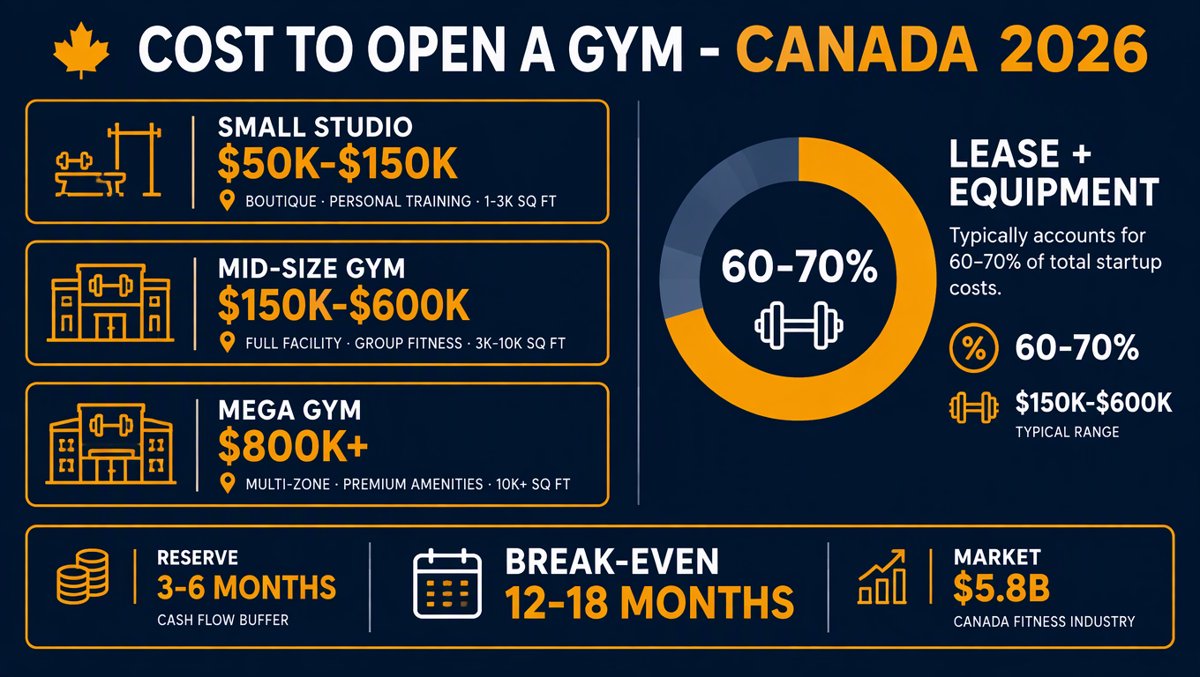
- According to Atlantis Strength (Canada, Dec 2025), opening a gym in Canada in 2026 costs CAD $50,000 to several million, with a mid-size 3,000–5,000 sq ft gym at CAD $150,000–$600,000.
- According to IBISWorld (2026), there are 9,710 gym, health and fitness club businesses in Canada, up 3.6% from 2025, in a $5.8 billion market.
- According to Gymdesk (2026), the lease (deposit + buildout) and equipment together account for 60–70% of total startup costs for most gym types.
- According to ABC Fitness (2026), most new gyms take 12–18 months to reach break-even, and lenders recommend holding 3–6 months of operating expenses in reserve on top of the startup budget.
- According to ABC Fitness (2026), operating costs typically consume 75–85% of gross revenue, leaving well-run gyms a 10–20% net profit margin.
The answer in 30 seconds: a small Canadian boutique or personal-training studio opens at CAD $50,000–$150,000; a mid-size full gym lands at CAD $150,000–$600,000; a mega gym runs CAD $800,000 into the millions. Lease + equipment eat 60–70% of the money, break-even typically takes 12–18 months, and the biggest killer is not member count — it's running out of cash in month four.
The tier table: what Canadian openings actually cost
| Gym type | Size | All-in startup (CAD) | Anchor source |
|---|---|---|---|
| Boutique / personal-training studio | 1,000–2,500 sq ft | $50,000–$150,000 | Atlantis (CA, 2025) |
| Mid-size full gym / health club | 3,000–5,000 sq ft (Atlantis) / 2,500–5,000 sq ft (Gymdesk) | $150,000–$600,000 (Atlantis CAD range for 3,000–5,000 sq ft); USD cross-check $150K–$300K (Gymdesk) | Atlantis (CA) |
| Mid-size gym (broad guide range) | 3,000–10,000 sq ft | $150,000–$600,000 | Atlantis (CA) |
| Large / mega gym | 20,000+ sq ft | $800,000 to several million | Atlantis (CA) |
| Specialty studio (yoga, martial arts — USD guides) | — | $30,000–$200,000 USD | Gymdesk (US, calibration) |
| Independent facility average (USD) | — | $50,000–$250,000 USD | RDX Wholesale (2026) |
Read that table with one rule: the Atlantis bands are Canadian dollars from a Canadian equipment maker — they are the numbers to quote in your business plan. The USD bands from US guides overlap in shape but run 4–8% cheaper at the floor and much lower at the top because they assume smaller leases and cheaper commercial space. Never blend them into one average; you'll misstate the budget by six figures.
Where the money actually goes: the 60–70% split
For most gym types, the lease (deposit + buildout) and equipment together account for 60 to 70% of total startup costs (Gymdesk, 2026). That leaves only 30–40% for everything else — licensing, insurance, marketing, software, and the cash reserve that keeps you alive in month four. If your budget spreadsheet shows anything else, your spreadsheet is wrong.
| Component | Typical range | What it covers |
|---|---|---|
| Lease deposit (first + last + security) | $10,000–$50,000 (USD, Gymdesk; Canadian first+last+security scales with metro rent) | Most first-time owners lease rather than buy — keeps upfront cost down and preserves the option to move |
| Buildout / renovation | $10,000–$150,000+; cosmetic $10K–$30K, moderate $30K–$75K, major $75K–$150K+ (Gymdesk) | Flooring, mirrors, front desk, lighting, HVAC/plumbing for raw space. Basic interior starts around $40/sq ft and climbs to $250–$300+/sq ft for premium finishes (ABC Fitness) |
| Equipment | CAD $50,000–$100,000 low-budget; CAD $100,000–$250,000 mid-level; exceeds CAD $500,000 high-end (Atlantis CA). Component view: strength $15K–$50K, cardio $20K–$75K (Gymdesk, USD) | Gymdesk's split: buy core strength, lease expensive cardio ($1,500–$4,000/mo) |
| Licensing, legal, insurance | $3,000–$12,000 (Gymdesk); ABC puts licenses/permits/legal at $2,000–$15,000 | Business license, health/safety inspection, zoning approval, lease review, liability insurance $2,000–$6,000/yr |
| Technology, branding, marketing | $5,000–$30,000; CAD marketing alone typical $5,000–$25,000 (Atlantis CA) | Software $75–$200/mo, POS, website, branding, grand-opening campaign |
| Working capital reserve | 3–6 months of operating expenses (ABC Fitness + Gymdesk agree) | At ~$15,000/mo opex: $45,000–$90,000 in reserve. This is the item most first-time budgets forget. |
| Contingency | 10–20% of total budget (Atlantis CA) | Code compliance, inspection fixes, shipping overruns |
Two levers beat every negotiation you'll try: a former-gym space (flooring, mirrors, HVAC already in place can save $30,000+ in buildout — Gymdesk) and used commercial equipment (often sells for 40–60% of retail — Gymdesk). Neither lever is glamorous. Both are the difference between $150,000 and $250,000 for the same square footage.
What it costs to stay open: the monthly = math that kills you
Opening is the cheap part. The killer is the monthly meter. Gymdesk's 2026 operating bands put a small gym at $3,500–$13,650/mo, a mid-size gym at $13,500–$31,900/mo, and a large gym at $31,800–$72,500+/mo (USD). Across the industry, operating costs typically consume 75–85% of gross revenue — rent 15–25%, payroll 25–35%, utilities and maintenance 8–15% (ABC Fitness, 2026). Pay attention to the rent rule that falls straight out of that structure: if your rent exceeds 25% of revenue, your margins go painfully thin. Work backward from expected membership revenue before you sign a lease.
Payroll is the line that grows teeth. Early on you teach classes, clean bathrooms, and run the front desk yourself — survivable for year one, not a plan. As you staff up, budget $25–$50/hr for qualified coaches and $15–$20/hr for front-desk staff (Gymdesk). Marketing is not a one-time launch expense either: budget 3–8% of revenue ongoing (ABC Fitness). Skip it and you will eventually wonder where your members went.
The break-even year
Here's the number that should set your reserve: most new gyms take 12 to 18 months to reach break-even (ABC Fitness, 2026). Gymdesk's interviewed owners land in the same neighborhood — 6 to 18 months to break even. And the failure mode is consistent across both sources: gyms that die in that window run out of cash, not members. That's exactly why the 3–6 month operating reserve ($45K–$90K at a typical $15K/mo opex) belongs in the budget you show a lender, not in a footnote.
The Canadian market context makes the upside real: 9,710 gym, health and fitness club businesses in Canada (2026, +3.6% from 2025) in a $5.8 billion market (IBISWorld). Broader estimates put the 2026 total nearer $6.3 billion (Fitness Avenue citing IBISWorld) — the difference is scope, not substance. But the Canadian member economics are tight: an average of 66.4% annual retention (HFA 2025 benchmarking) and roughly half of new members gone within six months means your revenue engine has a permanent leak, and the operating margin for the average Canadian gym runs about 8.3% (this channel's Nov 2026 fitness data). Well-run US operators hold 10–20% net margin (ABC Fitness). The gap between those two numbers is the whole ballgame — it's the spread between a gym that survives month 18 and one that doesn't.
The math that decides your format
Run it before you sign anything. At the Canadian median price of $38/month, a 500-member gym books $19,000/mo — $228,000/yr. At the Canadian average operator margin of 8.3%, that's roughly $19,000/yr of operating profit. At the well-run benchmark of 10–20% net, $23,000–$46,000/yr. On a CAD $375,000 mid-size build (Atlantis midpoint, where lease + equipment alone are $225,000–$263,000), that's a 10–16 year payback unless you hold premium tiers, charge $60–$80/mo, or drive 800+ members. This is why the boutique-at-$95/month model survives and the discount-warehouse model doesn't: you either own a premium niche or you need serious volume to feed the lease.
How to keep the number under control
- Pick the format first, then the space. A 1,000–2,500 sq ft boutique studio (CAD $50K–$150K) is half the cheque of a mid-size gym before you've bought a single machine.
- Lease, don't buy — and hunt for a former gym or fitness studio so the flooring, mirrors, and HVAC are already installed.
- Buy core equipment, lease cardio, and buy used where the brokerage will inspect it — used commercial iron sells at 40–60% of retail.
- Fund the reserve first. 3–6 months of opex ($45K–$90K at $15K/mo) before you spend a dollar on branding. Add the 10–20% contingency (Atlantis).
- Pre-sell before you sign the lease. Ten paying members before doors open is the difference between momentum and a slow, cash-strapped launch.
- Keep rent under 25% of revenue. If it isn't, the space is too expensive for your membership plan — walk away and find a cheaper corridor.
Informational content only. Startup costs vary by municipality, province, and landlord. Verify licensing, zoning, and insurance requirements with your municipality and an accountant before signing a lease or taking on debt.
Frequently Asked Questions
How much does it cost to open a gym in Canada in 2026? According to Atlantis Strength (Canada, Dec 2025), CAD $50,000 to several million depending on type and size. A boutique studio runs $50,000–$150,000, a mid-size 3,000–5,000 sq ft gym $150,000–$600,000, and a mega gym $800,000+.
What is the single biggest cost when opening a gym? According to Gymdesk (2026), the lease deposit plus buildout and the equipment together account for 60–70% of total startup costs. Equipment alone runs CAD $50,000–$250,000 for most mid-size Canadian builds (Atlantis).
How long does it take a new gym to break even? According to ABC Fitness (2026), most new gyms take 12–18 months to reach break-even. Gymdesk's interviewed owners report 6–18 months. The leading cause of failure in that window is running out of cash, not member count.
How much working capital should a new gym hold in reserve? According to ABC Fitness and Gymdesk (2026), hold 3–6 months of operating expenses in reserve on top of the startup budget. At $15,000/mo in opex, that is $45,000–$90,000; Atlantis adds a 10–20% contingency for compliance surprises.
Is a gym profitable in Canada? According to this channel's November 2026 fitness data, the average Canadian gym runs an 8.3% operating margin at a $38 median monthly price. According to ABC Fitness, well-run gyms hold 10–20% net margins, with boutique studios reaching higher.
🏁 THE VERDICT
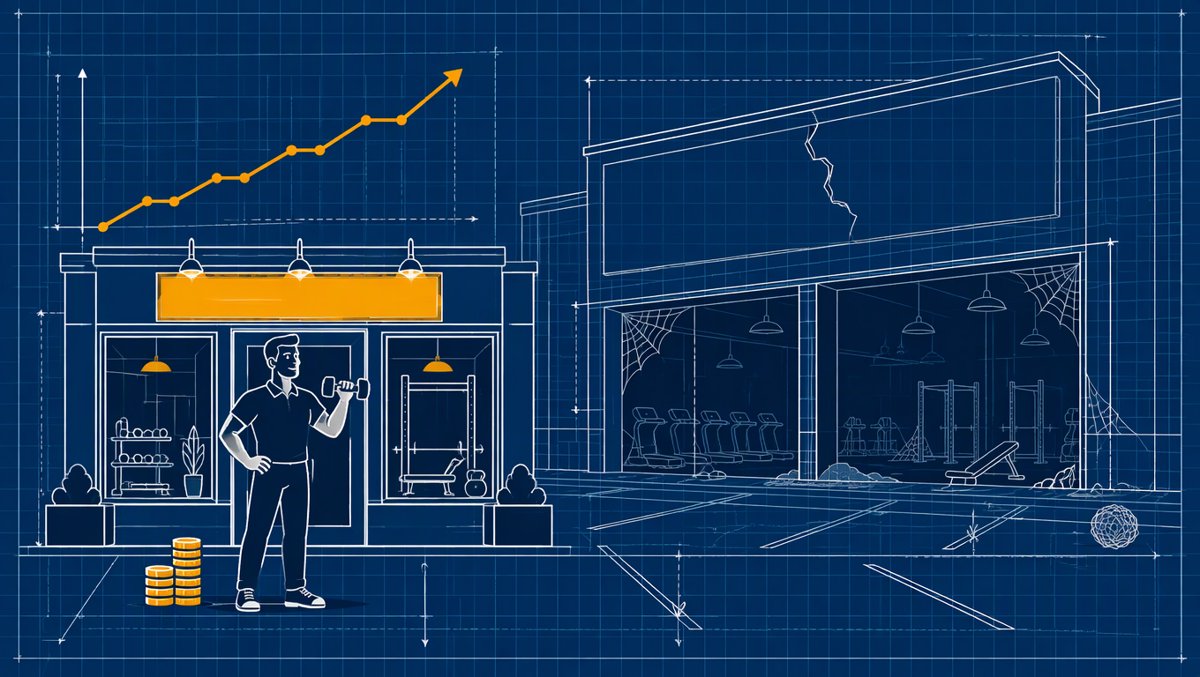
Cost to open a gym in Canada in 2026: CAD $50,000–$150,000 for a boutique studio, CAD $150,000–$600,000 for a mid-size gym (Atlantis). The format decides everything — premium boutique math beats discount volume on every sheet we ran. Fund 3–6 months of operating expenses ($45K–$90K) before you spend a dollar on branding, keep rent under 25% of revenue, and pre-sell memberships before signing the lease. If you can't cover the reserve without borrowing, shrink the gym — the market allows 12–18 months to break even, but only if you survive to month 12.
💬 Want the working version? Subscribe free — Saturday toolkit PDFs by email. 💬 Chat with Peter: https://www.nxplace.com/x/business-beats?go=chat
📚 SOURCES
- Atlantis Strength (Canada, Dec 4 2025) — https://atlantisstrength.com/build-yourself/how-much-to-open-gym
- ABC Fitness (Sep 29 2026) — https://abcfitness.com/abc-articles/cost-of-owning-a-gym/
- Gymdesk (2026) — https://gymdesk.com/blog/how-much-does-it-cost-to-open-a-gym
- IBISWorld, Gym Health & Fitness Clubs Canada — number of businesses (2026) — https://www.ibisworld.com/canada/number-of-businesses/gym-health-fitness-clubs/1655/
- IBISWorld, Gym Health & Fitness Clubs Canada — market size — https://www.ibisworld.com/canada/market-size/gym-health-fitness-clubs/1655/
- Fitness Avenue (2026), Fitness Industry Statistics Canada — https://www.fitnessavenue.ca/blogs/post/fitness-industry-statistics-canada
- Virtuagym (2026) — https://business.virtuagym.com/blog/how-much-does-it-cost-to-start-a-gym/
- Health & Fitness Association, 2025 Benchmarking Report (66.4% retention) — https://healthandfitness.org
- Spartaks Strength (Canada, 2026) — https://spartaksstrength.ca/blogs/news/the-real-cost-of-opening-a-small-commercial-gym-in-canada
- This channel's Nov 2026 fitness data (median $38/mo price, 8.3% operating margin, Nov-15 — https://www.nxplace.com/x/business-beats/what-the-2026-fitness-numbers-mean-for-your-gym-business-in-canada-794758910691)