Cost to Open a Grocery Store in Canada (2026 Breakdown)


Cost to Open a Grocery Store in Canada (2026 Breakdown)
Opening a grocery store in Canada costs CAD $60,000–$150,000 for a small neighbourhood store, $150,000–$420,000 for a mid-size supermarket, and $420,000–$950,000+ for a large-format store. Refrigeration is the single biggest line item at 25–35% of the budget, and the industry's net margin runs just 1–4% — so your build-out budget is the whole game.
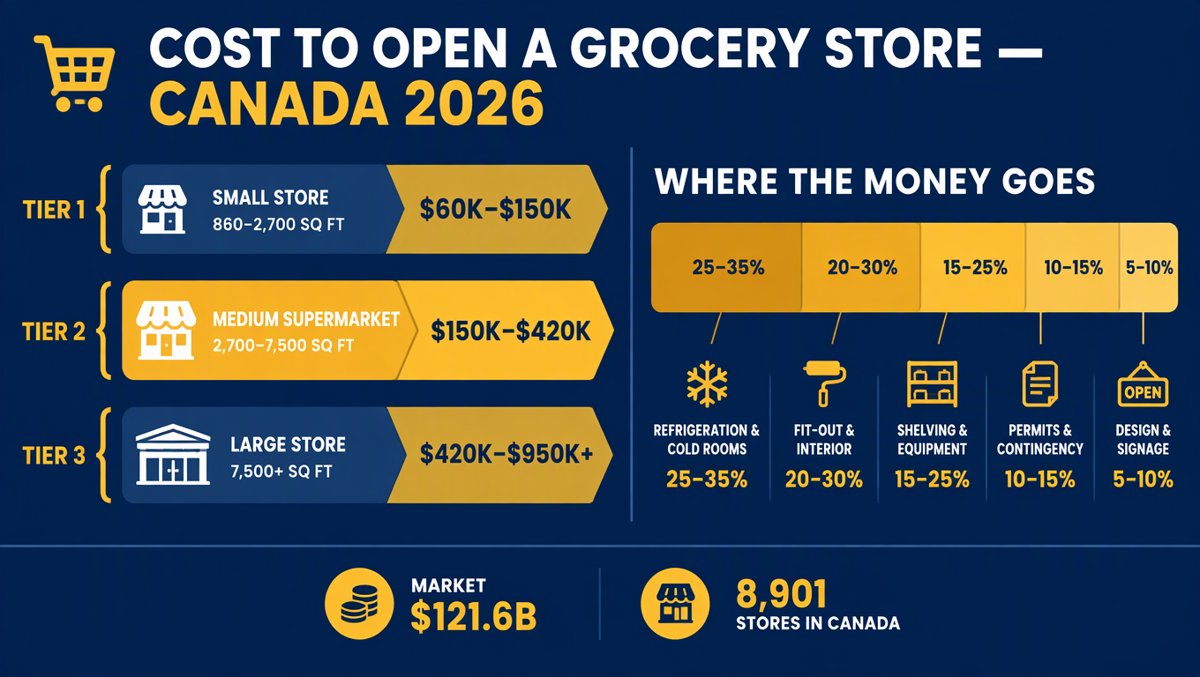
Typical 2026 cost ranges by store size, with the budget split between refrigeration, fixtures, inventory and working capital. Sources cited below.
Canada's grocery market generated $121.6 billion in 2026 across 8,901 supermarkets and grocery stores (IBISWorld), and it grew through every recession of the past two decades. The question isn't whether people will shop — it's whether you can survive a 2–3% net margin long enough to build volume. This breakdown gives you the 2026 numbers by store size, where the money actually goes, and the three costs that sink new grocers.
What You Get at Each Size
The cleanest Canadian cost tiers for 2026 come from Dina Group, a Toronto-based supermarket fit-out firm (sizes converted from square metres, approximately):
| Store type | Approx. size | Total setup cost (CAD) |
|---|---|---|
| Small grocery / convenience-style | ~860–2,700 sq ft (80–250 sqm) | $60,000 – $150,000 |
| Medium supermarket (produce, chilled, frozen, full journey) | ~2,700–7,500 sq ft (250–700 sqm) | $150,000 – $420,000 |
| Large supermarket / multi-department | 7,500+ sq ft (700+ sqm) | $420,000 – $950,000+ |
A ground-up build instead of a lease changes the math entirely: construction alone runs $200–$400 per square foot in Canada (Build IT, 2026), which is why almost every independent starts in a second-generation retail space rather than building new.
Where the Money Goes
Grocery budgets in Canada follow a predictable split (Dina Group, 2026):
| Budget line | Share of project |
|---|---|
| Refrigeration & cold rooms | 25–35% |
| Fit-out & interior works | 20–30% |
| Shelving & store equipment | 15–25% |
| Permits, setup & contingency | 10–15% |
| Design, branding & signage | 5–10% |
The component detail behind those percentages (from Displayarama's 2026 US cost guide — USD figures, labeled as US-sourced): a full equipment package runs $57,500–$193,000 USD, including walk-in coolers ($8,000–$30,000 each), walk-in freezers ($8,000–$25,000), open-face display cases ($15,000–$50,000), gondola shelving for the whole store ($15,000–$40,000), a multi-lane POS ($5,000–$20,000), and carts, baskets and scales ($2,000–$8,000). Used refrigeration and shelving can cut that by 30–50%.
Refrigeration: The Cost That Decides Your Budget
Refrigeration is both the biggest upfront line (25–35% of budget) and the biggest running cost — it typically consumes 40–60% of a grocery store's total utility bill (Displayarama). Undersizing it in month one means rejected dairy and meat; oversizing it kills your working capital. This is the one line where the guide's advice is unambiguous: get a professional layout done before you buy a single case, and spec energy-efficient units from day one.
Rent and Location: Parking Beats Foot Traffic
Grocery is a destination errand, not an impulse stop. Displayarama's 2026 US rent table (USD) gives useful calibration: a small corner market (1,000–2,000 sq ft) runs $2,000–$6,000/month, a mid-size store (5,000–10,000 sq ft) $10,000–$30,000/month, and first-year rent for a mid-size store lands at $60,000–$180,000 USD. Canadian rents in Toronto, Vancouver, Montreal and Calgary trend higher in prime zones — Dina Group flags location as the first cost factor. Plan for at least 1,000 sq ft of backroom storage and a loading area for daily produce, dairy and meat deliveries before you sign anything.
Inventory and Working Capital: The Silent Killer
Opening inventory for a mid-size store runs $38,000–$115,000 USD (Displayarama): shelf-stable goods $20,000–$60,000, produce $3,000–$10,000, dairy $3,000–$10,000, meat/deli $4,000–$12,000, frozen $5,000–$15,000. Two rules separate survivors from casualties:
- Open fresh at 60–70% of your target stock. Over-buying perishables in week one — before you know your real sell-through — is called out as the most common costly opening mistake in grocery.
- Hold a working-capital reserve. Lean-entry guides put it at $10,000–$25,000 USD (StartupsCosts) to cover payroll and restocking while revenue ramps. Food demand is resilient — Canada's Food Price Report 2026 projects families will spend up to $994 more on food this year (Dalhousie Agri-Food Analytics Lab) — but your cash still arrives weeks after your supplier invoices do.
Licences, Permits and Registration
A lean licence-and-permit package runs $605–$3,730 USD in the US guide (business formation, health permit, food handler cards, signage, occupancy) — with alcohol licences adding $300–$14,000+ where offered. Canadian requirements differ by province and municipality: local health authority approval, municipal permits, and possible CFIA involvement if you handle food across provinces (Dina Group). Budget 60–90 days for permit lead time before your target opening. Register for GST/HST once you pass the $30,000 small-supplier threshold (CRA, RC4022) — in grocery, you'll cross it in month one.
The Margin Reality: Why Budget Discipline Is Everything
Canadian grocery runs on 1–4% net margins — GroceryTradeNews puts most Canadian retailers at 2–4%, the Retail Council of Canada told the Competition Bureau in March 2026 that margins average around 3.5%, and large chains (Loblaw, Sobeys, Metro) sit at 1–3% per Broadbent Institute analysis of Statistics Canada data. US guides (Vantainsights, Displayarama) report the same 1–3% band, which makes the Canadian range the tighter, better-documented one.
Run the arithmetic (ours, labeled): a solid mid-size independent doing $2 million in annual revenue at a 3.5% net margin keeps about $70,000 a year. One point of margin — shrink, waste, theft — is $20,000. That's why every dollar of the setup budget above is a decision, not an expense.
🏁 THE VERDICT
Budget CAD $150,000–$420,000 for a mid-size independent grocery store in Canada — and treat refrigeration (25–35% of budget) as the line that decides whether you open on time and on margin. This lane suits operators with food-retail experience or capital partners, not first-time founders testing an idea — the 1–4% net margin forgives nothing. Your next step: commission a professional store layout (most fit-out firms do a free 2D plan) and get real lease quotes before spending a dollar on equipment.
Cost figures vary by province, lease terms and store format — verify with your accountant, your provincial registry and your local health authority before committing capital. This article is informational, not financial advice.
📚 SOURCES
- IBISWorld — Supermarkets & Grocery Stores in Canada, market size ($121.6bn, 2026): https://www.ibisworld.com/canada/market-size/supermarkets-grocery-stores/1040/
- IBISWorld — number of businesses (8,901, +1.1% YoY; CAGR 1.9% 2021–26): https://www.ibisworld.com/canada/number-of-businesses/supermarkets-grocery-stores/1040/
- Dina Group Canada — Supermarket Setup Cost in Canada 2026 (CAD tiers, budget allocation): https://dinagrp.ca/supermarket-setup-cost-in-canada/
- Displayarama — How Much Does It Cost To Open a Grocery Store? (2026; US figures, USD): https://displayarama.com/grocery-store/how-much-does-it-cost-to-open-a-grocery-store/
- Retail Council of Canada via Competition Bureau consultation (Mar 2026; ~3.5% avg margins): https://competition-bureau.canada.ca/en/how-we-foster-competition/consultations/response-retail-council-canada-consultation-market-study-retail-grocery
- GroceryTradeNews — Grocery Store Profits in Canada 2026 (2–4% net): https://www.grocerytradenews.com/grocery-store-profits-canada-2026/
- Vantainsights — Grocery Store Profit Margins 2026 (1–3%): https://vantainsights.com/insights/grocery-store-profit-margins
- Broadbent Institute — Canadian Grocery Profitability (large firms 1–3%, StatCan-derived): https://broadbentinstitute.ca/research/grocery-financialization/
- Build IT — Cost to Build a Grocery Store in Canada ($200–$400/sq ft): https://buildit.ca/blog/cost-to-build-a-grocery-store-canada/
- Toast Tab — Cost to Open a Grocery Store (store-size conventions): https://pos.toasttab.com/blog/on-the-line/cost-to-open-a-grocery-store
- StartupsCosts — Grocery Store Startup Cost 2026 (working capital $10K–$25K; US, USD): https://startupscost.com/grocery-store-startup-cost/
- Canada's Food Price Report 2026 — Dalhousie Agri-Food Analytics Lab (+$994/yr): https://www.dal.ca/sites/agri-food/research/canada-s-food-price-report-2026.html
- CRA — GST/HST small-supplier threshold ($30,000), guide RC4022: https://www.canada.ca/en/revenue-agency/services/forms-publications/publications/rc4022.html
💬 Want the working version? Subscribe free — Saturday toolkit PDFs by email.
💬 Chat with Peter: https://www.nxplace.com/x/business-beats?go=chat