Cost to Open a Clothing Store in Canada (2026 Breakdown)


Cost to Open a Clothing Store in Canada (2026 Breakdown)
Key Takeaways
- According to StartupCostHub (2026), a small retail store costs $20,000–$100,000+ to open; a lean boutique runs $20,000–$40,000.
- According to IBISWorld (2026), women's clothing stores in Canada are an $8.2 billion market with 4,192 businesses.
- According to Statista (2024 data), clothing store retail sales in Canada reached about CAD $32.9 billion, up from CAD $32.4 billion.
- According to AIMS360 citing NYU Stern (January 2026), apparel averages a 56.9% gross margin — yet retail net margins average just 2–5% (Vanta Insights, 2024).
- According to Square Canada (2026), an online clothing business can start for $500–$5,000; a physical storefront adds lease, fixtures and inventory on top of that.
The answer in 30 seconds: $20,000–$100,000+ for a physical store (lean boutique $20,000–$40,000), with opening inventory the biggest single cost at $15,000–$30,000 for a credible boutique selection — and working capital of $15,000–$40,000 as the survival line. Figures are itemized North American benchmarks; Canadian prime-metro rent can push past the top of the range.
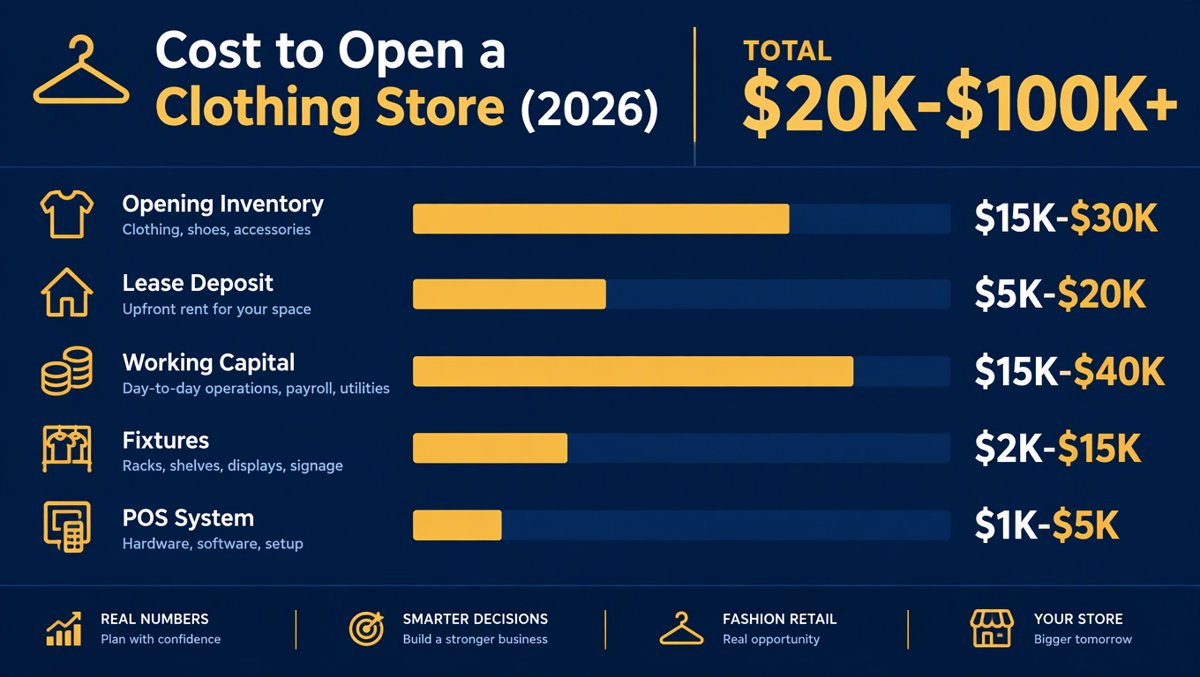
Where the money goes: the full cost table
Budget like this and reverse-engineer your concept from the total, not the other way around. Figures are itemized benchmarks from StartupCostHub's 2026 retail startup guide (US secondary markets), cross-checked against DisplayArama's clothing-store breakdown.
| Cost item | Low | High | Notes |
|---|---|---|---|
| Lease deposit (first + last + security) | $5,000 | $20,000 | Three months upfront is standard; rent runs $25–$40/sqft NNN for 1,000–1,500 sqft |
| Opening inventory | $10,000 | $50,000 | A boutique clothing store needs $15,000–$30,000 for a credible selection |
| Working capital (3–6 months) | $15,000 | $40,000 | Rent, payroll, utilities and restocking while traffic builds |
| Build-out / tenant improvements | $0 | $20,000+ | Negligible in a previously retail space; shell space costs more |
| Fixtures and shelving | $2,000 | $15,000 | Gondola shelving $150–$400 per unit; used fixtures cut this 40–60% |
| POS system | $1,000 | $5,000 | Square for Retail and Shopify POS Pro both run $89/month |
| Insurance | $2,000 | $5,000/year | General liability plus commercial property for inventory |
| Signage | $500 | $5,000 | Channel-letter sign $2,000–$5,000 installed; vinyl window $200–$800 |
| Website | $500 | $3,000 | E-commerce parallel to the store adds depth here |
| Licences and permits | $500 | $2,000 | Business licence plus signage and occupancy permits |
Total: $20,000–$100,000+, with your position in that range driven almost entirely by two decisions: how deep your opening inventory is, and whether the space needs build-out work. A clothing-boutique-focused cost guide (HowMuchToStart) puts the boutique range at $39,400–$300,000 — the top of that range assumes mall formats and broad assortments.
The inventory trap
Inventory is the largest variable cost, and the spot where new clothing retailers lose money fastest. The instinct is to fill the store — empty racks look unprofessional — so owners buy broad and deep across every line they plan to carry, before a single sales signal exists. Once that cash is sitting on shelves, it only comes back when the product sells. A 30% markdown on $15,000 of slow-moving stock costs $4,500 in margin, and repeating that two or three times in year one is what kills the cash cushion.
The fix is structural: launch with a tighter, curated selection, track sell-through weekly from day one, and reorder on what actually moves. Wholesale suppliers typically ship in 2–4 weeks, which is fast enough to restock a hit before it becomes a stockout. Budget 60–70% of your planned inventory dollars at opening and keep the rest as reorder capital.
Rent: the line that decides everything
Clothing retail leases are usually NNN (triple net): base rent plus your share of property taxes, insurance and common-area maintenance, which typically adds 10–25% on top of the advertised base. At $25–$40 per square foot for 1,000–1,500 square feet, monthly rent runs $2,000–$5,000 — and the deposit (first + last + security) alone is $5,000–$20,000 before build-out starts.
Negotiate three things before signing: a free-rent window of 1–3 months during build-out, a tenant-improvement allowance of $10–$30 per square foot toward fit-up costs, and category exclusivity within the centre. Get a lawyer to review the lease — the standard landlord form is written entirely in the landlord's favour.
What a Canadian storefront actually costs — and the honest caveat
Square Canada reports that a small clothing business can launch for $500–$5,000 — but that is online-leaning startup scope (via Businesses for Sale data). It excludes the lease, fixtures and opening inventory that dominate a physical store. None of the sources above publish a Canada-specific all-in storefront total, so every total in this piece is a US-proxy benchmark, not a Canadian quote. Treat Toronto and Vancouver prime rents as a reason your real number could land above the $100,000 top end, and get a written landlord quote before committing.
Margins: 56.9% gross, 2–5% net
The gross margin looks generous: appraisal of apparel companies averages 56.9% (AIMS360, citing NYU Stern, January 2026). The net tells the real story: average retail net profit margins run 2–5% (Vanta Insights, 2024). Apparel's variance is the widest in retail — ecommerce gross margins swing from 40–60% between $8 basics and $200 designer pieces (Nstar Finance, 2026).
Run the illustration: on $100,000 of annual sales, 56.9% gross margin produces $56,900 of gross profit. At a 2–5% net, only $2,000–$5,000 remains — while one year of rent at $2,000–$5,000 a month is $24,000–$60,000. That gap is why rent, markdowns and staffing — not product cost — decide survival. Statistics Canada data reported in August 2025 shows clothing, sporting goods and general merchandise operating profit rose $286 million (+9.1%), so the market is not dead; it is just unforgiving of overstocking.
Buy a franchise instead?
Franchising costs more up front but buys a brand, buying power and a playbook. US listing data puts clothing-retail franchise initial investment at $100,000–$500,000 (FranchiseGator), with boutique concept Apricot Lane at about $250,000 including a $39,500 franchise fee (US figures). In Canada, resale concept Plato's Closet operates nationally — the consignment model lowers inventory cost while adding royalty (an older listing cites $25,000 fee and 5% royalty; verify current terms before relying on them). Franchise math only wins if the brand's traffic replaces the marketing spend you'd otherwise carry alone.
The market you're entering
The Canadian clothing retail pie is large but not growing fast. IBISWorld puts women's clothing stores at $8.2 billion in 2026 (+4.2%) across 4,192 businesses (+1.5% from 2025), with five-year CAGR of just 1.3%. Family clothing stores are a $23.1–$25.1 billion range depending on the IBISWorld page (3,421 businesses on the industry page), and men's clothing stores are $2.8 billion across 1,320 businesses employing 144,831 people. Clothing and clothing accessories wholesaling is $13.7 billion — the supply tier your inventory buys from. Roughly 75% of Canadian shoppers still visit physical stores for clothing and similar categories (Canadian Chamber of Commerce), so the store format itself is not obsolete; a generalist assortment is.
How to open for less
Five levers that actually move the number: (1) take previously-retail space to keep build-out near $0 instead of $20,000+; (2) buy used fixtures through liquidators for 40–60% savings; (3) claim the tenant-improvement allowance before signing; (4) start with 60–70% of your inventory budget and reorder winners; (5) run Square for Retail or Shopify POS Pro at $89/month rather than a bespoke system. Fund 6 months of working capital and you have funded the difference between a store that survives its first markdown cycle and one that does not.
🏁 The verdict
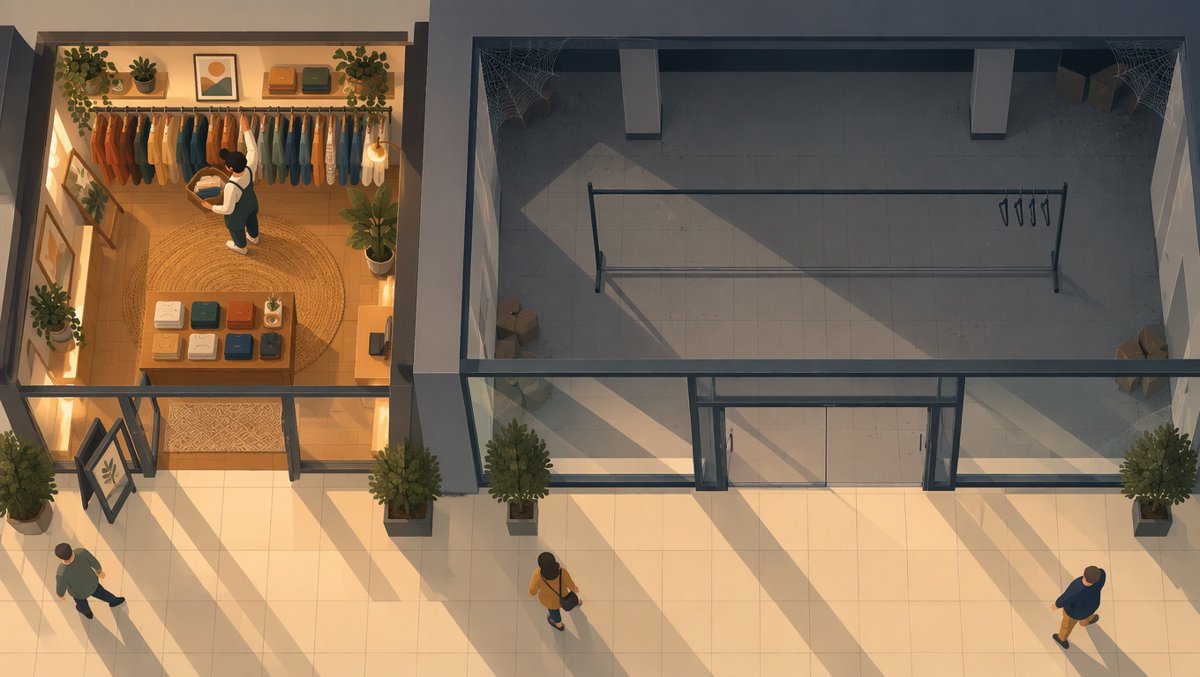
Open lean or don't open at all. A clothing store in Canada costs $20,000–$100,000+ before the first sale; the owners who survive year one bought $15,000–$30,000 of opening inventory, negotiated the lease, and kept $15,000–$40,000 in reserve. If your plan has no markdown budget and no six-month cushion, it is not a store — it is a closeout. The single next step: get a written lease quote and size your inventory to it, not the other way around.
💬 Want the working version? Subscribe free — Saturday toolkit PDFs by email. 💬 Got questions about opening a clothing store? Chat with Peter — ask the numbers, get the breakdown.
Figures are benchmarks from cited sources for planning purposes only — not financial advice. Verify lease, licensing and franchise terms with your landlord, accountant and provincial registry before committing capital.
Frequently Asked Questions
How much does it cost to open a clothing store in Canada? Itemized 2026 benchmarks put a small retail store at $20,000–$100,000+ (StartupCostHub), with a lean boutique at $20,000–$40,000 — these are US secondary-market benchmarks, so treat prime Canadian metro rent as likely to push above that range. No Canada-specific all-in total was published in the sources cited.
What is the biggest cost of opening a clothing store? Opening inventory: $10,000–$50,000 across retail, with a boutique clothing store needing $15,000–$30,000 for a credible selection (StartupCostHub), plus a $5,000–$20,000 lease deposit upfront. Together those two lines are the majority of a lean launch budget. Fund working capital of $15,000–$40,000 separately for the months before the store turns profitable.
Can I open a clothing store for under $10,000? Online, yes: Square Canada cites $500–$5,000 for a small clothing business launch. Physically, no — the lease deposit alone runs $5,000–$20,000, and a credible boutique inventory is $15,000–$30,000 (StartupCostHub). A pop-up or online-first test fits under $10,000; a permanent storefront does not.
What is the profit margin on clothing retail? Apparel gross margins average 56.9% (AIMS360 citing NYU Stern, January 2026), but after rent, markdowns and staffing, retail net margins average just 2–5% (Vanta Insights, 2024). The gap between those two numbers is the whole business: at $100,000 in sales, roughly $56,900 of gross profit shrinks to $2,000–$5,000 net in the benchmark range.
Is a clothing franchise cheaper than opening independently? No, not up front: US clothing-retail franchises list at $100,000–$500,000 initial investment (FranchiseGator), with Apricot Lane around $250,000 including a $39,500 franchise fee. The franchise premium buys brand traffic, buying power and a playbook — you are paying to replace marketing spend and first-year mistakes, not to save startup capital.
📚 SOURCES
- StartupCostHub, Retail Store Startup Costs 2026: $20K–$100K Itemized (Apr 2, 2026)
- HowMuchToStart, Clothing Boutique startup costs
- DisplayArama, How Much Does It Cost to Open a Clothing Store?
- Square Canada, How To Start a Clothing Business in 2026 (Jan 20, 2026)
- IBISWorld, Women's Clothing Stores in Canada (2026)
- IBISWorld, Family Clothing Stores in Canada (2026)
- IBISWorld, Men's Clothing Stores in Canada (2026)
- Statista, Apparel market in Canada
- Retail Insider, Retail trade sees increase in operating profit: Statistics Canada (Aug 25, 2025)
- AIMS360, Clothing Profit Margins 2026 (NYU Stern data) (Apr 28, 2026)
- Vanta Insights, Retail Profit Margins 2026 Benchmarks (Oct 19, 2026)
- Nstar Finance, E-Commerce Profit Margins by Category 2026
- Apricot Lane Franchise, Investment
- FranchiseGator, Clothing Retail Franchises
- Canadian Chamber of Commerce, State of Small Business PDF (Jan 2024)