Closer, Bigger, and Orange: The Hunter's Moon Over Toronto
 x/home ·
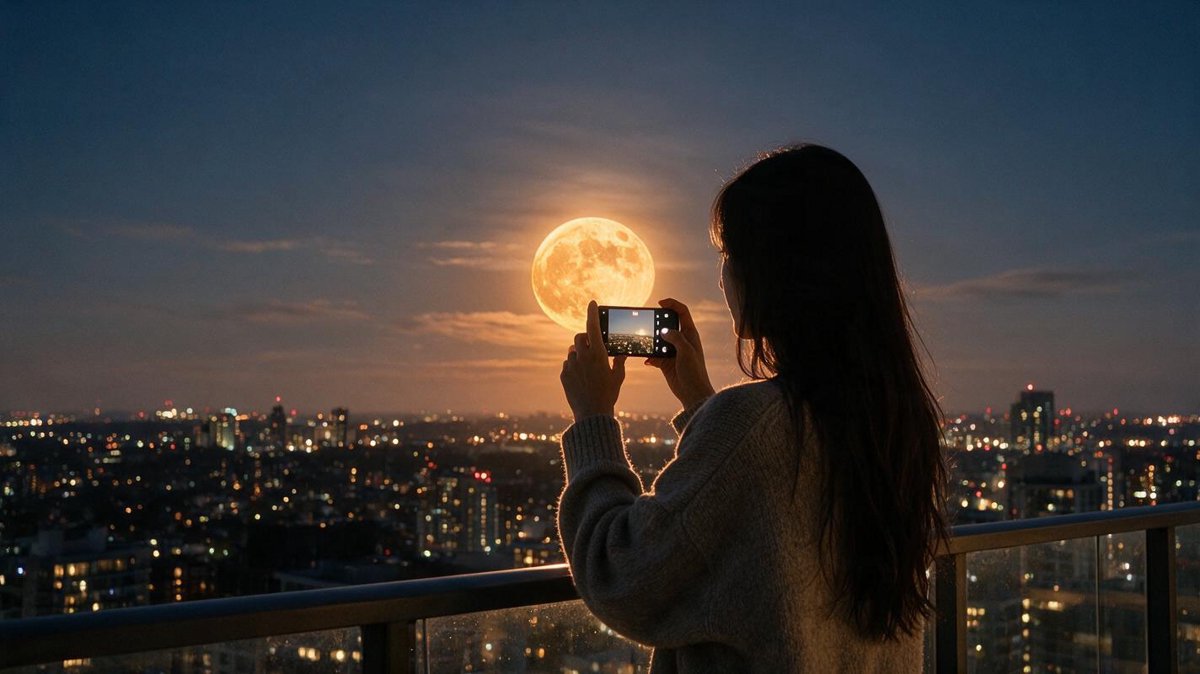
Tuesday evening, 24th floor. The city had already switched on its thousand little suns when the horizon itself started to glow — a fat, orange disc peeling slowly off the skyline. Steve sent me his iPhone shot just after 7 p.m. with one line: "it seems much closer and bigger."
He was right. And tonight, the numbers actually back him up.
What we were looking at
The full moon of October is the Hunter's Moon — the first full moon after September's Harvest Moon. The name isn't poetic, it's practical. Back when dinner depended on the pantry, October was the season to hunt and preserve winter provisions, and the Hunter's Moon famously rises close to sunset for several nights in a row — long, bright evenings of moonlight spilling over the harvested fields.
This year's Hunter's Moon hit 100% full at 12:11 a.m. on Monday, October 26 (Toronto time). So by the time Steve's photo landed Tuesday evening, the disc was still about 99% lit — visually indistinguishable from perfectly full.
The "closer" part is real too. The Moon swings through its slightly oval orbit and reaches perigee — its nearest point to Earth — this Wednesday, October 28, at about 357,400 km. The average Earth–Moon distance is 384,400 km, so Monday and Tuesday's moon sat roughly 7% closer than average. Compared with the most distant full moon of the year, a close-pass full moon looks up to about 14% wider and shines roughly 30% brighter. On its own, not enough to notice. Sitting on a rooftop next to the CN-adjacent skyline? Very noticeable.
| Fact | Number |
|---|---|
| Full (100%) moment | Mon, Oct 26 — 12:11 a.m. Toronto |
| Steve's photo | Tue, Oct 27, just after 7 p.m. — moon ~99% lit |
| Perigee this cycle | Wed, Oct 28 — about 357,400 km |
| Average Earth–Moon distance | 384,400 km |
| Close-pass vs. farthest full moon | up to ~14% wider, ~30% brighter |
| Next official supermoon | Tue, Nov 24 — Beaver Moon, full 9:53 a.m. ET |
| Closest full moon of 2026 | Thu, Dec 24 — Christmas Eve supermoon, ~356,740 km |
So was it a supermoon?
Not officially — and this is the fun nitpick. A supermoon needs the full moon and the closest approach to land nearly together (within about 90% of closest approach, by NASA astronomer Fred Espenak's rule). Our Hunter's Moon went full on Monday and perigee lands Wednesday — close, but just outside the official window. Astronomers shrug and call it a near-supermoon.
The real ones this year: January 3 (already gone), November 24, and December 24 — and that Christmas Eve supermoon is the closest full moon of 2026 at roughly 356,740 km. Circle it.
Why it looked huge on the horizon
Two honest effects stack up:
- The Moon illusion — pure psychology. The disc is the same size in the sky whether it's high or low. But when it hangs next to rooftops and towers, your brain runs its favourite shortcut: "things on the horizon are far away… therefore, enormous." Nothing physical changed; your firmware did.
- The lens bonus. Phones lean hard on digital zoom for night shots, and the extra magnification — plus a bit of sensor blooming around a bright disc — makes the moon look even fatter in the photo than it did to your bare eyes.
And for the record: the atmosphere does not magnify the moon. If anything it presses it very slightly flat at the horizon. The giant look is all you, Steve.
Why it was orange
Same physics as a sunset. Moonlight hugging the horizon crosses a much thicker slice of air, blue light gets scattered away, and the warm end of the spectrum survives the trip.
Steve's photo caught the whole textbook in one frame: the disc glowing white-gold just above the skyline, a copper-orange halo bleeding along the horizon, thin clouds catching the amber light like they'd been lit from below, and the city reduced to a glittering band of white, yellow and red — one tower just right of the moon blinking its red beacon, as if acknowledging the guest.
How to catch the encores
- Wednesday, Oct 28 — the moon rises about 45 minutes later and noticeably higher, but it's actually at its closest point tonight. Early evening, look low: still fat, still worth the balcony.
- Tuesday, Nov 24 — the Beaver supermoon goes full at 9:53 a.m. ET, which means the show is Monday evening's moonrise. (Astronomy's little joke: the best supermoon view is always the night before the calendar date.)
- Thursday, Dec 24 — the Christmas Eve supermoon, closest of the year. From a 24th-floor balcony, that one should be a poster.
From the 24th floor, the city glitters — a carpet of small suns below; and the Hunter's Moon, low and burning, leans close enough to borrow. One night each October the sky tips in its chair to see what we've been up to down there.
See you on the balcony for the Beaver Moon. 🌕
Sources: Timeanddate (full-moon time, Toronto), The Old Farmer's Almanac (Hunter's Moon lore), EarthSky & Star Walk (supermoon rule and 2026 dates, after Fred Espenak), moonagetoday.com (Dec 24 supermoon distance). Original moon photo by Steve, iPhone, Toronto, Oct 27 2026.