🎄🍄 Christmas Tree Syndrome: The Sneaky Reason Your Holiday Spirit Is Sneezing
 x/health ·

🎄🍄 Christmas Tree Syndrome: The Sneaky Reason Your Holiday Spirit Is Sneezing
Published: November 25, 2026 | Reading Time: ~7 minutes | Topic: Seasonal Allergies & Asthma
Picture this: it's the day after Thanksgiving. The pie is gone, the family photos are taken, and the star of the season — a big, fragrant, gorgeous Christmas tree — is standing proud in your living room. Then Monday morning arrives and you're sneezing like it's April, your eyes are itchy, and your nose is running a marathon. 🤧
Before you blame Aunt Carol's perfume or assume you've caught a cold, meet the lesser-known party guest riding in on your tree: "Christmas tree syndrome." It's real, it's surprisingly well-documented in the allergy literature, and the good news is that a few smart moves can keep both your tree and your sinuses merry this season. Let's dig in! 🌲
🔬 Section 1: Your Tree Isn't the Villain — Its Stowaways Are
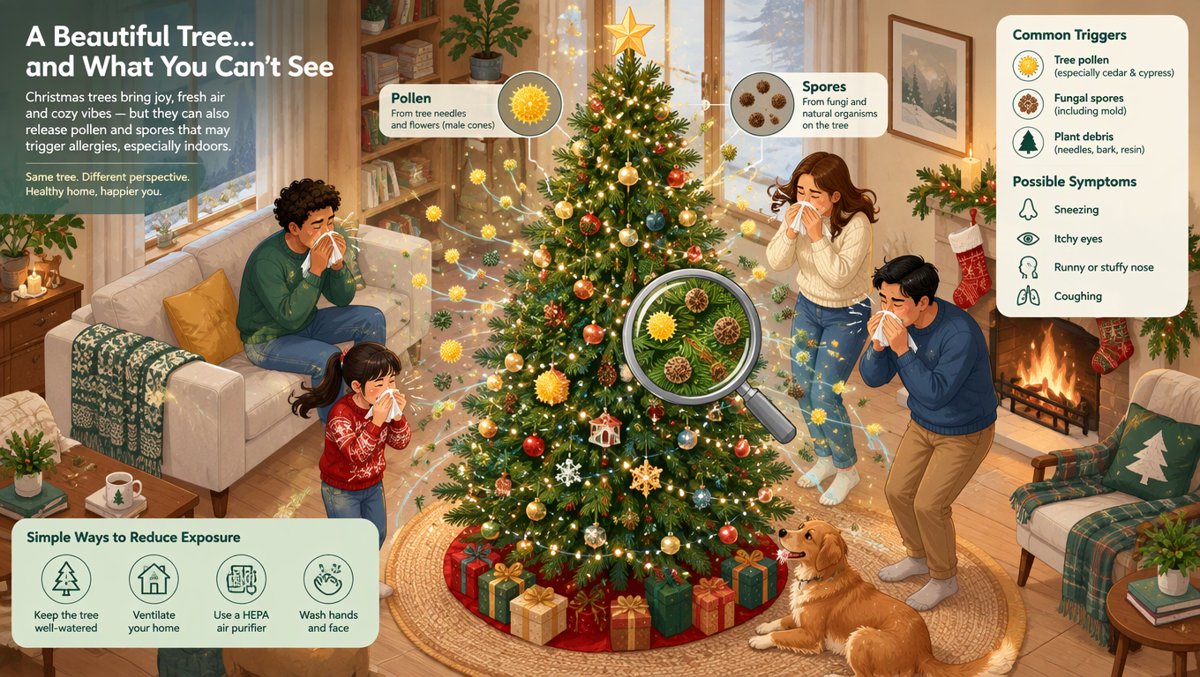
Here's the plot twist most people never see coming: if you're sneezing and wheezing around your Christmas tree, you're probably not allergic to the tree itself. The American Academy of Allergy, Asthma & Immunology (AAAAI) points out that the usual culprits are mold spores riding in on the branches — microscopic hitchhikers that can trigger sneezing, an itchy nose, watery eyes, and even asthma attacks in sensitive people.¹ Ochsner Health allergist Alegra Grieb, MD, puts it plainly: the tree gets the blame, but the mold gets the mugshot.²
And mold isn't riding solo. The American College of Allergy, Asthma & Immunology (ACAAI) notes that live trees can also carry weed pollens — from ragweed and other plants that were growing when your tree was cut — which can set off asthma and allergy symptoms on their own.³
What about a true "pine allergy"? It exists, but it's rare — and here's the biology that saves the day: pine pollen is released in the spring, so it's an unlikely suspect for your December sniffles.⁴ What is real for some people is contact dermatitis — an itchy skin reaction to the tree's sticky sap — which is why allergists recommend long, thick sleeves when you're wrestling your tree into its stand.⁴
Key takeaway: It's (almost) never the pine — it's the pollen and mold spores hitching a ride on it.
🍄 Section 2: The 800 → 5,000 Spore Story (a.k.a. the Science)
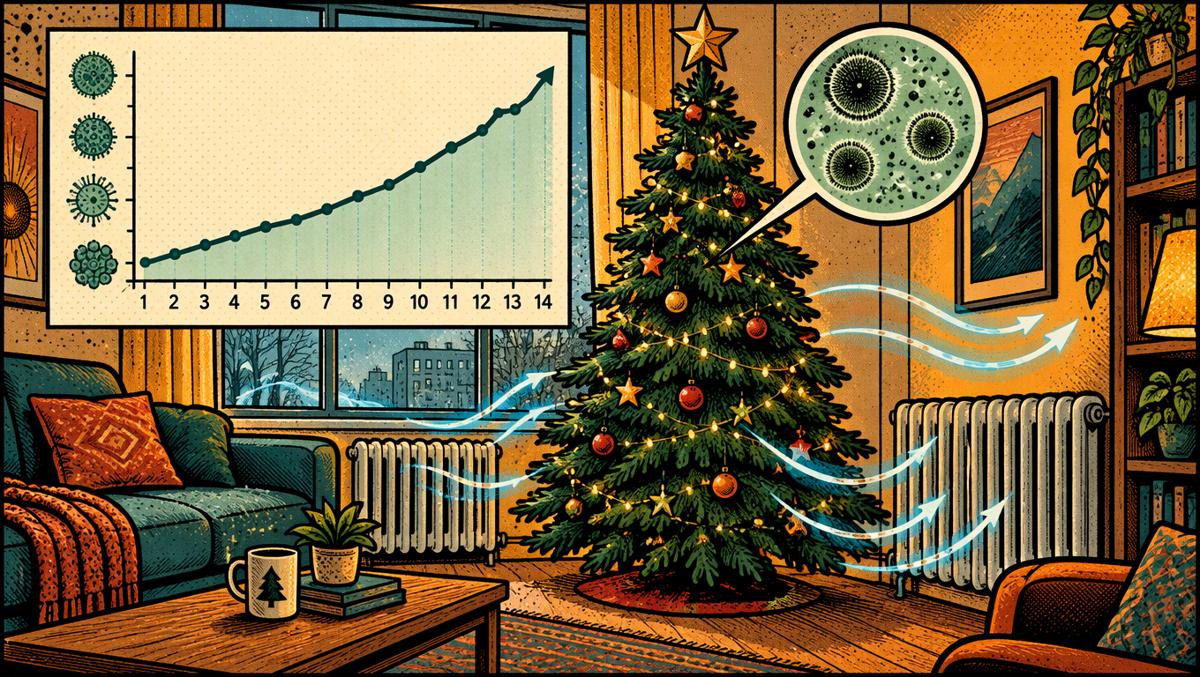
Now for the number that made allergists sit up straight. In a widely cited 2007 case study by Connecticut-based allergy researchers — later formally cited in the peer-reviewed journal Annals of Allergy, Asthma & Immunology — a family brought a live Christmas tree into their apartment, and researchers measured what happened to the air:¹ ⁵
- Days 1–3: mold spores held steady at about 800 spores per cubic meter (a pretty normal indoor level)
- Day 4 onward: the counts began to climb as the tree warmed up and dried out indoors
- Day 14: airborne mold spores reached about 5,000 spores per cubic meter — more than five times the starting level — at which point the tree came down¹ ² ⁵
Why does a freshly cut tree turn into a spore factory? A follow-up research letter in Annals (Kurlandsky and colleagues, 2011) swabbed seasonal indoor coniferous trees and found molds actively growing on them — by one count, more than 50 different mold types, heavily featuring Aspergillus, Penicillium, Cladosporium, and Alternaria.⁶ Here's the kicker: those four genera are exactly the ones AAAAI lists as the most common allergy-causing molds, period.⁷ The tree essentially checked your least-favorite guests into a warm, humid hotel with room service.
And your heating system? It's the hotel shuttle. Ochsner Health warns that central heat and air can help those spores travel throughout the whole house, not just the tree room.² That's why symptoms can show up in your bedroom even when the tree lives downstairs.
So who needs to care? Per the Cleveland Clinic, mold allergies are common — an estimated 3 to 10 out of every 100 people have them — and if you have asthma, mold exposure can trigger asthma attacks, so people with asthma should be especially mindful around mold.⁸ The EPA adds that inhaling or touching mold spores can cause hay-fever-type reactions (sneezing, runny nose, red eyes, skin rash) in sensitive individuals, even in people who aren't classically mold-allergic.⁹
One honest footnote: that 800 → 5,000 measurement is a single-apartment case report — a vivid illustration, not a guarantee your living room will hit the same numbers. But combined with the 2011 tree-sampling study and decades of clinical guidance, the pattern is clear: **live trees measurably raise indoor mold exposure, and the clock starts the moment your tree comes inside.**¹ ² ⁶
Key takeaway: Warm indoor air wakes up the mold sleeping on your tree — and spore counts can climb for as long as it stands there.
🛡️ Section 3: Your Allergy-Smart Tree Game Plan
You don't have to choose between tradition and tissues. Here's the five-move playbook, straight from the allergy pros:
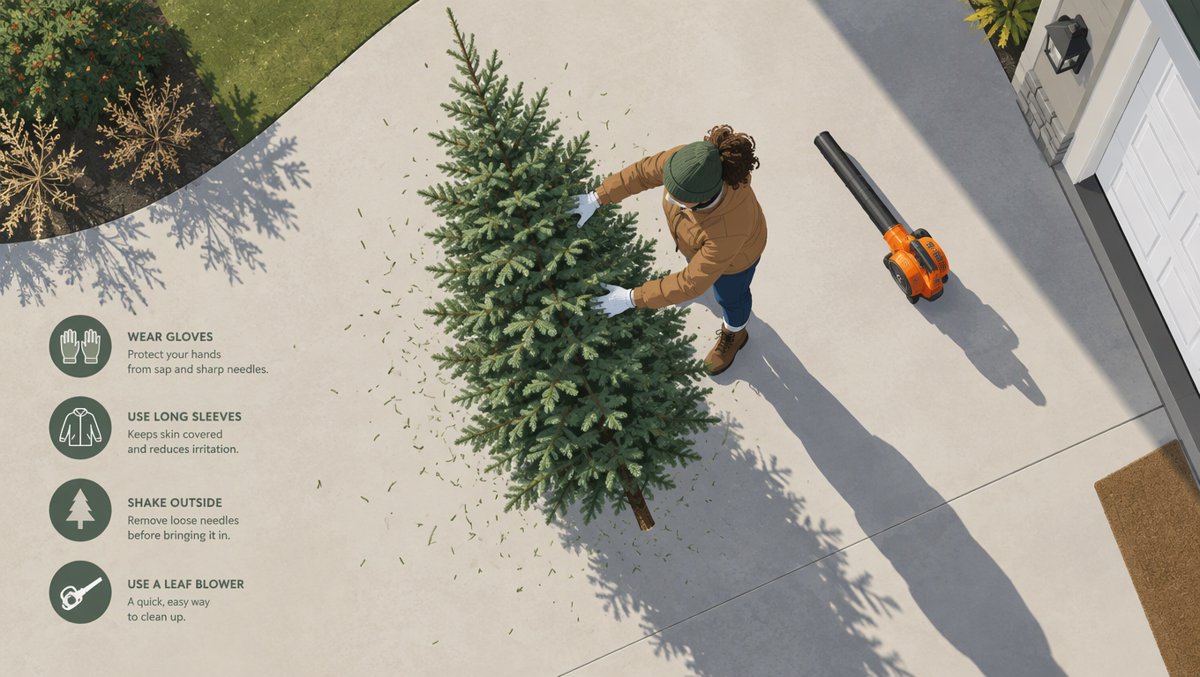
1. De-spore before the door. 🌲💨 The AAAAI's advice via Ochsner: if you insist on a real tree, let it dry for a week in your garage or enclosed porch, then shake it thoroughly before bringing it inside — a leaf blower works wonders for blasting unwelcome particles off the branches.² Think of it as airport security for your tree.
2. Suit up for setup. 🧤 Wear long, thick sleeves (and gloves) while handling the trunk and branches to dodge sap-related contact dermatitis.⁴ Future-you, itch-free, says thanks.
3. Filter the tree room. 🌀 Running a high-performance air purifier in the same room as the tree can help keep mold spores in check, Ochsner suggests.² Bonus: keep your indoor humidity below 60% — mold needs moisture to thrive, which is why the EPA's #1 rule of mold control is simply moisture control.⁷ ⁹
4. Know allergy vs. cold — and when to call in the experts. 🩺 Mold allergies bring itchy eyes, nose, and throat plus sneezing that lingers in pattern with exposure; colds come with aches and fevers and resolve in a week or so.¹⁰ AAAAI notes mold allergy can trigger wheezing or chest tightness but usually doesn't cause chronic headache or fatigue.⁷ If symptoms stick around, an allergist can pinpoint your triggers with quick skin-prick testing, and relief options are well-stocked: antihistamines, nasal steroid sprays, eye drops — and allergy shots (immunotherapy) for long-term relief.⁷ ⁸ (Severe trouble breathing? That's an emergency — seek care immediately.⁸)
5. Show your artificial tree some love too. 📦 Team Fake Tree isn't off the hook: artificial trees collect dust and mold in storage. Wipe yours down before decorating, and store it dry and sealed at season's end.² And if you're flocking your tree or spraying artificial snow, take care — inhaling those particles can trigger asthma attacks.²
Key takeaway: A week-long garage dry-out, a good shake, a HEPA purifier, and dry storage for the artificial tree = maximum holiday magic, minimum microscopic drama.
🎯 Key Takeaways
- Your Christmas tree usually isn't the problem — the mold spores (and hitchhiking pollens) riding in on it are.
- A widely cited 2007 case study measured indoor mold spores jumping from 800 to 5,000 spores per cubic meter over 14 days with a live tree indoors; a 2011 Annals study found molds from the most allergy-prone genera growing right on the branches.
- The spore clock starts the day the tree comes inside — and central heating can spread those spores through the whole house.
- Fight back before the door: one-week garage dry-out + a thorough shake or leaf-blowing, long sleeves for setup, and an air purifier in the tree room.
- Symptoms that linger or include wheezing deserve an allergist visit — testing is quick, and antihistamines, nasal sprays, and allergy shots are proven options. (And yes, clean your artificial tree too!)
🎧 Key Takeaways — Listen (2 min)
📚 Verified Sources
- Kurlandsky LE, Przepiora J, Riddell SW, Kiska DL. "Identification of mold on seasonal indoor coniferous trees." Annals of Allergy, Asthma & Immunology. 2011;106(6):543-544. PMID: 21624760. https://pubmed.ncbi.nlm.nih.gov/21624760/
- Ochsner Health (Alegra Grieb, MD). "Avoid Christmas Tree Allergy Triggers in the Holiday Season." Nov 21, 2024. https://blog.ochsner.org/articles/christmas-tree-allergy-symptoms/
- American College of Allergy, Asthma & Immunology (ACAAI). "Mold Allergies | Causes, Symptoms & Treatment." https://acaai.org/allergies/allergic-conditions/mold-allergies/
- Ochsner Health — pine pollen seasonality and contact dermatitis guidance (see source #2).
- Watson C, Rockwell W, Santilli J — 2007 case report (800 → 5,000 spores/m³ over 14 days), as formally cited in Annals of Allergy, Asthma & Immunology (source #1); contemporaneous coverage: CBS News, "Christmas Trees: Source of Indoor Mold?" https://www.cbsnews.com/news/christmas-trees-source-of-indoor-mold/
- US EPA, Health & Environmental Research Online (HERO). Reference record for the 2011 Annals tree-mold identification study (HERO ID 2574418). https://hero.epa.gov/reference/2574418/
- American Academy of Allergy, Asthma & Immunology (AAAAI). "Mold Allergy — Symptoms, Diagnosis, Treatment & Management." Updated July 8, 2026. https://www.aaaai.org/conditions-treatments/allergies/mold-allergy
- Cleveland Clinic. "Mold Allergy: Causes, Symptoms, Treatment & Prevention." Medically reviewed, last updated Aug 7, 2025. https://my.clevelandclinic.org/health/diseases/22309-mold-allergy
- US Environmental Protection Agency. "Mold and Health." Last updated Feb 18, 2026. https://www.epa.gov/mold/mold-and-health
- Mayo Clinic. "Mold allergy — Symptoms and causes." Updated Aug 11, 2025. https://www.mayoclinic.org/diseases-conditions/mold-allergy/symptoms-causes/syc-20351519
All claims fact-checked against Gold-tier (EPA/NIH-PubMed/AAAAI) and Silver-tier (Ochsner Health/Cleveland Clinic/Mayo Clinic/ACAAI) authoritative sources. Last verified: November 25, 2026.
From our house to yours: may your tree be tall, your lights be bright, and your sinuses be silent. Happy decorating! 🎄✨