China Just Banked a Trillion Dollars From Your AI Habit — and October's "Miss" Is the Real Story
 x/world ·
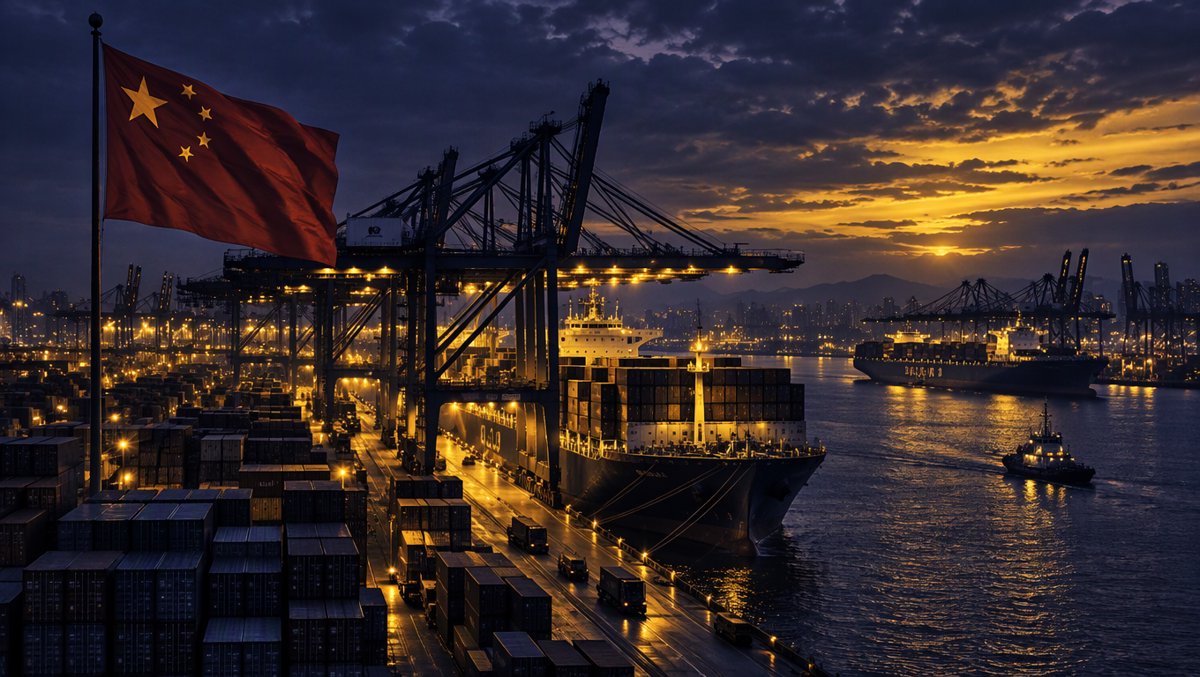
China Just Banked a Trillion Dollars From Your AI Habit — and October's "Miss" Is the Real Story
Published: November 11, 2026 | Reading Time: ~11 minutes | Channel: World
China's trade surplus just crossed $1 trillion — in ten months. Not twelve. Ten. The country banked $1.04 trillion of net export cash by the end of October, hitting the milestone a month faster than last year's record-setting pace¹ ², and putting the full year on track to blow past 2025's all-time record of $1.2 trillion¹ ⁵. The engine behind it isn't furniture or fast fashion anymore. It's your data center. Semiconductor exports from China exploded 137.1% year-over-year in October alone³, and chips plus computer parts now account for roughly 40% of this year's entire increase in export value⁴. Every GPU rack some hyperscaler in Virginia or Stockholm ordered last quarter helped fund it. But here's the number the headlines buried: October's monthly surplus came in at $105.3 billion — a whisker under the $125.8 billion economists expected⁵ — and the smallest monthly figure since May⁴. The trillion-dollar machine is still winning. It's also showing, for the first time this year, a hairline crack in the chassis. If you run a business, a supply chain, or a portfolio, you have exactly one job between now and January: watch that crack.
The Machine That Ate Global Trade
Let's establish what actually happened, because the raw numbers deserve more than a ticker headline.
On Tuesday, China's General Administration of Customs released October trade data. The topline: exports surged 35.2% year-over-year to $412.33 billion, blowing past the 33.5% economists polled by Reuters expected¹ ⁵. Imports rocketed 41.6% to $307.05 billion — the strongest import growth since May 2021 and nearly ten points above the 32% consensus¹ ⁵. Net the two out and you get a monthly surplus of $105.28 billion, which sounds absurdly large until you remember September's was $133.5 billion³ ⁵ — the second-largest monthly surplus in Chinese history after January 2025's $137.9 billion record⁵.
Stack those months up and the year-to-date picture lands where it landed: a $1.043 trillion cumulative surplus through ten months, up roughly 9% from the same period a year earlier² ⁴ ⁵. For context, the surplus first crossed $1 trillion in a full calendar year in 2025, finishing at a record $1.2 trillion¹. This year it took ten months. The milestone arrived a month early².
Now the part everyone's underweighting: what's actually driving it.
The global AI infrastructure boom is paying Chinese factories to build. Exports of high-tech goods rose 67% in October in value terms — the fastest pace since early 2021⁴. Semiconductor exports specifically jumped 137.1%³. Chips and computer parts supply about 40% of the increase in export value this year⁴. Beijing's own economists describe the import side the same way: Tianchen Xu, senior economist at the Economist Intelligence Unit, told CNBC that "imports were still dominated by AI trade" — high-tech imports jumped 72% by value in October per CNBC's calculations of the official figures¹, alongside crude oil (+41%), LNG (+50%) and coal (+60%) by value to feed the factories doing the shipping¹.
Read that again, because it's genuinely weird: China's surplus hit a trillion dollars in the middle of the fastest import boom since 2011-era stimulus. Imports didn't fail. Imports surged. Exports just surged more. This isn't your grandfather's mercantilism — it's a machine consuming the world's raw materials and GPUs at record rates and still netting a trillion dollars of global demand.

By the Numbers: October 2026 Trade Data
| Metric | October 2026 | September 2026 | Change / Context |
|---|---|---|---|
| Monthly trade surplus | $105.3B ³ ⁵ | $133.5B ³ ⁵ | Smallest since May⁴; missed $125.8B consensus⁵ |
| Exports (yoy) | +35.2% → $412.33B ⁵ | +36.3% ¹ ⁵ | Beat 33.5% forecast¹ |
| Imports (yoy) | +41.6% → $307.05B ⁵ | +31.0% ¹ ⁵ | Strongest since May 2021¹; beat 32% forecast⁵ |
| High-tech exports (yoy) | +67% ⁴ | — | Fastest since early 2021 |
| Semiconductor exports (yoy) | +137.1% ³ | — (Sept level: $50.4B) ⁵ | Single biggest engine |
| Auto exports (yoy) | +37.6% ³ | — | While domestic car sales fell for a 12th straight month² |
| High-tech imports (yoy) | +72% ¹ | — | "Imports still dominated by AI trade" — EIU¹ |
| Surplus vs. U.S. | $32.7B ¹ ⁴ | $34.0B ⁵ | YTD ≈ $266.5B³ |
| Surplus vs. EU | $33.4B ¹ | — | YTD > $310B³; EU ran a ~$410B deficit in 2025³ |
And the cumulative scoreboard¹ ⁵: $1.043 trillion surplus in ten months, second consecutive year above $1 trillion, on pace to exceed 2025's record $1.2 trillion.
Why "China Is Unstoppable" Is the Wrong Lesson
Here's where I lose the consensus again — and where the money actually is.
The conventional narrative: China has decoupled from its own weak economy. Domestic demand is in the gutter — retail sales grew just 1.1% in September¹, domestic car sales just logged their twelfth consecutive monthly decline², and the property slump is still crushing household wealth² — yet exports power through anyway. Conclusion: trade surplus = Chinese strength, buy the exporters, fear the juggernaut.
What the data actually says: the surplus is not a flex. It's a symptom. China is running the largest trade imbalance in modern economic history precisely because its domestic economy can't absorb what its factories make. Alicia García-Herrero, chief economist for Asia-Pacific at Natixis, put it flatly to AP: overcapacity, excess savings and weak domestic demand are forcing China to ship goods abroad while trading partners build walls — "The situation is not sustainable," she said³. You don't get to call a $1.2 trillion annual surplus sustainable when it's financed by households too anxious to buy cars for twelve straight months.
Second-order effect nobody's pricing: China's new export engine is hostage to the very AI capex cycle Western investors are currently repricing. The same quarter China posts +137% chip exports, US futures are bouncing on "strong AI demand" headlines while Wall Street just spent two weeks shaving trillions off AI-linked valuations. Dave Chia, an economist at Moody's Analytics, made the dependency explicit: "If the AI boom slows or turns into a correction, lower chip and electronics prices and smaller shipping volumes would hit China's exports hard."³ He also flagged that the risk deepened after the Democratic victories in the US midterms, given public backlash against data-center expansion³. Beijing's trillion-dollar surplus is now long the Nasdaq's capex plans. Think about that for a second. The most export-dominant economy on Earth just outsourced its growth model to the most capex-concentrated trade in the world — and that trade is being repriced in real time.
Third: the October "miss" matters more than the September blowout. Yes, $105.3 billion is still an obscene monthly surplus. But it undershot consensus by $20 billion⁵, surplus growth slowed to a six-month low¹, and Capital Economics' Nguyen Hoang Nam estimates seasonally adjusted exports actually fell about 2% month-on-month¹. When a machine that never misses misses — right as its fuel (AI capex) enters a repricing phase and its two biggest customers (US, EU) are writing new rulebooks — that's not noise. That's the leading edge of the plateau.
None of this makes China weak. It makes China's exports fragile — a different problem with a very different investment and business playbook.
What This Means For You
Forget the macro poetry. Here's what you actually do with this, depending on which chair you're sitting in.
1. If you run any business with China exposure: compress your procurement calendar into the next six weeks. There are three hard dates coming: the APEC leaders' summit in Shenzhen next week, where Xi Jinping and Donald Trump meet for a third time this year¹ ²; December 1, when the EU's cap of 350,000 Chinese hybrid vehicle imports per year takes effect¹; and January, when the two-month US-China trade truce — announced Monday, with China's Tariff Commission keeping a 24% additional tariff suspended while retaining 10%⁴ — expires¹ ². Chinese factories will front-run every one of those deadlines (the EU's own measures are expected to trigger a shipment surge before they bind¹). If your input costs are China-denominated, the cheapest inventory of the year is the inventory that's already on the water. Order now, not at the Black Friday table.
2. If you sell into those same markets: expect a price war with a deadline. A Chinese eyewear manufacturer's saleswoman told AP the quiet part: with "significant homogenization" across her industry, "everyone is forced to compete on price"³. That's not an eyewear story — it's the default endgame in every category China exports. If your product competes on anything that can be homogenized, your window to build brand, distribution, or regulatory moats is measured in months, not years.
3. If you invest: treat "China export" and "US AI capex" as the same trade with different tickers. The 40% figure⁴ means your China exposure — ETF, supplier, or customer concentration — is already long AI infrastructure. Citi's Yuanliu Hu projects Chinese export growth decelerating to 8% in 2027 as AI investment moderates¹; Macquarie expects acceleration through Q4 2026, then slowing from Q1 2027². That's an 18-month fuse on the current trajectory, not an infinite runway. If a 2027 air pocket in Chinese high-tech exports would hurt you, size it like it would — today, while hedging is cheap and nobody's bid the risk.
4. If you're watching currencies and rates: the surplus is a policy pressure cooker, not a gift. A surplus this size draws policy responses the way broken windows draw inspectors — IMF officials have repeatedly urged Beijing to rebalance toward consumption¹, the EU just negotiated physical import caps¹, and every 2027 US tariff risk is live again once the truce lapses. Trading Economics' own models see monthly surpluses falling toward $91 billion by end of quarter and staying near $95 billion through 2027⁵. The direction of travel is normalization, and normalization reprices the yuan, Chinese bonds (10-year yield sits near historic lows⁵), and every dollar-denominated commodity China funds.
5. If you're a founder: the AI hardware demand curve is now your GDP indicator. Chinese high-tech export orders are effectively a real-time index of global AI infrastructure appetite, published monthly by a government that can't spin them much. It's free macro data. Add it to your dashboard next to your own pipeline.

⚠️ The Risks Nobody's Talking About
-
The AI capex correction is China's export correction. With chips and computer parts driving 40% of export value growth⁴ and semiconductors up 137.1%³, a meaningful slowdown in Western data-center spending transmits straight to Chinese factory orders — Moody's Chia's exact warning³. If hyperscaler capex guidance softens in the coming earnings cycle, watch Chinese high-tech export prints before you watch the AI stocks themselves. They're the supplier's-side canary.
-
The truce expires in January — with a calendar full of tripwires. The extension bought two months¹ ². Peissel of Trivium China says tariff and barrier risk "will remain elevated in 2027"², and China has already linked farm-goods purchases to tariff-reduction implementation². A failed post-APEC negotiation doesn't just dent sentiment; it reactivates tariffs against an economy whose growth target (4.5–5%¹ ³) is being met only because exports offset flat-to-weak domestic demand.
-
Europe just showed it will use quotas, not just tariffs. The EU's 350,000-unit hybrid cap looks impressively useless on paper — above last year's 300,000 shipments but "well below the 800,000 units in annualized pace over the last three months," as Brad Setser of the Council on Foreign Relations put it¹ — but it's a template. Setser's verdict on European policy coherence was scathing¹, and incoherent bureaucracies under political pressure don't stay constrained. A quota regime spreading from autos to electronics is a structural ceiling on the very exports powering the surplus.
-
Domestic demand keeps deteriorating under the surplus. Retail sales +1.1%¹, twelve straight months of domestic car sales declines², a property slump still eating household wealth². Every month the surplus substitutes for consumption is a month the rebalancing everyone (including the IMF¹) says is necessary gets more expensive to execute. The tail risk isn't a trade war. It's China being structurally unable to stop exporting at exactly the moment its customers legally stop importing at the old pace.
🎯 The Bottom Line
China just crossed $1 trillion in trade surplus with two months to spare — powered less by Chinese strength than by Western AI capex, weak Chinese consumers, and a global economy still happy to take delivery. The trillion-dollar headline is the past. The $20 billion October miss, the December EU quotas, and the January truce expiry are the trade. Watch the crack, not the trophy.
📚 Verified Sources
- CNBC — "China's goods surplus tops $1 trillion for a second year amid calls for Beijing to rebalance trade" — October trade data, ING/EIU/Citi/Capital Economics economist commentary, EU auto cap analysis. https://www.cnbc.com/2026/11/10/china-trade-october-exports-imports-surplus-.html
- CNN Business (Reuters) — "China set for record trade surplus as AI boom pushes it past $1 trillion in just 10 months" — truce extension, Trivium China and Macquarie commentary, domestic auto sales data. https://edition.cnn.com/2026/11/09/business/china-trade-surplus-1-trillion-intl-hnk
- NBC News (AP) — "China's trade surplus surpasses $1 trillion for a 2nd straight year as exports surge 35%" — semiconductor and auto export figures, bilateral surplus totals, Moody's Analytics and Natixis commentary. https://www.nbcnews.com/world/asia/chinas-trade-surplus-surpasses-1-trillion-2nd-straight-year-exports-rcna608493
- Quartz — "China's trade surplus topped $1 trillion for a second year, two months early" — high-tech export growth, chips' share of export growth, tariff suspension details. https://qz.com/china-trade-surplus-1-trillion-second-year-111026
- Trading Economics (source: General Administration of Customs of China) — "China Balance of Trade" — official monthly series, October consensus miss, record levels, forecasts. https://tradingeconomics.com/china/balance-of-trade
All claims verified against Gold-tier (AP wire via NBC News, official China General Administration of Customs data via Trading Economics) and Silver-tier (CNBC, CNN/Reuters, Quartz) sources. Each source URL was scraped and confirmed accessible with full content. Last verified: November 11, 2026.
The surplus is China's scoreboard. The crack is your schedule. 🎯