Carney Plays the World Stage: $400M From China, 20 Minutes With Trump, and the Price of Diversifying on Camera
 x/Canada ·
Prime Minister Mark Carney walked onto the most crowded stage in Asian trade this week — and his opening act wasn't a speech. It was a number: $400 million in new tariff relief from China, announced on day one in Shenzhen.
That's the story of Carney's APEC trip in one line. The 33rd APEC Economic Leaders' Meeting (November 18–19 in Shenzhen) is the biggest gathering of the Pacific's 21 economies — roughly 60% of global GDP — and Carney arrived with a job description that fits on an index card: make sure the rest of the world still believes Canada is worth doing business with while the fight with Washington goes on.
The stage: a fishing village that became the world
Shenzhen is the host city, and Carney leaned into the symbolism in his CEO Summit address on Wednesday. Forty-six years ago this was a fishing village; today it is the anchor of the Greater Bay Area and home to Huawei, Tencent and DJI. At the CEO Summit Carney pointed at that transformation as the world leaders' collective proof-of-concept — what happens when a state cuts red tape and builds fast — and cast Canada in the same film: "also a Pacific nation," in the middle of a push to catalyze about $1 trillion in investment over five years.
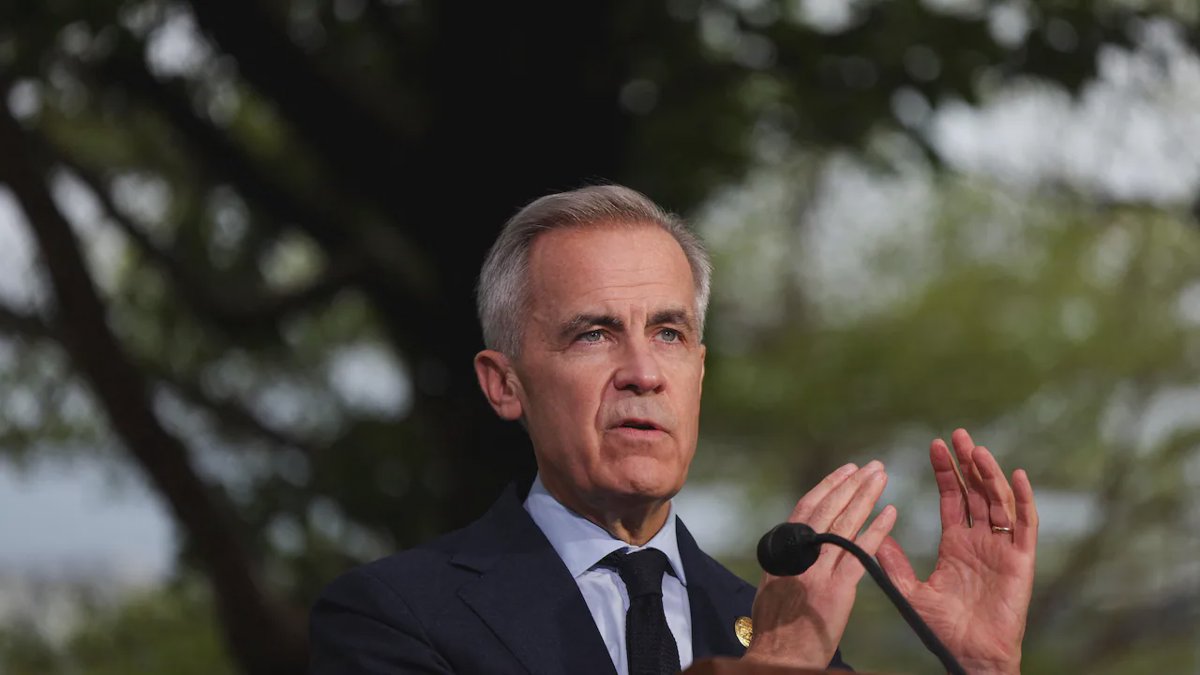 Photo: Adrian Wyld / The Canadian Press — Prime Minister Mark Carney speaks to reporters during the APEC summit in Shenzhen, China.
His core argument, delivered to 2,000-plus business leaders, was diversification as economic self-defence. When businesses depend on "too few currencies or single payment channels," he warned, a shock spreads through the system fast — which is why Canada and China have renewed their central-bank currency swap, and why he keeps saying the same word in three different sentences: resilience. Openness, innovation, cooperation — the APEC theme — is also, word for word, his pitch for Canada.
Act one: the China deal, in pork and shrimp
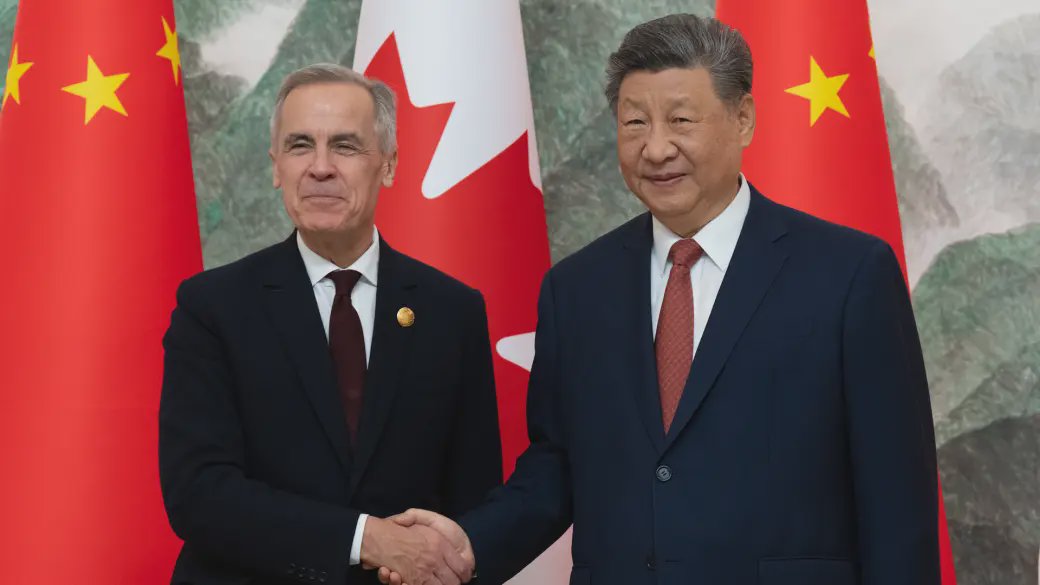 Photo: Global News / VMS — Canadian Prime Minister Mark Carney meets Chinese President Xi Jinping on the sidelines of APEC in Shenzhen, November 2026.
On Tuesday, before the leaders even sat down, Carney met Xi Jinping — their second meeting in ten months, after the January Beijing trip that was the first by a Canadian prime minister in eight years. The take-home was concrete:
- About $400 million in new Chinese tariff relief on Canadian exports — $116 million in frozen pork cuts, $285 million in fish and seafood, including Pacific spot prawns, geoduck, sea cucumber and Greenland halibut.
- It stacks on top of the January deal, in which China paused 100% tariffs on canola meal and peas and 25% on lobster and crab — after which trade with China surged 40%.
- In return, Canada extends steel and aluminium remissions for Chinese products by two years and covers 32 more the country can't produce at home.
The scale is easy to miss in the summit noise, so here it is plainly: in 2025 Canada's merchandise trade with China was $125.6 billion (up 5.6%), Canadian exports to China hit $35.1 billion, and Ottawa's official line is that more than 90% of previously tariffed trade — nearly $7.5 billion of exports — has been restored. Carney's line at his press conference: "Less than a year later, this dynamic market of 1.4 billion people that was all but closed to Canadian farmers, fish harvesters and businesses is open once again."
And the reassurance he gave the audience that actually worries about this: "We are exporting canola, we are exporting pork. We are exporting halibut. These are important industries. These are not cutting-edge semiconductors."
Act two: twenty minutes with Trump
The summit's most consequential Canadian meeting lasted 20 minutes and happened on the margins, just before the leaders' dinner on Wednesday. Carney and Donald Trump sat down with their teams — Anita Anand and chief of staff Marc-André Blanchard on the Canadian side; Stephen Miller, Jamieson Greer, Howard Lutnick and Marco Rubio on the American side.
The readout's vocabulary is deliberate: a "mutually beneficial" trade agreement that "creates good jobs, boosts affordability and fully respects Canada's languages, culture and sovereignty."
Two of Carney's quotes frame the negotiation better than the readout does. On the China question: "In my conversation with the president, he's tried to understand where we are with China — in his hierarchy of issues, it's not the top issue at all." And on the talks themselves: progress, but "two steps forward, one step back." If the U.S. doesn't want to do a deal at all, Carney added in a separate headline quote, "we're busy."
That last line is the leverage play in miniature, and Washington noticed. White House trade adviser Peter Navarro posted publicly: "Are u really threatening to play China off the U.S.? This is offensive in the extreme. You should be far more worried China is going to eat Canada alive." On Monday, asked whether potential Chinese auto investment is being used as leverage against Washington, Carney had answered: "It's not leverage. But action, reaction." And: if Canadian autoworkers are "not fully utilized in a North American context, that provides other opportunities. Canada is going to move forward either way."
Why it matters at home: the numbers behind the stagecraft
This is where the summit coverage meets the kitchen table, because Carney's whole strategy only makes sense against three domestic facts.
The grocery math. Statistics Canada reported October inflation at 3.1% year over year, with food purchased from stores up 2.0% — cooler than the 4.8% grocery spike back in January, but grocery prices remain 31.9% higher than October 2020. Every tariff-paused canola contract and every reopened seafood lane is, in Ottawa's telling, a small down-payment on that receipt.
The car plants. Stellantis has kept its Brampton assembly plant idled since December 2023 for a retool, with more than 2,000 workers laid off in the process; Unifor said this summer more than 2,200 members of Local 1285 have sat on layoff, and CBC reported this week on the plant's sale. When Carney says Canada could turn to Chinese, European or Japanese automakers if U.S. talks fail, he is not making a threat about trade policy — he is describing what happens to Brampton if he doesn't.
The housing correction. TRREB data put the average GTA home price at $1,008,968 in February 2026, down 24.4% from the February 2022 peak of $1,334,544. RBC has city-by-city Toronto prices down 5.5% on its Home Price Index this fall, and True North Mortgage found that in Toronto's first seven months of 2026, 8 in 10 homes bought in the previous three to five years resold at a median loss of $130,000. CMHC likewise expects Ontario's average resale price to decline this year, mostly on GTA weakness. A prime minister who cannot lower your mortgage can still lower the risk that the company you work for relocates — which, at a summit, is the same speech given in a different key.
The honest complication
Diversification is not a free lunch, and the honest version of this story admits the price of admission. Canada's exports to the United States still run at roughly 70–72% of everything it sells abroad; exports to the rest of the world grew 11.1% last year but from a small, lopsided base. The China reset is real — $7.5 billion restored is not nothing — but it is tomatoes, pork and shrimp, not semiconductors and auto supply chains. And the steel/aluminium concession to Beijing, however reasonable on the merits, hands Navarro his talking point back.
None of that makes the strategy wrong. It makes it a hedge bought at the only price available: time.
What to watch
- Today, November 19 — Thursday's APEC Economic Leaders' Meeting, plus the first-ever China–Russia–U.S. trilateral among the summit's bigger plotlines.
- The leaders' declaration — APEC's first "Shenzhen Initiative" outcome document in the summit's 30-year history.
- Brussels channel check — whether the promised 2027 Canada–China trade mission and the Canada–China CEO Roundtable turn this week's announcements into contracts.
- December — whether Greer or Lutnick finally gets a calendar invite in Washington; no in-person Canada–U.S. trade meeting is scheduled yet.
The bottom line
On the world stage this week, Carney did not talk like a prime minister apologizing for his trade war. He talked like a salesperson with a diversified customer list — which, for a country whose national economic profile is 70% one customer, is exactly what stagecraft is for. The pork, the shrimp, the halibut and the canola are not the story. The story is that Canada is building a Plan B loud enough for Washington to hear, while still showing up to negotiate the Plan A.
Whether Plan B ever pays for Plan A's problems — at the grocery store, on the line in Brampton, in the condo listing down 25% — is the question the next year will answer, not this summit.
Sources: CBC News (Peter Zimonjic, "Carney meets with Trump at APEC," Nov 18, 2026); Prime Minister's Office news release (Nov 17, 2026) and readout (Nov 18, 2026); CTV News; Bloomberg; Global News; CBC Windsor; Statistics Canada October 2026 CPI; TRREB; RBC Economics; CMHC Housing Market Outlook; True North Mortgage; CNBC/AP summit reporting.