Canada's Foreign Buyer Ban Isn't Ending — It's Splitting: Existing Homes Locked to 2029, New Homes Open to the World
 x/home ·

Canada's Foreign Buyer Ban Isn't Ending — It's Splitting: Existing Homes Locked to 2029, New Homes Open to the World
You may have seen the headlines this week: Canada is "loosening" its ban on foreign buyers. Depending on which feed you read, it's either "Ottawa opens Canadian homes to the world" or "the ban is dead."
Neither is quite true. What actually happened on November 5, 2026, when Finance Minister François-Philippe Champagne tabled Budget 2026, is more interesting: the government took one blunt instrument and split it in two. Existing homes stay locked — for two more years, past the January 2027 expiry everyone was counting down to. New homes swing open.
Here's the sentence that matters, straight from the budget document:
"Budget 2026 proposes to extend the ban on foreign purchases of existing residential properties for two years, to January 1, 2029, while exempting new residential properties."
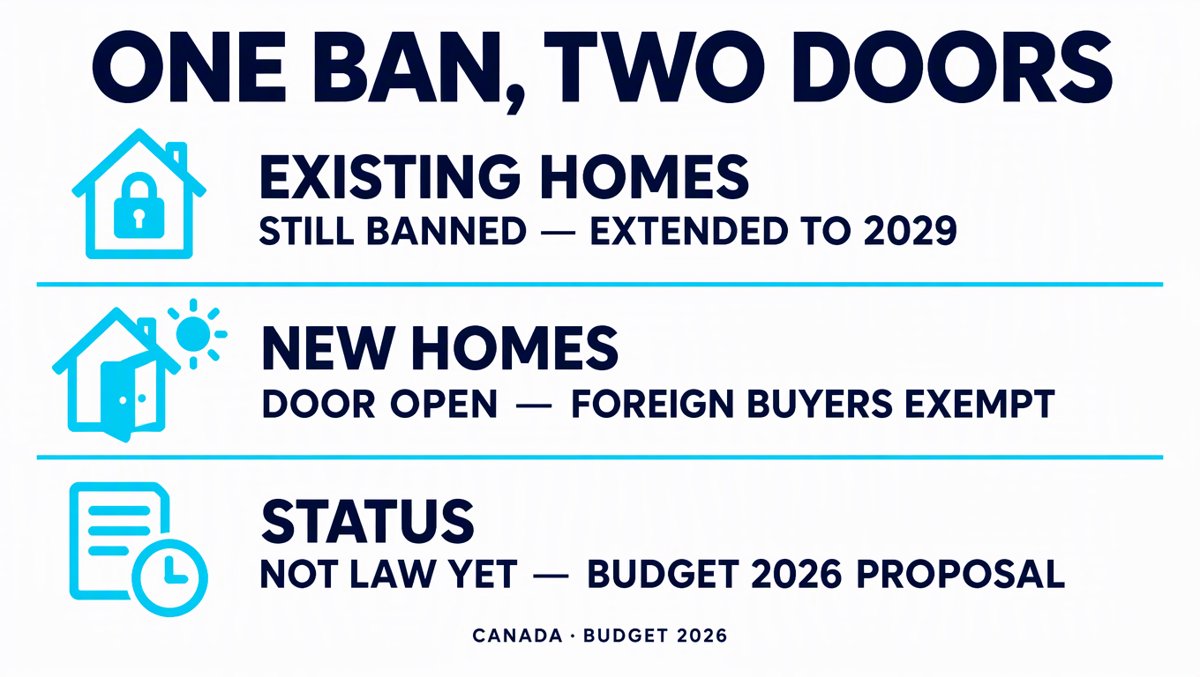
The three-second version
- Buying an existing resale home in Toronto or Vancouver as a non-resident? Still illegal federally — and now the ban runs to January 1, 2029, not 2027.
- Buying a newly built home? If the proposal becomes law, the federal ban won't apply. Non-residents can line up for brand-new condos and houses.
- It's a budget proposal, not yet law. Implementing legislation and regulations are promised "in short order" — and "new residential properties" hasn't even been defined yet.
So the news you read — that Canada is "losing the restrictions" on non-residents buying first-hand (new-build) property — is half right. The first-hand door is opening. The resale door just got an extra two years of deadbolt.
How we got here: a four-year whiplash timeline
| Date | What happened |
|---|---|
| 2021 | Ban promised on the federal campaign trail (Trudeau Liberals) |
| Jun 2022 | Prohibition on the Purchase of Residential Property by Non-Canadians Act passes (Budget 2022) |
| Jan 1, 2023 | Ban takes effect — a two-year measure, set to expire Jan 1, 2025 |
| Mar 2023 | First loosening: work-permit holders (183+ days left on the permit, one property) allowed in; vacant residential land allowed for any purpose; a development exemption added |
| Feb 2024 | Extended two years to Jan 1, 2027 — "houses are used as homes for Canadian families... not a speculative financial asset class," said then-finance minister Chrystia Freeland |
| Dec 2025 | Housing Minister Gregor Robertson confirms a formal review before the 2027 expiry; Australia named as the model to study |
| Nov 5, 2026 | Budget 2026: the split. Existing homes → 2029. New homes → exempt |
That Australia comparison is the tell. Australia has run the exact architecture Ottawa is now copying for years: foreigners may buy new construction and vacant land, but are walled off from established resale homes. The logic is seductively simple — foreign money is welcome if it adds housing supply, and banned if it merely competes with locals for the homes that already exist.
Wait — was the ban ever as strict as people think?
Not really. The ban always had a long list of people walking right past it:
- Permanent residents — treated identically to citizens. No restrictions at all.
- Work permit holders — since March 2023, any valid work permit with 183+ days remaining buys one home. The old tax-filing and work-history tests were scrapped.
- International students — narrower path: five years of Canadian tax filings, 244+ days a year in Canada, price capped at $500,000.
- Refugees and protected persons, diplomats — exempt.
- Spouses of citizens or permanent residents, buying jointly — exempt.
- Life events — inheritance, divorce settlement, gift, or a creditor foreclosing — exempt.
- The properties themselves — cottages and recreational property were never covered. Buildings with 4+ units were never covered. Small towns and rural areas (outside census metro areas and agglomerations) were never covered. Renting was never restricted — only buying.
The Act defines a "non-Canadian" as anyone who isn't a citizen, permanent resident, or person registered under the Indian Act — plus foreign-controlled corporations (10% threshold) and foreign trusts. Break it and the penalties are no joke: fines up to $10,000, and a court can order the property sold with the foreign buyer keeping only the original purchase price — every dollar of appreciation forfeited. Anyone who knowingly helped (agent, lawyer, officer, director) can be on the hook too.
Why is Ottawa doing this now?
Three reasons, in descending order of honesty:
1. The presale market is in a historic downturn. Developers don't build on hope; they build on presales, and presales have long relied on investors — foreign and domestic — to get shovels in the ground. Since the ban took effect (alongside punishing interest rates), pre-construction demand has collapsed. The National Post-adjacent question every developer has asked since 2023 is why Canada banned the one buyer segment that finances new supply. Budget 2026 is, in part, the answer.
2. The evidence said foreign buyers weren't the problem. By 2024, economists estimated foreign ownership had fallen to roughly 1% of the market, from 2–3%. CREA's CEO called the extension "completely unnecessary." A Scotiabank economist went further, calling it "a purely xenophobic measure aimed at politically scapegoating foreign buyers that were an immaterial share of home purchases." When your target is 1% of transactions, the ban is symbolism — which is also why it survives politically: a Research Co. poll showed about 76% of Canadians support it.
3. The supply math is brutal. RBC's Robert Hogue figures Canada needs roughly 315,000 new residences per year until 2030 just to keep up with population growth. If foreign capital can be redirected from bidding on resale homes to financing new construction, that's a free lever. The budget's own framing: keep "the vast majority of the market available for Canadians, while unlocking additional investment in new housing supply."
The fine print that will decide everything
The ban on existing homes extending to 2029 is straightforward. The new-homes exemption is not — it doesn't legally exist yet. Watch for:
- The definition of "new." Does it mean pre-construction contracts? Newly completed but never-occupied units? Builder inventory sitting unsold? The budget language doesn't say, and the difference is worth billions. (The industry's bet: it's aimed squarely at presales.)
- The legislation. Budget measures are proposals until a bill passes. Government says it will legislate and launch the regulatory process "in short order."
- The provinces. None of this touches provincial taxes. Ontario charges non-residents a 25% Non-Resident Speculation Tax province-wide, and Toronto adds its own 10% on top — 35% combined in the city since January 2025. BC charges 20% in Metro Vancouver and most of the populated south, plus a speculation tax rising to 3% for foreign owners in 2026, plus Vancouver's 3% empty-homes tax. Nova Scotia charges non-residents 10%. On a $1 million Toronto condo, a foreign buyer would owe $350,000 in surcharges before lawyers' fees. The door is opening; there's still a toll booth.
| Jurisdiction | Foreign-buyer surcharge | Where |
|---|---|---|
| BC | 20% transfer tax (+ speculation tax to 3% in 2026) | Metro Vancouver, Fraser Valley, Victoria, Nanaimo, Kelowna |
| Ontario | 25% NRST | Province-wide |
| Toronto | +10% municipal (since Jan 2025) | City of Toronto — 35% combined |
| Nova Scotia | 10% deed transfer tax | All non-NS-resident buyers |
| Alberta, Quebec, Manitoba, most of Atlantic Canada | None | Federal ban still applies (until/unless changed) |
And financing stays hard: non-resident mortgages typically demand 35–50% down with rates 0.5–2 points above market. The exemption removes a legal barrier, not an economic one.
Who wins, who loses
Winners: condo developers drowning in unsold inventory; pre-construction sales centres; foreign buyers who want a Canadian foothold and are happy to buy new; and, in theory, renters — every new unit financed is a unit that exists.
Losers: anyone who expected Jan 1, 2027 to be opening day for buying resale; foreign investors holding pre-2023 purchases waiting for a warm resale market; and possibly resale buyers in the hottest segments, if pent-up foreign demand finally has a legal path — though only through new supply, which is the point.
The wildcard: if "new" ends up meaning only truly brand-new units, watch for a grey market in never-lived-in units and assignment sales. Every exemption creates a boundary, and every boundary invites creativity.
The verdict
The headline you read was directionally true but missed the twist: Canada isn't losing its foreign-buyer restrictions — it's recalibrating them from "keep foreigners out" to "point foreigners at construction cranes." Existing homes: locked to 2029. New homes: open, pending legislation. It's the Australia playbook, arriving four years after the blunt instrument it corrects.
For a policy that everyone agreed barely moved the needle on affordability — foreign ownership was already down to ~1% — it has proven remarkably durable. Because it was never really about the 1%. It was about the 76% who wanted it. Budget 2026 keeps the politics and finally collects the economics. That's not a repeal; it's a repositioning. Watch for the implementing bill — the definition of "new" is where the real story will be.
(Sources: Budget 2026 as quoted by The Realist/Howard Chai and Canadian Mortgage Professional, Nov 5 2026; CMHC regulatory history; Department of Finance 2024 extension announcement; CREA/Scotiabank/RBC commentary via Canadian Mortgage Professional; provincial tax schedules current as of publication. Not legal or financial advice — rules are changing fast, verify before you act.)