Canada Small Business Cost 2026: $51.5B Red Tape Tax

Canada Small Business Cost 2026: $51.5B Red Tape Tax
Published: 2026-11-24 | Reading Time: ~12 minutes | Channel: business
Short Answer
In 2026, Canada had 1,079,188 small employer businesses (98.2% of all employer businesses) spending an estimated $51.5 billion on regulatory compliance, with $17.9 billion attributed to red tape, while 64.3% of businesses expected cost-related challenges in Q2 2026 — yet a majority remained profitable over the past three years.
Key Takeaways
- According to Statistics Canada (October 2026), 64.3% of Canadian businesses expected cost challenges in Q2 2026, up from 58.9% in Q1 2026.¹
- According to Innovation, Science and Economic Development Canada (2025), Canadian businesses spent $51.5 billion on regulatory compliance in 2024, with $17.9 billion from red tape.²
- According to Statistics Canada (October 2026), 72.9% of businesses with 1–4 employees, 67.1% with 5–19, and 69.6% with 20–99 employees were profitable in each of the past three years.³
Canadian small businesses are profitable. They're also getting squeezed alive. That is the canada small business cost 2026 story in one sentence, and if you're thinking about opening one, ignoring either half is how you lose money.
Here's the tension nobody wants to say out loud: the latest Statistics Canada survey shows most small businesses made money over the past three years — and the same data shows cost pressure rising, tariff fear climbing, and a regulatory bill that would make a Fortune 500 CFO sweat. Profitable is not the same as safe. Profitable is not the same as resilient. And in 2026, the gap between those two words is where Canadian entrepreneurs are bleeding.
This article breaks down the real numbers: what small businesses actually cost to run, where the money is leaking, who the squeeze hits hardest, and — bluntly — what to do about it before the next quarter hands you another surprise bill. No fluff. No "follow your passion" poster talk. Just the claw.
The $51.5 Billion Problem That Has Nothing to Do With Your Product
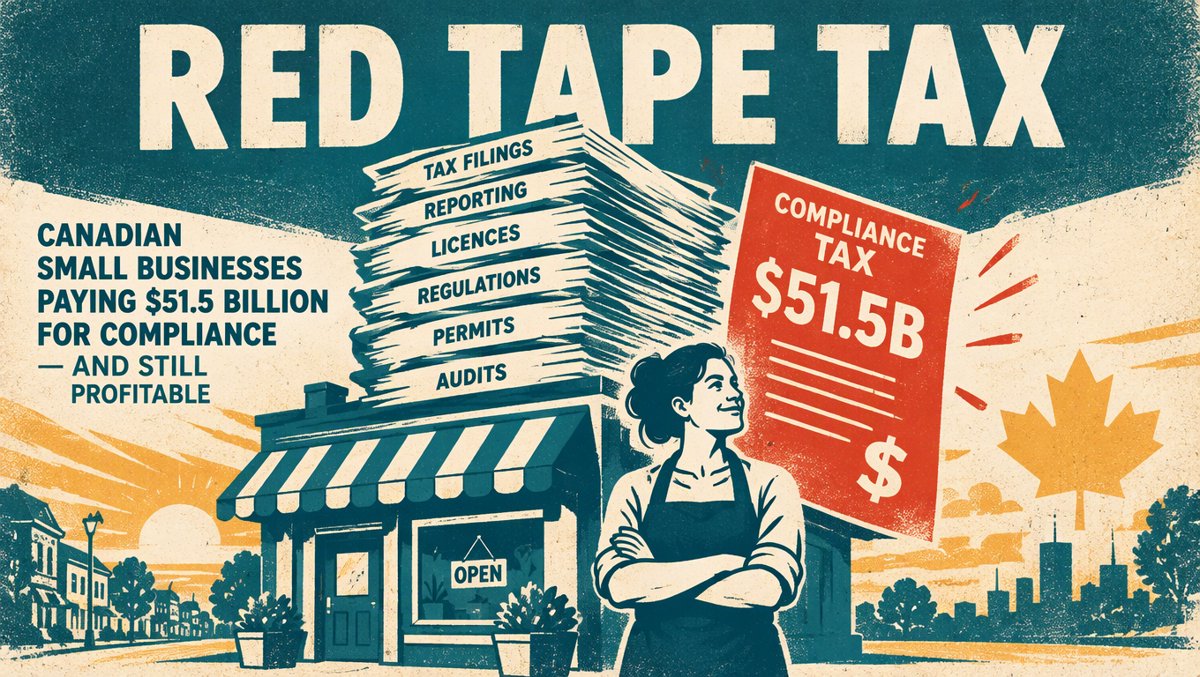
Let's start where it hurts. According to Innovation, Science and Economic Development Canada (2025), Canadian businesses spent an estimated $51.5 billion on regulatory compliance in 2024, with $17.9 billion of that attributed to red tape.² Read that again. That's not payroll. That's not rent. That's the cost of proving you're allowed to operate.
For small businesses, that burden is grotesquely regressive. According to Zenbooks (September 2026), businesses with fewer than five employees pay an estimated $10,208 per employee in compliance costs, versus $1,374 per employee at businesses with 100 or more employees.² That's a 7.4-to-1 disparity. The bigger you are, the thinner the per-head paperwork tax. The smaller you are, the more each hire carries an invisible surcharge.
And here's the part that should make every small business owner in Canada angry: this is largely a fixed cost. The form doesn't get shorter because your revenue did. The filing deadline doesn't care that you have four employees and one accountant who sees you once a year. The system was designed for scale, and small businesses pay the design flaw as a tax.
According to CanadianSME Magazine (October 2026), 74% of CFIB respondents identified the total tax burden as their primary worry, 70% cited tax and regulatory expenditures, and 69% cited insurance expenses.¹ The paperwork isn't an annoyance. By their own ranking, it's the main event — ahead of finding customers, ahead of hiring, ahead of everything that actually grows a business.
By the Numbers: The Canada Small Business Cost 2026 Scorecard
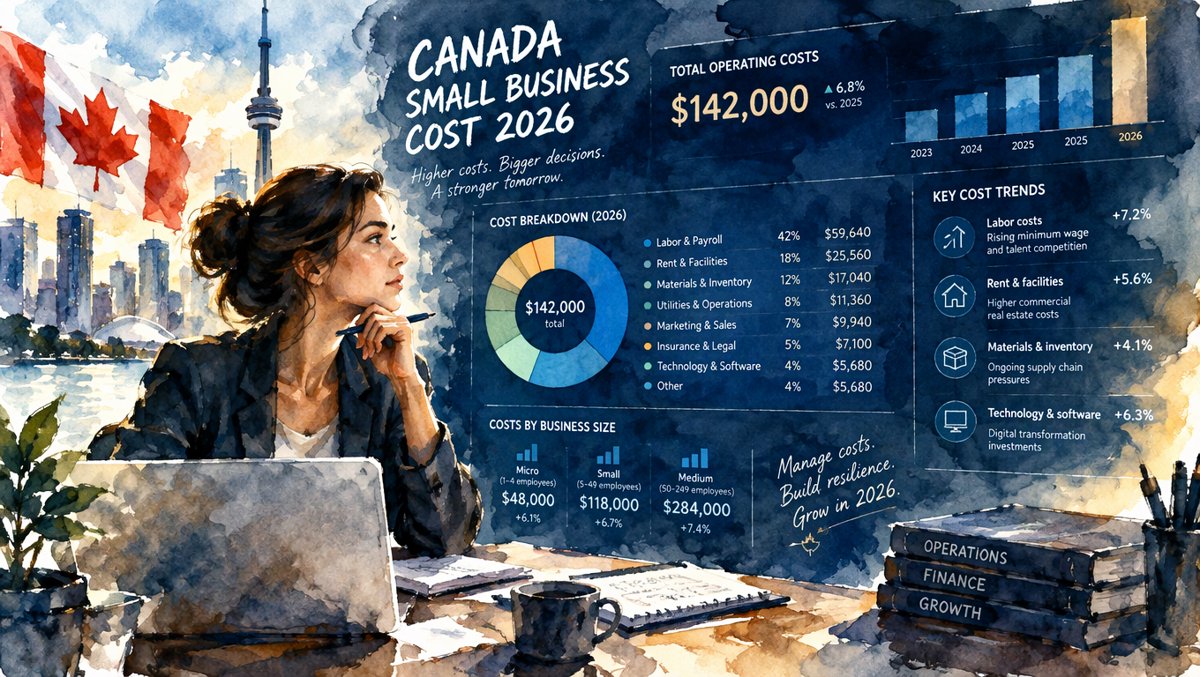
Let's stop talking in generalities and put the numbers in one place. Every figure below is a citable stat — entity, number, year, source — because vibes don't pay invoices.
According to Innovation, Science and Economic Development Canada (2025), Canada had 1,079,188 small businesses with 1 to 99 employees as of December 2024, representing 98.2% of all employer businesses, employing 5.8 million Canadians or 46.6% of the total private labour force.² According to Statistics Canada (October 2026), 64.3% of Canadian businesses predicted cost-related challenges in the second quarter of 2026, up from 58.9% in the first quarter.¹ According to Statistics Canada (October 2026), in Q3 2026, 27.8% of businesses with 1–4 employees expected US tariffs to negatively impact them in the next 12 months, rising to 38.7% among businesses with 20–99 employees.³
| Metric | 1–4 employees | 5–19 employees | 20–99 employees |
|---|---|---|---|
| Profitable past 3 years | 72.9% | 67.1% | 69.6% |
| US tariffs: negative impact expected | 27.8% | 36.9% | 38.7% |
| Canadian tariffs: major negative impact | 26.2% | 35.3% | 44.0% |
| Inflation = top obstacle | 14.6% | 10.3% | 8.2% |
| Recruiting skilled staff = top obstacle | 4.4% | 14.3% | 13.6% |
| Input costs = top obstacle | 6.1% | 7.6% | 10.9% |
Source: Statistics Canada, StatsCAN Plus, October 20, 2026 (CSBC Q3 2026, fielded July 2–August 6, 2026).³
Read the table like an operator, not an economist. The smallest businesses feel inflation first — 14.6% name it their top obstacle, more than three times the share that feels hiring pain. The mid-sized businesses feel trade exposure first — 44.0% of the 20-to-99 group fear major negative impact from Canadian tariffs. Different sizes, different cliff edges. Same country, same quarter, completely different risk profile.
And the survival numbers? According to ISED (2025), 68.0% of Canadian businesses with 1 to 99 employees survive five years and 48.2% survive ten years.² That's not a 90% success rate. That's a coin flip that gets harder every year costs climb. Optimism alone is not a strategy — 66.8% of firms were enthusiastic about the coming year in Q2 2026, but enthusiasm doesn't file your GST return.¹
Why "But We're Profitable" Is Half a Sentence
Here's the contrarian take the gurus won't give you: profitability is a lagging indicator dressed up as a leading one. The fact that 72.9% of micro-businesses were profitable over the past three years tells you about the past three years. It tells you almost nothing about whether the cost structure that produced those profits still exists.
According to Statistics Canada (October 2026), the Q3 2026 survey was conducted from July 2 to August 6, 2026 — prior to the latest US tariffs that took effect August 22, and Canada's countermeasures announced August 25 and effective September 8.³ In other words, the most optimistic profitability data we have was collected before the trade shock landed. The current numbers are pre-impact baseline. If you're anchoring your 2027 plan on them, you're steering by a map of where the ice used to be.
This is the classic small business trap: revenue is up, costs are up faster, margins feel fine because you're comparing to last year, and then a single tariff line or insurance renewal reprices your entire model overnight. According to CanadianSME (October 2026), wage costs posed a barrier for 62% of small businesses in January 2026, and 54% cited sluggish demand as their primary growth constraint.¹ Translation: costs are fixed upward, demand is softening, and owners are being told to "hustle harder" inside a math problem that hustle cannot solve.
The second-order effect nobody talks about? When compliance and input costs eat the margin, owners don't cut innovation first — they cut systems. They skip the bookkeeper, defer the software, do the books themselves at midnight. Which is exactly how you end up here.
According to Zenbooks (September 2026), the national Financial Clarity Index score was 56.7 out of 100 for all Canadian SMEs, and 56.5% scored below 60.² Only 29.1% track KPIs consistently. 27.6% of owners delayed paying themselves in the last 90 days — including 19.7% of businesses above $1 million in revenue.² Read that last number again: nearly one in five six-figure-plus-revenue businesses couldn't pay the owner on time. That's not a startup problem. That's a systems problem wearing a revenue costume.
And the kicker: 77.2% of owners rate their own financial management as good or excellent, but only 43.5% actually score in that range.² Owners overstate their financial management by an average of 13.4 points.² The businesses running the most manual processes are the least able to see their own gaps — calibration error of +21.3 points for mostly-manual businesses versus +5.0 for fully integrated ones.² You don't know what you don't know, and the spreadsheet you trust most is the one costing you the most.
What Does This Mean For You? How Do You Actually Open And Run One In 2026?
If you're asking how much does it cost to open a small business in Canada in 2026, the honest answer is: the government fee is the smallest line item on the invoice. Everything after that — insurance, leasing, payroll, compliance hours, tariff exposure — is where the real cost lives. Here's how to play it like an operator, not a tourist.
1. Price like the next cost increase already happened. According to Statistics Canada, 64.3% of businesses expect cost challenges — that's not a forecast, it's a consensus.¹ Build a 10% cost buffer into your pricing model before you open, not after your first supplier email. If your margin only works at today's prices, it doesn't work.
2. Never skip the 13-week cash flow plan. CanadianSME's operator advice is blunt and correct: forecast weekly inflows and outflows for 13 weeks — receivables, payroll, rent, taxes, loan payments, supplier bills.¹ Money in the bank decides whether you make payroll Friday. Profit on paper decides nothing. If cash looks tight in four weeks, you have four weeks to fix it. If you don't look, you have zero.
3. Hire against a bottleneck, not a vibe. Payroll is the cost you can't cut fast when sales dip. According to CanadianSME, CFIB data puts wage barriers at 62%.¹ Every new hire should map to a specific bottleneck — a coordinator so the founder can sell, a technician so the backlog clears — not to "we're growing." Growth without a bottleneck is just overhead with confidence.
4. Integrate your systems before you scale them. Fully integrated businesses score 71.9 on the Financial Clarity Index versus 44.1 for mostly manual ones — a 27.8-point gap, the widest of any practice measured.² Automation isn't a luxury upgrade. It's the difference between knowing your numbers and guessing them while paying $10,208 per employee for the privilege.
5. Read the tariff line before you sign the supplier. 44.0% of mid-sized businesses expect major negative impact from Canadian tariffs alone.³ If your supply chain crosses the border, model both tariff scenarios now — current rates and +10% — and only enter the deal if you survive the worse one.

Also worth reading: our breakdown of most profitable home service businesses in Canada, the cost to open a clothing store in Canada, and small business Canada 2026: profitable but squeezed — the three closest pieces of our own work on this exact battleground.
Frequently Asked Questions
How much does it cost to open a small business in Canada in 2026?
The government registration itself is the easy part — the real canada small business cost 2026 is the operating stack behind it. According to ISED (2025), Canadian businesses spent an estimated $51.5 billion on regulatory compliance in 2024, and businesses with fewer than five employees pay about $10,208 per employee in compliance costs.² Budget for insurance, leasing, payroll, and compliance hours — not just the incorporation fee — before you commit.
Is small business Canada profitable in 2026?
Mostly, yes — but profitably and safely are different words. According to Statistics Canada (October 2026), 72.9% of businesses with 1–4 employees, 67.1% with 5–19, and 69.6% with 20–99 employees reported being profitable in each of the past three years.³ However, that survey predates the August 2026 tariff measures, so the margin picture has already shifted since those numbers were collected.³
What is the biggest cost challenge for Canadian small businesses in 2026?
Cost pressure, full stop. According to Statistics Canada, 64.3% of Canadian businesses expected cost-related challenges in Q2 2026, up from 58.9% in Q1 2026.¹ According to CFIB data cited by CanadianSME (October 2026), 74% of respondents name the total tax burden as their primary worry, ahead of wages at 62% and insurance at 69%.¹
Do Canadian small businesses survive long term?
About half do. According to ISED (2025), 68.0% of businesses with 1 to 99 employees survive five years and 48.2% survive ten years — with micro-enterprises (1–4 employees) at 63.0% and 44.7% respectively.² The gap between year five and year ten is where cost discipline decides who stays.
Why are small businesses struggling with cash flow despite being profitable?
Because profit and cash are different animals. According to Zenbooks (September 2026), 27.6% of Canadian small business owners delayed paying themselves in the last 90 days, including 19.7% of businesses above $1 million in revenue.² A business can be profitable on paper and still miss payroll if receivables are late, bills are early, and there's no 13-week cash flow plan watching the gap.¹
⚠️ The Risks Nobody's Talking About
1. The tariff shock is not yet in the data. The Q3 2026 CSBC was fielded July 2–August 6 — before the August 22 US tariffs and Canada's September 8 countermeasures.³ Every profitability figure in this article is pre-shock. If tariff pass-through lands in Q4, the headline "72.9% profitable" becomes actively misleading for forward planning.
2. The compliance tax is structurally regressive. $10,208 per employee for firms under five staff versus $1,374 at 100+ staff.² Every new hire you add to a micro-business carries roughly 7x the per-head paperwork burden of a corporate hire. Growth, which you're told saves you, barely dents the smallest firms' cost per head — it just adds more heads to the same fixed system.
3. Self-assessment is wildly miscalibrated. 77.2% of owners rate their financial management good or excellent; only 43.5% score that way; average overstatement is 13.4 points.² Businesses with the most manual systems overestimate the most (+21.3 calibration error).² The owners most at risk are the ones most convinced they're fine.
4. Demand is the silent killer. 54% of small businesses cite sluggish demand as their primary growth constraint.¹ Cost control without customer protection is half a strategy — you can cut yourself efficient and still starve. Blanket discounting is not the fix; repeat customers, bundling, and higher-value segments are.¹
🎯 The Bottom Line
Canada small business cost 2026 is not one number — it's a stack: a $51.5 billion compliance bill, 64.3% of businesses expecting cost challenges, and a profitability headline that predates the tariff shock. The businesses that survive this aren't the ones with the biggest passion. They're the ones with integrated systems, 13-week cash visibility, and pricing built for the next cost increase — not the last one.
Be profitable and legible to yourself. One without the other is just a faster way to find out.
📚 Verified Sources
- CanadianSME Magazine — Costs, Cash Flow and the Road Ahead for Canadian SMEs (October 9, 2026). https://canadiansme.ca/costs-cash-flow-and-the-road-ahead-for-canadian-smes/
- Zenbooks — 98 Small Business Finance Statistics (2026 Edition), citing ISED Key Small Business Statistics 2025 and Zenbooks Financial Clarity Index 2026 (n=565) (September 1, 2026). https://zenbooks.ca/blog/small-business-finance-statistics/
- Statistics Canada — How are small businesses doing? StatsCAN Plus, CSBC Q3 2026 (October 20, 2026). https://www.statcan.gc.ca/o1/en/plus/9358-how-are-small-businesses-doing
All claims verified against Gold-tier (Statistics Canada, ISED) and Silver-tier (CanadianSME, Zenbooks) sources. Each source URL was scraped and confirmed accessible. Last verified: 2026-11-24.
Profitable is a mood. Cash flow is a fact. Build for the fact. 🎯