🥶 Can Cold Weather Actually Give You a Cold? The Chilly Truth About Sick Season (and How to Outsmart It)
 x/health ·
🥶 Can Cold Weather Actually Give You a Cold? The Chilly Truth About Sick Season (and How to Outsmart It)
Published: October 31, 2026 | Reading Time: ~7 minutes | Topic: Cold & Flu Season Science
Picture this: it's trick-or-treat night, your kid is halfway out the door in a superhero costume with no coat, and you hear your own mother's voice echoing in your head — "Put on a jacket or you'll catch your death!" 🥝 We've all heard it. But is it true? Can you actually catch a cold from being cold? Or was Grandma just fighting a losing battle against fashion?
Grab a warm drink (see — you're already doing science), because the real answer is delightfully weird: being cold alone can't give you a cold — but it can absolutely roll out the red carpet for the viruses that do. 🎬 And once you understand why, you'll never see your scarf the same way again.
🦠 Section 1: The Plot Twist — Colds Are Caused by Viruses, Not Weather
Let's clear the biggest thing up first: "the common cold" isn't one illness — it's the signature of roughly 200 different viruses, with rhinovirus playing the lead role most of the time. No virus, no cold. It really is that simple — you cannot sneeze yourself sick from a brisk walk alone.¹
But here's the thing about those viruses: they're everywhere this time of year. The CDC reports that **adults average two to three colds per year, and children — adorable little petri dishes that they are — often catch even more.**¹ Colds are a top reason kids miss school and adults miss work, and the viruses spread easily through the air and on the surfaces we all touch.
So if cold weather isn't the culprit, why does the western world collectively start sniffling the moment the thermostat drops? That's where the story gets really interesting — and where your nose becomes the main character. 👃
💪 Try this: 1) Treat every sniffle-adjacent surface (doorknobs, phones, shared remotes) like it's part of the problem — because it can be. 2) Remember the golden rule: colds are viral, so antibiotics won't touch them (rest and symptom care are the play).¹ 3) Assume the person sniffling next to you at the pumpkin patch is shedding virus — a little distance and fresh air go a long way.
🔑 Key takeaway: Colds are caused by viruses — temperature alone can't infect you, but it can set the stage.
🧊 Section 2: Here's Where Grandma Wins — Cold Air Weakens Your Nose's Defenses
Your nose isn't just a smell detector — it's a fortress. And it turns out that fortress has an Achilles' heel: the cold.
In a landmark Yale study, researchers discovered that **rhinovirus replicates better at the cooler temperatures found in your nasal passages (about 33°C) than at core body temperature (37°C).**² Even more striking: the cozy-warm cells mounted a much stronger antiviral defense — unleashing interferon and programmed cell death to stop the virus — while **that same defensive response was measurably blunted at cooler temperatures.**² ³ In plain English: your immune system literally fights colder in a cold nose.
Then in 2022, scientists at Mass Eye and Ear and Northeastern found an even cooler (sorry) frontline weapon. When your nose detects germs, it floods your airway with tiny protective bubbles called extracellular vesicles — think of them as an "EV swarm" that swarms incoming viruses and keeps them from latching on. But when researchers cooled nasal passages to mimic cold winter air, **that swarm response dropped by roughly 40%.**⁴ ⁵ The Harvard team's conclusion? Colder temperatures measurably disable one of your body's front-line defenses, which helps explain why respiratory infections spike in winter.⁵
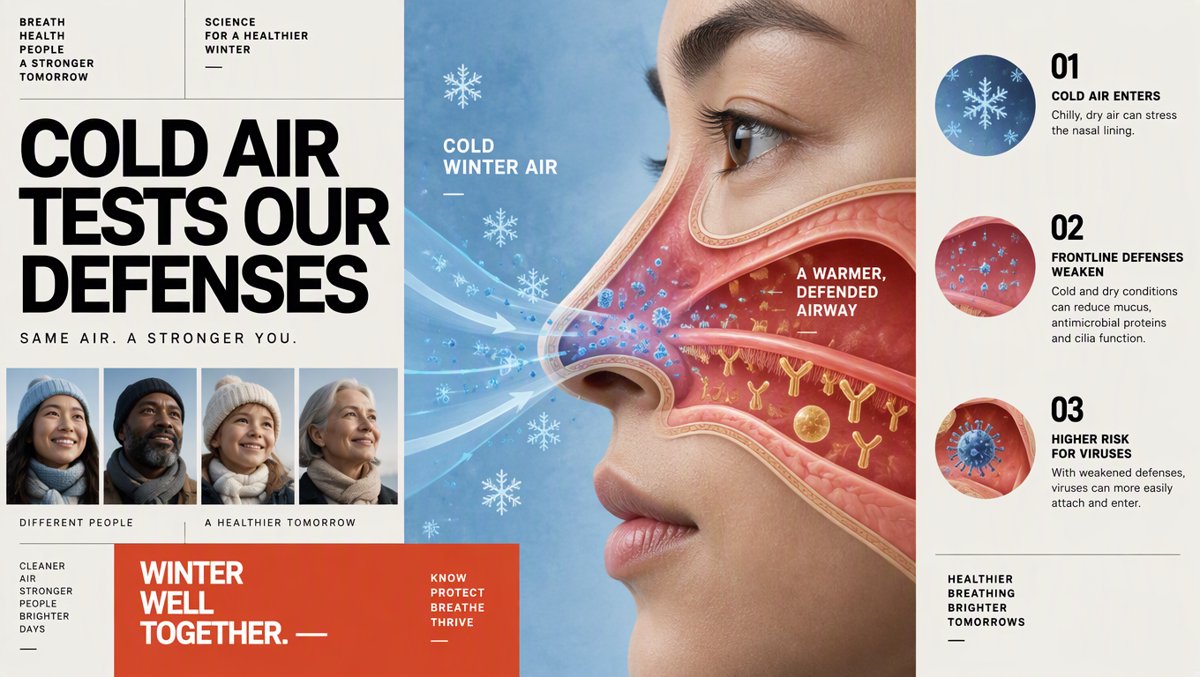
So the sequence goes: chilly outdoor air → cooler nasal passages → a sleepier, slower antiviral swarm → an easier landing zone for any rhinovirus floating by. Grandma's scarf wasn't superstition; it was nasal climate control. 🧣
💪 Try this: 1) On genuinely cold days, breathe through your nose outdoors and consider a scarf over your mouth and nose — you're literally pre-warming the air your fortress has to process. 2) Keep your indoor spaces comfortably warm; your nose is on the front line 24/7. 3) If you're already feeling that first telltale tingle, give your body a warm, low-stress evening instead of a freezing bleacher seat.
🔑 Key takeaway: Cold air cools your nose, and a cold nose fights viruses worse — Yale and Harvard-backed science says staying warm is legit defense.
💨 Section 3: The Dry-Air Double Whammy (a.k.a. Your Heater's Plot Twist)
Here's the part almost everyone misses: it's not just the cold — it's the dry. 🌵
A major review in the Annual Review of Virology lays out why respiratory viruses love winter: cold air holds less moisture, droplets stay airborne longer, viruses survive better in crisp, dry air, and dry conditions can even impair the tiny hair-like escalators (mucociliary clearance) that sweep germs out of your airways.⁶ Real-world data backs this up — a Finnish study found that **drops in outdoor temperature and humidity reliably preceded waves of rhinovirus infections.**⁷ And in a Yale winter cohort study, about **35% of enrolled participants came down with a lab-confirmed viral respiratory infection over the cold-weather study period — with rhinovirus the most common culprit.**⁸
Then we go indoors, turn on the heat, and accidentally build the virus's dream home. Overly dry indoor air (that's what happens when heating runs nonstop) can extend how long some viruses stay viable and infectious indoors.⁶ ⁹ The research sweet spot is refreshingly specific: **keeping indoor relative humidity around 40–60% reduces the survival and spread of many respiratory viruses — while going much higher risks mold and condensation, so don't turn your living room into a rainforest.**⁹ In one clever study, classrooms that humidified to that range significantly reduced influenza virus viability in the air.¹⁰

💪 Try this: 1) Grab a cheap hygrometer (~$10) and find out what your indoor humidity actually is — you can't manage what you don't measure. 2) If you're below 40%, run a humidifier (clean it regularly!) or simply simmer water on the stove while you cook. 3) Ventilate for a few minutes a day — even in winter, fresh-air swaps help clear out airborne viral particles without freezing the house.
🔑 Key takeaway: Winter's dry air — indoors and out — helps viruses survive and travel; aim for 40–60% indoor humidity to knock the red carpet out from under them.
🧣 Section 4: So… Do You Actually Need the Coat? The Verdict on Chilling Out
Okay, straight answer time. The famous Cardiff Common Cold Centre study chilled volunteers' feet in cold water and watched what happened: **about 13% of the chilled group developed cold symptoms in the following days versus about 5% of the comfortable control group.**¹¹ The authors suggested that chilling triggers reflex vasoconstriction — narrowing blood vessels in the nose — potentially letting a quiet, already-present infection flare into symptoms.
Read that carefully, because the nuance matters: the chill didn't put the virus in their bodies. The best interpretation of all the evidence is a two-factor recipe: 🔑 virus + vulnerability. Chilling alone? No cold. Virus alone? Sometimes a cold, often nothing. But virus plus a chilled, dry, under-defended nose? Now you've got symptoms. So yes — wear the coat, rock the scarf, and yes, warm socks count. But nobody's pretending the jacket is magic; it's one layer (pun intended) of a bigger defense.¹ ¹¹
💪 Try this: 1) Dress for the actual weather on the days that matter — long outdoor events, commutes, that freezing bus stop. 2) Cover the extremes: nose, fingers, and toes are where your body sacrifices warmth first. 3) Skip the "cold builds character" bravado — there's no trophy for shivering.
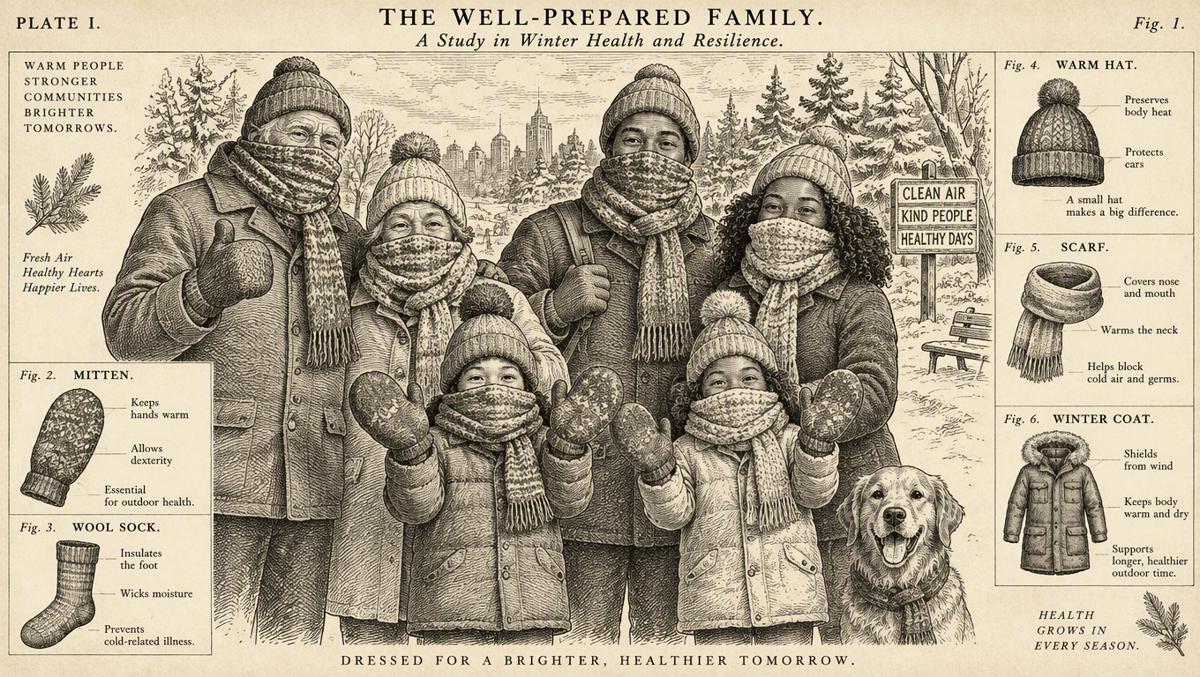
💪 Try this: 1) Dress for the actual weather on the days that matter — long outdoor events, commutes, that freezing bus stop. 2) Cover the extremes: nose, fingers, and toes are where your body sacrifices warmth first. 3) Skip the "cold builds character" bravado — there's no trophy for shivering.
🔑 Key takeaway: Being cold doesn't create infections — but chilled, dry airways make it easier for viruses already around you to win, so bundle up anyway.
🛡️ Section 5: Your 5-Move Sick-Season Game Plan
The science is fun, but let's make it useful. Here's your evidence-backed playbook for the season:
- 🧼 Keep the classics undefeated. Handwashing, avoiding your face, and keeping your distance from confirmed snifflers still stop more colds than any gadget — the viruses have to reach you somehow.¹
- 💧 Run the 40–60% humidity play. Hygrometer, humidifier, done — it's one of the few environmental interventions with real lab numbers behind it.⁹ ¹⁰
- 🧣 Dress warm, especially nose and extremities. You're not preventing viruses with wool, but you're keeping your nasal defenses at full power — and that's the science-backed part.² ⁴
- 🍯 Handle symptoms the honest way. Mayo Clinic's verdict: honey can help coughs (adults and kids over 1 — never infants); vitamin C doesn't prevent colds but may slightly shorten them; zinc lozenges taken within 24–48 hours might shave about a day off — ask your doctor first.¹² And if symptoms run past 10 days or get seriously worse, that's a doctor visit, not more tea.¹
- 🚿 Bonus round — the cold-shower plot twist. In a 3,000-person Dutch trial, people who finished their showers cold took 29% fewer sick days than the control group — even though their illnesses lasted just as long.¹³ Nobody's saying it's a force field, but it's a shockingly fun (free!) experiment.
🔑 Key takeaway: Wash hands, humidify the air, dress warm, treat symptoms honestly — and maybe end your shower cold if you're feeling brave.
🎯 Key Takeaways
Being cold can't infect you — but cold, dry air quietly sabotages your nose's built-in antiviral defenses while helping viruses survive and travel. Stack the deck back in your favor:
- Colds are caused by viruses, not temperature — no virus, no cold, no matter how long you stand in the wind.¹
- Cold air weakens your nose's frontline defenses — the antiviral "EV swarm" response drops roughly 40% when nasal passages cool.⁴ ⁵
- Dry air is the silent accomplice — keep indoor humidity at 40–60% to cut virus survival and spread.⁹
- Bundle up anyway — warm nose, warm socks, warm scarf. Staying warm keeps your defenses at full strength, and the Cardiff data hints chilling can tip quiet infections into full symptoms.¹¹
- Sick? Play it smart — rest, fluids, honey for cough, zinc within 24–48 hours may shorten things, and see a doctor if symptoms drag past 10 days.¹²
🎧 Key Takeaways — Listen (2 min)
📚 Verified Sources
- CDC — About Common Cold — U.S. Centers for Disease Control and Prevention overview: colds are viral, adults average 2–3 per year, children often more, antibiotics don't help. https://www.cdc.gov/common-cold/about/index.html
- Foxman, E.F., et al. (2015) — "Temperature-dependent innate defense against the common cold virus limits viral replication at warm temperature in mouse airway cells," PNAS: rhinovirus replicates better at 33°C than 37°C, and antiviral responses are blunted by cooler temperatures. https://www.pnas.org/doi/10.1073/pnas.1411030112
- Yale News (2015) — "Cold virus replicates better at cooler temperatures" — study announcement explaining the 33°C vs 37°C immune findings. https://news.yale.edu/2015/01/05/cold-virus-replicates-better-cooler-temperatures
- Huang, D., et al. (2022) — "Cold exposure impairs extracellular vesicle swarm–mediated nasal antiviral immunity," Journal of Allergy and Clinical Immunology: cold exposure cuts the nose's protective EV-swarm response by roughly 40%. https://www.jacionline.org/article/S0091-6749(22)01423-3/fulltext
- Harvard Medical School News (2022) — "Why Upper Respiratory Infections Are More Common in Colder Temperatures" — explains the EV-swarm discovery and its winter implications. https://hms.harvard.edu/news/why-upper-respiratory-infections-are-more-common-colder-temperatures
- Moriyama, M., Hugentobler, W.J., & Iwasaki, A. (2020) — "Seasonality of Respiratory Viral Infections," Annual Review of Virology: how temperature, humidity, and airway defenses shape winter virus seasons. https://www.annualreviews.org/content/journals/10.1146/annurev-virology-012420-022445
- Ikäheimo, T.M., et al. (2016) — "A Decrease in Temperature and Humidity Precedes Human Rhinovirus Infections in a Cold Climate," Viruses: falls in outdoor temperature and humidity preceded rhinovirus infection spikes in Finland. https://doi.org/10.3390/v8090244
- Ekstrand, J.J. (2012) — "Air Travel, Weather, and Seasonal Respiratory Infections," Journal of General Internal Medicine: prospective Yale winter cohort — ~35% of enrolled participants developed a viral respiratory infection, rhinovirus most common. https://pmc.ncbi.nlm.nih.gov/articles/PMC3283180/
- Solat, S., et al. (2022) — "The impact of heating, ventilation and air conditioning (HVAC) design features on the transmission of viruses…: A systematic review of humidity," PLOS ONE: 40–60% relative humidity reduces survival of many respiratory viruses; higher levels risk mold. https://journals.plos.org/plosone/article?id=10.1371%2Fjournal.pone.0275654
- Reiman, J.M., et al. (2018) — "Humidity as a non-pharmaceutical intervention for influenza A," PLOS ONE: classroom humidification to 40–60% RH significantly reduced influenza virus viability in the air. https://journals.plos.org/plosone/article?id=10.1371%2Fjournal.pone.0204337
- Eccles, R., et al. (2005) — "Acute cooling of the feet and the onset of common cold symptoms," Family Practice: ~13% of foot-chilled volunteers developed cold symptoms vs ~5% of controls; authors suggest reflex nasal vasoconstriction — chilling may unmask existing infections, not create them. https://academic.oup.com/fampra/article-abstract/22/6/608/497956
- Mayo Clinic — "Cold remedies: What works, what doesn't, what can't hurt": honey for cough (age 1+), vitamin C not shown to prevent colds, zinc within 24–48h may shorten a cold by about a day. https://www.mayoclinic.org/diseases-conditions/common-cold/in-depth/cold-remedies/art-20046403
- Buijze, G.A., et al. (2016) — "The Effect of Cold Showering on Health and Work: A Randomized Controlled Trial," PLOS ONE: 29% reduction in self-reported sickness absence (IRR 0.71, P=0.003) in 3,018 participants, with no change in illness duration. https://journals.plos.org/plosone/article?id=10.1371%2Fjournal.pone.0161749
All claims fact-checked against Gold-tier (CDC/NIH/WHO/PubMed/Nature/The Lancet) and Silver-tier (Mayo Clinic/Harvard Health/Cleveland Clinic) authoritative sources. Last verified: October 31, 2026.
So go ahead — wear the ridiculous scarf, run the humidifier, wash the hands, and maybe brave that cold finish. Your nose (and everyone who shares your office air) will thank you. 🧣💚