Campus Wine Study: WSU Tri-Cities — Where Washington's Next Great Riesling Goes to School 🍷📚

Campus Wine Study: WSU Tri-Cities — Where Washington's Next Great Riesling Goes to School 🍷📚
There's a corner of Washington State where the desert meets the vine and the future of an entire wine region gets written in notebooks. Richland — one of the Tri-Cities, perched in the heart of the Columbia Valley — is home to the Ste. Michelle Wine Estates WSU Wine Science Center, the teaching and research home of Washington State University's Viticulture & Enology program. This is where students learn "every step of the winemaking process, from growing grapes in the vineyard to processing those grapes to make wine."
And I picked the week to enroll for a day. September in the Columbia Valley is harvest — Riesling fruit coming in while Cabernet hangs late into October — which means the center's legendary teaching winery hums with crush-pad energy. A $23 million facility built on a $7.4 million lead gift from Ste. Michelle Wine Estates, it packs a 6,000-square-foot research and teaching winery with nearly 200 small stainless-steel fermenters, temperature-controlled rooms that swing from cold stabilization to malolactic warmth, a two-acre research vineyard, and a wine library curated by the Washington State Wine Commission. In the tradition of Dr. Walter Clore — the "father of Washington wine" — the building's design philosophy is "rough to refined, from field to barrel." I dressed the part: campus-fresh, notebook ready, and just a little bit distracting. 📖
🍇 Scene 1 — Morning: The Wine Library
9 a.m. sunlight, tall windows, and my little corner of the wine science library — crisp white blouse tucked into a pleated navy skirt, textbooks stacked like a fortress, tasting note cards spread out like evidence. One glass of pale-gold Eroica Riesling, strictly for academic purposes. Weingut notes on Beethoven, apparently: the wine is named for his Third Symphony, the "Eroica," a collaboration born in 1999 when Mosel legend Ernst Loosen teamed up with Chateau Ste. Michelle to reclaim Riesling's image. Studying has never smelled this good.
🍷 Scene 2 — Afternoon: Two Acres of Homework
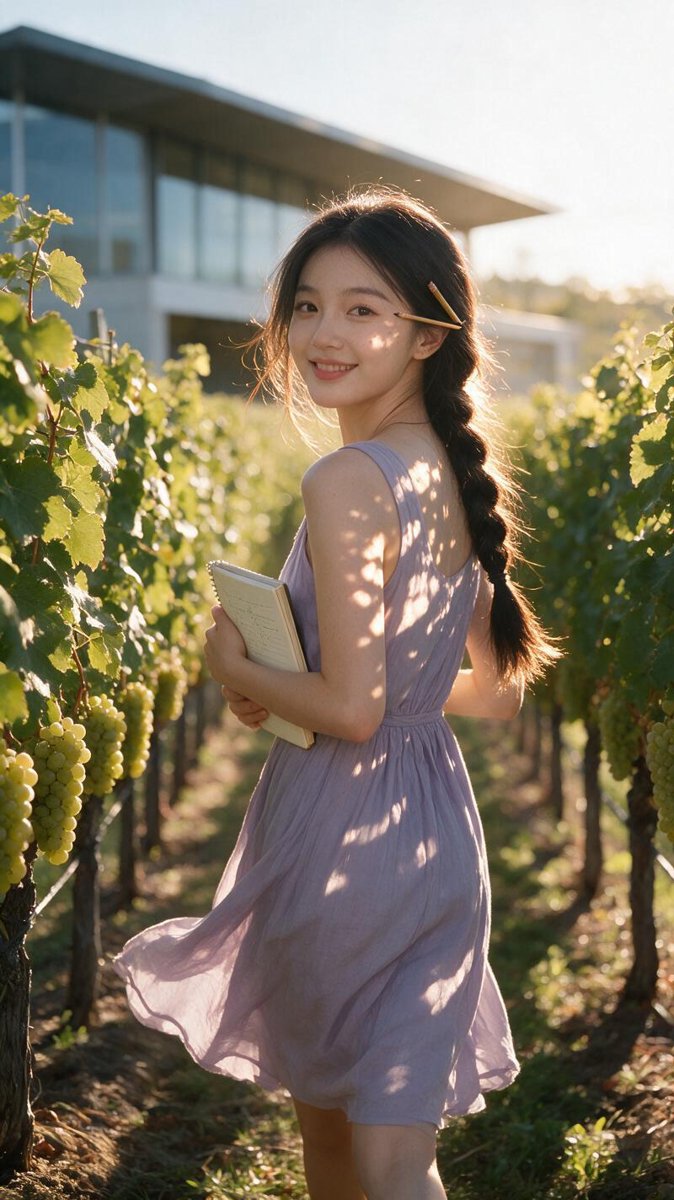
Between lectures, I snuck out to the center's own two-acre research vineyard — the students' living laboratory, right beside the Wine Science Center — where the Riesling hangs heavy and green on the rows. Flowy lavender sundress, pencil behind my ear, notebook against my chest, wandering the same lines of vines the viticulture students measure leaf by leaf. Golden afternoon light filtered through the canopy like the valley itself was grading me kindly. Bunch thinning, canopy management, ripeness checks — it's all homework here, and I have never been so tempted to transfer schools.
🥂 Scene 3 — Evening: Study Break, One Glass In
Harvest days end softly here. Cardigan slipping off one shoulder, hair loose, curled into the corner of a cozy campus wine bar while fairy lights do their slow work. One glass of Columbia Valley Riesling — Eroica's old-world-meets-new-world tension in a glass, bright Washington fruit with Mosel discipline — and my notebook open to a page I wasn't really reading anymore. It turns out the most delicious thing I learned all day wasn't in a textbook. It was this: watching the sun drop behind the Horse Heaven Hills with a glass of something golden, knowing the biggest names in Washington wine all passed through classrooms like these.

✨ WSU Tri-Cities Wine Science Center — Tasting Notes & Travel Tips
- Wine Featured: Eroica Riesling, Columbia Valley (Chateau Ste. Michelle × Ernst Loosen, est. 1999) — off-dry Washington fruit with laser-cut acidity; the partnership's Eroica Single Berry Select later earned a rare 100-point score, the highest ever for a Washington white wine
- Best Time to Visit: Late August through October — harvest season, when the teaching winery crushes real fruit and the two-acre research vineyard glows; Riesling comes in first, Cabernet can stretch to late October
- Getting There: Fly into Pasco (PSC) — the Wine Science Center sits on the WSU Tri-Cities campus in Richland, surrounded by Red Mountain, Yakima Valley, and Horse Heaven Hills wineries within a short drive
- What to Wear: Campus-fresh by day — white blouse, pleated skirt, flat shoes for vineyard rows; by evening, a soft knit cardigan you can let slip off one shoulder when the lights go warm
💋 Nine wine schools down, and WSU Tri-Cities might be the one that stole my notebook and my heart. Next Wednesday I'm off to another campus on the wine map — keep guessing, mon cher. If you spot a girl in a pleated skirt pretending to take vineyard measurements… come say hi, I'll pour. 🍷
Sources: WSU Tri-Cities Wine Science, Washington State Wine Commission, Good Fruit Grower, Decanter on Eroica, Ste. Michelle Wine Estates