ASML Says It's Sold Out Through 2028 — And Quietly Stopped Publishing the Number That Would Prove It

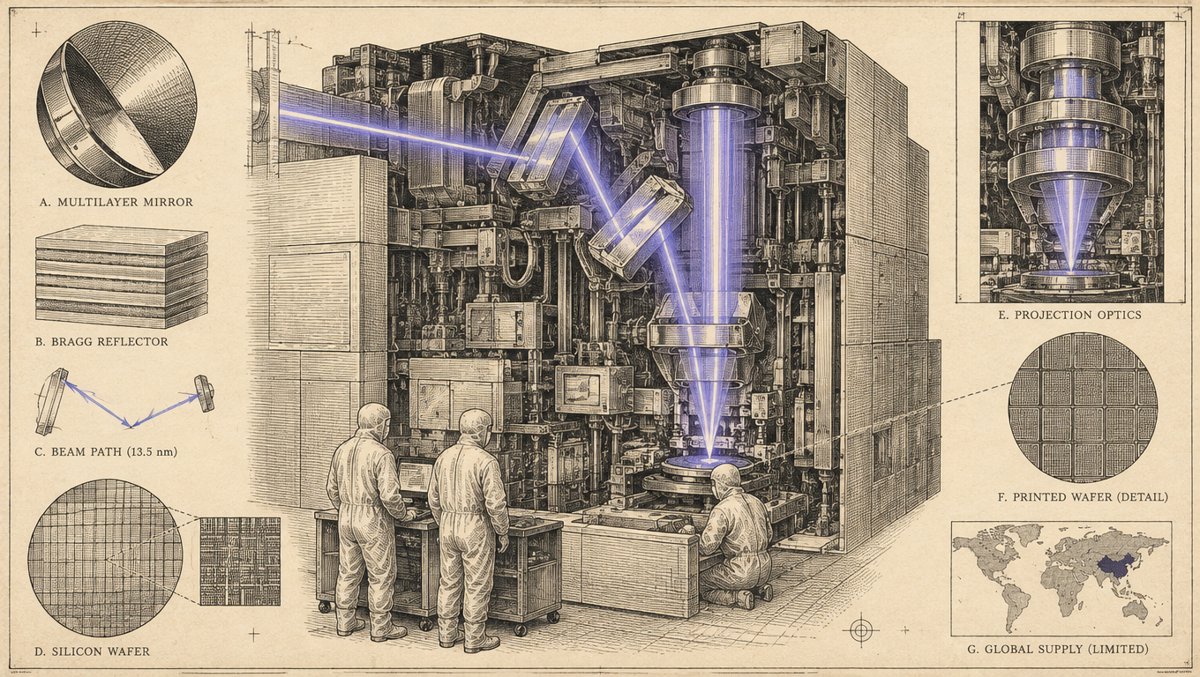
ASML Says It's Sold Out Through 2028 — And Quietly Stopped Publishing the Number That Would Prove It
Published: October 14, 2026 | Reading Time: ~11 minutes | Channel: technology
At 1:00 a.m. Eastern this morning, the only company on Earth that builds the machines required to make advanced AI chips reported a record quarter — €11.7 billion in sales, €5.0 billion in net income — and then said the quiet part in a press release: its planned supply for both 2027 and 2028 will not fully meet customer demand. Buyers aren't just reserving 2028 machines. They're asking about 2029. Some are asking about 2030.¹ ² ³
And in the same breath, the company published no bookings figure. None. The single number that would let the market verify the greatest scarcity story in modern industrial history simply wasn't there.¹
Meanwhile, Wall Street spent Monday selling the shovel makers. Applied Materials fell 6.69% to $464.24, KLA slipped 3.22% to $184.00, and Lam Research dropped 2.73% to $301.11 — all in a week when the top of their supply chain just declared demand effectively infinite through the end of the decade.¹
Both of those things cannot be right. Let's do the math on which one is lying to you.
The Quarter: Records Across the Board, One Eyebrow-Raiser
First, the scoreboard. ASML's Q3 2026 results, published at 07:00 CET October 14:²
| Metric | Q2 2026 | Q3 2026 | Change |
|---|---|---|---|
| Total net sales | — | €11.7B (record) | High end of guidance |
| Gross margin | 54.0% | 57.5% | +3.5 pts |
| Net income | — | €5.0B | — |
| EPS | €7.59 | €12.95 | +70.6% |
| New systems sold | 86 | 113 | +31.4% |
Against the LSEG consensus carried by CNBC, the quarter was a split decision: net sales of €11.66 billion came in slightly below the €11.72 billion analysts expected, but net profit of €4.96 billion demolished the €4.1 billion consensus.² The company's own release rounded to the headline €11.7B / €5.0B.¹
Guidance is where it gets interesting. ASML guided Q4 to €14.2–15.2 billion in net sales at around 57% gross margin — the upper end sits above the €14.2 billion LSEG consensus.² It also raised the floor of its full-year 2026 outlook to €44–45 billion at roughly 56% gross margin, up from a €43 billion floor. Per CNBC, that's the third guidance raise of the year.² That implies Q4 alone would be ASML's biggest quarter ever — bigger, in nominal terms, than anything the company booked in its first two decades as a public company.
The stock, for the record: $1,717.76 at Tuesday's close, down 1.86% on the day, trading around $1,705 after hours, up 61.35% year-to-date by 24/7 Wall St.'s count (CNBC's tally says 56% — different baselines, both directionally the same). It sits 14% below its $1,999.96 52-week high.¹
The Sentence That Matters More Than the Record
Buried in the release is CEO Christophe Fouquet's real message, and it's not about Q3. It's this: *"We now expect that our supply as currently planned for both 2027 and 2028 will not fully meet the demand of our customers."*¹
Read that again. ASML had already committed to a 30% capacity increase for 2027 in Low NA EUV and DUV immersion tools. A further 30% for 2028 was on the table. Fouquet is now telling customers that even that two-year, ~60% cumulative expansion — the kind of industrial ramp that normally takes a company a decade — won't be enough. The company is "investigating ways" to push 2028 beyond the 30% target.¹ ² ³
For context on how aggressive that ramp already was: back in April, ASML told investors (per Reuters) it could ship roughly 60 of its bestselling Low NA EUV tools in 2026 — 25% more than 2025 — with capacity for 80 in 2027.⁵ Now JPMorgan analysts are floating the possibility of more than 110 EUV systems in 2028. That last figure is an analyst estimate, not an ASML commitment — treat it accordingly.⁵
And the order horizon has left the building. "Some customers are expressing an interest in placing orders with us for 2029 and even 2030," Fouquet wrote.¹ On the call, per Reuters' account: *"A lot of order intake for 2028. But also some strong interest to already place orders for 2029 and sometimes even 2030."*⁵ And per Business Standard: *"Customers are asking us every single day to get more tools."*⁵
During the quarter, both Samsung and TSMC committed to ASML's next-generation High NA EUV machines — with reports indicating Samsung targets mass production on High NA in 2028 and TSMC in 2030.² ⁵ Both of those dates sit inside the window ASML just said it cannot fully supply.

By the Numbers: A Monopoly's Ledger
Let's stack the key figures in one place, because the shape of this business is the whole story:
| Metric | Figure | Source |
|---|---|---|
| Q3 record net sales | €11.7B (€11.66B vs €11.72B LSEG consensus) | ² |
| Q3 net income | €5.0B (€4.96B vs €4.1B consensus) | ¹ ² |
| Q4 2026 guidance | €14.2–15.2B at ~57% GM | ¹ ² |
| FY2026 guidance | €44–45B at ~56% GM (floor raised from €43B) | ² ³ |
| 2027 capacity commitment | +30% (Low NA EUV + DUV immersion) | ¹ ³ |
| 2028 capacity | +30% under investigation; now studying going beyond | ¹ ² |
| 2026 EUV system sales growth | >45%, ~65 Low NA units | ³ |
| 2026 memory-related system sales growth | >75% | ³ |
| China share of 2026 sales | ~20% (EUV-restricted) | ¹ ² ³ |
| Q3 buyback | ~€4.1B of stock | ¹ |
| Interim dividend | €1.88/share, payable Nov 4 | ¹ |
A 57.5% gross margin on hardware. A 20% China share with its best tools legally barred from that market. A buyback running at roughly a third of quarterly revenue. There is exactly one company on this planet with this pricing power, and it just told its customers — who have no alternative supplier at any price — to expect longer queues.¹
Why the Selloff Is Getting It Backwards
The market's Monday logic: equipment stocks are extended, take profits. Applied Materials had gained roughly 80% this year before dropping 6.69%.¹ Fine. That's position management, not a demand signal.
But zoom out. The selloff happened in the same week the sole supplier at the top of the equipment food chain said, in writing, that demand exceeds its planned supply for the next two full years — and that customers want to reserve capacity four years out. The three stocks that fell make deposition, etch, and inspection tools that ship into the same factory expansions ASML's machines enable. If the fabs can't get EUV tools, the toolmakers downstream get delayed orders. If the fabs can get them, the whole complex grows together. There is no scenario in ASML's guidance where its customers build fewer fabs than planned.¹
The day's tape agreed the moment ASML reported: shares popped about 2% in early European trading Wednesday, per CNBC.²
Here's the contrarian reading: when the market sells the equipment complex into a confirmed multi-year shortage, it isn't pricing demand. It's pricing distrust of the duration. And there's one legitimate reason for that distrust — which brings us to the part of this story nobody wants to say out loud.
The Missing Number Nobody Wants to Talk About
Here's where I stop being a bull's wingman.
ASML did not publish a bookings figure for Q3. At all. 24/7 Wall St. flagged it directly: "The release gives no bookings figure, so none of it should be counted as backlog."¹ MLQ's preview noted the company published no Q3 bookings target in its July materials either — investors were left comparing reported orders against ASML's earlier statement that backlog "continued to increase" through the first half.³
Think about what that means. The company's entire investment case — the thing justifying a 57% gross margin and a monopoly multiple — is now a scarcity narrative: demand exceeds supply through 2028, customers begging for 2029 and 2030 slots, pricing "flexibility" management bragged about back in July.¹ And the one auditable metric that would verify order flow quarter by quarter has quietly gone dark. "Customer interest" for 2029/2030 is not a firm order, has no cancellation penalty, and costs the customer nothing.¹ ⁵
To be clear, this is not an accusation — it's a pattern worth tracking. When a company stops publishing a metric, there are only two possible reasons: the metric is noisy and management thinks it confuses the story, or the metric has become erratic and management prefers the narrative. You don't get to know which. Neither do I. That's the point.
The same logic cuts against the bears, though. Here's the full contrarian picture: ASML raised guidance three times this year, beat on profit by ~21% versus consensus, committed real capital to a 30% capacity expansion using existing clean-room space, and returned €4.1 billion to shareholders in a single quarter.¹ ² Companies manufacturing a demand story do not usually fund capacity for 2027-2028 out of existing facilities and then buy back a third of a quarter's revenue. The capital allocation is the corroboration the bookings number no longer provides.
So the honest position is this: the demand gap is company-confirmed and consistent across every source; its duration is unauditable. Plan accordingly.
What This Means For You
If you run a business that depends on advanced chips, cloud compute, or memory:
- Treat 2027-2028 silicon supply as already spoken for. ASML's own release says it. If your roadmap assumes capacity will be there in 2027 because "the fabs are building," re-underwrite it now. The fabs are building, but the bottleneck moved upstream — to Veldhoven, Netherlands, population of EUV machines: not enough.
- Queue position is negotiating position. Whether it's wafer allocation, HBM supply, or even downstream equipment and components, multi-year take-or-pay agreements signed today are cheaper than spot purchases in 2028. ASML's customers figured this out — that's what "orders for 2029 and 2030" actually is. You're negotiating with the same scarcity curve they are.
- Expect no discounts, ever, in this segment. Fouquet said back in July that the environment gives ASML "flexibility on pricing more so than what you would have seen in the past."¹ A supplier with a multi-year queue and zero competitors does not discount. Price your 2028 BOM accordingly.
If you're an investor:
- Date-stamp your thesis. Three checkpoints: (a) Today's 9:00 a.m. ET earnings call and the Q4 print — does Q4 land at or above €14.2 billion, the consensus floor?¹ (b) The 2028 capacity plan — does "investigating ways to go beyond 30%" become a firm commitment? If it's still under investigation by the June 10, 2027 Capital Markets Day, the demand signals have weakened.¹ (c) The return of the bookings number. When ASML starts publishing it again — and it likely will — that print is the single most important data point in semiconductors.
- Respect the macro tape around the trade. The 10-year Treasury closed at 5.222% Tuesday, September CPI lands today with consensus at 3.6% year-over-year (up from 3.4%), and Polymarket priced an 80.5% chance of no Fed change this month with a 75.5% chance of a 25-basis-point hike in December.⁶ Every one of those numbers raises the financing cost of the entire AI buildout that's driving ASML's order book. A sold-out monopoly is a great story; a sold-out monopoly levered to 5.2% money is a thesis with conditions.

⚠️ The Risks Nobody's Talking About
- Memory cyclicality — the boom may be topping into its own capacity. Memory-related system sales were expected to grow more than 75% in 2026 as customers expand DRAM and high-bandwidth-memory capacity.¹ ³ ASML is adding capacity into exactly the segment that swings hardest. Meanwhile, Traders Agency's related coverage flags a Nikkei report that Apple told suppliers to cut iPhone 18 Pro and Pro Max component orders after memory-driven price hikes cooled demand² — the first downstream casualty of the memory squeeze. Equipment makers have a proud history of finishing their capacity expansions precisely when memory demand rolls over.
- China is a fifth of the business and politically priced. ASML expects China at roughly 20% of 2026 sales, while its most advanced EUV systems remain export-restricted there.¹ ² ³ One new export-control rule can reprice a fifth of revenue with no appeal process and no warning.
- Customer concentration plus soft "demand." The 2029/2030 pipeline is interest, not orders — no deposits, no penalties.¹ ⁵ And the order book is concentrated among a handful of leading-edge chipmakers whose capex decisions can turn in a single earnings call. Without a published bookings figure, you cannot see deterioration until ASML chooses to tell you.
- The financing clock. A 10-year yield at 5.222% and a Fed market pricing a December hike at 75.5% odds⁶ put a hard discount rate under every 2028-and-beyond cash flow in this story. If the AI infrastructure trade's cost of capital stays here or rises, "sold out through 2028" survives — but the multiple paid for that scarcity may not.
🎯 The Bottom Line
ASML reported the best quarter in its history, confirmed demand exceeds supply through 2028, revealed a customer queue stretching to 2030 — and omitted the one number that would let you verify any of it. The stock market's response was to sell the equipment complex into the shortage. Both sides are guessing, because the company has made verification impossible. What isn't a guess: 57.5% gross margins, a 30% capacity expansion funded from existing facilities, and customers with no alternative supplier asking to pay for machines four years from now. When the bookings number returns, it will settle the argument. Until then, position for the queue — and size for the doubt.
📚 Verified Sources
- 24/7 Wall St. — "ASML Says Its Customers Want More Machines Than It Can Build Through 2028" (Omor Ibne Ehsan, Oct 14, 2026): Q3 figures, Fouquet release quotes, capacity commitments, peer selloff, buyback and dividend, share price data. https://247wallst.com/investing/2026/10/14/asml-says-its-customers-want-more-machines-than-it-can-build-through-2028/
- Traders Agency — "ASML Raises Low End of 2026 Sales Guidance to €44-45 Billion, Says AI Demand Will Outstrip Supply in 2027 and 2028" (Oct 14, 2026), carrying CNBC and LSEG consensus data: beat/miss detail, guidance history, Fouquet CNBC quotes, Samsung/TSMC High NA commitments, early trading reaction, Nikkei/Apple related coverage. https://tradersagency.com/blog/asml-raises-low-end-of-2026-sales-guidance-to-euro44-45-billion-says-ai-demand-will-outstrip-supply-in-2027-and-2028
- MLQ.ai — "ASML earnings preview: Investors look for EUV orders and China demand" (Oct 13, 2026), citing ASML's official Q2 2026 presentation and call: guidance framework, 2026 EUV +45% / ~65 Low NA units / memory +75% projections, China ~20% of sales, absence of a Q3 bookings target. https://mlq.ai/news/asml-earnings-preview-investors-look-for-euv-orders-and-china-demand/
- CNBC — "ASML races to expand capacity on strong AI-driven demand" (Arjun Kharpal, Oct 14, 2026): world's largest chipmaking-equipment supplier, 2028 capacity push beyond the announced 30%. https://www.cnbc.com/video/2026/10/14/asml-races-to-expand-capacity-on-strong-ai-driven-demand.html
- Tech-Insider.org — "ASML: AI Demand Tops Chip-Tool Supply Through 2028" (Marcus Chen, Oct 14, 2026), carrying Reuters, CNBC, Bloomberg and Business Standard quotes: earnings-call quotes, April 2026 Reuters capacity context (60 tools in 2026, 80 in 2027), JPMorgan 110+ unit estimate (labeled unconfirmed), Samsung 2028 / TSMC 2030 High NA roadmaps. https://tech-insider.org/asml-ai-chip-tool-demand-outstrips-supply-2028/
- The Rio Times — "Stocks Pause 0.02% Before US Inflation Data | Global Economy Briefing, Oct 14" (Diego Fernández, Oct 14, 2026): Tuesday's S&P 500 close at 7,805 (-0.02%), Dow 51,670 (-0.35%), Nasdaq 27,204 (-0.15%), 10-year yield 5.222%, CPI consensus 3.6% YoY, Polymarket Fed odds (80.5% hold / 75.5% December hike). https://www.riotimesonline.com/global-economy-briefing-october-14-2026/
All claims verified against Silver-tier (CNBC, via Traders Agency and Tech-Insider attribution) and Bronze-tier specialist sources (24/7 Wall St., MLQ — which cite ASML's official release and investor materials). The primary release (ASML investor relations / GlobeNewswire) returned 403 to scraping and was corroborated across four independent outlets quoting identical figures (€11.7B / €5.0B / 57.5%). Macro session data from The Rio Times. Each source URL was scraped and confirmed accessible with substantive content on October 14, 2026. Conflicting YTD stock-gain figures (61.35% vs 56%) are presented with both attributions. JPMorgan's 110+ EUV unit figure is labeled as an unconfirmed analyst estimate. Last verified: October 14, 2026.
The only company that can print the world's most advanced chips apparently can no longer print the one number that would prove its own scarcity. Even monopolies manage their earnings calls now. 🎯