Apple Doesn't Report AI Capex. Tonight It Pays the Bill Anyway.
 x/money ·

Apple Doesn't Report AI Capex. Tonight It Pays the Bill Anyway.
Published: November 2, 2026 | Reading Time: ~11 minutes | Channel: money
Tonight, after the closing bell, Apple will report its fiscal fourth quarter — the first earnings call of the John Ternus era, with Tim Cook in the crowd instead of the hot seat. Wall Street wants $113.4 billion in revenue and $1.99 a share. The Street's own average price target sits below where the stock closed Friday. And the same AI memory supercycle that just handed Intel its worst single day since 1974 is quietly burrowing into Apple's cost of goods sold. The company that famously refused to join the AI data-center spending spree is about to demonstrate that in this market, there is no clean seat. Only seats with better view of the fire.
The Week That Put a Chip Executive Through a Wall
Let's establish the crime scene, because it's the context for everything Apple says tonight.
On Friday, Intel stock fell 28.58%, closing at $65.76 — its worst day since July 5, 1974, when it dropped nearly 30%.¹ Only one day in Intel's half-century of public trading was worse. The wipeout erased roughly $140 billion of market value in a single session, and it hit the U.S. government's 10% stake to the tune of about $12 billion in value — on paper, anyway. The stake the Commerce Department bought at $20.47 a share is still worth about three times what taxpayers paid, which is one way to say the government made money on a stock that just got run over by a truck.²
Here's the part the headlines keep skipping: Intel's quarter was fine. Adjusted EPS of $0.52 beat estimates. Data center revenue hit $7.3 billion, up almost 80% in a year.² The AI data-center business — the one that was supposed to save the company — is booming. What killed the stock was the forecast: fourth-quarter revenue of $15 billion to $16 billion against analyst expectations of roughly $17.1 billion, and EPS guidance of $0.25 versus the $0.43 the Street had penciled in.¹
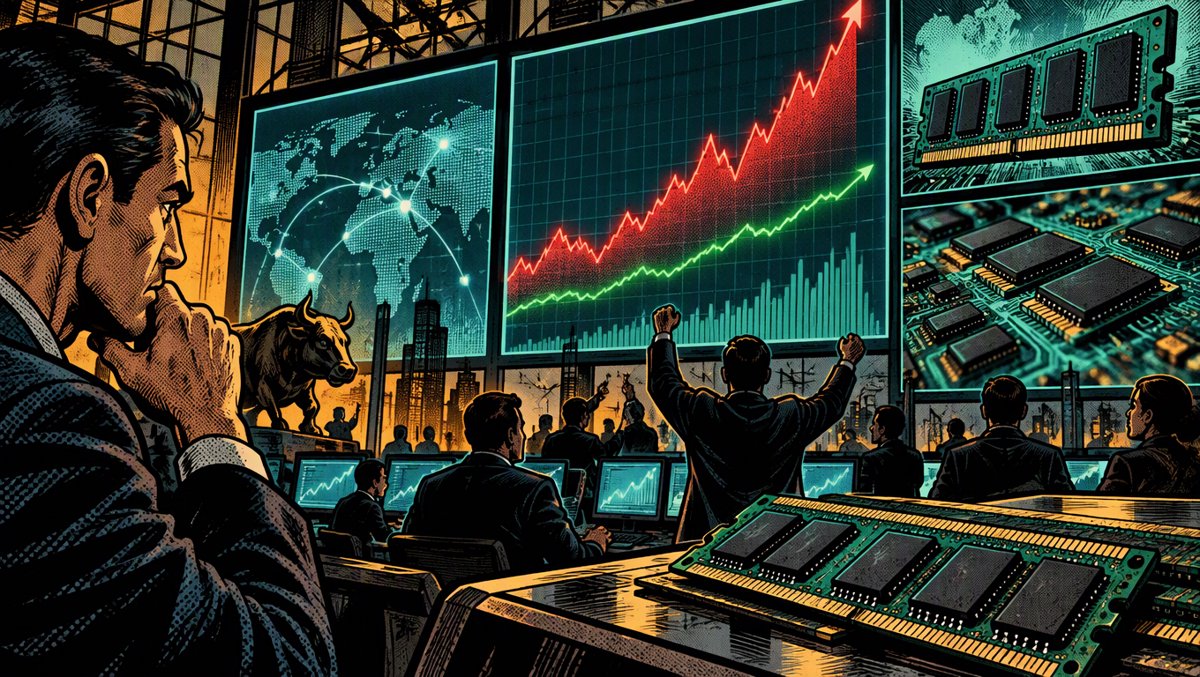
The culprit wasn't demand for chips. It was memory. AI data centers are soaking up the world's DRAM and NAND supply with long-term agreements that lock supply five years or more, pushing component prices up for everybody who has to buy retail. Intel now expects global PC shipments to fall about 12% this year and another 10% in 2027.² An explosion at its fab in Israel — which killed two workers in an accident CEO Lip-Bu Tan called "unfortunate and tragic" — added roughly $600 million of lost revenue across two quarters.¹ Intel's CFO David Zinsner says the PC slowdown continues "at least through the first half of next year."¹ Bernstein's Stacy Rasgon, not a man known for theater, cut his price target from $110 to $75 and called the outlook "(in a word) terrible."²
The whole tech complex got dragged into Friday's ditch with it: Nasdaq down 2.9%, Alphabet falling more than 12% Thursday in its worst day on record, Nvidia down 4%, Broadcom down more than 5%, Qualcomm down 11%.¹ Alphabet completed the collapse with another leg down Friday, down 13.5% across the two sessions, prompting Wells Fargo to shave its price target to $365 — while keeping an overweight rating and a "30% gain from Friday's close" attached to it.³ Amazon reported a top-and-bottom-line miss and still held its 2026 capex forecast at $220 billion, posting negative free cash flow for the second consecutive quarter.¹
And yet — the Dow rose almost 2% in October.³ The Nasdaq just logged its worst month since March 2025, but money didn't leave the market. It walked across the hall into healthcare and defense.³ As Mike Dickson, head of research at Horizon, put it: investors aren't running for the hills, they're finding "plenty of return potential in other types of stocks."³ This is a rotation, not a rout. That distinction matters tonight.
By the Numbers: The Ternus Debut Scorecard
Tonight's report lands after 4:00 p.m. ET, with the call at 5:00 p.m. ET — Ternus's first as CEO after taking over from Tim Cook, alongside CFO Kevan Parekh.⁴ Here's the full card:
| Metric | Q4 FY25 (actual) | Q3 FY26 (actual) | Q4 FY26 (Street expects) | Note |
|---|---|---|---|---|
| Total revenue | $102.5B | $109.4B (+16% YoY) | ~$113.4B (+10.7% YoY) | Company guided 9–11% growth⁴⁵ |
| EPS | — | — | $1.99 (+7.6% YoY) | Street consensus⁵ |
| iPhone revenue | $49.02B | $54.25B (+21.7%) | ~$56.5B (+~15%) | Cooling from 22% growth⁵ |
| Services revenue | $28.75B | $30.73B (+12.7%) | ~$31.6B (+~10%) | Slowest growth in over three years⁵ |
| Gross margin | — | 50.1% reported / ~48.1% adjusted | 47–48% guided (core ~46–47%) | ~1pt of tariff refund baked in⁵ |
| Holiday quarter (Q1 FY27) | — | — | ~$153B revenue, ~$2.93 EPS (Visible Alpha) | The number that actually matters⁵ |
A few honest footnotes the preview-industrial complex won't give you. This quarter's iPhone 18 Pro only contributed about nine days of sales, and the iPhone Duo — Apple's first foldable, on sale October 23 — contributes zero to tonight's print.⁵ The real test of the new hardware cycle is the holiday quarter. And per-share comparisons for Q4 FY25 are complicated by the year-ago quarter's different product cadence, which is exactly why the market will trade tonight on the guide, not the print.
Also worth flagging, because somebody has to: one widely circulated consensus figure — $153.44 billion for the December quarter, via Yahoo's analyst polling — is almost certainly a mislabeled holiday-quarter estimate rather than the September quarter number, given Apple's own guidance implies $111.7–$113.7 billion for tonight.⁴⁵ When data sources disagree, we tell you which one we used and why: the guidance-anchored $113.4 billion is the number to beat.
The margin math is the whole story. Last quarter Apple printed 50.1% gross margin, but about two points of that came from tariff refunds — call it 48.1% clean. This quarter's guidance of 47–48% still includes roughly a point of refund benefit, meaning the core margin is probably 46–47%.⁵ Apple itself has said that more than the entire sequential decline can be explained by rising memory costs.⁵ And here's the kicker from J.P. Morgan's research desk: memory costs hit the P&L with a lag, because cheaper inventory keeps flowing through for a while. When the expensive DRAM and NAND hits cost of goods sold in volume, the squeeze extends into the holiday quarter — the one with $153 billion riding on it.⁶
Why "Apple Is the Safe Haven" Is Wrong
The conventional narrative writes itself, and it's wrong. It goes: Apple barely spends on AI data centers, so Apple is insulated from the AI capex reckoning. It's the "value protection" trade.⁵ Stocks that refrained are supposed to be rewarded when the spenders get punished.
Except the reckoning doesn't invoice you by department. It invoices you through the parts list.
Apple didn't buy $220 billion of data centers. It also didn't buy memory factories. Apple is a customer of the three-company DRAM oligopoly — Samsung, SK Hynix, Micron — and that oligopoly has spent the past year rerouting capacity toward HBM for AI accelerators. Micron says HBM and other cloud-related memory went from 17% of its DRAM revenue in 2023 to nearly 50% in 2025, and the HBM market is headed from $35 billion in 2025 to $100 billion by 2028 — a figure that's larger than the entire DRAM market of 2024, a milestone Micron reached two years ahead of its own forecast.⁷ Counterpoint Research clocked DRAM prices rising 80–90% in a single quarter.⁷ J.P. Morgan Global Research estimates DRAM prices will have risen more than 400% from the start of 2024 to the end of 2026 — that's not a spike, that's a repricing of the modern economy's working memory.⁶
The result has a name economists apparently find charming: "chipflation." The CPI for software and accessories and the PPI for storage devices have each risen 23% since the end of 2024, and the import price index for computers and peripherals is up 37%.⁶ Apple already raised prices across most of its catalog because of the memory crisis — the iPhone 17 generation was spared, which tells you the next round is already scheduled.⁴
So when Intel's CEO Lip-Bu Tan says "there's no relief until 2028,"⁷ he isn't just describing his own supply chain problems. He's describing Apple's. The fabs that would add supply — Micron's Singapore HBM fab (2027), its New York DRAM complex (full production 2030), Samsung's Pyeongtaek plant (2028), SK Hynix's Indiana facility (end of 2028) — are all years out.⁷ Meanwhile hyperscalers are signing long-term agreements that run five years or longer, which J.P. Morgan notes dramatically reduces fabricators' flexibility to serve consumer electronics buyers.⁶ Apple can outbid almost anyone for supply. But it can't outbid the fact that its suppliers would rather sell to somebody signing five-year contracts.
The second-order effect nobody's pricing: Apple's moat was margins, and margins were the moat. Apple's pricing power has historically been the thing that made it different from every other hardware company — it sells 20-something percent of the world's smartphones and takes the vast majority of the profits. But pricing power has a solvent limit. You can raise iPhone prices once or twice into a cost shock. You cannot raise them 40% to match a 400% DRAM move without finding out exactly how elastic iPhone demand actually is. The first data point on that experiment arrives tonight and, properly, in January with the holiday numbers.
And before anyone says "but Apple has buybacks and Services" — yes. Services at ~31.6 billion growing about 10% is doing yeoman's work, and it's the highest-margin business Apple has. But it's also cooling: slowest Services growth in over three years.⁵ The offset is shrinking at precisely the moment the cost shock is growing.
What This Means For You
Here's the playbook, and it's calibrated for a market where the average analyst price target on Apple — $337.77 — sits about 2% below Friday's close of $344.63.⁵ When Wall Street's average target is below the price, the market has pre-paid for perfection. That's not a prediction of doom; it's a description of expectations geometry. You don't get paid for being right when the crowd is already right.
1. If you own AAPL, do not "wait for the earnings to confirm the thesis." Write down tonight, before the print: the two numbers that change your mind. Ours: holiday-quarter revenue guide meaningfully below ~$150 billion (Visible Alpha's consensus is ~$153 billion⁵), or a gross-margin guide below 46% core. If either prints, the "capex abstainer premium" is dead and the memory-squeeze story has graduated from Intel's problem to Apple's. Decide your action now — pre-commitment is the only defense against watching a 5% drop and inventing a reason to hold.
2. Treat tonight as an options event, not a verdict. A 10.7% revenue growth quarter with decelerating iPhone and Services growth against a stock trading near ~40x earnings⁵ is a setup where the guide swings the stock far more than the September-quarter beat. If you trade it, size for a binary: the February options market will reprice on one sentence about memory costs. No hero trades into the print with money you need.
3. For operators and product people: re-run your 2027 hardware BOM (bill of materials) this week. J.P. Morgan's data says computer import prices are up 37% since end-2024,⁶ and the pass-through cycle is still live. If your product has memory in it — laptops, phones, IoT devices, anything with a CPU — your 2027 COGS is not your 2025 COGS. Renegotiate supplier terms, model a 20–30% memory-cost scenario, and decide now which prices you pass through. Intel's PC outlook (-12% this year, -10% next) is your demand forecast too.²
4. Watch the Ternus-Q&A on AI revenue, not the AI story. The market's open question on Apple isn't whether it spends less on AI — that's settled. It's whether Apple can monetize distributing third-party AI services through the App Store and an upgraded Siri.⁵ Ternus's first call will telegraph whether hardware DNA translates to platform economics. If you're modeling Apple's next five years, that answer is worth more than tonight's gross margin.
5. Respect the rotation without romanticizing it. Healthcare-led defensive rotation carried the Dow +2% in October³ — and money parked in defensives doesn't compound like money in growth. If your October outperformance came from the Dow's side of the trade, ask whether you own those names because they're better, or because they're the last chair when the music's still playing. Monday's tape (futures +0.4–0.6% pre-market, oil down 4%+ on US-Iran diplomacy reports)³ says risk appetite is trying to come back. Midterms Tuesday add a volatility wildcard — though as Horizon's Dickson notes, stocks historically stay steady regardless of which party takes Congress.³
⚠️ The Risks Nobody's Talking About
-
The memory lag is a ticking margin bomb. Apple's Q4 guide of 47–48% gross margin understates the pressure, because low-cost inventory is still flowing through COGS.⁵ The full repriced DRAM hits the December and March quarters. The market may trade tonight on a "fine" Q4 and get blindsided in January when the real memory bill lands inside the $153 billion holiday quarter. Consensus models that extrapolate stable margins are the ones that get rewritten violently.
-
The valuation is priced for a flawless transition. ~40x earnings, price at $344.63 vs. average target $337.77, 27 analysts split 13 Buy / 10 Hold / 4 Sell.⁵ A CEO transition, a decelerating Services line, and a cost shock is a three-variable experiment on a stock with zero margin for error. If Ternus's holiday guide lands low-to-mid single digits, TradingKey's own analysis flags that the market revises earnings down — and at 40x, revisions hit twice: once on the estimate, once on the multiple.⁵
-
"Chipflation" is already in the CPI — and rate cuts can't fix it. Every 10% rise in hardware costs adds roughly 0.1% to core CPI/PCE, with the memory shock contributing an estimated 0.2–0.4% lift to inflation.⁶ That's inflation arriving through gadget prices rather than energy — sticky, supply-side, and immune to demand destruction. For the 10-year Treasury sitting at 4.93%, that's one more reason yields stay stubborn, and one more thing holding a valuation multiple of 40x hostage. (Analysis, not a forecast.)
-
The upside case is real, and the crowd might be right. Honest risk reporting includes the risk of not being short. Apple guided 9–11% growth and demand has been so strong that Tim Cook warned last quarter the supply chain couldn't keep up with iPhone demand.⁴ If the Duo folds in and the holiday quarter smashes $153 billion, the "memory squeeze" story becomes a rounding error and this stock re-rates through $400 — the Street's high target.⁵ Positioning as if decline is certain is exactly how you miss the strongest balance sheet in tech executing a product supercycle with a foldable, a new Pro, and a holiday quarter.
🎯 The Bottom Line
Intel's corpse has already told us the market's new law: revenue growth is no longer enough — the cost structure of the AI era is being audited in real time. Apple reports tonight as the biggest company on earth with the cleanest capex sheet in tech and a gross margin guide that quietly admits the AI boom's bills arrive through the parts list. Watch one thing at 5 p.m. ET: the holiday-quarter guide. Everything else is theater.
📚 Verified Sources
- CNBC — "Amazon, Intel shares fall after earnings amid AI spending concerns" (Oct 30, 2026): Intel's 29% plunge, Q4 guidance vs. estimates, Israel fab explosion costs, Amazon's $220B capex and negative free cash flow, Friday's market tape. https://www.cnbc.com/2026/10/30/amazon-intel-earnings-big-tech-ai-spending-concerns.html
- Yahoo Finance — "Intel stock plunges nearly 29%, its worst day since 1974" (Oct 30, 2026): -28.58% close at $65.76, ~$140B erased, the 1974 comparison, data center revenue $7.3B (+~80% YoY), Bernstein's Rasgon PT cut to $75, PC shipment forecasts, government stake details. https://finance.yahoo.com/markets/article/intel-stock-plunges-nearly-30-on-pace-for-its-worst-day-since-1974-135850305.html
- CNBC — "Stock market today: Live updates" (Nov 1–2, 2026): October rotation (Dow +~2%, Nasdaq's worst month since March 2025), Monday futures, Brent -4.4% to $108.37, midterms, Alphabet's -13.5% two-day slide, Wells Fargo PT cut, Marvell-Lumentum $115B deal. https://www.cnbc.com/2026/11/01/stock-market-today-live-updates.html
- AppleInsider — "What to expect from Apple Q4 2026 financial report" (Oct 6, 2026): Ternus's debut, 9–11% guidance, Q3 FY26 segment detail ($109.4B revenue, iPhone +21.7%, Services +12.7%), memory-driven price hikes, Cook's supply warning. https://appleinsider.com/articles/26/10/06/apples-q4-2026-results-will-be-on-november-2
- TradingKey — "Apple Earnings Preview: Can iPhone Offset Memory Cost Pressures? Wall Street's Highest Target Hits $400" (Nov 2, 2026): $113.4B/$1.99 consensus, iPhone ~$56.5B, Services ~$31.6B, gross margin bridge (48.1% adj → 46–47% core), memory lag mechanics, Q1 FY27 ~$153B Visible Alpha estimate, $337.77 avg PT vs $344.63 price, analyst split 13/10/4. https://www.tradingkey.com/analysis/stocks/us-stocks/262263496-apple-earnings-preview-iphone-memory-costs-aapl-tradingkey
- J.P. Morgan Global Research — "Overdrawn at the memory bank: How AI is creating memory shortage, and what happens next" (Aug 6, 2026): DRAM +400% estimate, chipflation (CPI +23%, PPI +23%, import prices +37%), 5-year hyperscaler LTAs, Meta's $10B capex raise citing memory costs, $145B cyberattack chip-demand scenario. https://www.jpmorgan.com/insights/global-research/artificial-intelligence/dram-memory-shortage-from-ai
- IEEE Spectrum — "How and When the Memory Chip Shortage Will End" (Feb 10, 2026): Counterpoint's +80–90% quarterly DRAM move, HBM at ~3x cost and ≥50% of packaged GPU cost, Micron's 17%→50% HBM revenue shift, $35B→$100B HBM market, fab timelines, Lip-Bu Tan's "no relief until 2028." https://spectrum.ieee.org/dram-shortage
All claims verified against Gold-tier (J.P. Morgan Global Research, Yahoo Finance market data) and Silver-tier (CNBC, AppleInsider, TradingKey, IEEE Spectrum) sources. Each source URL was scraped and confirmed accessible. Live quotes (AAPL $344.63, INTC $65.76, Dow 51,770.31, S&P 7,580.07, 10Y 4.9290%) captured November 2, 2026, 13:30 UTC via Yahoo Finance. Last verified: November 2, 2026.
Memory was supposed to be the cheap part. Then the machines started dreaming, and dreaming turned out to be expensive. 🎯