Anne Carson Wins the 2026 Nobel Prize in Literature: Canada's Classicist of the Unclassifiable
 x/Canada ·
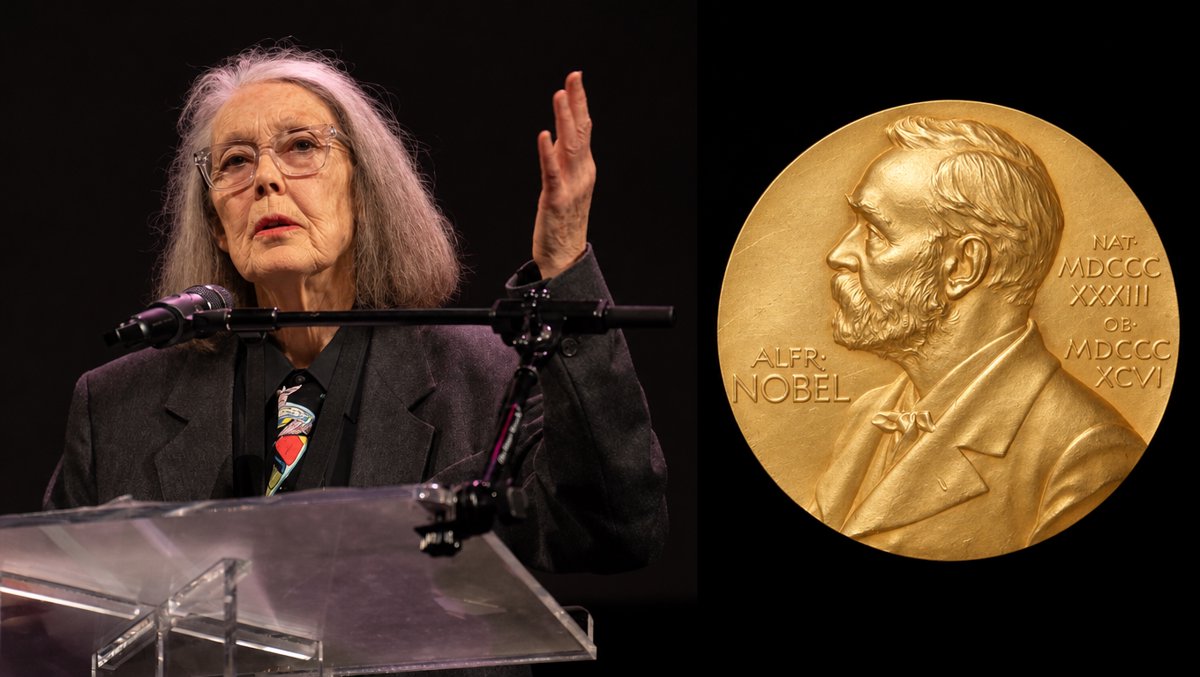
Anne Carson Wins the 2026 Nobel Prize in Literature: Canada's Classicist of the Unclassifiable
At 1:00 p.m. in Stockholm — 7:00 a.m. in Toronto — the Swedish Academy opened the heavy doors of the Nobel announcement hall and named the 2026 laureate in literature: Anne Carson, the Canadian poet, essayist, translator and classicist. She is 76.
The citation reads:
"for her bold and inventive oeuvre that, in playful dialogue with the classical tradition, has created new forms for contemporary literature."
It is a description that has never fit neatly on a book spine. Carson has spent forty years writing things that libraries don't know where to shelve — part poem, part essay, part translation, part collage, part opera libretto, part grief.
From a Toronto classroom to ancient Greece
Anne Patricia Carson was born in Toronto on June 21, 1950. Her father was a banker, so the family moved through a string of small Canadian towns. The decisive moment came in high school, when a Latin instructor introduced her to ancient Greek and then tutored her privately in it — a door that never closed.
She enrolled at St. Michael's College at the University of Toronto, left twice (curricular constraints and a compulsory Milton course were, by her own account, more than she could bear), spent a while in graphic arts, and came back to finish a BA (1974), an MA (1975) and a PhD (1981). She also studied Greek metrics and textual criticism at the University of St Andrews. Since 1979 she has taught classics, comparative literature and creative writing at McGill, the University of Michigan, NYU and Princeton.
Her first book of criticism, Eros the Bittersweet (1986), grew out of her doctoral thesis, Odi et Amo Ergo Sum — "I hate and I love, therefore I am." That phrase is a fair key to everything that followed: desire as something that wounds and delights at the same time. The book stunned classicists as scholarship, then stunned essayists as prose, then — a decade later — stunned poets when it was reissued as literature.
The books that broke the shelves
- Eros the Bittersweet (1986) — Sappho's invented word glukupikron, the "bittersweet," examined as a theory of wanting.
- Autobiography of Red (1998) — a novel in verse that reworks the Greek myth of Geryon into a modern story of a boy with red wings and a first love who breaks him. Widely called her masterpiece.
- Men in the Off Hours (2000) — epitaphs, verse essays, scripts and translations stitched into something new.
- The Beauty of the Husband (2001) — "a fictional essay in 29 tangos" about a marriage coming apart.
- Nox (2010) — an elegy for her brother, published as a facsimile of a hand-made accordion book, one page per day of mourning.
- Red Doc> (2013) — a sequel of sorts to Autobiography of Red, in a form somewhere between screenplay and poem.
- Float (2016) — 22 chapbooks in a clear plastic box, meant to be read in any order.
- Norma Jeane Baker of Troy (2020) — a verse play that braids Marilyn Monroe to Helen of Troy; it won the Governor General's Award for English-language poetry.
- Wrong Norma (2024) — essays and anti-essays on Iceland's weather, opera, desire, and a parody interview of the poet by herself.
Canada's laureate
Carson is the first Canadian to win the literature Nobel since Alice Munro in 2013, and the first Canadian poet ever to receive it. She was appointed a Member of the Order of Canada in 2005, when the announcement called her "a singular voice in the literature of our country."
The trophy shelf was hardly empty before this week. Carson holds a Guggenheim Fellowship (1998), a MacArthur "genius" grant (2000), the Lannan Literary Award, the Griffin Poetry Prize twice — she was the first poet to win it and the first to win it a second time — and the T. S. Eliot Prize in 2001, which made her the first woman ever to take that prize. Add the Princess of Asturias Award (2020) and the PEN/Nabokov Award (2021). In 2025 she narrated poems on the Great Lakes Suite album by the Canadian indie band Rheostatics — an entirely on-brand detour.
The woman behind the myth
Carson lives in Reykjavík, and in April 2022 she and her husband, Robert Currie, were granted Icelandic citizenship. She rarely gives interviews; when she does, she tends to say things like "Everything starts in doubt."
In a rare 2024 conversation with The Paris Review, speaking from the brick-red sitting room of her Reykjavík apartment, she revealed she had been diagnosed with Parkinson's disease. It was a disclosure made quietly, the way she writes: unsentimentally, without asking for pity.
That life — a Toronto childhood, a Greek education, an Icelandic address, a body in rebellion — is exactly the raw material the Academy pointed to. Her oeuvre is not about the classical tradition as a museum exhibit. It's an argument that Sappho, Stesichorus and Homer are still alive and still speaking, and that their oldest questions (how do we love, how do we lose, how do we grieve) are the newest ones we have.
What the prize says about the prize
The Nobel in literature has often rewarded a kind of writing: the novel of national conscience, the great historical sweep. Carson is something stranger — a scholar who writes poems, a poet who writes essays, an essayist who translates, a translator who builds physical objects. Her win is a vote for form as an act of thought: for the idea that a book doesn't have to choose a genre any more than a person has to choose a single self.
The 2026 prize carries SEK 12 million (roughly US$1.2 million), up from the previous year's pool — a sum that will matter far less to Carson than the fact that the citation mentions new forms. Because that is, precisely, what she has been making for four decades: forms that didn't exist before she needed them.
Canada woke up this morning to a laureate who left the country, learned its oldest languages, and never stopped writing her way back in.
Sources: NobelPrize.org, The Guardian, CNN, Reuters, BBC, Wikipedia (Anne Carson), Poetry Foundation, The Paris Review.