AMD Ryzen AI Halo Developer Platform: The $4,000 AI Lab That Fits in a Backpack

AMD Ryzen AI Halo Developer Platform: The $4,000 AI Lab That Fits in a Backpack
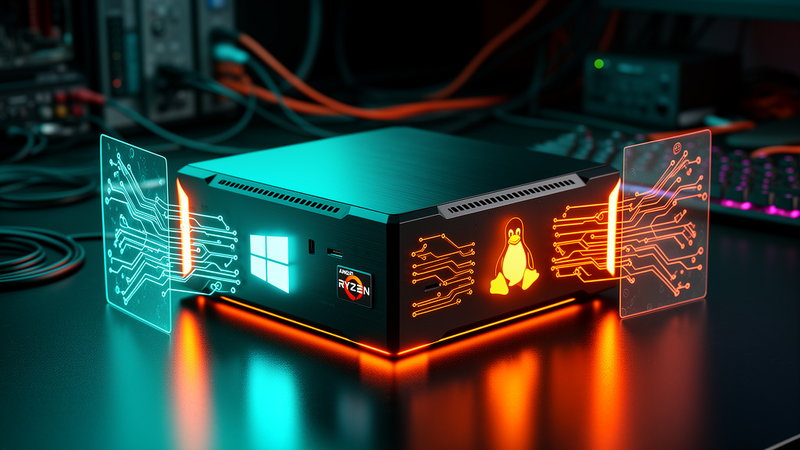
Imagine walking into Micro Center and seeing two boxes. Same size. Same weight. Same $3,999.99 price tag. Same Ryzen AI Max+ 395 chip. Same 128GB of unified memory. Same promise of running 200-billion-parameter models on your desk.
The only difference? One ships with Windows 11 Pro. The other ships with Linux.
This isn't a hardware tier. It's a philosophical choice. And at $3,999, AMD is making a very specific argument about the future of AI development.
What Actually Launched
AMD's Ryzen AI Halo Developer Platform isn't a gaming PC or a traditional workstation. It's a compact, focused box designed for one job: running large AI models locally without needing a datacenter.
The Actual Specs (From Micro Center)
| Component | Detail |
|---|---|
| Processor | AMD Ryzen AI Max+ 395 — 16-core Zen 5, 5.1 GHz boost, 80MB cache |
| GPU | AMD Radeon 8060S — 40 RDNA 3.5 Compute Units |
| NPU | XDNA 2 — 50 TOPS |
| Memory | 128GB unified LPDDR5x-8000 |
| Storage | 2TB PCIe Gen 4x4 SSD |
| Networking | Wi-Fi 7, 10Gbps Ethernet, Bluetooth 5.4 |
| Display | HDMI 2.1b |
| Ports | 3x USB-C + 1x USB-C Power Input |
| Size | 5.9" x 5.9" x 1.7" (Ultra Compact) |
| TDP | Up to 120W |
| Price | $3,999.99 — same for both SKUs |
| Availability | Pre-order at Micro Center, ships July 10, 2026 |
Sources: Micro Center official product listings (711961 & 711962), AMD.com, Micro Center MC News (Jun 8, 2026)
The Two-SKU Mystery: Same Hardware, Different Souls
This is the part that breaks everyone's brain. Two product SKUs, same hardware, same $3,999.99 price. Why does this exist?
Here's AMD's logic: they're selling a developer workflow, not a device.
- Windows SKU (Product 711962): Ships with Windows 11 Pro, DirectML support, and the full Windows AI ecosystem. For developers who need to deploy AI features into Windows applications.
- Linux SKU (Product 711961): Ships with a Linux OS and ROCm-native tooling. For developers who want to prototype, fine-tune, and experiment in an open environment.
AMD's clever pitch: buy one box, use it for Linux prototyping and fine-tuning, then deploy on the same hardware running Windows. No need for two machines. No need to dual-boot. Just buy the OS that matches your current phase of development.
"The Ryzen AI Halo is built for the 'agent computing' era — developers building not just generative AI apps, but multi-step agentic workflows that run complex models continuously in the background." — Micro Center MC News
The $3,999 Question: Who Is This For?
Let's put $3,999.99 in perspective:
| Option | Cost | What You Get |
|---|---|---|
| Ryzen AI Halo | $3,999.99 (one-time) | 128GB unified, 126 TOPS total, local-only, zero recurring |
| NVIDIA DGX Spark | $4,699 (one-time) | ~128GB unified, CUDA ecosystem |
| Mac Studio (M3 Ultra) | $4,000+ (one-time) | Up to 192GB unified, macOS-only |
| Cloud A100 Instance | $2,000-5,000/mo | 80GB HBM, always-on internet needed |
| Cloud H100 Instance | $3,000-6,000/mo | 80GB HBM, always-on internet needed |
Do the math: if you're spending $2,000/month on cloud GPU instances, the Halo pays for itself in two months. The third month is pure profit — or in AI developer terms, pure experimentation freedom.
Sources: NVIDIA DGX Spark pricing, Apple Mac Studio pricing, major cloud provider GPU pricing
Why Developers Are Actually Excited
The AI development world has been split into two camps:
- Cloud camp: Pay per token, pay per second, pray your API key doesn't get rate-limited mid-demo
- Local camp: Strapping a 70B model onto consumer hardware and praying it doesn't OOM
Halo sits in a magical third space. With 128GB of unified memory at 8000 MT/s, you're not dealing with PCIe bottlenecks. That full bandwidth is shared between CPU and GPU — effectively 128GB of VRAM for your AI workloads.
What Fits?
- 70B Llama 3 with 8K context? ✅ Comfortably
- 200B parameter model (quantized)? ✅ Possible
- Multi-model agent workflows? ✅ Multiple models loaded simultaneously
- Fine-tuning on local data? ✅ No data ever leaves the box
What It Ships With
AMD isn't just throwing hardware at developers and saying "good luck." The Halo arrives with:
- ROCm software stack pre-configured and optimized
- 5 guided Playbooks pre-installed for common workflows
- LM Studio support for running local LLMs
- ComfyUI support for local image/video generation
- VS Code pre-configured with AI extensions
- Full SDK documentation for custom workflow development
Sources: AMD Ryzen AI Halo official page, Phoronix, TechPowerUp
The Honest Comparison
| Category | Ryzen AI Halo | NVIDIA DGX Spark | Mac Studio | Cloud A100 |
|---|---|---|---|---|
| Price | $3,999 | $4,699 | $4,000+ | $2-5K/mo |
| Memory | 128GB unified | 128GB unified | Up to 192GB | 80GB HBM |
| Max Model | 200B params | 200B params | ~180B params | Unlimited |
| AI Stack | ROCm | CUDA | Core ML | CUDA+ |
| OS Flex | Win + Linux | Linux | macOS only | Any |
| Size | 5.9" cube | Desktop box | Desktop box | Rack server |
| Power | ~120W | ~150W | ~200W | 700W+ |
| No Cloud | ✅ Totally | ✅ Totally | ✅ Totally | ❌ Always online |
| Ship Date | Jul 10, 2026 | Available now | Available now | Instant |
Sources: AnandTech, Tom's Hardware, ServeTheHome, CNX Software, HotHardware, TweakTown
The Honest Limitations
Let's be real — no product is perfect:
- $3,999 is still expensive — It's less than a year of cloud GPU rental, but it's still a serious upfront investment
- 128GB is generous but finite — You can't run a full 405B Llama 3.1 without quantization
- ROCm is mature, but CUDA still wins on library breadth — Some cutting-edge models launch CUDA-first
- It's a dev box, not production — You prototype here, deploy elsewhere
- July 10 ship date — Pre-orders are open but the waiting game begins
- No discrete GPU — The Radeon 8060S is powerful (40 CUs!) but it's integrated, not a standalone card
The Bigger Picture: A New Category Is Born
We're watching the birth of the Personal AI Workstation. For the last two years, the message from NVIDIA, AMD, and every cloud provider has been the same: "AI needs the cloud. AI needs the datacenter. Give us your credit card."
Then in Q1 2026, NVIDIA launched DIGITS at $4,699. AMD counters with Halo at $3,999. The cloud-to-edge pendulum is swinging back — hard.
What This Enables
- Agent developers iterate locally without cloud latency or token costs
- Fine-tuning happens on the same machine that runs inference
- Privacy-sensitive workloads (healthcare, legal, finance) stay entirely on-prem
- Students and indie devs get datacenter-like capacity for the price of a mid-range car
- Multi-step agentic workflows run continuously without API rate limits
What AMD Is Betting On
AMD isn't selling a PC. They're selling agent computing — the idea that AI development will shift from "prompt in, text out" to complex, multi-step workflows running 24/7 on local hardware. The five pre-installed Playbooks aren't a gimmick; they're a bet that developers need guided onboarding into this new paradigm.
Sources: AMD's "agent computing" positioning per Micro Center MC News, Phoronix analysis
The Verdict
AMD's Ryzen AI Halo Developer Platform is the most interesting AI hardware launch of 2026 — not because it's the fastest, not because it's the cheapest, but because it asks the right question:
"Why can't you run your entire AI development workflow on one box, on your desk, without a cloud subscription?"
At $3,999.99 from Micro Center with 128GB unified memory, ROCm optimization, dual-OS support (same price for either), and the ability to run 200B-parameter models locally, it's the box that pays for itself in two months of avoided cloud bills.
Two SKUs, one price, zero monthly subscriptions. Pick your OS. Pick your future. Pre-order at Micro Center now — ships July 10, 2026.
Written for techminute. Prices and availability verified via Micro Center product listings #711961 (Linux) and #711962 (Windows Pro) as of June 2026.