Alphabet Grew Everything and Still Lost $400 Billion — Because the AI Trade Just Started Grading Cash Flow
 x/money ·
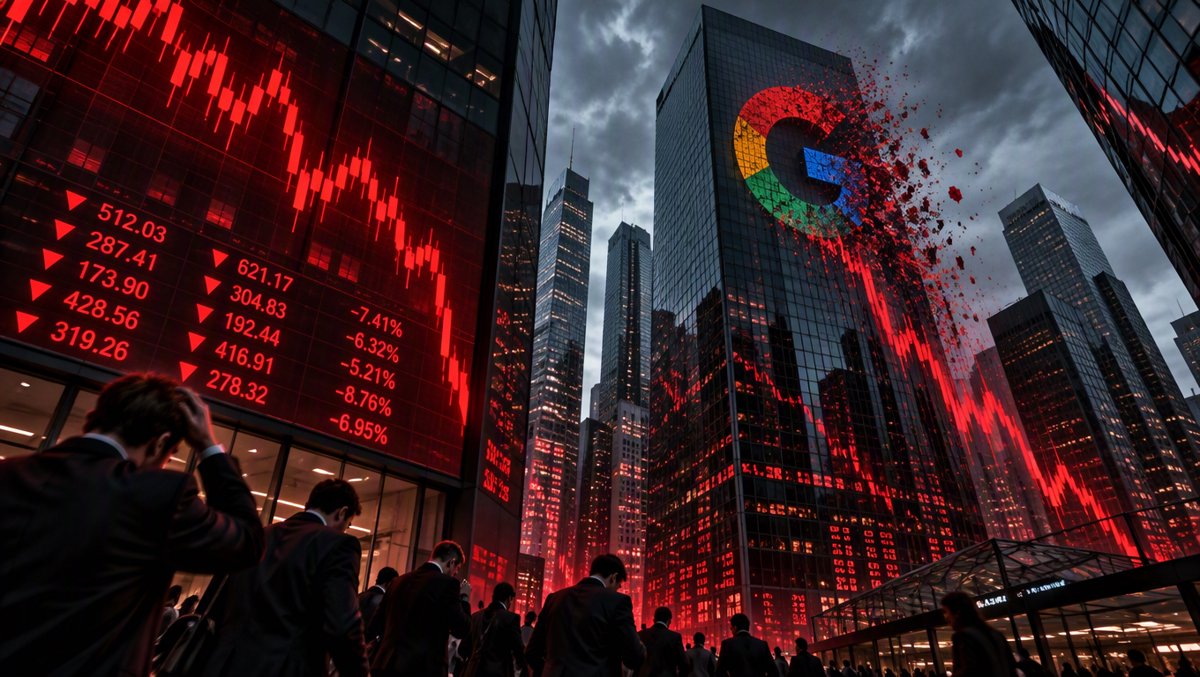
Alphabet Grew Everything and Still Lost $400 Billion — Because the AI Trade Just Started Grading Cash Flow
Published: October 29, 2026 | Reading Time: ~11 minutes | Channel: money
Here's the stat that should break your brain this morning: Alphabet posted its fastest search query growth in five years, grew search revenue 12% to roughly $63 billion, more than doubled Google Cloud to $30.71 billion — and the stock is down 10–11% in premarket trading, set to erase more than $400 billion of market value in a single session.¹ ² ³ That would be the second-largest one-day market-cap wipeout in U.S. stock market history. The only company that's ever lost more in one day is Nvidia, which shed close to $600 billion in January 2025 when everyone panicked that DeepSeek had stolen its lunch.³
The reason for the sell-off isn't demand. It isn't competition killing the golden goose — not yet, anyway. It's that Alphabet burned through $9 billion more cash than it generated in the quarter — negative free cash flow of about $9.07 billion, roughly three times what Wall Street expected — while search revenue missed estimates for the second consecutive quarter.¹ ⁴ For the first time in two decades as a public company, the most profitable advertising machine ever built cannot currently fund itself.
This is the morning the AI trade stopped being a faith-based initiative. Here's what actually happened, what everybody's getting wrong about it, and what to do before Amazon and Intel report tonight.
The Morning That Changed Everything
Wednesday after the close, two earnings reports landed within minutes of each other, and together they drew the new map of the AI economy.
Alphabet's quarter was, on paper, a blowout by any historical standard. Total revenue rose 25% to $127.6 billion.⁴ Google Cloud revenue surged 103% year over year to $30.71 billion as customers raced to lock up TPU capacity.⁴ The cloud backlog — contracted revenue waiting to be delivered — hit roughly $560 billion, and management said just over half of that will convert to recognized revenue over the next 24 months.¹
And yet. Search and other revenue — the segment that pays for literally everything else — grew 12% to roughly $63 billion, below estimates for the second straight quarter, after beating expectations in each of the previous four.¹ ³ The deceleration is textbook: 19% growth in Q1, 17% in Q2, 12% in Q3.¹ Meanwhile free cash flow went to −$9 billion on $51.36 billion of quarterly capital expenditures, TPU inventory build-out, and a European Commission fine payment.¹ ³ ⁴ It's the second consecutive negative-FCF quarter — Q2 was −$5.9 billion, the first negative print in Alphabet's history as a public company.¹
Wall Street's verdict was immediate and brutal. Robert Hum's math at CNBC: more than a 9.77% decline today would be the worst post-earnings reaction in Alphabet's history as a public company.² Business Insider had the stock at $287, down more than 11%, as of 8:11 a.m. ET — a $3.95 trillion market cap bleeding past the $400 billion mark.³ It's also the company's first double miss (earnings and revenue) since Q4 2022.²
The contrast with Microsoft, which reported the same evening, is the entire story. Microsoft beat on everything, Azure grew 48% to $33.2 billion — now the company's biggest single business — guided Q2 revenue up to $97 billion, and cut its full-year capex forecast from $175 billion to $170 billion. Stock up roughly 3.5% premarket. S&P Global Visible Alpha's head of research Melissa Otto told Reuters the two reports were "night and day."⁴

By the Numbers: One Night, Two Report Cards
| Metric | Alphabet (Q3 2026) | Microsoft (Q3 FY26) |
|---|---|---|
| Revenue | $127.6B, +25% YoY (missed)⁴ | Beat; Q2 guide up to $97B² |
| Flagship growth line | Cloud +103% to $30.71B⁴ | Azure +48% to $33.2B² ⁴ |
| Core franchise | Search +12% to ~$63B — 2nd straight miss¹ | Now its biggest single business² |
| Free cash flow | −$9.07B (est. deficit: ~1/3 that)¹ ⁴ | Positive; "stronger cash generation"⁴ |
| Capex stance | Held FY guide at $195–205B¹ ⁵ | Cut FY guide $175B → $170B⁵ |
| Stock, premarket | −10 to −11% (~$287)² ³ | +~3.5%⁴ |
And the search deceleration, quarter by quarter:¹
| Quarter | Search & Other YoY Growth |
|---|---|
| Q1 2026 | 19% |
| Q2 2026 | 17% |
| Q3 2026 | 12% |
That's a 7-point growth collapse in six months, in a segment that still generates the majority of Alphabet's profit. Now layer on the cash flow: two consecutive negative quarters, −$5.9 billion then −$9.07 billion, against a Wall Street that modeled roughly a third of that deficit for Q3.¹ ⁴ CFO Anat Ashkenazi's explanation was honest: "You see cash going out and we're building up the inventory base. As we start delivering and billing customers for these TPU systems, then you see cash coming in."¹ That's a real answer. It is not a comforting one when the print lands −$9 billion instead of −$3 billion.
Why "AI Finally Killed Google" Is Wrong — For Now
Here's the lazy take writing itself across every feed this morning: AI is eating search, Google is Blockbuster, sell everything. UBS says the results bring "Search cannibalization fears right back to the forefront," and Mizuho's Jordan Klein says the numbers elevate fears that AI agents are taking share from Search and YouTube.¹ D.A. Davidson's Gil Luria — who's been carrying this particular torch since 2023 — told CNBC, "This may be the quarter we feared."²
They're half right, which is the most dangerous way to be right.
The usage data says the opposite of a dying franchise. Google itself reported that search query growth is the strongest it's been in five years.¹ People are searching more, not less — they're just doing it through AI Mode, where monetization lags the classic ten-blue-links page. Google's own chief business officer, Philipp Schindler, said it out loud: "the strong growth in AI Mode queries had an impact because of the lower monetization we were seeing in AI Mode."³ Sundar Pichai reached for the oldest analogy in the drawer: "Just like our shift to mobile over a decade ago, we are focused on building the best Search user experience, followed by monetization."³
That's not a demand-collapse story. That's a revenue-conversion story. Mobile took years to monetize too, and it ended up bigger than desktop ever was. The question nobody can answer today — not UBS, not Mizuho, not me — is whether AI Mode's eventual revenue per query gets back to search-ad levels, or whether a chatbot answer structurally carries fewer commercial slots than a results page. Bernstein's Mark Shmulik put the honest version on record: "Is Google an AI winner? Probably, but not today."³
The second thing everyone's missing: the market punished Alphabet partly for discipline and timing, not just spending. Alphabet held its full-year capex guidance at $195–205 billion — it did not raise it.⁵ The FCF hole got deeper partly because outside compute capacity "came online only at the very end of Q3," per Ashkenazi, meaning Alphabet front-ran the spending and is still waiting on the delivery.¹ ⁵ Meanwhile the company is sitting on a $560 billion contracted backlog.¹ The cash flows out before the cash flows in. That's how infrastructure businesses work — railroads, pipelines, subsea cables — and it's the first quarter the market has decided to grade Alphabet like one instead of like a software company.
The third thing: watch what the CFO didn't cut. No guidance reduction on the $195–205 billion, and management said spending will "increase significantly" in 2027.¹ ⁵ If the board actually believed the cash cow was dying, you'd see retrenchment. You're seeing pacing, not retreat.
The Money Didn't Leave the AI Trade — It Moved Down the Stack
While American mega-cap tech ate a $400 billion haircut, one company quietly printed the largest quarterly profit in the history of the technology industry.
Samsung Electronics reported third-quarter operating profit of ₩107.44 trillion — about $80.5 billion — up roughly 780% year over year, on revenue of ₩195.25 trillion, up 127%.⁶ It's the first South Korean company of any kind to cross ₩100 trillion in quarterly operating profit.⁶ The semiconductor (Device Solutions) unit alone did ₩147.1 trillion in revenue and ₩106.5 trillion of operating profit, and the board approved a ₩30 trillion cash dividend.⁶ Samsung and SK hynix both say the memory shortage deepens into 2027.⁶
Read that next to Alphabet's print and you understand exactly where the value in this build-out currently accrues. Alphabet is spending $51.36 billion a quarter¹ to build machines whose components are in a shortage so severe that Samsung's profit went up sevenfold.⁶ The pricing power, this year, belongs to the company that sells the scarce thing — not the company that buys it and rents it out. Alphabet's own smartphone-adjacent pain is mirrored in Samsung's numbers, by the way: Samsung's phone unit posted an operating loss of ₩0.6 trillion because memory costs are squeezing everything downstream.⁶ The bill for AI is showing up in phone prices, and consumers haven't even felt the full pass-through yet.
Microsoft's quiet capex cut tells you the same story from the demand side. Amy Hood blamed third-party AI-chip providers for delays pushing capacity into the first half of 2027, and guided spending to re-accelerate then.⁵ The neoclouds — CoreWeave, Nebius, IREN — all fell on that news, because Microsoft is their whale client, and a delayed order from the whale is a delayed revenue line.⁵ ⁴ Gartner told CNBC it expects 80% of neocloud companies to be absorbed or dead by 2030, and Nvidia-backed Firmus already pulled its IPO this month despite usage commitments from Meta and OpenAI.⁵ Hyperscaler capex is still expected to top $1 trillion next year⁵ — the build-out isn't over — but the market is now sorting survivors from borrowers in real time. Meta, remember, reported last week: capex guidance of $135–145 billion, negative free cash flow, stock sank.⁵
Pattern, for those keeping score: the balance sheets with $100-billion-class operating cash engines (Microsoft) get to pace the spending. The ones borrowing to keep up are getting repriced daily. And the humble supplier of memory chips is banking a ₩30 trillion dividend.⁶
What This Means For You

1. Grade your growth stocks on cash conversion, starting today. The single variable that flipped Alphabet from hero to zero wasn't growth — it was free cash flow of −$9.07 billion against a −$3 billion estimate.⁴ For any position you own that's ridden the AI trade, pull the last two quarters of FCF and capex before Friday. If FCF is negative and the company funds it with debt rather than an existing cash machine, you're holding a credit story dressed up as a growth story. Price it accordingly.
2. Respect the calendar this week — four catalysts in nine days. Amazon reports tonight, with analysts already expecting another negative-FCF quarter; Intel reports tonight too (~$16.5 billion revenue and $0.40 adjusted EPS expected); AMD reports November 3; Nvidia November 17.⁴ If Amazon also posts negative FCF while holding capex guidance, that's three of the four biggest AI buyers now running cash-negative — the market's tolerance for that math gets thinner every quarter. Don't add exposure before these prints; wait for the capex commentary, which now matters more than the revenue lines.
3. Reassess the "AI winner" concentration in your portfolio — barbell it. The Cantor view on Microsoft (buy, price target raised to $630 from $608)⁵ is the funded-and-disciplined end; memory suppliers with multi-year shortages (Samsung, SK hynix, and their Western analogues) are the pricing-power end. What no longer works is owning everything AI-adjacent as one trade — CNBC's own math shows the Magnificent Seven doesn't trade as a monolith anymore.² Sherlund Partners calculated that its Silicon & Semis group fell 11.9% between October 9 and 23 while analysts' 2027 earnings estimates barely moved⁴ — multiple compression, not fundamentals. When price moves without estimate changes, position sizing is your only protection.
4. If you sell products online, assume your cheapest acquisition channel is depreciating. Google reported the strongest query growth in five years¹ — and simultaneously told you the monetization on those AI Mode queries is lower, with ads only now expanding internationally into AI Mode.³ The traffic is real; the intent-to-purchase plumbing is being rebuilt. Diversify acquisition now — direct email, communities, marketplaces you don't own — before the pricing on AI-surface placements gets set without you in the room.
5. Business owners: negotiate your memory-dependent hardware purchases yesterday. Samsung and SK hynix both project the memory shortage deepening through 2027,⁶ and phone makers are already absorbing losses. Laptops, phones, servers, storage — everything with DRAM and NAND in it gets more expensive next year. Lock Q1 2027 pricing now if your vendor will take it.
⚠️ The Risks Nobody's Talking About
-
The FX fig leaf has a shelf life. Alphabet management blamed foreign exchange as the biggest factor behind the search deceleration, with a bigger currency hit expected in Q4.¹ Maybe. But that's a one-to-two quarter explanation, and if Q4 search growth prints 11% or 10%, "it's the dollar" stops being an excuse and becomes a trend. Watch the Q4 constant-currency disclosure like a hawk.
-
The backlog is a promise, not cash — and delivery is slipping. Alphabet's $560 billion cloud backlog converts over years,¹ and Ashkenazi already conceded outside compute arrived "only at the very end of Q3."¹ ⁵ Microsoft's Hood is telling the same story — capacity pushed to H1 2027.⁵ Every month of delayed data center delivery pushes Alphabet's FCF break-even further right while the capex burns today. If chip or power constraints worsen, the −$9 billion quarters compound before the $560 billion arrives.
-
Rates are moving against every negative-FCF company simultaneously. The Fed held Wednesday and traders price roughly an 81% chance of a December hike.⁴ Morgan Stanley's Mike Wilson thinks semis can fall another 10–15% on financing concerns alone.⁴ Neoclouds are already getting cut off by lenders because they lack investment-grade ratings.⁵ If the December hike lands, the discount rate on every "cash comes later" business model rises at once. That's not a stock-specific risk; that's a regime risk.
-
The cannibalization math could genuinely break bad. The bullish "monetization lag" story requires AI Mode revenue per query to eventually approach classic search levels. If agentic answers structurally carry fewer ads — one conversation instead of ten queries, zero click-outs instead of eight — the lag never closes and search TAM shrinks in real terms. Gene Munster's warning is the one to keep: if personalized bots become "the starting point of commerce, which impacts where Google is."¹ Luria's caveat cuts both ways: "We would not rush to conclusions based on one quarter, but will definitely need to reassess."¹ ²
🎯 The Bottom Line
The AI trade didn't die this morning — it got audited. Alphabet grew queries at a five-year-high pace, doubled its cloud business, and still took a $400 billion hit, because the market now grades the build-out on cash conversion, not demos. Own the companies that generate the cash (Microsoft), the ones that price the scarcity (memory), and treat every negative-FCF growth story as a loan, not a lottery ticket.
📚 Verified Sources
- CNBC — Alphabet earnings miss reflects first real sign that AI is taking a bite out of search. https://www.cnbc.com/2026/10/29/alphabet-google-search-ai-earnings.html
- CNBC (Morning Squawk) — Alphabet drags on Nasdaq futures as the stock faces a record post-earnings loss. https://www.cnbc.com/2026/10/29/alphabet-nasdaq-futures-record-post-earnings-loss.html
- Business Insider — Google faces a $400 billion stock wipeout in the 2nd biggest market cap loss in history. https://www.businessinsider.com/google-share-price-stock-plummet-earnings-ai-search-revenue-2026-10
- Invezz — Why are Nvidia, AMD and Intel stocks crashing in pre-market trading today? https://invezz.com/news/2026/10/29/why-are-nvidia-amd-and-intel-stocks-crashing-in-pre-market-trading-today/
- CNBC — AI build-out hits snag as Google and Microsoft hold capex forecasts. https://www.cnbc.com/2026/10/29/microsoft-google-ai-capex-estimates.html
- SiliconANGLE — Samsung confirms record-breaking operating profit on soaring AI memory chip demand. https://siliconangle.com/2026/10/28/samsung-confirms-record-breaking-operating-profit-on-soaring-ai-memory-chip-demand/
All claims verified against Silver-tier (CNBC, Business Insider) and specialist/research-tier (Invezz, SiliconANGLE) sources. Each source URL was scraped and confirmed accessible with full content on October 29, 2026. Reuters, WSJ, and MarketWatch versions of these stories were bot-walled (401/403) and were discarded per verification protocol. Last verified: October 29, 2026.
Nothing here is personalized financial advice — it's analysis with the numbers left in. Do your own homework, size your positions, and mind the calendar. 🎯
The market didn't stop believing in AI today. It stopped believing in stories — and started demanding receipts. Bring cash flow, or bring a cushion. 🎯