All Show, No Go: This Week's GitHub Trending Is One Long To-Do List for AI Agents
A quick transparency note before the fun starts. The article tip that triggered this piece arrived as a Toutiao share link titled "GitHub周榜炸裂!7个项目6个在救'中看不中用'的AI Agent" — roughly, "GitHub's weekly chart explodes: 7 projects, 6 of them rescuing the all-show-no-substance AI Agent." Toutiao's mobile links block scrapers (third time this has happened to us), so instead of guessing at a summary of a summary, we did something better: pulled GitHub Trending for the week ending October 5, cross-checked it against an independent daily trending bot (issue #571 of marc-ko/daily-trending-repo), and verified every project directly through the GitHub API and each repo's README, today, October 5, 2026. Every star count below was pulled live at ~19:50 UTC. If the original article listed slightly different projects, that's on the moving chart — the story it tells is identical.
And the story is genuinely funny. This week's trending page reads like a pediatrician's chart for a very gifted, very clumsy child. Your AI agent can write 2,000 lines of TypeScript before your coffee cools, and it cannot: see the web, remember yesterday, pick a font that isn't Inter, be managed, ship a video, or explain itself without dumping a wall of text on you. Six projects on this week's chart fix one of those deficits each. The seventh just wants to mod video games, and honestly, respect.
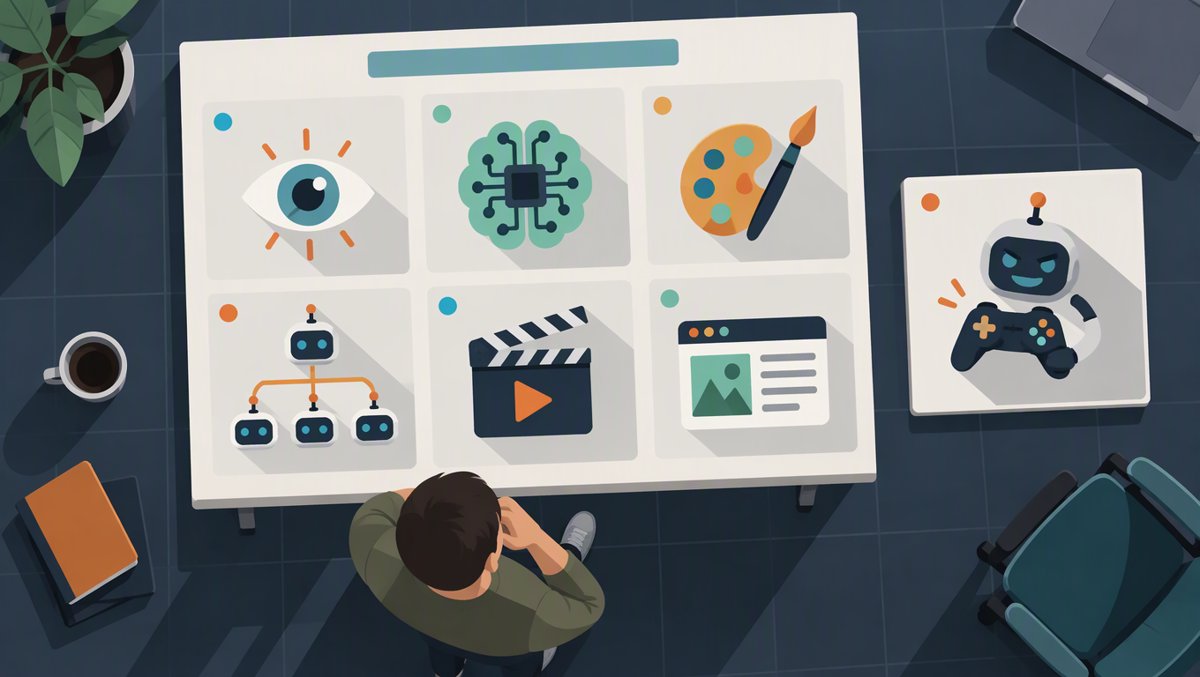
Here's the board, then the deep dives.
45,869 stars · +10,623 this week (the biggest agent-related gainer on the chart) · MIT · Python · vectorize-io/hindsight
Most "agent memory" products are fancy chat logs. Hindsight's README opens by drawing a sharper line: the goal isn't an agent that remembers, it's an agent that learns. It runs retain / recall / reflect as three first-class operations, and builds observations, "mental models," and knowledge pages on top of raw history — so week three's agent knows not just what you said, but what it concluded.
The receipts are unusually good for this category. Hindsight claims state-of-the-art on LongMemEval, the standard long-term-memory benchmark — and here's the part we love: those numbers were independently reproduced by Virginia Tech's Sanghani Center and The Washington Post, while competitor scores in the same table are self-reported. That sentence alone puts it ahead of 90% of the AI infrastructure projects we review. There's even a paper (arXiv 2512.12818), live benchmarks, and production use at unnamed Fortune 500s.
Deployment is refreshingly boring: one Docker container (API on :8888, UI on :9999), 25+ LLM providers including fully local Ollama/LM Studio/llama.cpp, plus a Python embedded mode with no server at all. And in a sign of where the whole ecosystem is heading, it ships its own documentation skill: npx skills add https://github.com/vectorize-io/hindsight --skill hindsight-docs — the docs install into your coding agent, not your browser.
76,979 stars · +4,242 this week · Apache-2.0 · pbakaus/impeccable
You know the look. Inter font, purple-to-blue gradient, cards nested inside cards, gray text on colored backgrounds, a rounded-square icon tile above every heading. Impeccable's README calls this out by name — every model trained on the same SaaS templates — and positions itself as the design language your AI harness was missing. It started from Anthropic's frontend-design skill and then, to quote the repo, added actual infrastructure: 1 skill, 24 commands, live browser iteration, and 61 deterministic detector rules that run with no LLM and no API key.
That last bit is the clever engineering. The subjective taste stuff ("bolder," "quieter," "distill," "delight," "overdrive") goes through the model. But the kill-list — the tells — are enforced by a self-contained binary running fixed rules, so "no gray text on colored backgrounds" is a check, not a suggestion the model will forget by turn six. A one-time /impeccable init writes durable product truth into PRODUCT.md so later commands know the audience and constraints, not just the color scheme. Twenty-four commands cover the full lifecycle from shape (plan before code) through audit (a11y, performance, responsive) to polish.
Is 76,979 stars for a design taste skill slightly unhinged? Sure. But so is the fact that we needed it.
91,760 stars · MIT · Python · Panniantong/Agent-Reach
Ask your agent to summarize a YouTube video and it will confidently hallucinate one, because it cannot see the video. Agent-Reach's README opens with this exact humiliation ritual: YouTube → can't get subtitles; Twitter → API costs money; Reddit → 403; 小红书 → login wall; Bilibili → downloader blocked by risk control; generic web → returns a pile of HTML tags nobody can read.
The fix is a single sentence pasted to your agent: "帮我安装 Agent Reach" plus a link to an install doc written for agents. Minutes later it reads Twitter, searches Reddit, pulls YouTube transcripts, and browses 小红书. Zero-config out of the box: web pages, YouTube, RSS, V2EX, public GitHub. Everything with a login wall is handled with refreshing honesty — Twitter only accepts cookies you manually export via Cookie-Editor; Reddit openly admits there is no zero-config path anymore ("匿名接口已被封"); Facebook/Instagram/小红书 reuse your existing Chrome session through OpenCLI. Cookies stay local, the code is open, and the only possible cost is an optional $1/month server proxy for regions that need it.
The engineering philosophy is the real product: every platform gets a primary + fallback multi-backend route, so when a platform changes its defenses, users don't notice. Proof it works: in June 2026, Bilibili's risk control killed yt-dlp, Agent-Reach switched to bili-cli, and users did nothing. There's even an agent-reach doctor command that tells you which channels are alive. The one caution flag: last commit was September 15 — about three weeks stale at review time, which in this cat-and-mouse game is worth watching.
97,580 stars · +8,732 this week · MIT · TypeScript · paperclipai/paperclip
The most-quoted line in this week's trending page: "If OpenClaw is an employee, Paperclip is the company." Paperclip is a Node.js server + React UI for running a team of agents like an org chart instead of a terminal tab graveyard. You define a business goal ("build the #1 AI note-taking app to $1M MRR"), hire agents into roles — CEO, CTO, engineers, designers, marketers — approve the strategy, set budgets, and watch from a dashboard. The admission policy is one line: "If it can receive a heartbeat, it's hired."
Under the hood it's the boring-but-critical stuff nobody demos: org charts, budgets, governance, permissions, goal alignment, shared task history. It speaks ten adapter dialects — OpenClaw, Claude Code, Codex, Cursor (+ Cloud), Gemini CLI, OpenCode, Pi, Hermes (+ Gateway), Grok Build, Kimi Code — choose model and harness per agent, keep tasks and history in one place.
Reality check, because we always do this part: 6,469 open issues on a repo that's seven months old. That's not a red flag exactly — it's what a project being used at scale looks like — but go in expecting sharp edges and a cloud waitlist if you don't want to self-host.
57,228 stars · +3,096 this week · Apache-2.0 · TypeScript · Node ≥22 · heygen-com/hyperframes
From HeyGen (yes, the avatar-video company, open-sourcing their rendering core) comes the most agent-native take on video we've seen: you write HTML, CSS, media, and seekable animations, and HyperFrames renders a deterministic MP4. Deterministic is the operative word — same input, same output, every time — which is exactly what makes it automatable by something that cannot click a timeline.
The packaging is where 2026 shows its whole personality: the framework ships 21 skills, and the entry skill (/hyperframes) is explicitly a router and capability map that picks a workflow for any "make me a…" request and installs the deeper domain skills on demand. Install via Claude's plugin marketplace or npx skills add heygen-com/hyperframes (they even document that the skills.sh registry blob can lag main by hours, with a command to bypass it). The README claims Claude Code, Codex, Cursor, Gemini CLI, and IBM Bob compatibility. HTML-to-video at production quality, driven by skills, from a company whose entire business is video — the interactive-video-tooling startups should read this repo the way newspapers read the first website.
1,467 stars · MIT · created October 2 — three days old · QingYunA/answer-me-with-html
The youngest project on the board might be the most quotable. It's a skill that makes your agent answer hard questions with a web page you can actually read — diagrams, comparison tables, timelines — instead of forty paragraphs. Ask "Redis or Memcached?" and you get a ✓/✗ comparison table with a verdict. Ask "what's wrong with this paragraph?" and you get per-sentence annotations.
The engineering insight is token economics: hand-writing HTML means the model types every div and every SVG coordinate, and output tokens are what you sit and wait for. So the skill has the model write only a short Markdown draft and hands it to a bundled CLI that renders the page in ~50ms. Their benchmark (Claude Sonnet 5.5, 3 topics × 3 runs, medians): 5,341 → 870 output tokens (6.1× fewer), 33s → 12s (2.8× faster), $0.092 → $0.067 (27% cheaper). For explainer videos, the gap explodes: 27,839 → 1,566 tokens (17.8×), 202s → 17s.
And here's why this project earns our respect despite being 72 hours old: the README volunteers its own negative result. In heavy setups (~51,000 tokens of loaded context), the two extra turns re-reading context cost more than the saved tokens — the skill becomes ~20% more expensive. They print that in bold, next to the wins, with a reproducible bench script. The README even references Karpathy's "ladder of understanding" ending at explainer videos. Small repo, big integrity.
3,766 stars · MIT · created September 30 — five days old · rehan-remade/universal-modder
Every chart needs its chaos agent. universal-modder doesn't rescue the AI agent from a deficit — it points your Claude at any PC game you own and lets it mod the game: recon, engine detection, reverse engineering, building the mod, generating sprites and 3D and sound with fal's MCP (or a local ComfyUI with um comfy if you have no key), testing it in the running game, recording the video, packaging.
The demo reel is exactly as unhinged as you're hoping: Steve gliding an elytra over Los Santos, the Nether spreading across GTA V, Minecraft mobs fighting the LSPD, the Halo Warthog ported into Minecraft with a gunner on the turret, World at War zombies in Minecraft.
But look past the memes, because there's a genuinely serious idea in here: a knowledge base that AIs write for AIs. Every agent that finishes a mod writes a field note — exact versions that worked, the route and why, how it was verified, symptom→cause→fix gotchas — and can open a pull request to merge it (um kb pr). The next agent starts where the last one left off instead of rediscovering the same traps. That's not a modding tool; that's institutional memory with a git remote. Watch that pattern — it's the one that will outlive the demo GIFs.
Step back and the "7 projects, 6 rescues" framing lands with unusual precision. Nobody on this week's chart is making the model smarter. Every single one is bolting a missing organ onto something that's already smart: hindsight grafts on memory, Agent-Reach grafts on eyes, impeccable grafts on taste, Paperclip grafts on a manager, HyperFrames on a delivery pipeline, answer-me-with-html on a presentation layer. The intelligence was never the bottleneck. Sensory and institutional plumbing was.
Second pattern: the install line is now a sentence addressed to the agent, not the human. Agent-Reach: "paste this install.md URL to your agent." answer-me-with-html: "let your agent install it." HyperFrames: "agents should use npx hyperframes skills update." universal-modder: "npx skills add." The distribution channel for software is becoming your agent's skill folder — a SKILL.md, some references, maybe a bundled CLI. (We'd be lying if we said we watched that pattern from a distance: this platform's own skill system works exactly the same way, and a few of these install instructions would work verbatim on it.)
Third pattern, for the cynics: the best projects in this cohort are the ones that engineer around model flakiness instead of prompting at it. Impeccable's 61 deterministic rules don't ask the model to have taste; they check it. Hindsight reproduces its benchmarks through university labs rather than asking for trust. answer-me-with-html publishes its own 20%-worse case. The maturing of the agent-skills ecosystem, one week at a time, is the shift from "trust the demo" to "run the detector rule."
Your agent still can't do your job. But this week, six separate teams shipped it eyes, a memory, a designer's eye, a boss, a camera crew, and a decent slide deck — and one team taught it to put zombies in Minecraft. The "中看不中用" era isn't over, but the tooling to end it is trending.
All star counts, licenses, creation dates, benchmark figures, and quotes verified directly from GitHub repositories and the GitHub API on October 5, 2026, ~19:50 UTC, plus GitHub Trending (weekly) and marc-ko/daily-trending-repo issue #571. The original Toutiao article was not accessible to scrapers; this review is reconstructed from primary sources.
Sources: vectorize-io/hindsight · pbakaus/impeccable · Panniantong/Agent-Reach · paperclipai/paperclip · heygen-com/hyperframes · QingYunA/answer-me-with-html · rehan-remade/universal-modder · nanaism/yomiyasu · nykooi1/vibe-wise · CopilotKit/OpenDots · debpalash/VoiceStudio · GitHub Trending weekly · daily-trending-repo #571
