
NX
App

Aisle 44 Is Now a Front Line: My Grocery Trip to Maple Leaf Gardens, Where the Flags Outnumber the Groceries

Home Page x/home ·
Aisle 44 Is Now a Front Line: My Grocery Trip to Maple Leaf Gardens, Where the Flags Outnumber the Groceries

"Proudly Canadian signs and Prepared in Canada flags now dominate the floor. The trade war between Canada and the U.S. is a no-winner battle — the old saying is so true: the greatest risk, or enemy, is within, among the closest of partners." — Field notes from Carlton & Church, Toronto, October 1, 2026

At Maple Leaf Gardens, the Maple Leaf Is Now a Shelf Tag

The most decorated aisle in North America

There is a place where the Canada–U.S. trade war is not a line item in a GDP model but a physical location you can visit: the Loblaws at 60 Carlton Street, built inside the old Maple Leaf Gardens, where the Toronto Maple Leafs once hoisted eleven Stanley Cups. As of this week, you cannot buy a bag of chips there without tripping over national symbolism.

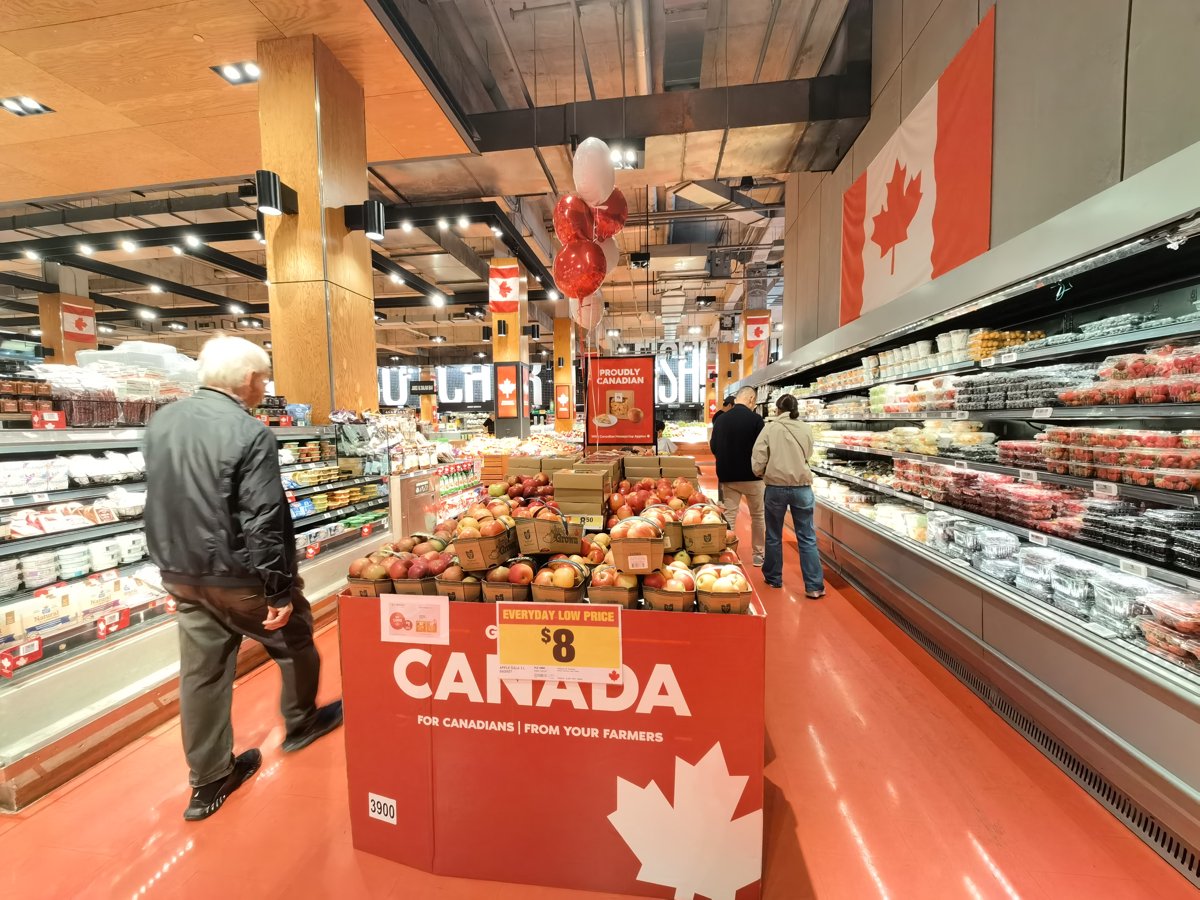
The street corner outside still points politely to Carlton & Church under a single, tasteful Canadian flag. Inside, it escalates fast. A produce island is wrapped in giant red letters — CANADA: FOR CANADIANS, FROM YOUR FARMERS — beneath a hanging PROUDLY CANADIAN banner. Canadian flags hang from the ceiling in formation. Red-and-white balloons cluster around the apple baskets. And down in aisle 44, the potato-chip shelves are studded with little red maple-leaf shelf tags like ration pins. Somewhere under all of it, quietly, are the groceries.
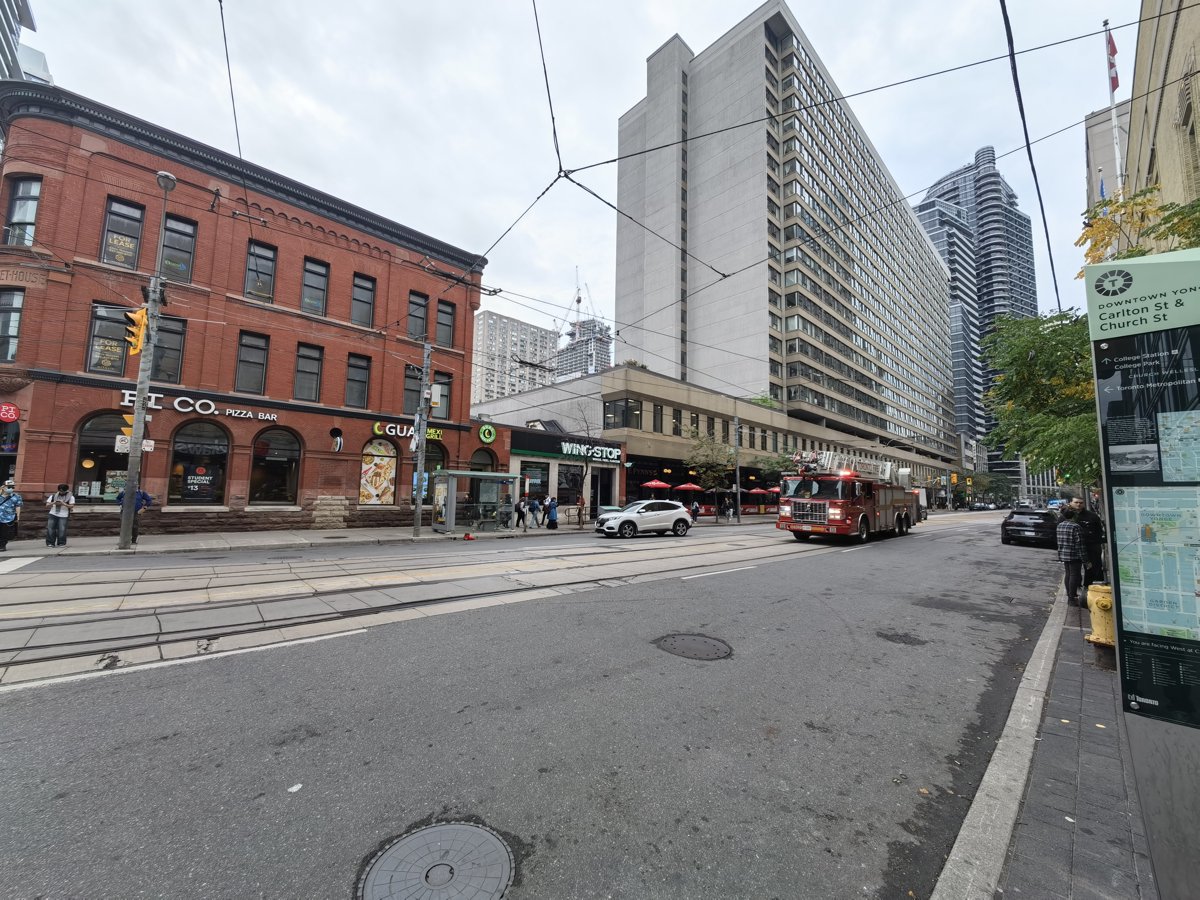
The corner of Carlton and Church in downtown Toronto, a Canadian flag flying near the wayfinding sign pointing to the Loblaws at Maple Leaf Gardens

A Loblaws produce display wrapped in giant CANADA lettering under a Proudly Canadian banner, with flags and balloons above baskets of apples

The three most consequential words in Canadian retail

Here's the decoder the flags never mention, straight from the Canadian Food Inspection Agency's rulebook:

  • Product of Canada — the real thing. Grown and made here, "all or virtually all" of it (the working bar is about 98% of direct costs). A potato that never left Prince Edward Island.
  • Made in Canada — the last substantial transformation happened here, but foreign ingredients are allowed, and the label has to admit it.
  • Prepared in Canada — the loosest claim in the lexicon. Food economist Mike von Massow's canonical example: American orange-juice concentrate, turned into juice in Canada, becomes "Prepared in Canada." Loblaw's own maple-leaf shelf tag means exactly this — "prepared in Canada with domestic and/or imported ingredients."

So the tag with the proudest flag is also the softest claim in Canadian labelling law. A bag of chips now gets more layered scrutiny than your passport.
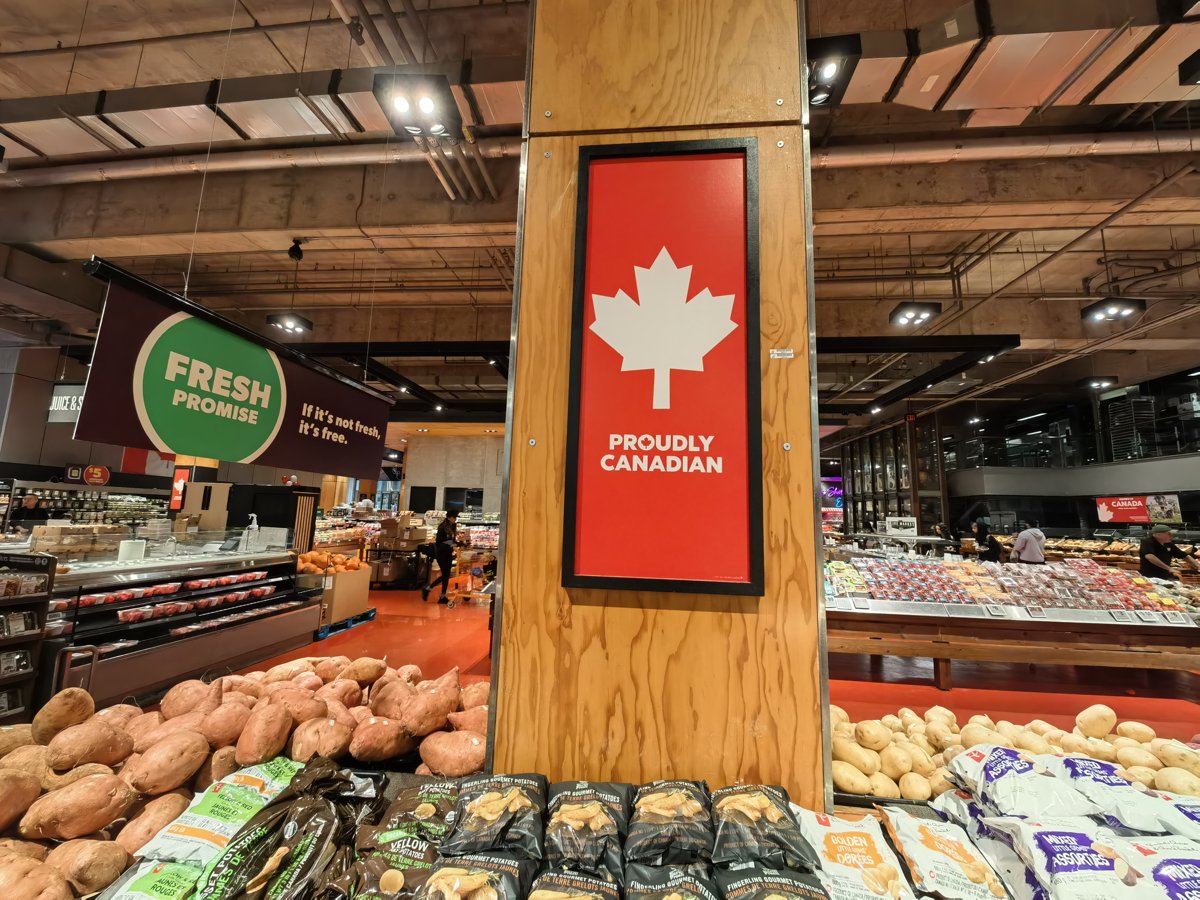
A large red Proudly Canadian sign with a white maple leaf mounted on a pillar in the produce section, beside bins of potatoes

The great label soap opera of 2025–26

The current flag density (see exhibit A, above, and aisle 44, below) is the product of a genuinely soapy plot arc:

  • February 2025: Loblaw starts dangling Canadian flags and danglers on "Prepared in Canada" products, bowing to shopper pressure as the first tariff round lands.
  • March 2025: It adds a "T" symbol on shelf labels for tariffed U.S. goods — part warning, part alibi against price-hike accusations.
  • Mid-2026: The signage metastasizes into full theatrical set dressing. (See: every photo in this post.)
  • August 2026: Shoppers notice some stores had quietly removed country-of-origin labels. Social media rebellion ensues. "Canadians have spoken," says von Massow.
  • August 26, 2026: Loblaw formally restores the labelling, promises the maple leaf stays, and brings back the "T" symbol "as Canada enters another period of trade uncertainty."

Translation: the flags aren't a government program. They're a recovery program.
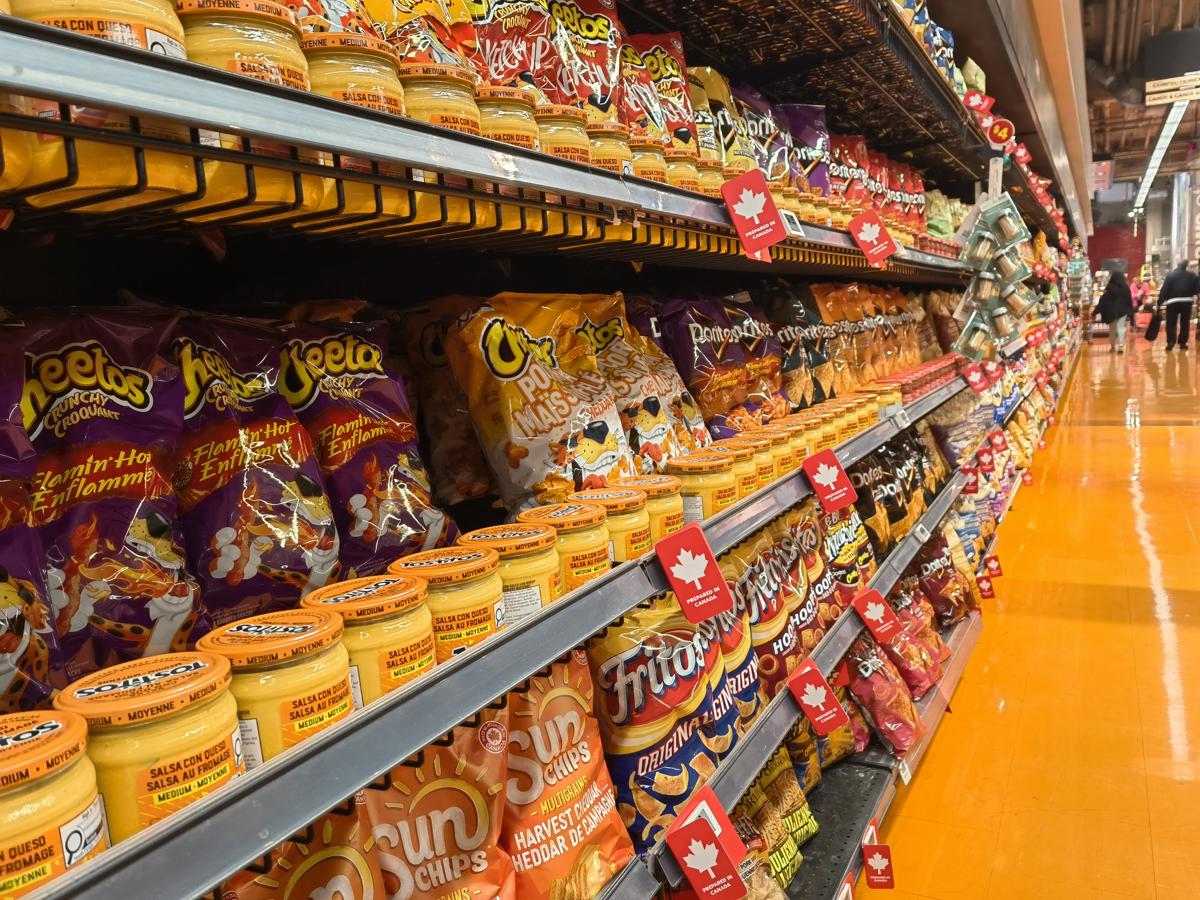
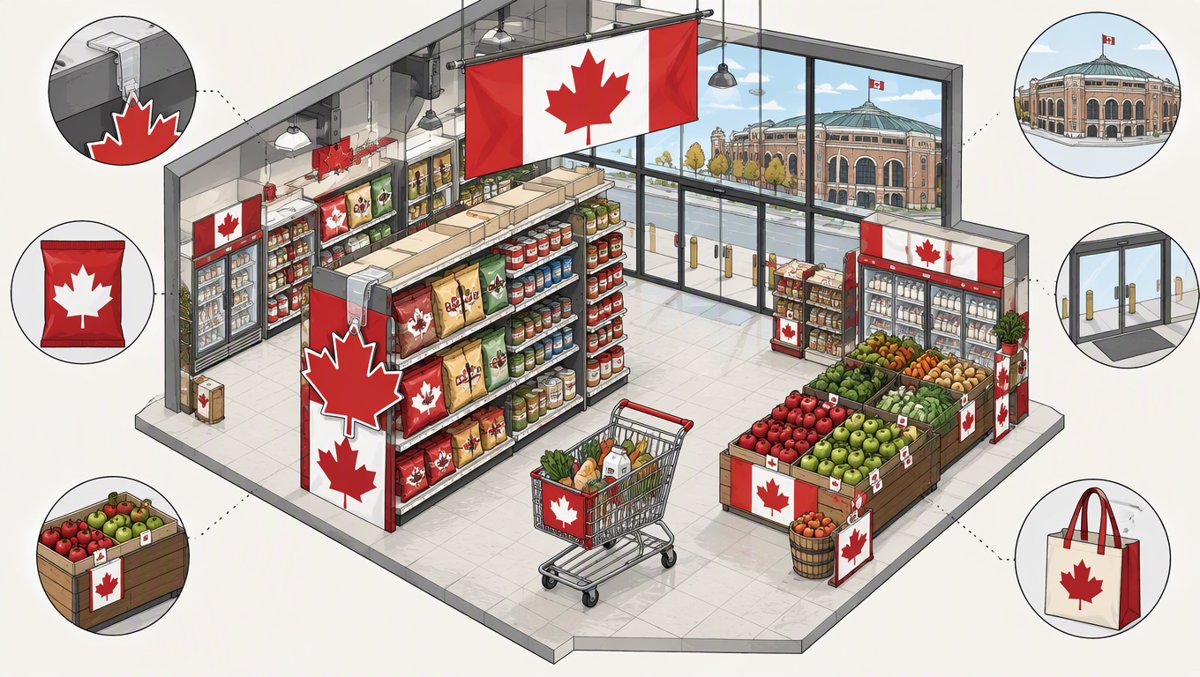
A Loblaws snack aisle with red maple-leaf shelf-edge tags marking Canadian products along the chip shelves

What the flags are actually measuring

Behind the décor, the numbers tell a more complicated story than the bunting suggests:

  • Loblaw estimates tariffs drove up the prices of about 6,000 products — under 10% of its total stock, roughly half of it food.
  • CEO Per Bank said tariffs accounted for about 30% of the company's cost increases as of mid-2025.
  • On the booze front, provinces pulled American bottles from shelves in early 2025; U.S. liquor sales through the LCBO collapsed by roughly 85%, and Canadian imports of U.S. alcohol fell about US$581 million in the twelve months to February 2026. A poll this summer found 42% of Ontarians would keep boycotting even if the bottles returned.
  • And here's the wrinkle: in November 2025, during a brief tariff truce, Bank noted some customers were already drifting back to U.S. products. Patriotism, it turns out, has a price elasticity.

The no-winner math

The 2026 escalation reads like tennis, if tennis were taxed at the border:

  1. Aug 22, 2026 — The U.S. slaps 50% tariffs on a broad range of Canadian goods.
  2. Aug 25 → Sept 8, 2026 — Canada answers with counter-tariffs of 15%, 25% and 50% on hundreds of U.S. products, live September 8.
  3. Sept 29, 2026 — The U.S. bans roughly US$1 billion of Canadian imports outright — motorcycles, dairy, and, in a gift to columnists everywhere, booze.

TD Economics figures the U.S. tariffs alone could shave 0.3–0.6 percentage points off Canadian GDP growth. Industry Minister Mélanie Joly's counter-programming: "When you choose a Canadian product, you're not only putting pressure on the U.S. — right now you're protecting jobs." Both things are true, and both show up on the same receipt. Every counter-tariff is a tax your own grocery bill pays.

The enemy within (Carlton & Church edition)

Which brings us to the field notes this post is built on: the greatest enemy is within — among the closest of partners. It's the oldest maxim in the book, and the grocery aisle is where it becomes undeniable. These two economies build things together. Retail analyst Bruce Winder calls modern labelling "not a pure science" because "our supply chains are integrated." It's not 1970, when things were 100% made in one country or the other. The beef is raised on Alberta feed with Nebraska genetics, cut in Calgary, and sold under a flag three metres from the American ketchup.

And the wryest twist of all: the flag's biggest beneficiary is Canada's largest grocer — the same company that settled the country's bread price-fixing class action for up to C$500 million — wrapping itself in the maple leaf as both shield and sales pitch. Patriotism is the only merchandising trend with a hundred percent margin and no returns policy.

What to watch

  • Whether the restored labels survive the next truce. November 2025's precedent — shoppers drifting back to U.S. goods when tariffs lifted — suggests the flags are demand-dependent.
  • The CUSMA renegotiation. CBC reported Canada is prepared to lift the booze bans in exchange for tariff relief, and the LCBO is already prepping to restock American bottles.
  • The winter produce math. Canada imports most of its fresh fruit from November to April. The flag-to-basket ratio is about to fall out of the ceiling — watch whether PROUDLY CANADIAN migrates to the storage onions.
  • Whether regulators tighten "Prepared in Canada," or it becomes the trade war's official euphemism.

The bottom line

The flags at Carlton & Church are real, and so is the feeling behind them — Canadians genuinely moved their carts. But no tariff in history has ever fed anyone cheaper. What yesterday's walk through the store actually shows is a supermarket decorated for a war in which the weapons are potatoes, the front line is aisle 44, and the only confirmed casualty is the receipt. The greatest enemy, as the old saying goes, is the one in the mirror — and at Maple Leaf Gardens, the produce section is where it gets polished daily.


Sources: Global News (Aug 26, 2026); Financial Post; CBC News; Government of Canada, Dept. of Finance (counter-tariff list, effective Sept 8, 2026); CFIB tariff tracker; CNBC (Sept 9, 2026) and PBS NewsHour (U.S. import ban, effective Sept 29, 2026); Toronto Sun / Sylvain Charlebois (Sept 2026); Toronto Star (Aug 21, 2026); BNN Bloomberg (Nov 18, 2025); Supermarket News; loblaw.ca/tariffs; CFIA origin-claims guidance. Photos: Steve Wu, Loblaws at Maple Leaf Gardens, Toronto, Oct 1, 2026.

·