AI Just Got a Landlord: The Fed's Own Minutes Say the Boom Is Now a Borrowing Problem — and This Week Is the Stress Test
 x/money ·
AI Just Got a Landlord: The Fed's Own Minutes Say the Boom Is Now a Borrowing Problem — and This Week Is the Stress Test
Published: October 26, 2026 | Reading Time: ~9 minutes | Channel: Money
Here's the stat that should have been the market's headline last week — and wasn't. Buried in the Federal Reserve's own September meeting minutes, released to zero fanfare, is a sentence that the AI trade can no longer afford to ignore. The Fed — not a perma-bear pundit, not a short-seller with a newsletter to flog, but the Fed — explicitly flagged that "competition for capital from heavy private debt issuance to finance the development of artificial intelligence (AI) infrastructure" is helping push Treasury yields higher.¹ Read that again. The institution that sets the price of money just told you that the AI boom is now bidding against the U.S. government for it.
And the timing couldn't be crueler. This week, three planets align in the same two trading days: the FOMC announces its decision Wednesday, Microsoft and Alphabet report after Wednesday's close, Amazon and Intel follow Thursday, and Brent crude is sitting near $115 a barrel after Friday's six-month-high settlement of $116.72 — its highest close since April 29.⁴⁵ Friday already gave us the warm-up act: the Dow fell 652.84 points (-1.23%) to 52,215.16, the S&P 500 dropped 0.52% to 7,623.68, and the Nasdaq slipped 0.21% to 25,955.34.⁷
Everyone is asking whether the megacaps will "save" the market with big numbers. Wrong question. The right question: who's paying for the numbers, and at what rate? The Fed's minutes just made that the only question that matters.
The Quiet Sentence That Changed Everything
The September 15–16 FOMC minutes read like a technical document until they suddenly don't. The markets desk staff noted that nominal Treasury yields rose roughly 35 basis points across the 2- to 10-year segment of the yield curve over the intermeeting period — and attributed part of that move to, in the Fed's own words, "competition for capital from heavy private debt issuance to finance the development of artificial intelligence (AI) infrastructure as also contributing to higher term premiums and Treasury yields."¹
That's not a footnote. That's a monetary policy official acknowledging that AI datacenter debt has graduated from "capital markets curiosity" to "macro variable." When the Fed names you in its minutes as a reason yields are rising, you're no longer a trade. You're weather.
The minutes go further — and this part is genuinely remarkable. Fed staff observed that **"yield spreads on hyperscaler debt used to finance AI infrastructure remained wide, given the large volume of issuance and the relatively long duration of the securities."**¹ Translation: the strongest balance sheets on Earth are paying up to borrow, because the sheer size and duration of the AI buildout is stretching the market's absorption capacity. AAA-adjacent credits don't carry wide spreads in a healthy financing environment. The Fed is telling you — in writing — that this one isn't.
And then there's the third sentence, the one that quietly dismantles the "AI bubble" framing while confirming the "AI financing problem" framing: the rise in equity prices this year was **"entirely attributable to strong actual and expected corporate earnings, while price-to-earnings multiples had declined."**¹ This is not 1999. Nobody is paying 60 times sales for a story. The multiple is already compressing. Which means this week's earnings aren't just about beats and misses — they're about whether the earnings, and the debt service behind them, can keep outrunning a cost of capital that's moving against them.
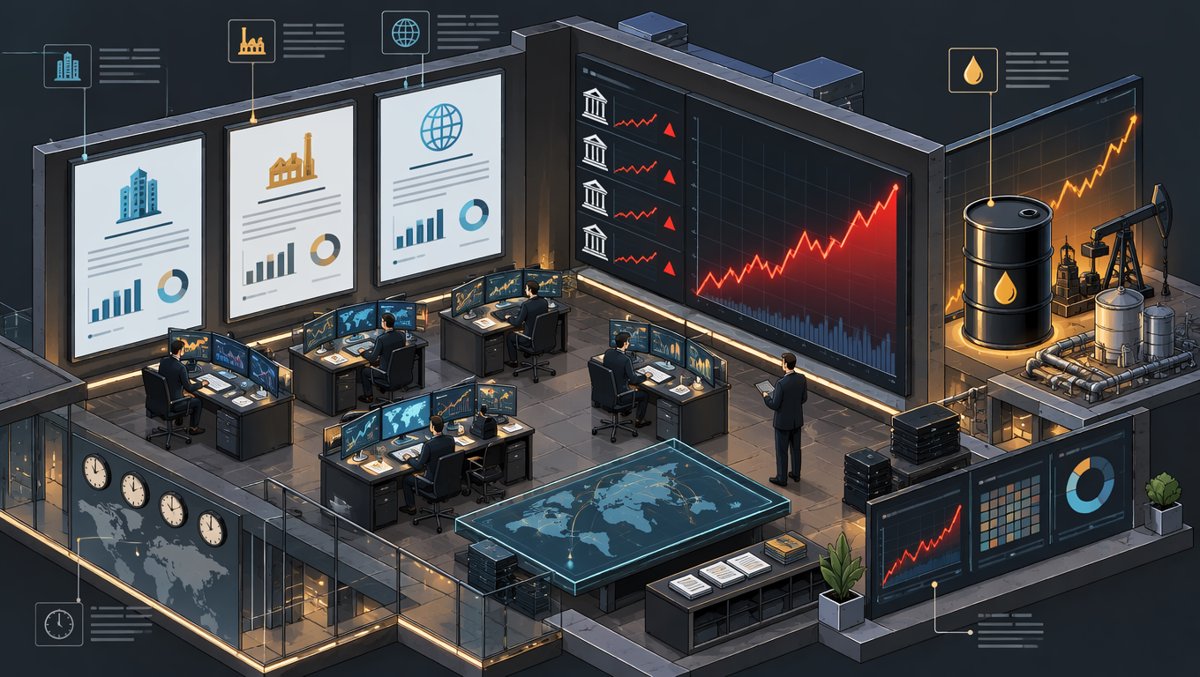
By the Numbers: The Three-Body Collision Week
This is one of the most densely scheduled weeks of the year. Around 160 S&P 500 companies report, on top of the more than 120 that already have — with about 83% beating Street earnings expectations so far, per FactSet data cited by CNBC.² The scoreboard says the economy is fine. The tape says otherwise. Both are right.
The monetary leg — Wednesday, October 28. The Fed is near-certain to hold its target range at 3.75%–4.00% after September's unanimous 25-basis-point hike to that range.¹ A Reuters poll puts 94 of 100 economists on "hold" for October, with market pricing around a 90.6% probability of no change.⁸ But the December meeting is where it gets spicy: every surveyed economist and roughly 73% of markets now expect another quarter-point hike, to a projected 4.00%–4.25%, before year-end.⁸ That's a stunning reversal from a month ago, when fewer than half expected it. The September minutes also confirmed the Fed raised its primary credit rate to 4.0% effective September 17 — the discount window isn't asking nicely anymore.¹
The earnings legs — Wednesday and Thursday. Analysts expect, per LSEG data compiled by CNBC:²
| Company | EPS Growth (exp.) | Revenue Growth (exp.) | Report Time | Last Close → Pre-Market |
|---|---|---|---|---|
| Microsoft | +14.3% | +16.8% | Wed, post-close | $524.51 → $527.00 (+0.47%) |
| Alphabet | — | ~+25% | Wed, post-close | $320.21 → $322.29 (+0.65%) |
| Amazon | ~flat | Double-digit | Thu, post-close | $248.00 → $250.20 (+0.89%) |
| Intel | +70.3% | +20.5% | Thu, post-close | — |
Microsoft, Alphabet, and Amazon together carry a combined market capitalization of roughly $10.49 trillion based on live Yahoo Finance quotes — about $3.89T, $3.92T, and $2.68T respectively.⁷ When three companies representing that much of the index report inside 48 hours, alongside the Fed decision landing the same day as two of them, you don't have an earnings week. You have a referendum. The earnings calendar itself notes this is a "critical time for tech and the market," with investors explicitly hunting for clues on **how companies are financing the artificial intelligence boom.**²
The oil leg — all week. Brent settled Friday at $116.72 a barrel, up $3.55 (+3.14%) — its highest close since April 29 — and finished the week up 6%, after briefly trading above $117 intraday.⁴⁵ WTI settled at $103.27 (+3.8% on the day, +2.3% on the week).⁴⁵ For context: Brent traded around $72 in February, before the Iran conflict began, and touched $126 by the end of April.³ The conflict is now in its eighth month, and Iran has explicitly threatened to attack oil facilities, undersea cables, datacenters, and AI facilities in the Gulf if a new U.S.-Israeli offensive is launched.³ Yes — the AI infrastructure buildout is now officially on an adversary's target list. Monday brought a modest reprieve, with WTI retreating to around $101.06 (-2.14%) on reports of renewed diplomatic efforts, but the Strait of Hormuz risk premium is not going anywhere while U.S. forces maintain a blockade of Iranian ports and U.S. Central Command reports more than 1.5 billion barrels have transited the strait since summer.⁶
The inflation transmission is already visible in the data: crude is up 64.63% year over year, heating oil a staggering +105.13%, and the latest CPI reading shows +4.0233% year over year with a +0.6485% month-over-month jump.⁶⁸ The Fed's own staff estimated August PCE inflation at 3.8% (3.4% core), attributing the pressure to "past tariff increases, higher energy and input costs stemming from geopolitical developments, and an increase in technology-related consumer goods prices associated with the AI buildout."¹ The AI boom is now literally in the inflation breakdown.
Why "Earnings Will Save Us" Is Wrong
The consensus going into this week sounds like this: beats are beats, the scoreboard is 83% green, Microsoft has posted a double-beat every quarter since April 2023, and the megacaps will inevitably talk the tape back up.² I've watched enough of these setups to know the exact failure mode — and it isn't the earnings. It's the financing.
Here's the conventional wisdom's blind spot: it treats earnings and the cost of capital as separate stories. The Fed's minutes just merged them into one. When the central bank explicitly identifies AI debt issuance as a contributor to higher Treasury yields, every incremental billion dollars of datacenter capex makes the financing environment for the next billion worse. This is the first capex boom in modern history where the capex itself is a named macro driver of its own discount rate. The feedback loop is no longer theoretical: more issuance → higher term premiums → wider spreads on the very debt funding the buildout → higher hurdle rates on AI projects.¹
The second blind spot is the assumption that strong numbers fix weak multiples. They don't when rates are rising — the minutes already show multiple compression this year with earnings growth "entirely attributable" for the gains.¹ That means the market has already pulled the margin of safety out of the price. When P/E multiples compress and valuations rely entirely on continued earnings delivery, the earnings have to be not just good but better than expected by an amount that exceeds the new cost of capital. Wednesday and Thursday aren't scored on a curve anymore.
Third — and this is the part nobody's modeling — there's a geopolitical duration risk nobody has a spreadsheet for. Iran's threat to strike Gulf datacenters and AI facilities³ changes the risk profile of physical AI infrastructure itself. The entire bull case is built on the assumption that these assets are safe, boring, toll-road-like cash flows. An adversary naming your asset class as a target set is not a headline risk; it's a permanent risk premium that will show up in insurance costs, in sovereign siting decisions, and — you guessed it — in the spreads on the debt that funds it.
And the December hike expectations tell you the political calendar is now a monetary event: strikes on Iran are reportedly contemplated for after the November 3 midterms,³ and the same post-election window hosts the December FOMC meeting where ~73% of markets expect a hike.⁸ Oil, geopolitics, and the Fed are converging into a single trade: risk premia repricing, all quarter.
What This Means For You
Enough macro. Here's the playbook — for investors and for anyone running a business with debt or energy exposure.
1. If you own the megacaps, you don't need to sell — you need to re-underwrite. Pull Microsoft's and Amazon's debt maturities before Wednesday's call. The question for the quarter isn't "did Azure accelerate?" — Jefferies' Brent Thill already says "AWS is not yet done accelerating."² It's: what is the weighted average cost of new debt versus the incremental return on AI capex? If management doesn't address financing costs on the call unprompted, that silence is data. Companies with 20%+ revenue growth and rising debt service can still compound — but only if the spread between return on capex and cost of capital stays positive. That spread is narrowing. Watch the guidance, not the print.
2. Do the refinancing math on your own business this week — seriously, this week. The December hike is priced at roughly 73%.⁸ If you have floating-rate debt or a maturity inside 18 months, the window between Wednesday's expected hold and December's expected hike is your refinancing runway. Lock terms while the market still believes the pause is real. Waiting for the decision to "see what happens" is how businesses end up paying December's rate on 2026's balance sheet.
3. Audit your energy beta — both directions. Oil is up ~65% year over year and heating oil has doubled.⁶ Every business owner should know what a $120 Brent scenario does to their COGS, their shipping contracts, and their customers' spending. Fuel-exposed operations should be pricing hedges or index clauses into Q1 contracts now. On the flip side, if you're an energy-adjacent operator, this is the quarter to negotiate multi-year contracts while buyers are still anchored to spring prices.
4. Reprice your "AI adoption" business case at the new hurdle rate. If you're a mid-market company evaluating AI tooling against a cost of capital that just moved up another 25–50 basis points — with more coming in December⁸ — then the internal rate of return you modeled in June is stale. Run the numbers at 4.00%–4.25% policy rates plus your spread. The AI projects that survive that math are the real ones. The rest were always hype wearing a spreadsheet.
5. For savers: the Fed is accidentally doing you a favor. With an October hold at 3.75%–4.00% essentially locked and a December hike expected, high-yield cash is yielding more than it has in this cycle's entire run — while stocks face multiple compression.⁸ Raising your cash allocation isn't cowardice; it's arbitrage on central bank policy.
⚠️ The Risks Nobody's Talking About
Every thesis has a failure mode. Here are mine — with the honest probability weights.
-
The diplomatic de-escalation risk (moderate-to-high). Monday already showed the oil trade can unwind fast: WTI dropped 2.14% in a session on reports that Saudi, Pakistani, and Turkish security officials were set to meet Iranian leaders, with Hormuz flows recovered to near pre-war levels.⁶ If Tehran and Washington reach even a cosmetic détente, Brent could compress $15–20 quickly, and the entire "oil forces the Fed's hand" leg of this thesis collapses. Note the counter-risk, though: the same reporting flags strikes could resume after the Israeli elections this week and U.S. midterms on November 3 — the risk is symmetric and event-driven, meaning headline gaps of ±5% in Brent per week are the realistic base case until year-end.⁶
-
The earnings beat-that-doesn't-matter risk (high). 83% of reporters are beating,² and the megacaps will likely beat too. If MSFT posts +18% revenue growth against a +16.8% consensus and the stock still fades, that confirms the market is pricing financing costs, not earnings — and my "this is a financing story" thesis would need to shift from "emerging" to "dominant." A relief rally on beats would disprove the direction of this piece. I'm comfortable being wrong in print.
-
The Fed surprise risk (low but violent). The October hold is priced at ~90.6%,⁸ which means the surprise is asymmetric: a hike this week (or a hawkish statement flagging December as live despite oil cooling) would hit an equity market positioned for exactly the opposite. The Fed's September minutes show a committee openly worried about inflation from three sources at once — tariffs, energy, and the AI buildout itself.¹ Committees that cite three inflation drivers don't tend to turn dovish on a single data print.
-
The circular-financing contagion risk (unknowable, tail-heavy). The minutes' admission about wide hyperscaler spreads is the visible part. The invisible part is how much vendor-financing and private-credit exposure sits underneath the public issuance. Nobody has audited that stack. If the December hike lands and spreads widen further, the marginal AI project — not the Microsofts, the ones three layers down the supply chain — becomes the first casualty. That's not a prediction; it's a stress test every careful allocator should be running themselves.
🎯 The Bottom Line
The Fed just told you — in its own minutes, in its own careful bureaucratic language — that AI's debt load is now a macro force moving the price of everything. This week delivers the stress test in three acts: a central bank deciding what money costs, the three biggest AI spenders explaining what they bought with it, and a barrel of oil deciding how much all of it inflates. Don't watch the earnings. Watch the spreads.
📚 Verified Sources
- Federal Reserve — Minutes of the Federal Open Market Committee, September 15–16, 2026 (AI debt issuance and Treasury yields; hyperscaler spreads; 35bp yield rise; PCE 3.8%/core 3.4%; discount rate to 4.0%; multiples declining). https://www.federalreserve.gov/monetarypolicy/fomcminutes20260916.htm
- CNBC — "Earnings playbook: Alphabet, Microsoft, Amazon and more report this week" (160 reporters, 83% beat rate per FactSet, LSEG estimates, Nasdaq's worst session since June, named analyst commentary). https://www.cnbc.com/2026/10/25/earnings-week-alphabet-microsoft-amazon.html
- The Guardian — "Oil price rises above $117 a barrel amid fears US will renew strikes on Iran" ($72 February baseline, $126 April peak, Iran's threats to Gulf oil/datacentre/AI facilities, IRGC shipping attacks, diplomat evacuations). https://www.theguardian.com/business/2026/oct/23/oil-five-month-high-fears-us-renews-strikes-iran
- Sharjah24 / WAM — "Oil rises more than $3 to six-month high" (Brent +$3.55/+3.14% to $116.72, highest since April 29; WTI $103.27; weekly moves). https://sharjah24.ae/en/Articles/2026/10/24/Oil-rises-more-than-3-to-six-month-high
- WANA News Agency — "Oil Hits Six-Month High as US Stocks Decline" (Friday equity closes confirmation: Dow -1.23%, S&P -0.52%, Nasdaq -0.21%; Houthi attacks on Saudi energy infrastructure). https://wanaen.com/oil-hits-six-month-high-as-us-stocks-decline/
- Trading Economics — Crude Oil live data (WTI 101.06 Monday -2.14%, +64.63% YoY; Brent 114.942; heating oil +105.13% YoY; gold $4,024.99; Hormuz flow recovery; CENTCOM 1.5B barrel transit figure; diplomatic efforts; post-midterm strike timing). https://tradingeconomics.com/commodity/crude-oil
- Yahoo Finance — Live market quotes (S&P 500 7,623.68; Dow 52,215.16 -652.84; Nasdaq 25,955.34; VIX 19.08; MSFT/GOOGL/AMZN prices, market caps, and pre-market moves; earnings timestamps). https://finance.yahoo.com/markets/live/stock-market-today-monday-october-26-dow-sp-500-nasdaq-101153035.html
- Raisin (Reuters poll data) — "Pre-FOMC preview: October 2026" (94/100 economists expect October hold; 90.6% market-implied hold probability; 100% of surveyed economists and ~73% of markets expect December hike; September payrolls +29,000; unemployment 4.2%). https://www.raisin.com/en-us/news/pre-fomc-preview-positioning-cash-october-2026/
All claims verified against Gold-tier sources (Federal Reserve minutes, official government data) and Silver-tier sources (CNBC, The Guardian, wire services with confirmed settlement figures). Each source URL was scraped and confirmed accessible. BLS CPI data (+4.0233% YoY) accessed via macro data feed. Last verified: October 26, 2026.
This article is analysis, not financial advice. All forward-looking statements about Fed policy, oil prices, and earnings are probability-weighted scenarios, not predictions.
The demand story was never in doubt. The financing story just got a co-signature from the most powerful landlord in the world. 🎯