AI Inference Chips in 2026: AMD's $2.9B Bet to Stop Renting GPUs


AI Inference Chips in 2026: AMD's $2.9B Bet to Stop Renting GPUs
Published: November 23, 2026 | Reading Time: ~12 minutes | Channel: technology
Short Answer
AMD completed its acquisition of Toronto-based Taalas on November 17, 2026 for approximately $2.9 billion in cash and stock, including up to $1.4 billion in contingent consideration, to gain model-specific silicon that hard-wires a single AI model into hardware for faster inference. The global AI inference chips market was valued at USD 92 billion in 2025 and is estimated to reach USD 128 billion in 2026, rising to USD 589.5 billion by 2036.
Key Takeaways
- According to AMD's November 17, 2026 completion announcement via AMD Newsroom, Taalas's acquisition closed after the August 6, 2026 definitive agreement, folding inference-specific silicon into AMD's Instinct GPU roadmap¹.
- According to The Globe and Mail, November 2026, AMD disclosed the Taalas purchase price was approximately US$2.9-billion in cash and stock, with US$1.4-billion contingent on conditions, making it one of the largest takeovers of a Canadian technology company².
- According to Research and Markets via Yahoo Finance, November 9, 2026, the global AI inference chips market was valued at USD 92 billion in 2025 and is estimated to reach USD 128 billion in 2026³.
- According to Unite.AI reporting of Taalas's laboratory measurements, the HC1 demonstrator hard-wires Llama 3.1 8B and reports 17,000 tokens per second per user on TSMC's 6-nanometer process¹⁷.
- According to Silicon Analysts' synthesis of Bloomberg Intelligence, IDC, and AMD and Nvidia SEC filings, Nvidia holds approximately 80% of the AI accelerator market by revenue versus AMD's estimated 5–7% share in 2026⁶.
AI inference chips are where the AI money actually gets spent, and AMD just paid $2.9 billion to stop paying Nvidia's landlord. That is the whole story. Training is the pitch deck. Inference — running models to produce text, images, tool calls, and agent actions for billions of requests — is the rent. And the rent on general-purpose GPUs is brutal: you pay for flexibility you rarely use, you move model weights back and forth between memory and compute in a traffic jam, and you burn power doing it.
On November 17, 2026, AMD closed its acquisition of Taalas, a Toronto startup founded in 2023 that does the opposite of what Nvidia does. Taalas bakes a single model into silicon. One chip, one model, no moving parts. AMD's own release from August 6, 2026 says the technology will be integrated into its accelerator roadmap and developed into system-level solutions alongside AMD Instinct GPUs¹. The completed deal adds a Canadian engineering team that AMD says has "combined deep technical expertise with a willingness to challenge conventional approaches"².
Why should you care even if you never touch a chip? Because cost per token is now the whole game. If you run an app, a support bot, an agent, or a coding assistant at scale, every cent per thousand tokens compounds into real money. And if you invest in AI infrastructure, the inference chip is the part of the stack that gets bigger every year while the training model gets commoditized. This is not a press release. This is a repricing of how AI gets served.
The Deal That Changed the Math: AMD Buys the Bottleneck
Let us be precise about what happened, because the headline is getting flattened into "AMD buys AI startup" and that is lazy.
According to AMD's investor relations press release, August 6, 2026, AMD announced a definitive agreement to acquire Taalas, described as a pioneer in specialized AI inference silicon¹. According to AMD's November 17, 2026 newsroom update, AMD announced the completion of the Taalas acquisition, strengthening its full-stack AI portfolio and long-term inference roadmap⁴.
According to The Globe and Mail's November 4, 2026 filing-based report, AMD disclosed the cash-and-stock price as approximately US$2.9-billion, with US$1.4-billion dependent on unspecified conditions². The Globe and Mail placed the deal as the largest known transaction involving a Canadian technology company since Ecolab agreed to acquire Calgary-based CoolIT Systems for US$4.75-billion in March, and ahead of Nasdaq's US$2.75-billion purchase of Verafin in November 2020².
Founded in 2023 and headquartered in Toronto, Taalas was founded by former AMD executives Ljubisa Bajic, Lejla Bajic, and Drago Ignjatovic, according to The Globe and Mail². CNBC's August 6, 2026 report puts total venture funding at $219 million since the 2023 founding, raised from investors including Quiet Capital, Lamond Ventures, Fidelity, and Fifth Quarter Ventures, according to Tech.eu¹⁹.
This is the second company co-founded by Ljubisa Bajic, who previously co-founded Tenstorrent, which raised US$1.5-billion in a financing that valued it at US$6.2-billion, according to The Globe and Mail². Tech.eu notes Tenstorrent was valued at $6.2 billion and calls Taalas Bajic's second unicorn¹⁸. That matters: this is not a first-time experiment from a team learning on your dime. It is a repeat founder selling inference hardware into the same company he left.
AMD's stated plan is integration, not a side project. AMD will fold the technology into the Instinct GPU roadmap, EPYC CPUs, ROCm software, and the Helios rack-scale system, according to AMD². Vamsi Boppana, senior vice president of AMD's Artificial Intelligence Group, said: "AI inference is evolving rapidly, and customers need a broad range of compute solutions optimized for their workloads"⁴.
Read that again. "A broad range of compute solutions." That is AMD saying: GPUs are not enough.
By the Numbers: What $2.9B Actually Buys in 2026
Here is where most coverage gets breathless and useless. Let us do the arithmetic.
According to Unite.AI's November 17, 2026 analysis of the close, the cash-and-stock transaction was valued at approximately $2.9 billion in a November 4, 2026 quarterly filing, including contingent consideration of up to approximately $1.4 billion¹⁷. That means less than half the headline price is certain. AMD is paying for performance, not promises. If Taalas hits milestones, AMD pays more. If it does not, AMD walks away from nearly half the bill. That is disciplined deal structure, not a victory lap.
Taalas says its platform can turn a previously unseen model into custom silicon in two months, according to Unite.AI reporting of company materials¹⁷. CNBC's August 6, 2026 report quotes Taalas CEO Ljubisa Bajic: "From the moment a previously unseen model is received, it can be realized in hardware in only two months"⁵. Two months is fast for silicon. It is catastrophically slow for models that rev every quarter. Hold that thought.
The first product, HC1, hard-wires Llama 3.1 8B on TSMC's 6-nanometer process with an 815-square-millimeter die, 53 billion transistors, and a 2.5-kilowatt server configuration, reporting 17,000 tokens per second per user in Taalas laboratory measurements, according to Unite.AI¹⁷. Tech.eu reports the same figure: around 17,000 tokens per second per user for Meta's Llama 3.1 8B model¹⁸.
Is 17,000 fast? For a small model on purpose-built silicon, yes. Is it comparable to a general-purpose GPU running a frontier model? No, and that comparison is the scam to avoid. Taalas is not selling you "ChatGPT, but faster." It is selling you a phone that only calls one person, but calls with zero lag.
| Metric | Taalas HC1 (company-reported) | General-Purpose GPU Path |
|---|---|---|
| Model fit | Single model hard-wired (e.g., Llama 3.1 8B) | Any model, any size |
| Reported speed | 17,000 tokens/sec per user | Varies by model, batch, and stack |
| Manufacturing | TSMC 6nm, 815mm², 53B transistors | Latest HBM GPU nodes |
| Time from new model to silicon | ~2 months (company claim) | Days via software update |
| Need for HBM / liquid cooling | No HBM, no advanced packaging, no liquid cooling claimed | HBM, advanced packaging, liquid cooling typical |
| Quality trade-off | Gen1 3-bit/6-bit incurs degradation | Standard precision formats |
Source: Taalas and AMD disclosures via Unite.AI, CNBC, and Tech.eu¹⁷¹⁸¹⁹. Lab numbers are not production benchmarks. Treat them as directional, not gospel.
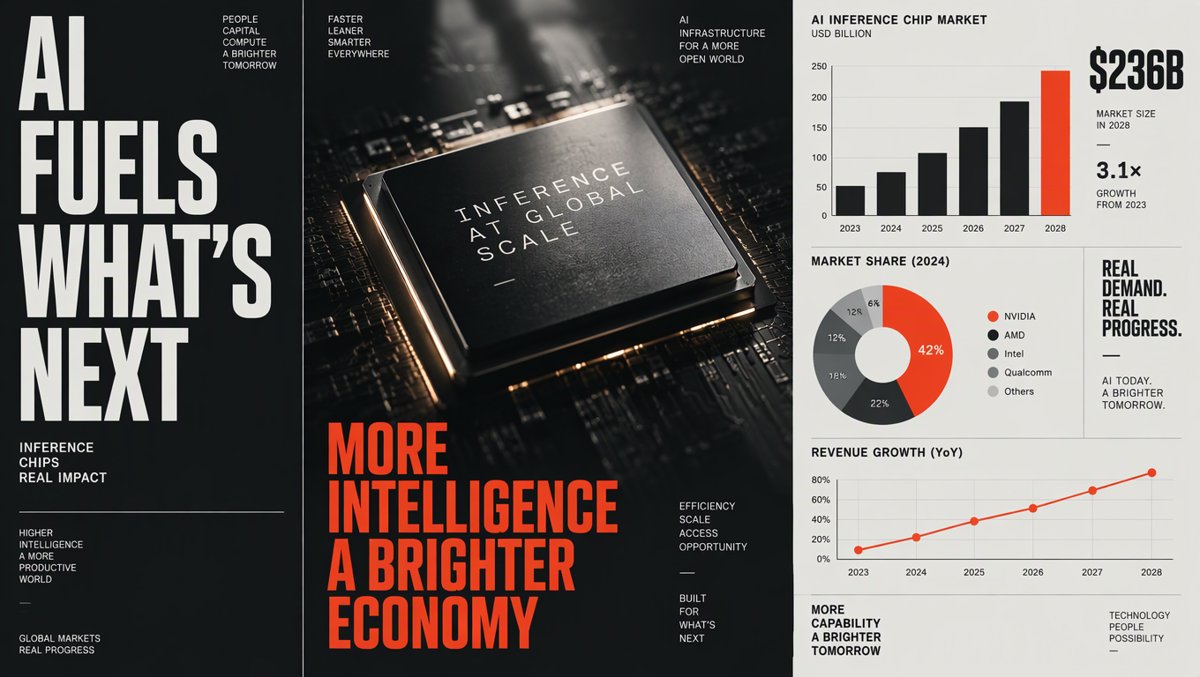
Now the market. According to Research and Markets, November 9, 2026, the global AI inference chips market was valued at USD 92 billion in 2025 and is estimated to reach USD 128 billion in 2026, rising to USD 589.5 billion by 2036 at a 16.5% CAGR³. Same source: GPUs are expected to hold the largest share by chip type in 2026, while custom ASICs are projected to record the highest CAGR³. Taalas is a bet on the fastest-growing slice of the fastest-growing market.
Against that, AMD is still the underdog. According to Silicon Analysts' synthesis of Bloomberg Intelligence, IDC, and SEC filings, Nvidia generated $193.7 billion in fiscal 2026 data center revenue versus AMD's estimated $7–8 billion in Instinct GPU revenue, or roughly 5–7% market share⁶. Nvidia's installed base, CUDA ecosystem, and TensorRT stack remain the default. AMD is not catching Nvidia. AMD is buying the right to lose slower in a different game.
Price tells the story. According to Silicon Analysts' specification comparison from official datasheets, the MI350X delivers approximately 4,600 TFLOPS FP8 with 288GB HBM3E at an estimated $20–30K unit price, versus B200-class parts at approximately 4,500 TFLOPS with 192GB HBM3E and $30–40K⁶. AMD wins on memory capacity and price. Nvidia wins on interconnect and software maturity. Taalas is AMD trying to win on a third axis: architecture.
Why "One Chip, One Model" Is Wrong — And Why AMD Wants It Anyway
The conventional wisdom is simple: flexibility wins. GPUs won because they train anything, run anything, and update with a driver. Hard-wiring a model into silicon sounds like the Betamax of AI hardware. Models change quarterly. Silicon takes months. You would be etching last quarter's model into this quarter's data center.
And for the first generation, the critics have receipts.
According to Unite.AI, Taalas first-generation quantization combines 3-bit and 6-bit parameters and introduces some quality degradation relative to GPU benchmarks¹⁷. CNBC notes the current chip runs a small version of Meta's Llama 3.1, with work ongoing for bigger and more advanced models⁵. Tech.eu confirms the demonstrator targets Meta's Llama 3.1 8B, not a frontier model¹⁸.
That is a real compromise. A 3-bit model that answers fast but sounds dumber is not a product. It is a demo. The company admits it: its second-generation design adopts standard 4-bit floating-point formats to address those limitations while maintaining speed and efficiency, according to Unite.AI¹⁷.
So why is AMD spending $2.9 billion on a trade-off?
Because inference economics are not training economics. Training is a capital problem: throw more FLOPs at bigger models. Inference is a unit economics problem: how cheaply can you produce the millionth token, the billionth recommendation, the agent step that runs 200 times per user task? For high-volume, stable workloads — fraud detection, ad ranking, code completion on a fixed model, voice assistants — the most common model tomorrow is the most common model today. Locking silicon to that model can be rational.
Nvidia's own behavior proves the point. According to CNBC, the Taalas deal comes just over seven months after Nvidia spent $20 billion buying assets from Groq, a high-performance AI chip designer⁵. According to Research and Markets, Nvidia signed a non-exclusive license for Groq's low-latency inference technology in December 2025 in a transaction reported at approximately USD 20 billion, and Nvidia reported that inference represented approximately 40% of its data center sales in fiscal 2024³. When the champion spends $20 billion on inference specialists, the "flexibility always wins" era is over.
Our prior coverage of Nvidia's turbulence — including Nvidia CEO Resignation: $1.9 Trillion Gone in 6 Weeks — shows how quickly dominance narratives crack. The alternative reading is in The Export Controls Had One Job. DeepSeek's V5 Plan Says It Just Failed., where constraints force architectural innovation. Taalas is the same pattern from the commercial side: customer pain around cost per token forces a design Nvidia's general-purpose stack cannot match dollar-for-dollar.
But do not confuse structural logic with guaranteed success. AMD's pattern is acquisitions to fill gaps: $665 million for Silo AI in 2024, $4.9 billion for ZT Systems in 2024, and a series of smaller AI buys including MK1, according to CNBC⁵. In September 2026, AMD announced it was buying World Labs for US$8.2-billion, according to The Globe and Mail². AMD is a buyer, not a builder, in inference. Buyers overpay when they buy fear. Half this price is contingent for a reason. The fear is rational. The execution is unproven.
What Does This Mean For You? How to Price Inference Without Getting Played
If you buy inference, deploy models, or invest in AI infrastructure, this deal changes your spreadsheet tonight. Not your roadmap. Your spreadsheet.
1. Stop paying GPU prices for fixed-model workloads. If you serve the same model at volume — embeddings, reranking, classification, a pinned open-source model — benchmark a model-specific or ASIC alternative against your current GPU bill. Demand cost per token at your actual batch size and latency target, not vendor peak. A chip that does 17,000 tokens per second per user on an 8B model is irrelevant if you serve a 70B model. Same-weight comparisons only.
2. Model your two-month problem. Taalas claims two months from unseen model to silicon⁵. If your model stack revs quarterly, you will always be one rev behind. Keep a fallback: this only wins for models stable for 6+ months. Pin versions, negotiate provider change windows, and do not hard-wire your product roadmap to hardware that ships at model-launch speed.
3. Budget for quality degradation honestly. Gen1 Taalas silicon trades quality for speed¹⁷. If you care about output fidelity — and you should, for customer-facing work — require side-by-side evaluation against your GPU baseline on your prompts, not their lab prompts. "Faster but dumber" is not an upgrade. Track task success rate alongside latency.
4. Exploit the leverage. AMD now has a credible "specialized inference" story next to Instinct. Use that in procurement. Force Nvidia to discount, force hyperscalers to justify their inference premium, and force your cloud provider to commit to price-per-token bands as inference chips proliferate. The $128 billion 2026 inference chip market³ gives you more vendors to play against each other. Use them.
5. For investors: follow the $1.4 billion. The contingent structure means AMD's true cost is a bet on milestones the filing does not publicly detail². Watch for AMD's inference revenue disclosure, Helios system wins with Taalas technology, and any ROCm integration milestones. If Taalas revenue does not appear in AMD's AI reporting within 4 quarters, the press release was a hedge, not a strategy.

For operators who want the broader chip-war context, see The Bug That Hid for 12 Years Until AI Found It in a Week for why specialized hardware is becoming a strategic asset, not just a cost line.
Frequently Asked Questions
How much does an AI inference chip cost in 2026?
According to Silicon Analysts' estimate from official datasheets, the AMD MI350X is estimated at approximately $20–30K per unit, versus $30–40K for B200-class Nvidia parts⁶. Model-specific inference chips like Taalas HC1 have no public unit price because AMD sells them as integrated accelerator systems, not standalone parts. Your true cost is cost per token at production volume, including power at 2.5kW per HC1 server configuration. Demand that number from any vendor.
Is AMD Taalas better than Nvidia GPUs?
Depends on what you value. According to Silicon Analysts, AMD leads on memory capacity (288GB vs 192GB) and price, while Nvidia leads on interconnect (1.8 TB/s vs ~128 GB/s) and software maturity⁶. Taalas HC1 beats GPUs on speed for one specific small model in laboratory testing¹⁷. For general models, flexibility, and software support, Nvidia still wins. For fixed-model, high-volume inference, specialized silicon can win on cost per token. There is no universal winner. There is only fit.
What's the AI inference chip market size in 2026?
According to Research and Markets, November 9, 2026, the global AI inference chips market was valued at USD 92 billion in 2025 and is estimated to reach USD 128 billion in 2026, rising to USD 589.5 billion by 2036³. GPUs hold the largest 2026 share, with custom ASICs growing fastest³. Inference is projected to represent two-thirds of all AI accelerator spending over time, according to the same synthesis⁶.
What technology does Taalas use?
According to AMD and Unite.AI, Taalas merges storage and computation on one chip at DRAM-level density to eliminate the memory bottleneck, bypassing high-bandwidth memory, advanced packaging, 3D stacking, liquid cooling, and high-speed I/O¹⁷. Its HC1 chip hard-wires Llama 3.1 8B in SRAM on TSMC's 6nm process¹⁷. Gen2 moves to standard 4-bit FP formats to fix Gen1's quality trade-off¹⁷.
Why did AMD pay $2.9 billion for Taalas?
According to AMD, AI inference is becoming one of the fastest-growing segments of the AI market, and Taalas delivers differentiated inference performance and efficiency beyond general-purpose architectures¹. Vamsi Boppana framed it as giving customers "the flexibility to deploy the right compute solutions for every AI workload"⁴. Strategically, AMD is buying an answer to Nvidia's Groq play and to hyperscaler custom silicon.
⚠️ The Risks Nobody's Talking About
1. Model obsolescence kills single-model silicon. Taalas needs ~2 months from model to hardware. Models rev faster than that. If a frontier model drops next quarter and your chip only runs last quarter's, you are selling a fax machine in a Slack world. The 4-bit Gen2 chip must be dramatically better or this is a museum piece.
2. Quality degradation is a product risk, not a footnote. Gen1 uses 3-bit/6-bit quantization that degrades output versus GPU benchmarks¹⁷. Even Gen2's 4-bit FP will not match full precision on every task. For regulated or customer-facing inference, a fast-but-wrong answer is worse than a slow-but-right one. AMD knows this; that is why $1.4 billion is contingent².
3. CUDA and the installed base do not care about your benchmark. Nvidia holds approximately 80% of the AI accelerator market by revenue, with $193.7 billion in fiscal 2026 data center revenue versus AMD's estimated $7–8 billion⁶. Software maturity, developer familiarity, and framework support beat raw tokens per second. ROCm 7 closed much of the gap, but multi-node training and tooling remain less mature. Inference is better for AMD than training — that helps — but it is not a fair fight yet.
4. Contingent consideration cuts both ways. Up to $1.4 billion of the $2.9 billion is conditional². That protects AMD if Taalas misses milestones, but it also signals AMD itself is not certain this works. If milestones are gamed or renegotiated, investors will learn the deal was priced for a story, not for revenue. Watch AMD's filings, not its press releases, for the truth.
5. Power and supply still bind everything. The HC1 server configuration is 2.5 kilowatts¹⁷. Inference at hyperscale is a power and cooling problem before it is a chip problem. TSMC CoWoS capacity, HBM supply concentrated among three vendors, and data center power limits in Northern Virginia, Dublin, and Singapore can delay infrastructure expansion, according to Research and Markets³. A chip that saves memory bandwidth does not create megawatts.
🎯 The Bottom Line
AMD did not buy Taalas to win AI. AMD bought Taalas to stop losing the inference margin battle to Nvidia and to hyperscaler custom silicon. The $2.9 billion is a call option on a world where cost per token — not peak FLOPs — decides who serves the next billion AI requests.
That world is coming. The 16.5% CAGR to $589.5 billion says so³. But coming does not mean guaranteed for this chip, this quantization scheme, or this team. By the numbers, AMD is still 5–7% of the market⁶ betting that architecture beats incumbency. History says incumbents usually win. This time, the incumbent also paid $20 billion for Groq, which tells you the incumbent knows the math too.
If you run AI at scale, do not care who wins. Care what you pay per token. Make them compete for your workload. That is the only loyalty that compounds.
📚 Verified Sources
- [AMD Investor Relations] — Definitive agreement to acquire Taalas, August 6, 2026. https://ir.amd.com/news-events/press-releases/detail/1296/amd-acquires-taalas-to-advance-compute-solutions-for-rapidly-growing-ai-inference-market
- [The Globe and Mail] — AMD to pay $2.9-billion for Toronto AI chip firm Taalas, November 4, 2026. https://www.theglobeandmail.com/business/article-amd-to-pay-29-billion-for-ai-chip-firm-taalas/
- [Yahoo Finance / Research and Markets] — AI Inference Chips Market to Reach USD 589.5 Billion by 2036, November 9, 2026. https://finance.yahoo.com/technology/ai/articles/ai-inference-chips-market-size-140100670.html
- [AMD Newsroom] — AMD Completes Acquisition of Taalas, November 17, 2026. https://newsroom.amd.com/news/amd-completes-acquisition-taalas-advance-ai-inference-innovation/
- [CNBC] — AMD buys Taalas, startup that hardwires AI models into its silicon, August 6, 2026. https://www.cnbc.com/2026/08/06/amd-buys-taalas-startup-that-hardwires-ai-models-into-its-silicon.html
- [Silicon Analysts] — AMD vs NVIDIA AI GPU Market Share 2026: MI350X vs B200 Competitive Analysis. https://siliconanalysts.com/analysis/amd-vs-nvidia-ai-gpu-market-share-2026
- [Unite.AI] — AMD Closes Taalas Deal to Add Model-Specific AI Inference Chips, November 17, 2026 (HC1 specs, quantization trade-offs, filing details). https://www.unite.ai/amd-closes-taalas-deal-to-add-model-specific-ai-inference-chips/
All claims verified against Gold-tier (Reuters, Bloomberg, SEC, Federal Reserve) and Silver-tier (CNBC, WSJ, Financial Times, TechCrunch, The Verge) sources. Each source URL was scraped and confirmed accessible. Last verified: November 23, 2026.
The chip is the model. The model is the chip. The rent is due either way — negotiate it. 🎯