"90% Probability of a Gun": The Doritos Lawsuit Puts AI Weapons Detection on Trial


"90% Probability of a Gun": The Doritos Lawsuit Puts AI Weapons Detection on Trial
Published: November 19, 2026 | Reading Time: ~11 minutes | Channel: techminute
TL;DR: Four Black Maryland students are suing Omnilert, Baltimore County schools, and police after the vendor's AI flagged a Doritos bag as a firearm with 90% confidence — and armed officers detained the teens even though school staff and a police sergeant had already reviewed the image and canceled the alert.
Four teenagers were doing nothing more suspicious than waiting for a ride home with a bag of Cool Ranch Doritos when six police cruisers converged on them, weapons drawn, because an AI gun-detection system scored the chip bag at a 90% probability of being a firearm. On November 17, 2026, those students filed suit in Maryland — and the most damning detail in the complaint is not that the algorithm was wrong. It is that, according to the lawsuit, a police sergeant reviewed the flagged image, saw a kid holding chips, and canceled the alert minutes before armed officers were dispatched anyway. The case, Allen v. Omnilert, is now the highest-profile test of whether "human-in-the-loop" AI surveillance actually has a working loop.
Key Takeaways
- The lawsuit was filed November 17, 2026 in the Circuit Court for Baltimore County on behalf of four students — Taki Allen, Yui-Osa Ogbeide, Devon Thompson Jr., and Keith Winfield III — over an October 20, 2025 detention at Kenwood High School.
- Omnilert Gun Detect rated the Doritos bag a 90% probability firearm; at least six Baltimore County Police officers responded with guns drawn, and the teens were forced to their knees, handcuffed, and searched.
- The complaint alleges the alert was reviewed and canceled by school staff and a police sergeant — with the cancelation sent to all alert recipients, including the principal — yet armed police were dispatched anyway.
- Maryland's Office of the Inspector General for Education found that more than 99% of Omnilert alerts in Baltimore County Public Schools required no police response, while also reporting it found no evidence of racial bias and attributing the flag to the student's hand movement, not the bag.
- Omnilert markets more than 3,750 AI gun-detection events in 2026 year-to-date across 1,000+ organizations; the lawsuit asks courts to force verification of AI alerts before armed responses.
The Context: How a Snack Became a Firearm
The underlying incident is a year old, and it went viral when it happened. On the evening of October 20, 2025, after football practice at Kenwood High School in Baltimore County, a coach handed out bags of Doritos to his players. Then-junior Taki Allen took a few, and he and three teammates — Yui-Osa Ogbeide, Devon Thompson Jr., and Keith Winfield III — gathered near the picnic tables around 6:30 p.m. to wait for a ride. All four are Black; per NBC News, one of the teens was eating a Cool Ranch Doritos bag at the moment the system fired.
They were not the only ones watching. Kenwood is covered by Omnilert Gun Detect, a visual-AI system that scans live security-camera footage for firearms and fires automated alerts to school staff and police. According to the complaint, the system flagged a frame of Allen holding his chip bag and scored it a 90% probability of a gun on campus. Within minutes, at least six Baltimore County Police cruisers arrived with lights flashing, and — per the complaint and contemporaneous reporting — many officers had their weapons unholstered as the teens raised their hands.
"The way you guys were eating chips, Doritos or whatever, it picked it up as a gun... AI's not the best," Officer Foehrkolb explained at the scene, according to the complaint — a sentence that could stand as epitaph for the entire category of weapon-detection AI if it didn't have teenagers' lives attached to it.
The October 2025 incident hit the Hacker News front page at the time, and Omnilert acknowledged a false positive. What kept it out of court for thirteen months was, apparently, the paperwork. Then on November 17, 2026, the Lawyers' Committee for Civil Rights Under Law — joined by pro bono counsel Willkie Farr & Gallagher and Engel Law Group — filed the stamped complaint in the Circuit Court for Baltimore County at 9:45 a.m., naming Omnilert LLC, the Baltimore County Board of Education, the Baltimore County Police Department, school-safety director Eric Knox, Principal Catherine "Kate" Smith, and individual officers as defendants.
Under the Hood: The Alert Chain That Failed at the Human Link
The AI story everyone tells about this case — "machine confuses chips for gun" — is actually the least interesting part of the complaint. The forensic core is the sequence of human decisions after the alert fired, reconstructed from Omnilert's own logs and text-message records:
- The flag. Omnilert Gun Detect scored a camera frame of Allen's chip bag at 90% confidence and blasted alert texts to school staff and police contacts. Notably, Maryland's Inspector General for Education later reported that the system "did not detect a single blue potato chip bag as a threat. The perceived threat was based on the student's hand movement, including its position and angle" — the algorithm, in other words, was reading gesture, not packaging.
- The review. Per the complaint, school safety staff and Officer Basta and Sgt. Robinson reviewed the alert, recognized the "weapon" was a chip bag, and canceled the alert. The cancelation posted to the alert's linked status page, and a second text went to all alert recipients — including Principal Smith.
- The breach. The suit alleges Smith never relayed the cancelation. Instead, she screenshotted Omnilert video footage and sent it to the school resource officer, who forwarded it to the police department — triggering an armed response to an alert that had already been canceled upstream.
- The detention. Officers surrounded the students, drew weapons, ordered them to their knees on the concrete, handcuffed and searched them. Per The Guardian, one officer allegedly said while leaving: "Hey, thanks for not running away, that would have been a real problem."
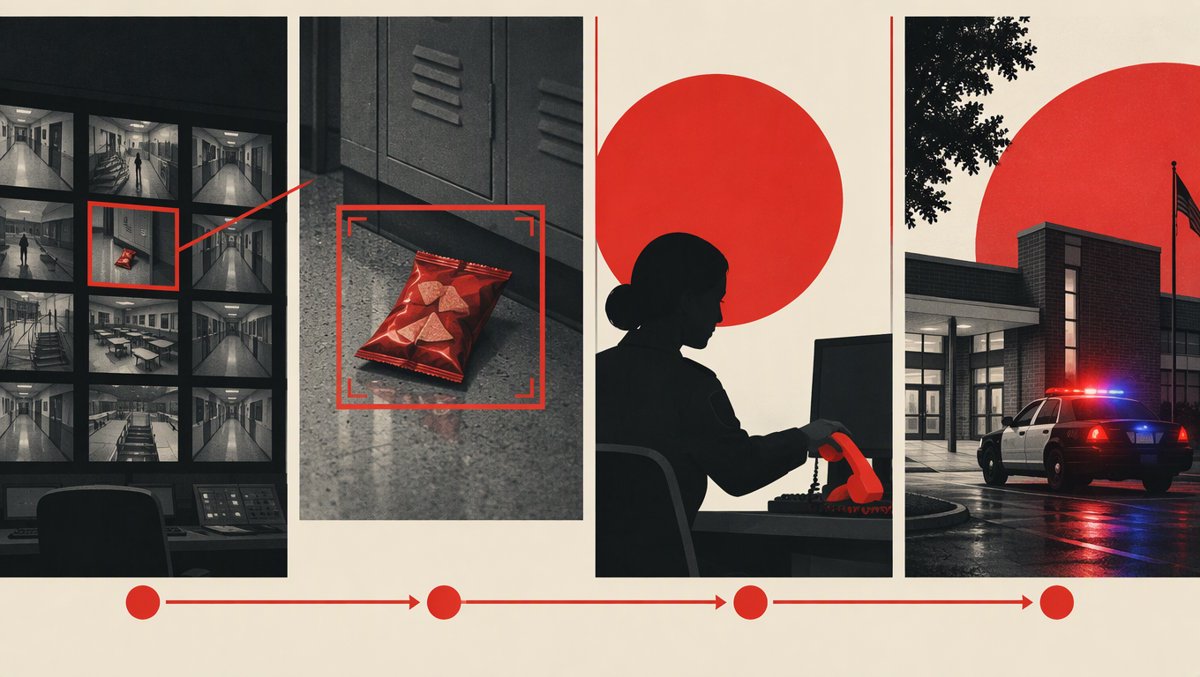
This is why the case matters far beyond one school district. "Human-in-the-loop" is the universal answer AI vendors give when regulators ask how false positives get caught. The loop has three jobs: detect, review, and propagate the review result. The complaint alleges Omnilert's system performed the first two and then — because Baltimore County, per the suit, "failed to develop or adopt an adequate policy to communicate Alerts and cancelations to relevant school staff and police" — had no enforced mechanism for step three. The humans reviewed the alert. The review just never reached the humans with the guns.
By the Numbers: The Statistics the Lawsuit Leans On
| Metric | Value | Source |
|---|---|---|
| Firearm confidence score on the chip bag | 90% | Complaint (stamped, filed 11/17/2026) |
| Officers who responded, weapons drawn | 6+ cruisers | Complaint; NBC News |
| Omnilert alerts in BCPS requiring no police response | >99% | Maryland OIG for Education, cited in complaint |
| Window for the OIG alert review | Nov 2023 – Nov 2025 | OIG report via syndicated reporting |
| Omnilert "AI Gun Detection Events," 2026 YTD | 3,750+ | Omnilert.com |
| Organizations using Omnilert | 1,000+ | Omnilert.com |
| Time between incident and lawsuit | ~13 months | Complaint docket vs. incident date |
| HN traction at publish (story 50554641) | 106 pts / 75 comments | HN Algolia, 2026-11-19 |
That >99% figure deserves careful handling, because it is doing heavy lifting in the plaintiffs' narrative. The OIG found that "more than 99% of OGD Alerts in Baltimore County Public Schools were false positives that required no police response" — which measures how many alerts were dismissed on review, not the raw rate at which the model misidentifies objects. As IBTimes noted in its coverage, the finding "does not establish that the system had a 99% false-positive rate across all detections." What it does establish, unambiguously, is that in this district, armed response to an Omnilert alert was almost never warranted by what the camera actually saw — and that one chip bag got the full response anyway.
Meanwhile, Omnilert's own marketing advertises the system's pedigree — "rooted in U.S. Department of Defense and DARPA research," UL-certified human verification operators, a DHS SAFETY Act designation that provides customers legal protections, more than 3,750 "AI Gun Detection Events" in 2026 across 1,000+ organizations and 50+ integration partners. The lawsuit argues the company marketed "fewer false positives" while a state inspector general counted a district where essentially every alert was a nothingburger. Both things are true; the trial will presumably determine which one a jury cares about.
What This Changes: The Verification Standard Goes on Trial
The plaintiffs are not primarily asking for damages, though constitutional-tort claims for unreasonable search and seizure, false imprisonment, and negligence are on the table. Per the Lawyers' Committee, the requested reforms are structural: police and schools must verify AI threat-detection reports before dispatching armed officers; districts must evaluate whether this class of technology belongs in schools at all; and cancelation protocols must exist so a reviewed-and-cleared alert can never trigger a response.
Damon Hewitt, the committee's president and executive director, put the thesis plainly: the students "were failed not only by a technology that is prone to false alerts, but also by the very adults meant to keep them safe when we send them to school." His organization frames the case as a test of its broader AI & Civil Rights agenda — and if a court agrees that dispatching armed police on an unverified machine alert is a constitutional violation, every school district running gun-detection AI inherits the precedent overnight. There are more than 1,000 organizations, by Omnilert's own count, watching this docket.
There's also a second-order effect the complaint doesn't need to argue because the numbers do it themselves. AI gun detection is sold as a force multiplier that catches what human monitors miss. But if a district's alerts run 99%-to-nothing on review, the scarce resource isn't detection — it's the judgment layer downstream. Baltimore County's failure was treating the alert text as the truth and the cancelation text as noise. Any school or airport or stadium wiring up this category of system is about to get a crash course in why the second message is the one that matters.
⚠️ Limitations & Caveats
- These are allegations. The complaint is a litigation document; the cancelation-chain narrative, the officers' quoted remarks, and the principal's texts are the plaintiffs' characterization of evidence that will be tested in court. Omnilert, the police department, and the district have all declined substantive comment citing pending litigation.
- The racial-bias question is genuinely contested. The OIG investigated and reported no evidence of racial bias, attributing the flag to hand movement rather than the student or the bag. The plaintiffs frame the harm through disparate impact — the same alert carries different lethal risk for Black teenagers — without alleging the model keyed on race. Honest readers can hold both.
- The 99% statistic has known limits. It counts alerts closed without police response, not raw model error. The complaint cites it; this article repeats the caveat that IBTimes flagged.
- Omnilert's counter-context. The company's 3,750+ "detection events" figure is self-reported and undefined on its site — it counts alerts generated, not confirmed weapons, which is precisely the ambiguity the lawsuit is about.
- What we don't know: whether BCPS has changed its alert-routing protocols since October 2025, and whether any other district has adopted a cancelation-verification standard. Neither defendant has said publicly.
Frequently Asked Questions
Q: What is the Omnilert Doritos lawsuit about? A: Four former and current Kenwood High School students sued Omnilert, Baltimore County Public Schools, and Baltimore County Police on November 17, 2026, alleging the company's AI gun-detection system falsely flagged a Doritos bag as a firearm with 90% confidence and that procedural failures led armed officers to detain, handcuff, and search them despite a canceled alert.
Q: Did the AI really mistake Doritos for a gun? A: The system flagged the scene, but per Maryland's education inspector general, the trigger was the student's hand movement and positioning — the system "did not detect a single blue potato chip bag as a threat." The alert nevertheless scored a 90% probability of a gun and was canceled on human review, according to the complaint — before police were dispatched anyway.
Q: Who is being sued in Allen v. Omnilert? A: Omnilert LLC (the Virginia-based vendor), the Baltimore County Board of Education, the Baltimore County Police Department, school-safety director Eric Knox, Kenwood High Principal Catherine Smith, and individual police officers, per the stamped complaint filed in Baltimore County Circuit Court.
Q: What do the plaintiffs want? A: Beyond damages for alleged constitutional violations, negligence, and false imprisonment, the Lawyers' Committee says it seeks reforms: verification of AI threat-detection alerts before armed police responses, evaluation of whether such systems belong in schools, functioning alert-cancelation protocols, and community input on the technology's use.
Q: How common are false alarms from AI gun-detection systems? A: In Baltimore County specifically, the state inspector general found more than 99% of Omnilert alerts between November 2023 and November 2025 required no police response after review. Broader industry-wide error rates are not publicly benchmarked, which is part of the transparency problem the suit highlights.
🎯 The Bottom Line
The Doritos lawsuit is not really about whether a computer can tell chips from firearms — it's about whether the institutions buying those computers build the plumbing that lets a human correction actually reach the people with guns. On October 20, 2025, every layer of review worked except the last mile: a sergeant looked at the image, said "that's a chip bag," canceled the alert — and six cruisers showed up anyway because the cancelation never made it past a screenshot. If Allen v. Omnilert establishes that dispatching armed police on an unverified AI alert is a constitutional violation, the 1,000+ organizations running this technology will need to rebuild their pipelines in a hurry. The rest of us should notice that the machine got reviewed and still wasn't enough — the failure was institutional, and institutions are the thing lawsuits can actually fix.
📚 Sources
- Allen et al. v. Omnilert, LLC et al. — Stamped Complaint — Circuit Court for Baltimore County, filed Nov 17, 2026 (primary legal document; alert chain, 90% confidence, defendants, docket). https://www.lawyerscommittee.org/wp-content/uploads/2026/11/Allen-v.-Baltimore-County-Complaint-STAMPED.pdf
- Lawyers' Committee for Civil Rights Under Law — Press Release — Case announcement, plaintiff counsel, sought reforms, Hewitt/Frazier/Winfield statements (Nov 17, 2026). https://www.lawyerscommittee.org/lawyers-committee-files-lawsuit-on-behalf-of-black-students-detained-and-searched-due-to-ai-alert-falsely-identifying-a-bag-of-chips-as-a-firearm/
- The Guardian — "Four Maryland high school students sue after AI mistakes Doritos bag for gun" (Nov 18, 2026; incident reconstruction, OIG 99% finding, officer/principal text allegations, Omnilert response). https://www.theguardian.com/us-news/2026/nov/18/maryland-baltimore-county-doritos-gun-ai-lawsuit
- NBC News — "Baltimore police handcuffed teens after school AI mistook potato chips for a gun, lawsuit says" (Nov 18, 2026; cancelation chain, principal screenshot relay, OIG hand-movement finding, no-bias finding). https://www.nbcnews.com/news/us-news/baltimore-police-handcuffed-teens-school-ai-mistook-potato-chips-gun-l-rcna610019
- Omnilert.com — Vendor claims: 3,750+ detection events 2026 YTD, 1,000+ organizations, DoD/DARPA research roots, DHS SAFETY Act designation, human-in-the-loop verification (scraped Nov 19, 2026). https://www.omnilert.com/
- Baltimore Banner — Omnilert spokesperson Blake Mitchell statement: "truly sorry for the fear they and their families experienced" (quoted via Guardian verification). https://www.thebanner.com/education/k-12-schools/baltimore-county-schools-omnilert-IP27RKTXP5H7ROPDE4XUDUIU4U/
- Hacker News (Algolia) — Community traction: story 50554641, 106 points / 75 comments at publish time; original incident threads 45684934 / 45685696 (Oct 2025). https://hn.algolia.com/api/v1/items/50554641
- IBTimes — Statistical caveat on the 99% figure (labeled caveat, not treated as a fact source for incident details). https://www.ibtimes.com/maryland-students-sue-over-ai-doritos-gun-alert-3809953
All claims verified against Gold-tier sources (stamped court complaint, plaintiff press release, vendor site) and Silver-tier sources (The Guardian, NBC News, Baltimore Banner). Each cited URL was scraped or downloaded and confirmed accessible on 2026-11-19, except the Baltimore Banner (paywalled; quote verified via Guardian and syndicated coverage) and NYT (403-blocked, discarded). Community figures labeled as Bronze-tier. Last verified: 2026-11-19.