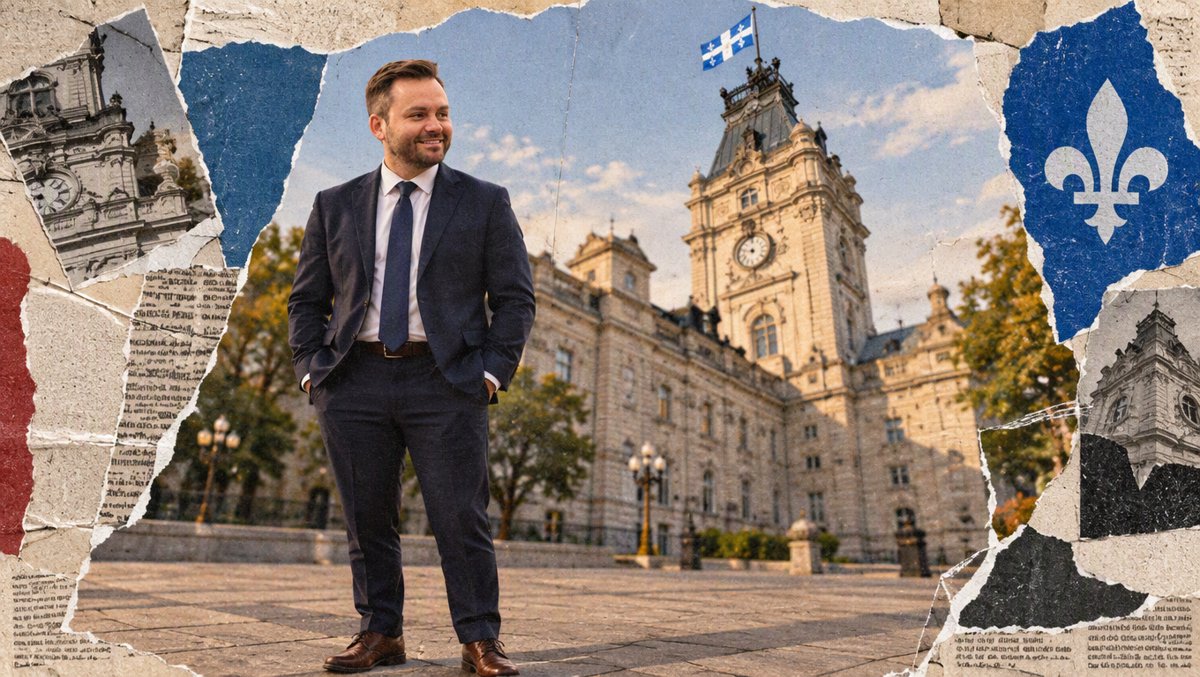
They came back from three seats to fifty-nine. They promised a country. Then they looked at the math — and reached for the brake pedal.
Quebec woke up on Tuesday to the strangest kind of political earthquake: the biggest comeback in modern Canadian history, delivered by the smallest mandate in Quebec's history. The Parti Québécois is back in power for the first time since 2014 — and its leader, Paul St-Pierre Plamondon, is already the most cautious revolutionary in the country.
Here's what actually happened, and what it means.
On Monday night, Quebec's electoral map was redrawn from scratch. Final-ish numbers:
That last line is the story. The CAQ, which won a thumping 90 seats in 2022, was wiped clean off the map — not reduced, erased. The PQ, which was reduced to three seats in the same 2022 election, now runs the province.
Read those two numbers together and the paradox jumps out: a 59-seatgovernment built on 28% of the vote — the lowest vote share for any governing party in Quebec history. Turnout was about 66.9%, which means the PQ's winning coalition rests on roughly one in five eligible voters.
The system did what first-past-the-post systems do: spread a minority of votes efficiently across a lot of ridings. The PQ cleaned up in the regions — taking 12 of 20 ridings in the Montérégie, for instance — while the opposition vote splintered four ways. Add it up and 59 seats is 59 seats, but it's five short of the 64 needed to govern alone.
Ninety-nine brand-new MNAs are heading to Quebec City. Only 28 incumbents survived. Welcome to the least-experienced, most-fragile legislature in memory.
The PQ campaigned on a promise to hold another referendum on Quebec independence. That promise is now a governing party's official position — and it collided with reality on day one.
A minority government needs opposition votes to pass anything, let alone to survive a confidence vote. So how does a sovereigntist premier square "we will hold a referendum" with "we can't pass a budget without the Liberals or the Conservatives"?
He doesn't rush it. In his victory speech, St-Pierre Plamondon leaned into the dream — "This dream of being a nation will one day be realized" — while vowing to be "the premier of everyone in Quebec." By Tuesday, the timetable got fuzzier: no referendum in the first years of the mandate, with a vote floated for 2029 or 2030. He told Prime Minister Mark Carney directly that a referendum was not an immediate plan, but something he'd be "considering."
Translation: the PQ won the argument about whether to talk about independence. It did not win the argument about when.
Ottawa's reaction was a masterclass in saying everything while promising nothing. Carney congratulated the premier-designate, then told reporters it was "a crucial time for Quebec, it's a crucial time for our country" — pitching a strong, sovereign Canada as the answer to Quebecers' anxieties rather than picking a fight over separation.
Pressed on whether a 28% government has a mandate to break up the country, Carney declined the bait and talked about prosperity and trade instead. His team's actual worry is subtler than a referendum: a PQ government that's cool to federal projects — including the Alto high-speed rail linking Quebec City and Toronto — can slow a lot of Ottawa's agenda without ever tabling a question.
This wasn't a love letter to sovereignty. It was a rejection of the incumbent.
Post-mortems converge on CAQ fatigue: after more than a decade in power and a leadership transition, the governing party had lost its coalition and its story. Voters didn't so much flock to the PQ as abandon the CAQ — and in a fragmented five-party race, the PQ was the party best positioned to catch the falling pieces.
The sovereigntist vote itself, meanwhile, was split: the PQ and the left-leaning Québec solidaire both ran on the independence spectrum. Quebec didn't vote to leave Canada Monday night. It voted to try something that wasn't the last ten years.
For contrast, scroll down the ballot box: in Canada's other big political show, Chris Alexander quit the Toronto mayoral race, saying his path to victory was "not obvious and perhaps not there at all" after a poll put him at just 4%. That leaves incumbent Olivia Chow and councillor Brad Bradford as the only candidates with real momentum.
One province elects a revolution and hits the brakes; one city's crowded mayoral field quietly thins itself out. Canadian politics in October 2026 is a study in anti-climax — which is exactly how referendums get lost.
The Parti Québécois won Quebec by the narrowest mandate in the province's history, and it knows it. The referendum dream is alive, official, and — for now — parked. The real question isn't whether Quebec wants a country; it's whether a 59-seat minority with 28% of the vote can govern long enough to ask.
Sources: Elections Québec and CBC News results; Montreal Gazette election charts; Globe and Mail and Global News takeaways; BBC, CNN, Al Jazeera, Politico and Reuters coverage of the Oct. 5, 2026 vote; CBC and National Post on Carney's response; Toronto Sun and CBC on Chris Alexander's withdrawal. Featured image: editorial illustration built from a real, openly licensed photograph of the Hôtel du Parlement, Quebec City (Wikimedia Commons), restyled as an election-night scene.