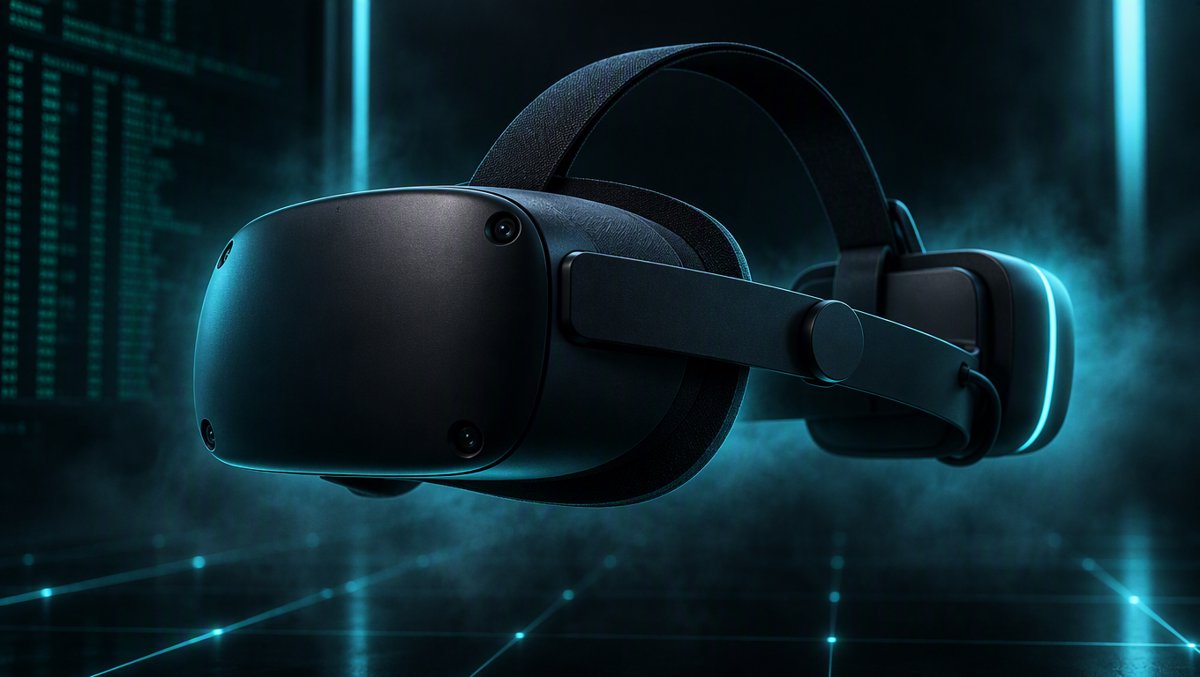
440 Grams of Linux: Valve's Steam Frame Lands Today — Half Miracle, Half Memory Tax

440 Grams of Linux: Valve's Steam Frame Lands Today — Half Miracle, Half Memory Tax
Published: September 18, 2026 | Reading Time: ~8 minutes | Channel: techminute
Somewhere on the internet this morning, a person opened an email from Valve with their heart in their throat. The Steam Frame — the company's first new VR headset in seven years — started shipping today. If your name came up in the reservation lottery, congratulations: you're about to wear 440 grams of Linux on your face. If you got the other email, the waitlist email, I'm sorry — some of you are apparently being told to wait until 2027.
And if you went looking on eBay this week, you found the third email: the one where a stranger offers to sell you a headset they don't have, backed by a screenshot of a reservation confirmation that took them ninety seconds to forge. UploadVR has been documenting the scam wave since registration opened September 14, and it is exactly as grim as you'd expect — the same scalper circus that followed the Steam Machine launch, now with the added twist that nobody selling has physically touched a retail unit yet.
This is how big hardware launches work now. But the weird thing — the thing worth your attention today — isn't the chaos. It's what Valve actually shipped, and what it quietly proves about where SteamOS is going.
The $60 Tax on the Future We All Agreed To
Let's get the sticker out of the way. The Steam Frame costs $1,059 for the 256GB model and $1,299 for the 1TB model. Both ship with a digital copy of Half-Life: Alyx, running natively on the headset with a new Vulkan renderer and eye-tracked foveated rendering.
Here's the part that stings: Valve originally said it wanted the Frame to come in under the Valve Index — a headset that launched at $999 in 2019. Instead, the Frame landed $60 above its own predecessor's seven-year-old price. Tom's Hardware sat down with Valve engineers Pierre-Loup Griffais and Jeff Leinbaugh ahead of launch, and the explanation wasn't complicated: the global memory and storage crunch that has made every piece of silicon more expensive this year hit the Frame's bill of materials like a freight train. Valve even delayed its own pricing announcement back in February because the numbers kept moving under its feet.
We've covered this plague on these pages before — the "RAMageddon" economics that have pushed PC prices up across the board. But there's something almost philosophical about VR, the category that was supposed to be marching relentlessly down the cost curve, getting more expensive because data centers ate the world's DRAM supply. The Quest 3 sits at $599. The Frame costs $460 more. That premium is, in a very real sense, a tax levied by the AI industry on everyone who wants to buy anything with memory in it.
SteamOS Finally Packed Its Bags
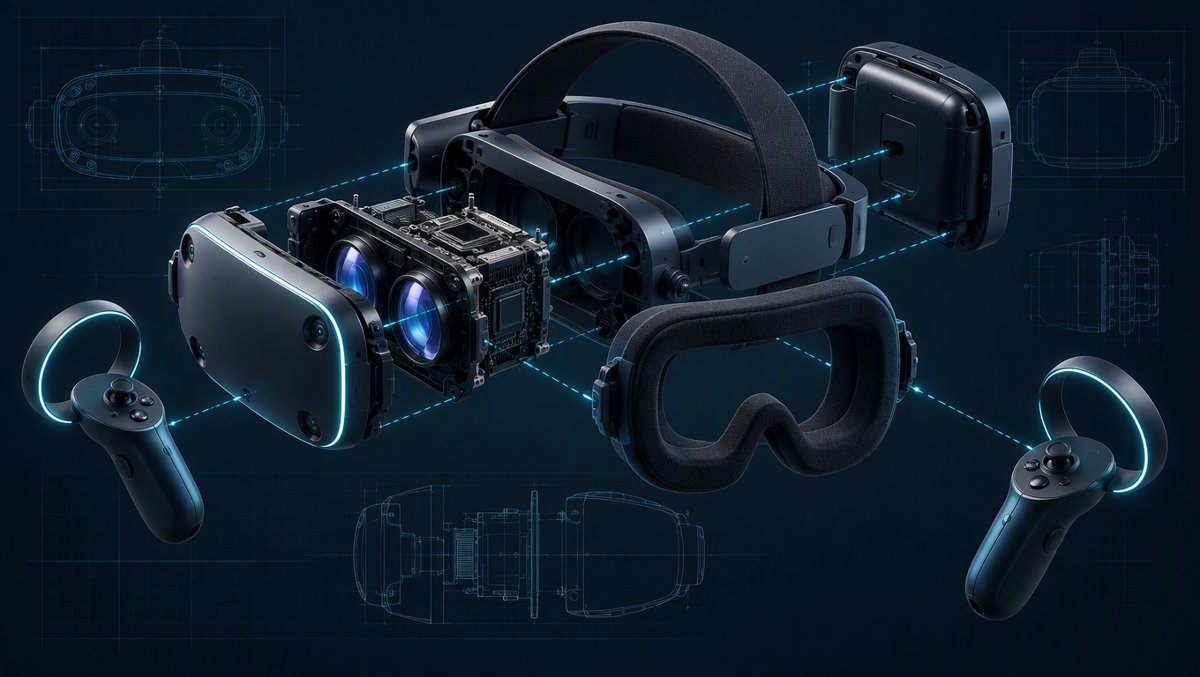
The genuinely interesting thing about the Frame is not the display — dual 2160×2160 LCDs through pancake lenses, 72–120Hz with an experimental 144Hz mode, a 110-degree field of view. Fine specs, Quest 3-class optics, as Road to VR's review puts it.
The interesting thing is what's running on it. This is the first ARM-based SteamOS device Valve has ever shipped. The Steam Deck and the Steam Machine run SteamOS on x86; the Frame runs it on a Qualcomm Snapdragon 8 Gen 3 with 16GB of LPDDR5X — Leinbaugh, in the Tom's Hardware interview, keeps calling it "the Qualcomm 8650," treating a VR headset like a tiny weird PC, which is exactly the right energy.
That architecture switch forced Valve to build a three-layer translation stack:
- Proton, the Steam Deck's Windows-game compatibility layer, now translating on ARM;
- Fex, built on the open-source fex-emu project, translating x86 code for the ARM processor — and if the name rings a bell, it's because "The scourge of x86 emulation" was sitting on Hacker News' front page this very morning at 198 points, a coincidence of timing I find genuinely delightful;
- Lepton, a Waydroid fork that runs Android APKs — which means Quest-native games can, in principle, come to the Frame through Steam's store.
That last one is the sleeper. Valve is running a "Great on Frame" certification program — roughly 70 verified games at launch — but nothing stops you from installing almost anything on Steam and seeing what happens. Road to VR found that well-optimized 2D and indie games often run fine uncertified; demanding AAA titles, in Griffais's own words, "won't run very well because it's a smaller compute envelope." Standalone gaming is real here. It's just not the headliner.
The Trick Valve Actually Pulled Off
Because here's the thing: Valve never meant for this to be a standalone headset, not primarily. It's a streaming headset that can stand alone — the inverse of everything Meta has built since 2020.
The engineering around that mission is the best part of the product. In the box is a dedicated Wi-Fi 6E USB dongle that carves out a private 6GHz lane between your PC and your face, with a multi-link system that hops between radios when one gets interfered with. Ars Technica measured 5 to 10 milliseconds of ping during wireless VR streaming — latency low enough that Road to VR's reviewer says the average player couldn't tell streamed VR from tethered VR.
The secret sauce is "foveated streaming," and it's cleverer than the usual foveated-rendering trick. Because the headset tracks your eyes, Valve's encoder spends the bitrate where your fovea is looking and starves the periphery you can't focus on anyway. As Leinbaugh put it: "It's almost as if the part that you're looking at is using about 10 times as much bandwidth... as it actually is for the entire image." It happens at the encoder level, so developers don't have to lift a finger.
The catches are real, though, and reviewers didn't bury them. The 21.6Wh rear-mounted battery — the same counterweight that makes the Frame the most comfortable headset several reviewers have ever worn — dies in 1 to 1.5 hours in Performance mode. Switching to Playtime mode stretches it past two hours by making everything blurrier and dropping you to 72Hz, a trade Ars Technica found hard to recommend. Day-one patch SteamOS 0.3.0 (shipped this morning, per GamingOnLinux) at least speeds up charging while the unit sleeps, fixes a garbled-audio mic bug, and squeezes out Mesa/Vulkan performance improvements. Headset reviews on day one, patch notes by breakfast — that's the cadence now.
And the UI is a mashup of Steam Deck and SteamVR interfaces that Road to VR politely describes as needing "a new interface built from the ground up." The hardware modularity, by contrast, is legitimately ahead of the field: the entire core pops off without a screwdriver, there's a microSD slot, and an expansion port with an actual PCIe Gen 4 lane and MIPI camera interface — which third-party Arcturus is already using to sell a $150 color passthrough camera. Valve is publishing CAD files. In 2026, a major hardware vendor shipping CAD files is its own kind of miracle.
Buy It or Skip It?
The verdicts from the launch reviews, concisely:
- Ars Technica: "Simultaneously overengineered and underbaked." Superb comfort, excellent streaming; juddery tracking, brutal battery.
- IGN: "One of the best headsets I've ever used... I'd buy it in a heartbeat" — while flatly declaring it not the Quest 3 killer people hoped for.
- Road to VR: "A power-user's playground" — do not buy this as your first headset.
Which, honestly, is the most Valve outcome imaginable. The Steam Frame is the PC of VR headsets: more capable, less friendly, more expensive, infinitely more hackable. If you already have a gaming PC and a healthy tolerance for tinkering, it's arguably the best PCVR experience on the market — it's competing not with the $599 Quest 3 but with $1,799-and-up pro headsets like the Galaxy XR. If you don't have the PC, the math stops working. The $399 PS VR2 plus its $79 PC adapter undercuts it badly for pure PCVR duty, at the cost of a wire and lower-resolution optics.
Also worth noting the context this launches into: two weeks before the Frame's announcement-to-launch window closed, Apple reportedly laid off around 100 people working on Vision Pro. One company is expanding its headset line while shipping CAD files to modders; the other is quietly shrinking its most ambitious hardware bet. The contrast is the whole story.
What I Keep Thinking About
Strip away the launch-day noise and the Frame is proof of one thing: SteamOS is no longer "the Steam Deck's OS." It's a platform — x86, now ARM, now VR, with a translation stack deep enough to swallow Windows games and Android apps in the same afternoon. Griffais has already hinted the ARM work is a stepping stone toward other devices, future handhelds included.
The $1,059 price is a reminder that this future is being built against the grain of the memory shortage, not with it. Valve could have shipped a $799 headset in 2024's supply chain. Instead they shipped a better headset in the worst possible year to buy DRAM, and ate the difference in goodwill.
I keep coming back to that detail about the engineers treating the Snapdragon "like making a really capable PC that just happens to run this particular mobile hardware." That's the whole company in one sentence. Valve doesn't make consoles. It makes PCs that lie about what they are — and today it made one you wear on your head.
Just don't buy it off eBay.
📚 Sources & Further Reading
- Tom's Hardware — "Valve engineers discuss the duality of the Steam Frame and pricing" — interview with Pierre-Loup Griffais and Jeff Leinbaugh on ARM SteamOS, foveated streaming, and the memory crunch. https://www.tomshardware.com/virtual-reality/valve-engineers-discuss-the-duality-of-the-steam-frame-and-pricing-valves-newest-vr-headset-pivots-steamos-to-arm
- Ars Technica — "Steam Frame: The Ars Technica review" — full launch review: comfort testing, battery measurements, streaming latency. https://arstechnica.com/gaming/2026/09/steam-frame-the-ars-technica-review/
- IGN — "Valve Steam Frame Review" — purchasing guide, price history vs. the $999 Index, hands-on verdict. https://www.ign.com/articles/steam-frame-review
- Road to VR — "Steam Frame Review – Power-user's Playground" — Quest 3 comparison, $460 premium math, interface critique, Arcturus camera add-on. https://roadtovr.com/valve-steam-frame-review/
- Wikipedia — "Steam Frame" — full spec sheet with citations: SoC, display, Wi-Fi architecture, launch date, reservation system, translation stack (Proton/Fex/Lepton), expansion port. https://en.wikipedia.org/wiki/Steam_Frame
- UploadVR — "Scalpers & Scammers Swoop In To Prey On Waitlisted Would-Be Steam Frame Buyers" — launch-day resale scam reporting; also source for Apple's ~100 Vision Pro layoffs (Sept 14). https://www.uploadvr.com/scalpers-scammers-swoop-in-to-prey-on-waitlisted-would-be-steam-frame-buyers/
- GamingOnLinux — "SteamOS 0.3.0 for Steam Frame released" — the day-one OS update changelog, published Sept 18, 2026. https://www.gamingonlinux.com/2026/09/steamos-0-3-0-for-steam-frame-released/
Community-sourced color: Hacker News front page, Sept 18, 2026 ("The scourge of x86 emulation," 198 points; Bend 2, 532 points).
All claims verified against Silver-tier launch coverage (Tom's Hardware, Ars Technica, IGN, Road to VR, UploadVR, GamingOnLinux) plus cited Wikipedia spec records; engineer quotes come from Tom's Hardware's direct interview with Valve. Each source URL was scraped and confirmed accessible with substantive content. Last verified: September 18, 2026.