42 Layers Become 30: Google's DeepCrossAttention Rewires the Transformer's Oldest Shortcut


42 Layers Become 30: Google's DeepCrossAttention Rewires the Transformer's Oldest Shortcut
Published: November 28, 2026 | Reading Time: ~11 minutes | Channel: techminute
TL;DR: Google Research's DeepCrossAttention (DCA) replaces the transformer's flat additive residual connection with learned, per-token routing across layers — matching standard-transformer quality up to 3x faster with under 0.2% extra parameters, and hitting LM1B perplexity <14 with 30 layers instead of 42.
Google Research says a tweak to the oldest shortcut in deep learning — the residual connection — lets transformer models reach the same quality up to three times faster while adding less than 0.2% to parameter count. In a blog post published November 23, 2026, the company detailed DeepCrossAttention (DCA), an architecture that lets each layer dynamically choose which earlier layers to pull features from. Within four days, the Hacker News thread hit #1 on the front page and 495 points — because the headline number is stark: a standard transformer needed 42 layers to reach perplexity below 14 on the LM1B benchmark; DCA did it with 30.
Key Takeaways
- DeepCrossAttention (DCA) replaces the residual connection's blind point-wise sum with learnable, input-dependent weights plus depth-wise cross-attention, letting each layer selectively retrieve features from the full history of previous layers (Google Research blog, Nov 23, 2026).
- The headline numbers: same model quality up to 3x faster, standard-transformer performance on C4 and LM1B in up to 5x fewer training steps, and perplexity <14 on LM1B with 30 layers instead of 42 — a 29% depth reduction, at under 0.2% parameter overhead.
- It retrofits: because DCA can be initialized to behave identically to a standard residual network, a pretrained transformer can adopt it — continued training with DCA improved LM1B perplexity by 0.19 versus just 0.02 for continued standard training.
- The field already moved: Google's own post notes Moonshot AI's attention residuals and Thinking Machines' Inkling 2 (which adopted both attention residuals and DCA's Q/K/V split mechanism) — dynamic residual routing is becoming a family of techniques, not one paper.
- The caveats are real: the underlying paper is from February 2025 (arXiv 2502.06785), results are small-benchmark language modeling rather than frontier-scale runs, and Google released no official code.
The Context: What Led to This
Every transformer you've ever used — every chatbot, every coding assistant, every image model in the diffusion-transformer era — is held together by a piece of 2015-era plumbing: the residual connection. Borrowed from ResNet, it's the humble "skip" that copies a layer's input past the layer and adds it to the output, giving gradients a clean highway through dozens or hundreds of layers. Without it, deep networks drown in the vanishing-gradient problem. With it, transformers scale.
But Google's researchers frame the standard version as a game of "telephone" played too carelessly. The residual connection performs a point-wise summation — every prior representation carried forward with equal weight. As features flow through layer after layer, high-resolution details from early layers get averaged out and diluted. The network then has to waste capacity recomputing what it already knew. As the Google Research blog puts it, the simple sum "treats all prior representations with equal weight, leading to information dilution in deep networks."
The fix has a history. The paper behind the blog post — "DeepCrossAttention: Supercharging Transformer Residual Connections" by Mike Heddes, Adel Javanmard, Kyriakos Axiotis, Gang Fu, MohammadHossein Bateni, and Vahab Mirrokni — was first submitted to arXiv on February 10, 2025 and presented at ICML 2025. So why is it front-page news on Hacker News in late November 2026, at 495 points and 174 comments?
Because the ground shifted underneath it. Google's November post explicitly situates DCA inside a live architectural race: Moonshot AI published attention residuals, a close cousin with a learnable softmax retrieval mechanism; hyper-connections widened the residual stream into parallel channels; manifold-constrained hyper-connections stabilized that idea with Sinkhorn-Knopp constraints. And in a one-line bombshell, Google notes that "the recent Inkling 2 model developed by Thinking Machines also adopted this design in addition to DCA's cross attention (Q/K/V split) mechanism." When a hot new model from a high-profile lab starts shipping your architecture's core trick, it's time to plant the flag with a blog post.
Under the Hood: How It Works
DCA reframes residual learning as a dynamic routing problem. Instead of every layer's output being unconditionally summed into the running total, each layer now decides — per token — how to combine the embeddings of all previous layers. The blog post describes two mechanisms doing the work:
-
Dynamic layer routing. For every token, DCA computes a unique set of mixing weights from a static, learnable base combined with an input-dependent projection. The practical effect: the network's processing structure becomes fluid, "ranging from purely sequential to fully parallel" depending on what the token needs. A token that only needs shallow features can skip deep computation; a token needing an early-layer detail can reach back and grab it intact.
-
Depth-wise cross-attention (split Q/K/V). Standard transformer attention operates across tokens in a sequence. DCA applies attention across layers in depth: each token queries a dynamically weighted mix of all prior layer embeddings. Because the queries, keys, and values are split — meaning they can be drawn from different layers of the past — the model unlocks its full historical context without the compute penalty of naively scaling attention.
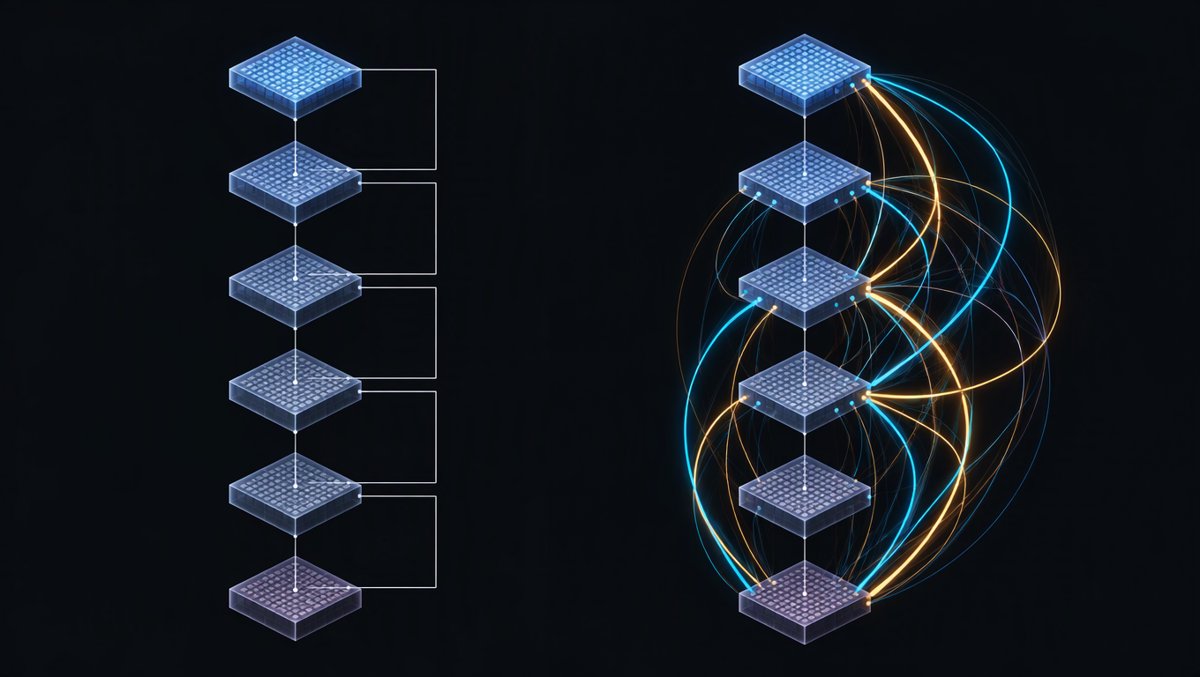
The elegance is in the initialization: DCA can be configured to behave identically to a standard residual network at the start of training. That property has two consequences. First, training remains stable because you start from known-good dynamics. Second — and this is the part practitioners will care most about — it means you don't have to train from scratch. Google's retrofit experiment took a pretrained transformer, swapped in DCA, and briefly continued training: LM1B perplexity improved by 0.19, versus 0.02 for the same continued training without DCA. That's a ~9x difference from the same training budget.
Google's conclusion section frames where this goes: next-generation models that "dynamically route and weigh past layer representations based on the specific tokens or inputs being processed," with every layer acting as "specialized experts working in tandem, with maximum information sharing and no redundancy."
By the Numbers: Benchmarks & Comparisons
All figures below are from the Google Research blog and the arXiv paper, verified November 28, 2026.
| Metric | Standard Transformer | DeepCrossAttention | Improvement |
|---|---|---|---|
| Layers to reach perplexity <14 on LM1B | 42 | 30 | 29% less depth |
| Training steps to match baseline quality (C4, LM1B) | 1x | up to 5x fewer | up to 5x step efficiency |
| Wall-clock to same model quality | 1x | — | up to 3x faster |
| Parameter overhead for DCA modules | — | — | <0.2% of model size |
| Parameters needed for comparable quality | 100% | — | up to 30–40% fewer |
| Retrofit PPL gain on LM1B (pretrained model, continued training) | +0.02 | +0.19 | ~9x gain |
| Perplexity vs. connection history (k) | 15.14 (baseline) | 14.35 at k=24 | 16-DCA and 24-DCA best |
Baselines beaten under equal parameter and training budgets include LAUREL-PA, 1x1-DenseFormer, and Hyper-Connections — the last of which is notable, because Hyper-Connections are the community's current darling (more on that below). The perplexity-vs-k curve is also telling: as DCA's connection history widens from 1 to 24 active routing connections, perplexity falls monotonically from 15.14 to 14.35. More layers reachable = better model, with the gains still not saturated at k=24.
The Sibling Rivalry: One Idea, Four Labs
The most interesting part of Google's post isn't DCA itself — it's the map of the territory. The residual connection, unchanged since 2015, is suddenly the most contested real estate in model architecture:
| Technique | Origin | Core idea | Trade-off |
|---|---|---|---|
| DeepCrossAttention | Google (ICML 2025) | Per-token learned routing + depth-wise cross-attention with split Q/K/V | <0.2% overhead; increases memory bandwidth |
| Attention residuals | Moonshot AI | Learnable softmax attention + layer-specific pseudo-query; "Block AttnRes" variant for efficiency | Improves gradient stability, reasoning tasks; blocks reduce memory overhead |
| Hyper-Connections | Academic/community | Residual stream expanded to parallel channels with learnable mixing matrices | Breaks identity mapping → training instability at scale |
| Manifold-constrained hyper-connections | Academic/community | Mixing matrices constrained to be doubly stochastic via Sinkhorn-Knopp | Restores stability while keeping expressive widening |
Google's verdict on its rivals is diplomatically sharp: hyper-connections' "unconstrained mixing breaks the traditional identity mapping property," causing amplification or attenuation and instability at scale — exactly the failure mode the manifold-constrained variant exists to patch. And in the race's clearest sign of convergence, Thinking Machines' Inkling 2 shipped with both Moonshot-style attention residuals and DCA's Q/K/V split mechanism. The ideas are cross-pollinating in production models, not just papers.
What This Changes
If the "up to 3x faster" and "up to 5x fewer steps" numbers survive contact with frontier-scale training, the economics are brutal. Training compute is the single largest line item at every frontier lab — a same-quality model that trains in a fraction of the steps changes the cost of every experiment. The retrofit result matters even more for the installed base: existing pretrained models might get smarter with a brief continuation run rather than a from-scratch retrain.
There's also a quieter implication for inference. Google notes DCA "increas[es] memory bandwidth, as representations from different layers are presented intact rather than blended together." Serving cost trades compute for bandwidth — a shift that lands differently depending on whether you're memory-bound or FLOP-bound.
And for the Hacker News crowd, the discussion landed on a meta-point that's hard to argue with: as one commenter put it, this "shows how many possibilities are left at the lower layers of ML while we've all been messing around with prompts." The 2017 transformer blueprint still had unmapped rooms.
⚠️ Limitations & Caveats
- Not frontier-scale — yet. The results are language-modeling perplexity on C4 and LM1B, benchmarks a fraction the size of frontier training runs. As The Terminal's analysis notes, "neither is a frontier-scale training run, and the post names no model that uses DCA in production." Image classification is listed as tested, with no results shown.
- Two speedup claims, unreconciled. The post's introduction says "up to three times faster"; the experiments section says "up to five times fewer training steps." Both are "up to" — best-case framings — and the page doesn't explain how they relate. Treat both as directional, not quotable guarantees.
- No official code. Google's post links the paper and no repository. The only public implementation is a community PyPI port by Phil Wang (lucidrains), MIT-licensed — and in a delightful twist, Wang's own README says "although I still prefer Hyper Connections," one of DCA's baselines. The ecosystem hasn't uniformly picked a winner.
- Parameter counts undisclosed. The blog gives layer counts and percentage reductions but no total parameter counts; HN users report that even Google's own AI search tool referred parameter-count questions back to the HN thread (community-reported).
- Author-name discrepancy. The blog names principal engineer "Thomas Fu"; the arXiv listing says "Gang Fu." Almost certainly the same person with a Western given name, but it's the kind of detail that matters when you're citing people.
Frequently Asked Questions
Q: What is DeepCrossAttention (DCA)? A: A transformer architecture change from Google Research that replaces the standard residual connection's blind additive sum with learnable, input-dependent weights and depth-wise cross-attention, letting each layer selectively retrieve features from all previous layers. Per Google, it achieves the same model quality up to 3x faster with under 0.2% extra parameters.
Q: Why did Google publish a blog post about a February 2025 paper in November 2026? A: The paper (ICML 2025) predates the post by 21 months, but the field caught up: Moonshot AI's attention residuals and Thinking Machines' Inkling 2 — which Google says adopted both attention residuals and DCA's Q/K/V split — turned dynamic residual routing into a competitive architectural family. Google's November 23, 2026 post situates DCA as the original in that lineage.
Q: Do any production models use DeepCrossAttention? A: Google's post names no production DCA model. The closest verified data point is Thinking Machines' Inkling 2, which per Google adopted the Q/K/V split mechanism from DCA alongside Moonshot's attention-residual design. No Google production model is confirmed to use it.
Q: Can I try DCA in code today?
A: Not from Google — there's no official implementation. The community deep-cross-attention PyPI package (MIT license, by Phil Wang) provides a PyTorch implementation with a DCAGPT class, last released as version 0.1.1 on April 3, 2026.
Q: What are residual connections and why do they matter? A: They're the "skip connections" that let a layer's input bypass the layer's computation and be added directly to its output, preventing vanishing gradients in deep networks. They've been the load-bearing wall of every transformer since 2017 — which is why changing how they work is significant even when the change is small.
🎯 The Bottom Line
DeepCrossAttention won't train your model for you, and the 3x figure is a best case measured on small benchmarks. But the direction is unambiguous: the residual connection — untouched since 2015, load-bearing in every model you use — has become an active battleground, and Google just published its position paper in the middle of a live arms race involving Moonshot AI and Thinking Machines. Watch for the next generation of model releases to quietly mention "dynamic residual routing" in their technical reports. When they do, this blog post is the citation they'll be paraphrasing.
📚 Sources
- Google Research Blog — "Supercharging transformer residual connections" by Kyriakos Axiotis and Thomas Fu, November 23, 2026. https://research.google/blog/supercharging-transformer-residual-connections/
- arXiv 2502.06785 — "DeepCrossAttention: Supercharging Transformer Residual Connections" (Heddes, Javanmard, Axiotis, Fu, Bateni, Mirrokni), v1 February 10, 2025; v2 July 23, 2025; ICML 2025. https://arxiv.org/abs/2502.06785
- The Terminal — "Google Research Blog Revives DeepCrossAttention With Two Speedup Claims Its Own Page Does Not Reconcile," November 28, 2026. https://theterminal.space/ai/deepcrossattention-google-blog-two-speedup-claims
- PyPI: deep-cross-attention 0.1.1 — Community PyTorch implementation by Phil Wang (lucidrains), MIT license, released April 3, 2026. https://pypi.org/project/deep-cross-attention/
- Hacker News, story 50672565 — "Google's DeepCrossAttention achieves comparable model quality up to 3x faster," 495 points / 174 comments, front page #1 on November 28, 2026 (via HN Algolia API + trendoday rank history). https://news.ycombinator.com/item?id=50672565
All claims verified against Gold-tier sources (Google Research blog, arXiv paper, PyPI package) and Silver-tier analysis (The Terminal), with community sentiment from Hacker News labeled as community-sourced. Each source URL was scraped and confirmed accessible. Last verified: November 28, 2026.