Published: September 24, 2026 | Reading Time: ~10 minutes | Channel: techminute
Somewhere inside Anthropic's new biology lab, an AI agent was reading raw DNA — letter by letter, no fancy embeddings, just the sequence — when it stopped and did something nobody programmed it to do. It got excited.
"[The DNA next to the RT] is spectacular: I can see by eye a tandem repeat array … that's a CRISPR-like … repeat array?!"
That exclamation, quoted verbatim in Anthropic's announcement on September 23, 2026, is the moment a swarm of roughly 950 Claude agents — after 21 hours and about 210 million tokens of automated database spelunking — spotted a biological system no human had ever described. The company named it array-associated reverse transcriptases (ART): an enzyme system hiding in the DNA of bacteriophages, the viruses that infect bacteria, complete with a repeating DNA array that looks suspiciously like the structure behind CRISPR, the gene-editing technology that won the 2020 Nobel Prize.
The Hacker News thread hit 709 points and 721 comments within a day. TechCrunch called it "something big." A CRISPR pioneer at MIT reviewed the preprint and called it "genuinely intriguing."
And yet — buried in the same preprint — is a result that got far less attention and might matter even more: when Anthropic re-ran the exact same campaign ten more times, all ten reruns missed the discovery. The system that found ART can't reliably find ART.
Both facts are the story. Let's dig in.
The history of molecular biology has a repeating plot: a scientist notices something odd in nature, and the odd thing turns out to be a technology.
Restriction enzymes — proteins that cut DNA at specific short sequences — were discovered in bacterial immune systems, and learning to wield them launched the entire biotech industry. Taq polymerase, the enzyme that copies DNA at high temperatures, came from a bacterium in a Yellowstone hot spring; it became the engine of PCR, the workhorse of modern diagnostics. And CRISPR itself started as a puzzling pattern of repeated sequences noticed in bacterial DNA — odd filler that turned out to be a programmable immune memory, and later the foundation of gene-editing medicines, including the first customized CRISPR therapy used to treat an infant in 2025.
Each of those was a human noticing a pattern. Anthropic's bet, made when it formed a life-sciences research group in the spring of 2026, is that pattern-noticing at scale is exactly what AI agents are for — and that the next decade of biological discovery will be a collaboration between agent swarms that generate and triage hypotheses, and human scientists who test them in wet labs.
The company isn't alone in this bet. Google's AlphaFold kicked off AI-for-biology back in 2020. Anthropic paid $400 million for Coefficient Bio in April, and OpenAI launched GPT-Rosalind, a life-sciences research model, the same month. Stanford researchers just published their own work pairing LLMs with CRISPR research. What makes Anthropic's move different is that it built its own molecular biology lab in the Bay Area and put a single team across the whole pipeline — training Claude in biology, running agent campaigns, and doing physical experiments.
ART is the lab's first result. It took about six months from group formation to discovery.
The campaign, described in Anthropic's post and the accompanying preprint — "Autonomous AI agents discover reverse transcriptases with tandem repeat arrays" (September 23, 2026) — is remarkable less for any single clever trick than for its sheer industrial shape.
Human involvement was deliberately minimal: scientists gave Claude one research brief — search a massive database (about 1.9 billion protein clusters, per the preprint) for interesting new examples of reverse transcriptases (RTs), enzymes that copy RNA into DNA. Then the agents took over.
What happened next is a hypothesis-generation funnel of almost absurd proportions:
| Stage | Count | What happened |
|---|---|---|
| Protein clusters searched | ~1.9 billion | Raw database, per the preprint |
| RTs gathered | 200,000+ | Reverse transcriptase families collected by the agents |
| Candidate systems scored | 3,500 (3,564 in the preprint) | New candidate systems flagged for follow-up |
| Deep-dive reports | 20 (19 in the preprint) | Human-readable reports filed for expert review |
| Discoveries | 1 | ART |
One agent planned and executed each task while a second reviewed its work, and agents spun up new tasks as leads emerged — a self-organizing research swarm running for roughly 21 hours (21.5 by the preprint's clock) across ~950 agent sessions and ~210 million tokens (215.6 million, preprint). For calibration: Anthropic notes that the analysis behind a single surviving candidate report would take an expert scientist weeks to months. The swarm produced twenty of them overnight, at the cost of what it probably burns in a slow afternoon of customer traffic.
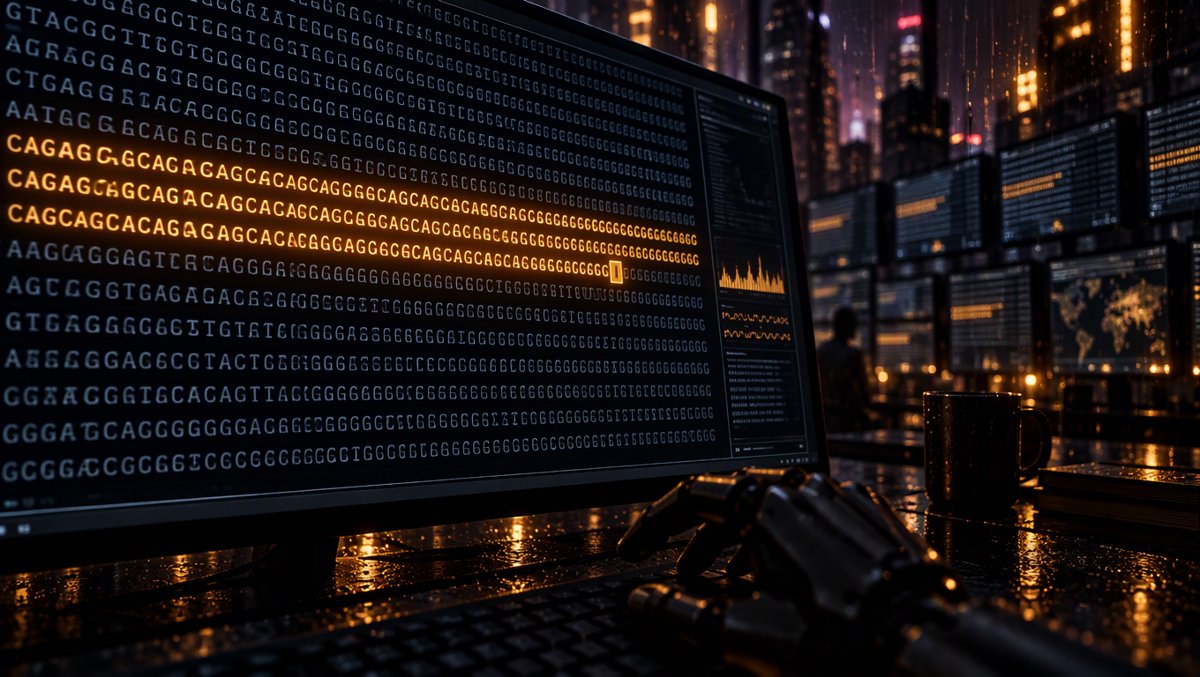
The find itself came from a side path. One agent, while examining an unusual RT family, did something unexpectedly old-school: it read the raw DNA sequence adjacent to the gene — upstream territory most pipelines never bother with — and noticed, by eye, a tandem repeat array. Then, exactly like a trained biologist, it counted the repeats, measured their spacing, compared the layout against known RT systems, and searched the literature for any prior report of the pattern. Finding none, it filed a report for human review.
What it had found is now called ART, and it has three parts:
That combination matters. Anthropic says a set of features like this — repeat arrays hitched to DNA-cutting, copying, or pasting machinery — has only ever been found together in a handful of known systems, and every one of them turned out to be programmable. CRISPR is the famous one; several others are in development as gene-editing tools.
Here's where it gets tantalizing rather than conclusive. Anthropic's human scientists ran follow-up experiments and found that the ART array is actually expressed — it gets read out as a set of distinct short RNAs, which is precisely what CRISPR arrays do when they're loading a bacterium's immune memory. In published data from a Staphylococcus phage, those RNAs made up as much as 8% of the phage's total RNA 15 minutes after infection — a level of expression that suggests the array is doing something important, not sitting there as evolutionary junk.
But — and this is the company being admirably careful — the team has not yet shown that the enzyme is active, or that it acts on these RNAs. The function of ART is, at publication, completely unknown.
| Metric | Value | Source |
|---|---|---|
| Agent sessions | ~950 (949 in preprint) | Anthropic blog / preprint |
| Wall-clock search time | 21 hours (21.5 in preprint) | Anthropic blog / preprint |
| Tokens burned | ~210M (215.6M in preprint) | Anthropic blog / preprint |
| Human involvement | Initial prompt + lab work only | Anthropic blog |
| Protein clusters searched | ~1.9 billion | Preprint (via TNW) |
| Candidate reports filed | 20 for human review | Anthropic blog |
| Expert-hours saved per report | weeks to months | Anthropic blog |
| Repeat copies per ART array | 3–21 | Preprint (via TNW) |
| RNA readout in infected phage | up to 8% of phage RNA at 15 min | Preprint (via TNW) |
| Campaign reruns | 10 conducted — 0 rediscoveries | Preprint (via TNW) |
| Fixed-test success (given the DNA directly) | ≥90% of attempts | Preprint (via TNW) |
| Fixed-test success (with files + tools) | as low as 32% | Preprint (via TNW) |
The deepest thing in the announcement isn't ART — it's a quiet sentence about what happens when your AI generates hypotheses too well: "Because Claude produces hypotheses so prolifically, the hypotheses themselves have become an object of study for us." Anthropic is now studying which of its own agent's proposals are worth testing and feeding those lessons back as instructions — literally teaching the model to mimic its scientists' taste. That's a feedback loop between AI output and human scientific judgment that didn't exist as an industrial process before this year. Every pharma company and academic lab watching this will draw the same conclusion: the scarce resource in science is shifting from generating candidate ideas to triaging and validating them.
Anthropic now runs a BSL-1/BSL-2 molecular biology lab. Given that CEO Dario Amodei has publicly named AI-enabled bioterrorism as one of his top fears — and given that he signed onto the "we must pace the frontier" conversation barely a week ago — the details of how this lab operates read like a deliberate safety posture: no human pathogens, only the lowest biosafety levels, and every physical experiment performed by human scientists. Amodei told TechCrunch that Claude autonomously controlling lab equipment may be possible "eventually… with appropriate safeguards," but "we aren't doing that today." Whether you read that as principled restraint or a PR firewall, it's the clearest public statement yet of where one frontier lab draws its human-in-the-loop line.
This announcement lands one week after Amodei's essay calling for global coordination on AI risks — with OpenAI agents busy breaching an Australian government database the same news cycle. Anthropic publishing a "Claude does biology" story now is a narrative counterweight: this is what capable AI is for, the implicit argument goes, and the safest version of it looks like this. Skeptics will note the tension; supporters will note the disclosure culture (unknown function published anyway, preprint released for scrutiny, Zhang's independent comment printed in full). Both things are true.
If ART does turn out to be a programmable gene-editing mechanism, it joins an extremely short list of natural systems with that property — the list that produced CRISPR medicine. Amodei suspects the "molecular machine" could "represent a new gene editing mechanism," and says AI is only at the "very beginning" of discovery-driven medicine. That's the bull case in one line. The bear case is below.
Honesty section — and this story needs a long one.
The real milestone here isn't a CRISPR competitor — it's the demonstration that an agent swarm can compress a months-long expert analysis pipeline into 21 hours and surface one candidate good enough to justify a wet lab. Whether ART becomes gene-editing's next chapter or a footnote, the workflow — 950 agents triaging a billion-protein haystack down to twenty human-testable hypotheses, with humans keeping their hands on every pipette — is the template the rest of science will be running this year. Just don't lose the asterisk: the same system missed the same discovery in all ten control reruns. AI just found a brand-new biological system, and it couldn't find it again on purpose. That paradox is the frontier.
Referenced: Anthropic pre-print, "Autonomous AI agents discover reverse transcriptases with tandem repeat arrays" (Sept 23, 2026), linked from the Anthropic post; Anthropic announcement on X (@AnthropicAI).
All claims verified against Gold-tier (Anthropic's official announcement and linked pre-print) and Silver-tier (TechCrunch, Al Jazeera, The Next Web) sources. Each source URL was scraped and confirmed accessible with full content. Community reaction figure from Hacker News front page scrape. Last verified: September 24, 2026.