'1980s Little Copper Lines': The Router Overload That Canceled 7,000 Flights in Four Hours

'1980s Little Copper Lines': The Router Overload That Canceled 7,000 Flights in Four Hours
Published: November 14, 2026 | Reading Time: ~10 minutes | Channel: techminute
TL;DR: On November 13, 2026, the FAA issued only its second nationwide ground stop since 9/11 — over 7,000 flights canceled in four hours — because legacy 1980s-era air traffic control routers became "overloaded with data," and the entire episode instantly became a referendum on both America's crumbling tech infrastructure and its reflex to blame AI for everything.
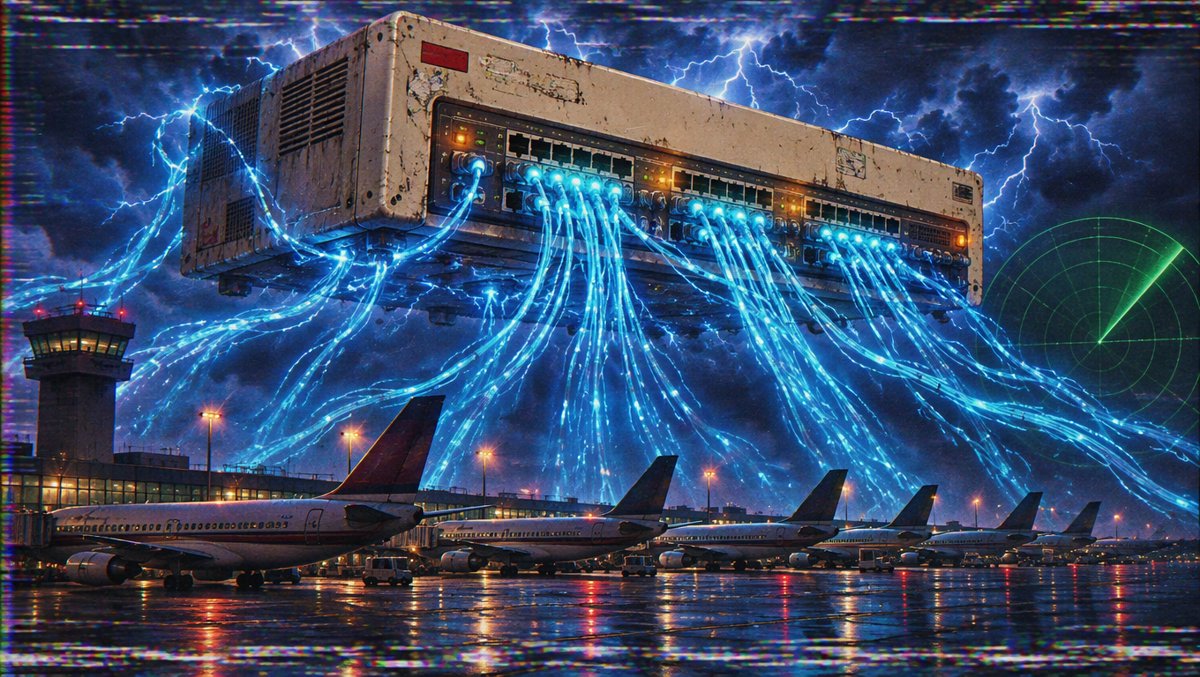
The United States grounded every departing flight in the country on Friday afternoon because its air traffic control network's routers — hardware running on what Transportation Secretary Sean Duffy called "1980s little copper lines" — became overloaded with data and started lying about the positions of aircraft. Between 3:54 p.m. and 8:15 p.m. ET, more than 7,000 flights were canceled, hundreds of thousands of passengers were stranded, and the federal government spent its evening news conference insisting, repeatedly, that neither hackers nor the FAA's brand-new AI system were to blame. It is the second nationwide ground stop since September 11, 2001, and the most vivid demonstration yet that the United States is running one of the world's most critical real-time systems on infrastructure older than most of the people maintaining it.
Key Takeaways
- The FAA ordered a nationwide ground stop at 3:54 p.m. ET on November 13, 2026 — the second since 9/11 — after radar and communications showed "instability" across Air Route Traffic Control Centers and TRACONs, starting at 3:36 p.m. (NPR, ABC News)
- The root cause, per officials: legacy routers "got overloaded with data" and produced inconsistent aircraft and radar data; a senior official said Saturday the offending system was located and taken offline (NBC News)
- More than 7,000 flights were canceled and over 8,000 delayed by 9 p.m. Friday (FlightAware); an estimated 300,000–400,000 passengers were stranded — two days before a holiday travel season (NPR)
- The FAA's newly deployed SMART AI tool was publicly exonerated by its own vendor within hours — while DHS Secretary Markwayne Mullin admitted "we're looking at that" (ABC News, NBC News)
- Duffy is now demanding roughly $50 billion from Congress to overhaul the system; Congress had previously approved $12.5 billion over five years (NBC News)
What Actually Happened: A Timeline of a Four-Hour Blackout
The facts of the afternoon are unusually well documented, because two Cabinet secretaries held a White House news conference the same night.
3:36 p.m. ET — Instability appears. Radar and air traffic communications at the FAA's Air Route Traffic Control Centers — the regional facilities handling high-altitude traffic — and at Terminal Radar Approach Control facilities (TRACONs) begin producing what Duffy described as "inconsistency in the data from those routers." At that moment, roughly 3,500 aircraft were in the sky (per Duffy); Flightradar24 counted 4,042 flights headed for U.S. destinations airborne when the alert dropped (NYT, NBC News).
3:54 p.m. ET — The FAA issues the nationwide ground stop. The alert's entire justification: "due to extraordinary circumstances and for reasons of safety," plus "all departing traffic should remain ground stopped until further notice." No cause named. No end time given (ABC News).
That's the part that should stop you, if you build systems for a living. The FAA did not lose the network. Duffy was explicit that the agency "did not lose all telecom or radar capabilities" (NBC News). What it lost was trust in the data — and when a real-time safety system can no longer trust its inputs, the only sane engineering move is to stop accepting new work. Every departing flight in America is, functionally speaking, a job submitted to the air traffic network. The FAA hit the global pause button rather than sequence aircraft on data it suspected was lying.
8:15 p.m. ET — The ground stop is lifted. The FAA's own Air Traffic Control System Command Center advisory — ADVZY 005, stamped 01:19Z on November 14, the Gold-tier primary document — reads simply: "THE FAA COMMAND CENTER NATIONWIDE GROUND STOP HAS BEEN CANCELLED." (FAA ATCSCC)
Saturday morning — The aftermath is still unresolved. By 9 p.m. Friday, FlightAware counted more than 8,000 delays and 7,000 cancellations; thousands more were canceled Saturday as carriers dug out (NPR, NBC News). A senior government official told NBC News the system causing the problem had been located and taken offline, and offered the most precise technical description anyone in government has given so far: the router "was essentially pinging too much information and overloading older air traffic control equipment."
Duffy said he expects the system to catch up before Thanksgiving. But he also told reporters: "you will have more of these. You will have more of them unless the American people and the Congress tell us to build" (ABC News).

Under the Hood: How Router Overload Becomes a National Emergency
Let's translate the government's language into network-engineering terms, because what happened Friday has a familiar shape to anyone who has run production infrastructure.
Air traffic control in the United States is a distributed real-time system. High-altitude traffic is managed regionally by Air Route Traffic Control Centers; the final approach segments are handled by TRACONs. Both depend on a continuous stream of radar feeds and coordination messages flowing across the FAA's telecommunications backbone. That backbone, by the Transportation Secretary's own account, includes "old switches, old routers... 1980s little copper lines" (NPR).
On Friday, something on that network began "pinging too much information" — the government's phrase, which sounds suspiciously like a traffic flood or a misbehaving device saturating older equipment's data plane. The routers didn't fail closed. That's the nightmare scenario here: they failed open, continuing to deliver data that was subtly inconsistent — radar tracks that disagreed with each other, comms that couldn't be fully trusted.
There's a term of art for this in distributed systems: split brain. When nodes in a real-time control system receive conflicting versions of the world, the system doesn't degrade gracefully — it makes confident decisions on bad inputs, which is far more dangerous than making no decisions. The FAA chose no decisions. Duffy confirmed the failures "were not universal, they were pervasive enough" to force the nationwide moratorium (NYT). The ~3,500 aircraft already airborne were never ordered down — pilots are trained to operate through communications outages, with spacing maintained through relay and redundancy, as aviation safety expert Jeff Guzzetti noted to NBC (NBC News). Medical flights, including organ transplants, were explicitly exempted.
What you had instead was the world's largest queue. Dartmouth aviation logistics professor Vikrant Vaze estimated 3,000–4,000 flights were being held at once, against a normal daily volume of about 25,000 U.S. domestic flights. Reagan National hit physical gate capacity by 6 p.m.; O'Hare was nearing it — meaning aircraft literally had nowhere to park (NBC News). Ground stops don't end when the routers recover; they end when the queue drains, which is why cancellations continued into Saturday.
It's also worth naming the eeriest detail: this is not a novel failure mode for the FAA. In January 2023, the only other nationwide ground stop since 9/11 was triggered when a contractor accidentally deleted files while synchronizing NOTAM databases — the system that delivers pre-flight hazard notices to pilots. That one lasted about 90 minutes. In May 2025, radar scopes at Newark Liberty went black for 90 seconds. Friday's event is the third data point on a curve everyone can now see (NPR, NBC News).
The AI Subplot: The Vendor That Had to Say 'It Wasn't Me'
Here's where 2026 earns its reputation.
The FAA has recently been rolling out an AI-enhanced tool called SMART, built by AirSpace Intelligence, as part of its air traffic modernization program (NPR). Within hours of the ground stop — before any official explanation existed — the company posted a statement on X that will surely be studied by every AI vendor's comms team from now on:
"The current ground stop is not based on or a result of the SMART system, any product of ASI or our integration with FAA and ATC." — NBC News
Read that timing again. Nobody had announced a cause. The vendor preemptively denied involvement, because the assignment of blame had already happened culturally, if not technically. At the White House briefing, DHS Secretary Mullin — asked directly whether the SMART rollout was connected — answered "we're looking at that" (ABC News). Duffy closed the loop the other way, saying SMART is "completely disconnected" from the equipment that failed (NBC News).
The blame-reflex extended across the whole stack of recent trauma. Mullin's repeated "zero evidence this was a cyberattack" line existed because everyone assumed cyberattack first — this is the same week Microsoft spent more than 20 hours restoring Outlook worldwide. The Atlantic published a piece titled "Of Course Americans Blamed the Ground Stop on AI," and over on Hacker News, community discussion of the stop ran north of 1,200 comments, with side threads tracking everything from Amtrak's coincidental booking-system issues to a live map of the country's frozen airspace (Hacker News — 1,598 points / 1,214 comments, the #1 story on the site at publication time).
There's a serious point buried in the comedy. The public's prior is now "the new AI thing broke it," and the government's internal prior isn't far behind — Mullin mused to reporters that new equipment the department had added might have overwhelmed the old infrastructure, while Duffy insisted the opposite: legacy equipment failed on its own (NYT). That disagreement — old-vs-new, inside the administration, on camera, with the root cause still unconfirmed — is the actual story of American infrastructure in one anecdote.
By the Numbers: Friday, November 13, 2026
| Metric | Figure | Source |
|---|---|---|
| Instability first detected | 3:36 p.m. ET | Duffy, via ABC News |
| Ground stop issued | 3:54 p.m. ET | FAA alert, via ABC News |
| Aircraft airborne at halt | ~3,500 (Duffy) / 4,042 U.S.-bound (Flightradar24) | NBC News |
| Ground stop lifted | 8:15 p.m. ET | Duffy, via ABC News; FAA advisory ADVZY 005 |
| Flights canceled (Friday) | 7,000+ | FlightAware, via NPR |
| Flights delayed (Friday) | 8,000+ | FlightAware, via NPR |
| Passengers stranded (estimate) | 300,000–400,000 | Aviation expert estimate, via NBC News |
| Normal daily U.S. domestic flights | ~25,000 | Prof. Vikrant Vaze, Dartmouth, via NBC News |
| Nationwide ground stops since 9/11 | 2 (this + Jan 2023 NOTAM) | NPR |
| Modernization funding approved / requested | $12.5B over 5 years / ~$50B | NBC News |
What This Changes
1. The modernization debate just got its exhibit A. Duffy spent most of the Friday night briefing doing something unusual for a Cabinet secretary in a crisis: asking Congress for money, on camera, with the receipts still smoking. He's seeking roughly $50 billion for what he called a "complete overhaul" of air traffic control, against the $12.5 billion over five years Congress approved last year (NBC News). Senator Richard Blumenthal called for a "prompt, penetrating investigation" the same evening; Senator Tammy Duckworth, the Aviation Subcommittee's ranking member, promised to demand answers from the FAA (NPR, ABC News).
2. It reframes AI-in-critical-infrastructure as a liability question, not just a capability question. The SMART episode is a preview of the next decade: every time a legacy system fails after an AI rollout, the AI is presumed guilty until proven innocent. Vendors will need pre-drafted denial infrastructure the way companies have outage runbooks. The sobering part is that the presumption isn't crazy — the genuinely open question Mullin raised (can new software layers destabilize ancient hardware by changing its traffic patterns?) is a real distributed-systems concern, and nobody could answer it on Friday night.
3. 'Fail safe' just demonstrated what it means at national scale. For all the chaos, the system worked in the way 1990s engineering intended: detect inconsistency, stop the world, land everything, investigate. 3,500 aircraft in the air at the moment of failure, zero evidence of danger to the public, every plane landed. The counterpoint is Duffy's own: this failure mode will recur, and each recurrence costs more than the hardware that would prevent it.
⚠️ Limitations & Caveats
- The root cause is not confirmed. As of Saturday morning, no official technical post-mortem exists. "Router overloaded with data" is the government's plain-language summary of an investigation still in progress; the specific device, protocol, or traffic pattern has not been named by any source. Anyone selling you a definitive cause is ahead of the evidence.
- The political framing is contested. The legacy-vs-upgrades dispute between Duffy and Mullin is exactly that — a dispute. It may turn out that a new system changed traffic patterns, that old hardware simply aged out, or both. Present company included: every figure in this article flows through administration officials' Friday-night framing.
- Counts are still moving. Friday's 7,000+ cancellations were the FlightAware count as of 9 p.m. ET; NBC reported thousands more Saturday. The stranded-passenger figure (300,000–400,000) is an expert estimate, not an official tally.
- History says be careful with superlatives. NPR and NBC characterize this as one of the biggest disruptions since 9/11 and the second nationwide stop of that scale. Precise superlatives beyond that aren't yet verifiable.
Frequently Asked Questions
Q: Why did the FAA ground all flights on November 13, 2026? A: The FAA ordered a nationwide ground stop after aging air traffic control routers became overloaded with data, producing inconsistent radar and communications data at Air Route Traffic Control Centers and TRACONs. With the integrity of its tracking data in doubt, the FAA paused all U.S. departures from 3:54 p.m. to 8:15 p.m. ET as a safety measure.
Q: Was the FAA ground stop a cyberattack? A: Homeland Security Secretary Markwayne Mullin said there was "zero evidence" of a cyberattack, while noting nothing was fully ruled out during the investigation. Officials said Saturday the offending system had been located and taken offline, and no evidence of malicious activity has been presented.
Q: Did the FAA's new AI system (SMART) cause the outage? A: Its vendor, AirSpace Intelligence, stated within hours that the ground stop was "not based on or a result of the SMART system," and Transportation Secretary Sean Duffy said SMART is "completely disconnected" from the failed equipment. DHS Secretary Mullin said investigators were "looking at" any possible link. No evidence connects SMART to the outage.
Q: How many flights were canceled in the nationwide ground stop? A: More than 7,000 flights were canceled and over 8,000 delayed by 9 p.m. ET Friday, per FlightAware, with thousands of additional cancellations on Saturday as airlines recovered. An estimated 300,000–400,000 passengers were stranded.
Q: When was the last nationwide ground stop before this? A: January 2023, when the FAA's NOTAM system — which delivers pre-flight safety notices to pilots — went down after contractors accidentally deleted files during database synchronization work. Before that, the only comparable event was the post-9/11 grounding on September 11, 2001.
🎯 The Bottom Line
A four-hour router overload canceled more flights than any single event in 25 years — not because American aviation is fragile, but because its control plane runs on hardware old enough to remember dial-up, and its operators were wise enough to stop the world when the data went quiet in a way they couldn't explain. The engineering response was flawless; the engineering context is indefensible, and now it has a $50 billion price tag attached and a very public deadline: Thanksgiving.
📚 Sources
- NPR — "Old tech blamed for the ground stop that caused flight chaos: 'It got overloaded'" (Nov 13, 2026). https://www.npr.org/2026/11/13/nx-s1-6040403/faa-nationwide-groundstop-airports
- FAA ATCSCC Advisory ADVZY 005 — Primary source: nationwide ground stop cancellation, stamped Nov 14, 2026 01:19Z. https://www.fly.faa.gov/adv/adv_otherdis?adv_date=11142026&advn=5
- NBC News — "FAA lifts ground stop hours after stranding thousands of flights across the U.S." (updated Nov 14, 2026). https://www.nbcnews.com/news/us-news/faa-orders-nationwide-ground-stop-departing-flights-reasons-safety-rcna609247
- ABC News — "Nationwide ground stop lifted after more than 4 hours as Trump administration blames old, overloaded tech" (Nov 14, 2026). https://abcnews.com/US/nationwide-ground-stop-ordered-airports-faa/story?id=138121848
- The New York Times — "What to Know About Friday's Nationwide Ground Stop" (Nov 13, 2026). https://www.nytimes.com/2026/11/13/us/faa-ground-stop-flights-what-to-know.html
- Hacker News (community tier) — "FAA issues national ground stop – lifted 4.5 hours later," 1,598 points / 1,214 comments, #1 on front page. https://news.ycombinator.com/item?id=50489641
- The Atlantic (context) — "Of Course Americans Blamed the Ground Stop on AI" (Nov 14, 2026). https://www.theatlantic.com/ideas/2026/11/faa-grounding-flights-cancelled/689444/
All claims verified against Gold-tier (FAA ATCSCC advisory) and Silver-tier (NPR, NYT, ABC News, NBC News) sources; each source URL was scraped and confirmed accessible with full content on November 14, 2026. Community-tier items (Hacker News, The Atlantic headline) are labeled as such. Last verified: November 14, 2026.