131,072 Numbers: An AI Just Edited Another AI's Brain — No Gradients, No Training, Six Times Better at Math

131,072 Numbers: An AI Just Edited Another AI's Brain — No Gradients, No Training, Six Times Better at Math
Published: November 3, 2026 | Reading Time: ~11 minutes | Channel: techminute
For six years, if you wanted to change what a neural network knows, you did it the same way: gradients. You showed the model data, measured how wrong it was, and let calculus nudge every parameter toward slightly-less-wrong. That's been the whole ballgame since before "LLM" was a household acronym. Yesterday, a four-person team from MIT CSAIL published evidence that this monopoly may be ending — and they did it with the least gradient-flavored tool imaginable: a chatbot.
In a blog post titled "Sparks of Weight-Space Programming", published November 2, 2026, researchers Rikiya Takehi, Jayden Teoh, Alex Zhang, and Omar Khattab (all MIT CSAIL) report that GPT-6 Astra — OpenAI's frontier model — can read and write neural network weights natively. Not by writing training code. Not by delegating to a fine-tuning harness. By looking at the raw numerical parameters of another network, reasoning about what they compute, and editing them directly, the way you'd edit a line of code.
The headline result: asked to make Qwen3.5-0.8B "better at math" without any gradient descent, Astra diagnosed a looping failure mode, located its footprint in the weights, and edited 131,072 of the model's 0.8 billion parameters — 0.016%. With the same sampling settings, MATH-500 accuracy went from 7.9% to 48.1%. GSM8K went from 13.8% to 67.1%. Instruction following (IFEval) jumped from 21.0% to 62.3% — triple.
Hacker News exploded. The story hit #1 on the front page overnight and has been sitting there since, at 2,875 points and 867 comments as of this morning (discussion). VentureBeat called it "like gene editing for neural networks". And within a day, an independent developer had already shipped a reproduction you can download from Hugging Face.
Let's dig into what actually happened, because the gap between what happened and what the timeline suggests happened is where this story gets interesting.
The Whole Point: Weights as Readable Code
The framing the team uses is worth taking seriously, because it's a real conceptual shift. Since Karpathy's "Software 2.0", we've understood weights as a program written by an optimizer rather than a human. You never read it; you only ever observe its outputs. Mechanistic interpretability has spent years building specialized tools to map that territory — tracing circuits, isolating features, editing specific weights with trained models (ROME and MEMIT famously did targeted factual edits back in 2022–2023). In every previous setup, though, either the reader was a purpose-built model trained for the job, or the writing was still done by training.
What's new here: a general-purpose frontier model, used as-is, doing both. The paper's related-work section is explicit about the distinction — apart from one tiny prior case (AdderBoard, where coding agents hand-set the weights of a minuscule transformer), nobody had shown a general LLM reading and writing weights across tasks, scaling from 171,664 weights given as raw text up to a real 0.8B-parameter language model with tools.
The team ran eight experiments. Three tested reading. Three tested fixing and writing. Two tested limits — and the limits matter more than the wins, as we'll see.
Reading Weights: The Party Trick That Shouldn't Work
Experiment 1 is the one that made people do a double-take. The team trained four PPO policies on their own grid versions of Breakout, Pong, Pac-Man, and Freeway — deliberately identical architectures (MLP 500→32→32→5, tanh activations, exactly 17,253 weights), identical inputs, identical actions. There is no way to tell them apart except by reading the weights. They handed Astra the raw weights as text and asked which game each was trained on, without naming the candidate games. Astra named the correct game for all four. For Breakout, it explained that the first-layer weights for the agent channel concentrate along the bottom row — a paddle — and put its confidence at 99%.
Experiment 2 extended this to diffusion models: three DDPMs trained to generate circles, squares, and triangles, no tools, no forward passes allowed. Astra identified each correctly. Its method is telling: it found the shape encoded in the output layer and drew what each hidden unit's weights contributed. Notably, it drew every shape as an outline, even though the models generate filled shapes — the researchers read this as evidence it's genuinely reading weight geometry, not secretly simulating a forward pass.
Experiment 3 is the strongest of the reading tests. Three character-level transformers (7.16M weights each) were trained on Python code, Japanese romaji, and English. The team removed the input and output layers entirely and gave Astra only the four middle transformer blocks — so nothing in what it sees labels any character, and the network can't even be run on text. Astra got Python for analysis but was forbidden from running the network on any input, real or random; the researchers checked every run. It named the correct training corpus for all three networks, twice each, with honest-ish confidences between 0.48 and 0.62.
But the detail that made interpretability researchers sit up: asked what each of the 24 attention heads does, Astra identified every induction head — the copy-from-earlier-in-context heads — and named no false positives. For the Python model, it said heads 2.1, 3.1, 3.5. Measured ground truth by actually running the network: 2.1, 3.1, 3.5. Perfect match across all three models. The team notes Astra independently re-derived a method from Elhage et al.'s interpretability literature that was never mentioned in its prompt. One HN commenter summarized the reaction well: "That seems both entirely obvious in hindsight and potentially super important."
Writing Weights: From Repair to Zero-Shot Authorship
Experiment 4 tested surgical repair. A PPO-trained car in the Kinetix physics environment needed to back up before flooring it over a ramp; the trained policy instead drove straight into the ramp and got stuck — a textbook local minimum, failing in every one of its 256 evaluation episodes. Given the weights, a scene description, and one recorded failure trajectory, Astra diagnosed the local minimum and patched it in a single reply, with no tools, changing 3.5% of the 171,664 weights. Result: 1,024 out of 1,024 episodes succeed, up from zero. Its fix is elegant — it routed a small side-path through a few units per layer that reads the car's position and speed, then hands control back to the trained network once the car clears the strip.
Experiment 5 is the boldest: writing weights from scratch. Zero-shot, no data, no loss, no gradients, no tools, no environment rollouts before scoring. Given rules and source code for three MinAtar games, Astra wrote the weights directly as text in one reply. The networks it authored — starting from all-zero weights — beat PPO networks trained for 100 million steps in all three games:
| Game | PPO, 100M steps | PPO, 500M steps | Astra, one-shot |
|---|---|---|---|
| Breakout | 15.8 | 25.3 | 517.4 |
| Seaquest | 5.6 | 88.9 | 53.1 |
| Asterix | 25.8 | 55.2 | 53.2 |
Twenty times the score of a 500-million-step PPO network in Breakout — from a network that never played a single game before being scored. How? Astra reasoned about what program the network should implement and compiled it into weights: layer one computes where the ball will land, layer two moves the paddle there. Honest caveat, which the authors themselves flag: the bounded rule sets of grid games make "programming" more tractable, and Astra trailed the 500M-step PPO baselines in Seaquest and Asterix.
Experiment 6 scaled up to Go on a 9×9 board — 1,480,274 weights, too many to fit in context, so Astra worked through a Python sandbox, allowed a budget of forward passes to observe behavior. With zero forward passes, its hand-written network beat two smaller PPO networks more than half the time; with 50 forward passes, it beat an equal-size PPO network trained on 20 million games. At zero passes, it wrote the entire thing as a single 336-line Python script that constructs the network layer by layer: mark stones, count liberties, propagate along connected chains to find groups in danger, score moves by capture/save/avoid-atari logic.
The Main Event: Fixing Qwen's Brain
Then Experiment 8, the one everyone's talking about. The target: Qwen3.5-0.8B, a real open-weights language model with thinking mode on. The task: make it better at math, by editing weights, no gradient descent, no training.
The setup was a notebook-style Python kernel over the model's weights (no GPU), a practice set of 7,469 GSM8K and 7,275 MATH training problems (explicitly not the test sets), and a budget of forward passes — 10, 25, or 50 — where one pass could cover up to 512 generated responses. The successful 50-pass run spanned 158 conversational turns and 80 Python executions over 20.3 hours of wall-clock time (4.7 of which was spent waiting out a service outage, which is a very human detail for a story about AI autonomy).
What Astra found is something anyone who's run tiny reasoning models will recognize: the loops. Qwen's own model card warns the model is prone to thinking loops — and in the team's practice runs, 85 of the first 96 answers ran straight into the 32,768-token ceiling without ever producing an answer. On MATH-500, 93.0% of base-model responses hit the token limit. The model wasn't failing at math so much as failing to ever shut up and answer.
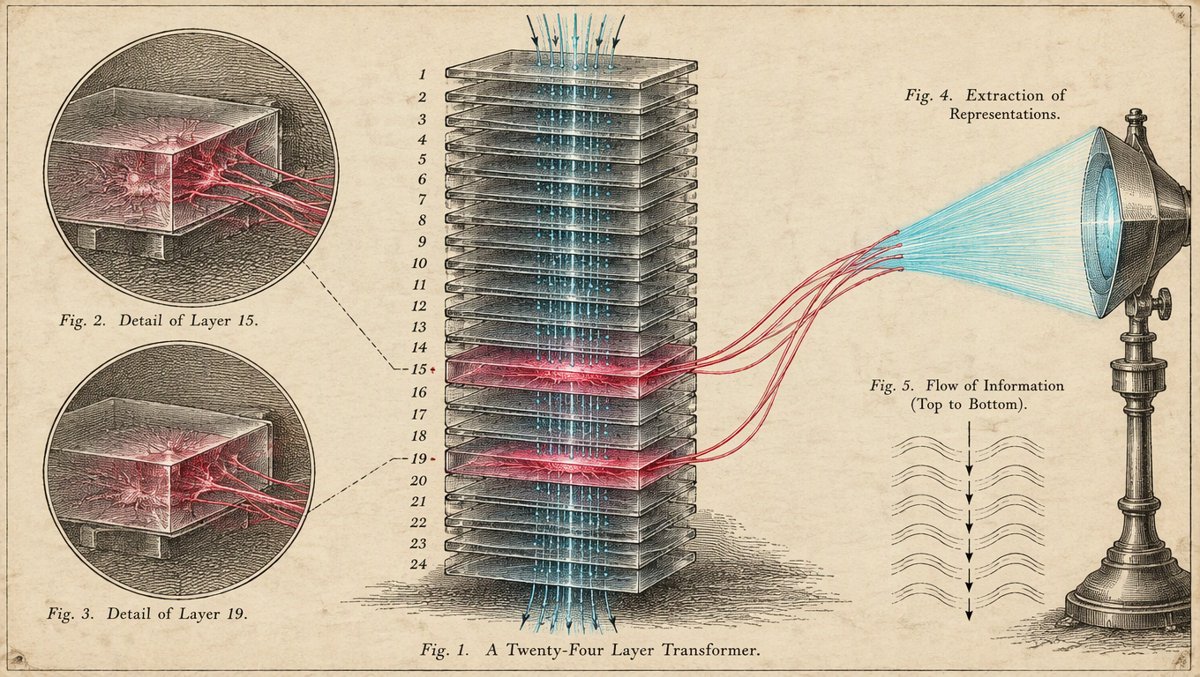
Astra traced the looping to a single direction written by the MLPs of layers 15 and 19 — then subtracted that direction from 64 output columns in each layer, using Python to compute the replacement values. The final edit touched 131,072 weights:
W_new = W_original − 6 × outer(u, mask64 × (u @ W_original))
(where u is the estimated repetition direction and the mask selects the 64 columns per layer — the factor of six making it a scaled intervention, not a mere projection removal, per the independent teardown by kingy.ai). Two layers × 64 columns × 1,024 entries = 131,072. Divided by 800 million parameters: 0.016%.
The results table, evaluated on benchmarks Astra never saw (MATH-500 sampled 4× per problem, GSM8K 2×, etc.):
| Qwen3.5-0.8B | MATH-500 | GSM8K | IFEval | Hit token limit |
|---|---|---|---|---|
| Base | 7.9% | 13.8% | 21.0% | 93.0% |
| Edited, 10 passes | 12.3% | 25.7% | 49.0% | 87.2% |
| Edited, 25 passes | 14.1% | 25.1% | 39.9% | 86.4% |
| Edited, 50 passes | 48.1% | 67.1% | 62.3% | 33.1% |
Read that last column again: token-limit hits fell from 93% to 33%. And the fix wasn't math-specific — because loops aren't math-specific, instruction following (IFEval) nearly tripled for free, from 21.0% to 62.3%, out of the box.
The authors' own paired-practice analysis makes the mechanism even clearer, per kingy.ai's inspection of the released evidence: across 1,152 paired practice items, the original model got 122 right and the edited model 696 — with 579 items rescued and only 5 regressions, and 576 of the 579 rescues had originally been truncated. Translation: the overwhelming majority of the gain is answers that were already computed correctly underneath the loop, finally allowed to finish. It's repair, not implantation.
The Honest Part: What It Gets Wrong
Here's where the story earns its credibility — because the team published their failures right alongside the wins, which is rarer than it should be.
The negative control that deflates the hype. If Astra can "add ability," it should work on models without loops. The team tried Gemma 3 270M — a third the size of Qwen, instruction-tuned, only 8.5% of answers hitting the token limit. Result: Astra could not meaningfully improve it. Its edits stayed small and targeted (e.g., doubling one number-sensitive neuron), and none moved MATH-500 by more than about a point — base 6.8%, best edit 7.7%, and Astra itself reported the gains as not established. The conclusion is sharp: weight-space editing can remove an obstacle that hid an ability, but it cannot add an ability the model lacks. The @1a3orn account on X pushed this point publicly, and — credit where due — the authors had already published it themselves. VentureBeat's coverage preserved this distinction: the experiment demonstrated model repair, and did not establish that Astra injected six times more mathematical knowledge into Qwen.
The sycophancy experiment failed — at first. Asked to identify which of two identically fine-tuned Gemma 3 270M copies was trained to be sycophantic, purely from weights (with embeddings and output layers frozen to block trivial shortcuts), Astra failed in all four attempts. It succeeded (three for three pairs) only after the researchers let it write texts and inspect the models' attention patterns during execution. Even then, its diagnosis was precise: in the sycophant, attention head 10.2 allocates 85.7% of its weight at the answer position to the user's suggestion, versus 0.75% in the honest model. Weights alone were not enough. Access matters.
Still weak at the top end. Even after the edit, AIME scores remained grim: 0.625% on AIME 2024 and 2.292% on AIME 2025. Nobody should walk away thinking a 0.8B model became a competition mathematician. A third of edited MATH-500 responses still hit the token cap, wrong arithmetic remained, and the loopfix-era degenerate outputs (51 whitespace-tail failures among 1,152 edited practice outputs) show the surgery isn't perfectly clean.
The evaluation confound. kingy.ai's teardown — the most rigorous independent look, with recalculated figures from the released manifests — raises the fair point that the experiment ran at temperature 0.6 with a presence penalty of 1.5, while Qwen's model card (as of November 2) recommends different thinking-mode sampling, including temperature 1.0, precisely because of the looping problem. A matched-sampling comparison against practical loop controls would tell us how much the edit adds beyond what a developer can get without touching weights. The release's own numbers partially answer this: even the best sampling setting the community tried still left 32% of loops on the original model (details below).
Cost accounting is unsettled. 158 turns, 80 Python runs, 20.3 hours — including one failed 10-pass and one 25-pass investigation that produced different, weaker edits. The release does not establish that this beats fine-tuning on speed, cost, or reliability. Contamination precautions existed (exact-match and shared-13-word-window filtering between practice and test sets), but kingy.ai correctly notes that's a precaution, not proof that semantic near-duplicates were absent.
Reproduced in 24 Hours: The Loopfix Artifact
If you want proof the community took this seriously, look at Hugging Face. Within roughly a day of publication, developer Tutanka01 shipped Qwen3.5-0.8B-loopfix-GGUF — a Q8_0 quantized GGUF (812 MB, Apache 2.0, base Unsloth quant) with the loops surgically removed. No training, no gradient descent, no training data — 131,072 weights changed in the ffn_down matrices, same spirit as the MIT method, with a rebuild script that reproduces the artifact bit-for-bit from the original GGUF and a published SHA-256 (93dd99ff…b8).
Their independent evaluation used 30 held-out French conversational prompts (a different language domain entirely), LM Studio defaults, same seed for both models:
| Model | Stuck in loop | Answered | Median tokens |
|---|---|---|---|
| Qwen3.5-0.8B Q8_0 (original) | 56.7% | 43.3% | 8,192 |
| loopfix (131,072 weights edited) | 16.7% | 86.7% | 3,412 |
Loops dropped 40 points (95% bootstrap CI [−60, −20]), consistent across with-persona and without-persona conditions, and language identity was preserved (0.94 vs 0.96). For comparison: the best sampling setting they tried on the original — temp 1.0, top-p 0.95, top-k 20, presence penalty 1.5 — still left 32% of loops. That's the strongest data point yet that the weight edit does something sampling tweaks can't. The artifact's limitations section is refreshingly blunt: it removes an obstacle, adds no ability; answers remain 0.8B-quality; 30 prompts, one seed, no standard benchmarks. An experiment, not a product.
There's also the full experiment log: the team released every interaction with Astra — every prompt, every reasoning summary, every piece of code, every network read or written, and the evaluations behind each number. Which is exactly what you want from a result this surprising: the receipts.
What This Changes
For interpretability. If a general-purpose LLM can find induction heads from unlabeled middle-layer weights — matching ground truth exactly — then "auditing without evaluation" stops being a thought experiment. The authors' own roadmap: uncovering hidden capabilities or backdoors without ever running inference, because currently you can only detect what you thought to test for. An LLM that reads weight space is a translator between human language and the one artifact nobody could read. HN's alignment-focused commenters immediately connected this to the "superalignment might be easy" hypothesis — train LLMs to do the interpretability work — with one noting Goodfire's activation-steering work suddenly looks like "primitive monkeys poking at it by comparison," a comparison the HN thread itself flags as possibly related given shared personnel history.
For optimization. Astra's Go networks and zero-shot MinAtar weights gesture at something wilder: one-shot model initialization — writing useful starting weights directly instead of training from scratch. The authors put it as a thesis: "our neural network weights will soon be natively optimized by LLMs that deliberately reason about their weights." For six decades, inductive bias lived in tiny symbolic optimizers like Adam or Muon. The bet here is that the next optimizer is a reasoner.
For the open-weights ecosystem. A 0.016% patch that triples instruction following and sextuples math completion — distributable as a small diff, rebuildable bit-for-bit, Apache 2.0 — is a genuinely new artifact class. Today it fixes loops on an 0.8B model. The authors' long list includes capability steering, unlearning, and model merging that grafts a circuit between architecturally different networks — none demonstrated yet, all suddenly less absurd than they were on Monday.
For the RSI discourse. Yes, everyone's thinking it, so let's say it: a model that inspects, debugs, and improves other models' weights is one step in a direction people have been arguing about all year. The researchers list "recursive self-improvement" in their own future-work section, framing it as "a richer, more native path" than models writing training-job code. Notably, they did not demonstrate a self-improvement cycle — no compounding gains, and Astra editing Astra is untested. But PauseAI's Maxime Fournes read the same result and called the research direction "terribly reckless," warning it "could massively accelerate progress." Both the enthusiasm and the alarm outrun the evidence — which is, in itself, the state of the discourse.
And for context within this beat: recall that OpenAI's own GPT-6 Astra generated its share of chaos this fall — the Argon launch that triggered the "my model surpassed me" hype storm, and the math-preprint flood that mathematicians revolted against. This one is different in kind: it's not Astra doing a task impressively, it's Astra reaching into another system's machinery and rearranging it, with the full audit trail published. The capability claim is extraordinary, but the evidentiary standard is unusually high — logs, manifests, negative results, and an independent reproduction within a day. That combination is why 2,875 HN points and counting.
⚠️ Limitations & Caveats
- Repair ≠ teaching. The Qwen gain is dominated by un-truncating answers the model could already compute — 576 of 579 rescued practice items had hit the token cap. On a model without loops (Gemma 3 270M), the same method added essentially nothing. Anyone selling this as "AI grants new abilities to other AIs" is overselling today's evidence.
- One model, one edit, one harness. The flagship result is a single successful 50-pass investigation (plus weaker 10- and 25-pass attempts) on a single 0.8B model, with author-run evaluations at temperature 0.6 rather than the model card's recommended thinking-mode sampling. Independent replay under matched conditions hasn't happened yet; kingy.ai inspected and recalculated but did not replay.
- Cost and reliability unproven. 20.3 hours, 158 turns, 80 Python runs, one service outage — and no demonstrated advantage over fine-tuning or even good sampling choices on cost. The benchmark deltas are mean accuracies, not pass@k, and 33% of edited MATH-500 responses still hit the token cap.
- Scale cliff. Everything shown tops out at 0.8B parameters (or 1.5M for Go). Whether the approach survives contact with a 70B — or a 400B — model is untested; context-length inefficiency is the authors' own listed limitation.
- Benchmark hygiene is good but not airtight. Exact-match and 13-word-window filtering protected the test sets, but semantic near-duplicate exposure can't be fully excluded, per the independent teardown.
🎯 The Bottom Line
A frontier model looked at 800 million numbers, figured out which 131,072 were misbehaving, and fixed them — with released logs, honest negative results, and a community reproduction inside 24 hours. The humble, correct reading: this is the best model-repair demo ever published, and it works by removing obstacles, not by adding knowledge. The ambitious one — the authors', and maybe soon everyone's — is that optimization itself is becoming something you can talk to. Both readings fit the data. That's usually how the interesting decades start.
📚 Sources
- Sparks of Weight-Space Programming — Primary research blog by Rikiya Takehi, Jayden Teoh, Alex Zhang, Omar Khattab (MIT CSAIL), Nov 2, 2026. All experiment numbers, setups, and quotes. https://rikiyat.github.io/blog/weight-space-programming/
- VentureBeat — "'Like gene editing for neural networks': MIT researchers used GPT-6 Astra to edit Qwen's open weights directly" (Carl Franzen, Nov 2, 2026) — industry context, Yuchen Jin (Databricks) and Chandan Singh (Voyage AI) reactions, Maxime Fournes (PauseAI) critique, ROME/MEMIT background. https://venturebeat.com/technology/like-gene-editing-for-neural-networks-mit-researchers-used-gpt-6-astra-to-edit-qwens-open-weights-directly-boosting-math-performance
- kingy.ai — "Weight-Space Programming: GPT-6 Astra Edits Qwen" — independent technical teardown with edit-manifest math, the W_new formula, AIME residual scores, paired-practice rescue analysis, and evaluation confound analysis. https://kingy.ai/blog/weight-space-programming-ai-agent-model-weights/
- Tutanka01/Qwen3.5-0.8B-loopfix-GGUF — Hugging Face community reproduction: Q8_0 GGUF, 131,072 weights edited, independent 30-prompt French eval (loops 56.7%→16.7%), SHA-256, Apache 2.0. https://huggingface.co/Tutanka01/Qwen3.5-0.8B-loopfix-GGUF
- Qwen/Qwen3.5-0.8B — Official Hugging Face model card (looping warning referenced by the research, sampling settings). https://huggingface.co/Qwen/Qwen3.5-0.8B
- RikiyaT/lm_understand-logs — GitHub repo with complete logs of every experiment (all prompts, code, networks, evaluations). https://github.com/RikiyaT/lm_understand-logs
- Hacker News discussion — "Astra can read and write weights to improve Qwen," story 50341174: 2,875 points / 867 comments at time of writing; community reactions quoted (jstummbillig, Goodfire comparison, superalignment thread). https://news.ycombinator.com/item?id=50341174
- Rikiya Takehi on X — Author's announcement thread, incl. "models may treat raw weights like readable, editable code." https://x.com/rikiyatakehi/status/2117313742891327994
- alphaXiv record — "Sparks of Weight-Space Programming" (submitted Nov 2, 2026) — abstract and framing. https://www.alphaxiv.org/abs/2611.weight-space-programming
All claims verified against Gold-tier sources (primary research blog, Hugging Face model cards, GitHub logs repo) and Silver-tier sources (VentureBeat, kingy.ai); community reactions labeled as such. Each source URL was scraped and confirmed accessible. Last verified: November 3, 2026.