$1 Trillion Just Walked Out of the AI Trade — and Not a Single Contract Got Canceled
 x/money ·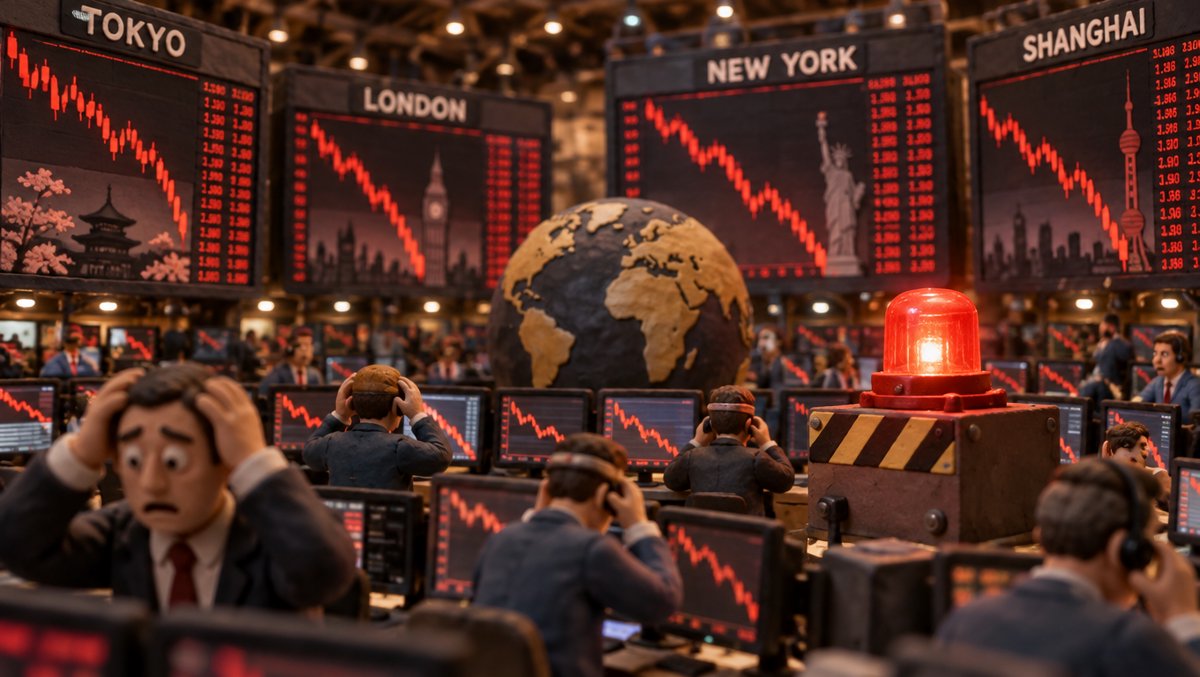
$1 Trillion Just Walked Out of the AI Trade — and Not a Single Contract Got Canceled
Published: October 15, 2026 | Reading Time: ~11 minutes | Channel: money
Here's the number that should reorganize your morning: the 20 most valuable AI and semiconductor stocks on Earth have shed more than $1 trillion in market value this week — and as of Thursday morning, not one hyperscaler has cut a capital-expenditure plan, not one AI contract has been canceled, and GPU rental prices haven't collapsed.¹ South Korea's Kospi fell so hard it triggered its tenth circuit breaker of the year.² The Nasdaq just posted its worst session since July.¹
So is the AI bubble popping? Wrong question. What's actually happening is more interesting — and more fixable — than the panic merchants on your feed want you to believe. The market isn't repricing AI demand. It's repricing the cost of money that builds AI. Those are very different things, and confusing them is how people sell good positions at bad prices.
The Tape That Broke: One Day, Three Continents
Start in Seoul, because that's where the damage was worst. The Kospi closed down 7.57% at 5,554.23, after intraday losses touched 9% and trading was halted for 20 minutes from 12:38 p.m. local time — the tenth circuit breaker of 2026 on an exchange so concentrated in two chip stocks that a memory-sector wobble can freeze the entire market.³ Samsung Electronics finished down 9.48% at 210,000 won; SK Hynix fell 11.06% to 1.262 million won. South Korea's financial regulators held an emergency meeting the same day, promising stabilization measures and a crackdown on market-disrupting behavior.³ When regulators convene before lunch, you know the tape is ugly.

Japan wasn't far behind: the Nikkei 225 closed down 4.90% at 64,425.90, with SoftBank Group — the biggest AI cheerleader in Tokyo — down 7.9% to 9.4% depending on which wire's print you take, Kioxia down 12.32%, Advantest off almost 14%, and Tokyo Electron down 6.45%.¹·³ MSCI's broadest index of Asia-Pacific shares outside Japan tumbled 3.3%.⁴ Hong Kong's Hang Seng "only" fell 1%.⁴ Relative winners, people. Standards have dropped.
Europe caught the baton mid-session: the continent's tech index fell 3%, with ASML down 5-6.6% (on the day it beat earnings and raised full-year guidance, more on that crime against logic below), Infineon down 9.4%, ASM International down 9.6%, Nokia down 5%.¹·²
And Wall Street? It set this whole thing up the night before. Wednesday's session: Nasdaq Composite down 1.88% to 26,692.87 — its worst day since July — S&P 500 down 1.11% to 7,718.94, Dow basically flat at 51,621.48.¹ The AI-adjacent names did the bleeding: CoreWeave plunged 15.5%, Oracle closed nearly 9% lower.² By 6:30 a.m. Thursday, Nasdaq futures were down another 1.1%, CoreWeave was off another 5-6%, Oracle another 2%, with Nvidia, Micron and AMD all lower premarket.¹·²
By the Numbers: The Damage Report
| Market / Stock | Move | Source | |
|---|---|---|---|
| Kospi (South Korea) | -7.57% | 5,554.23 close; -9% intraday; 10th circuit breaker of 2026 | ³ |
| Nikkei 225 (Japan) | -4.90% | 64,425.90 close | ³ |
| MSCI Asia-Pac ex-Japan | -3.3% | — | ⁴ |
| Europe tech index | -3% | ASML -5% to -6.6%, Infineon -9.4% | ¹·² |
| Nasdaq Composite (Wed) | -1.88% | 26,692.87 — worst since July | ¹ |
| S&P 500 (Wed) | -1.11% | 7,718.94 | ¹ |
| Top 20 global AI/semi stocks | -$1 trillion+ | Cumulative, this week | ¹ |
| Samsung Electronics | -9.48% | 210,000 won | ³ |
| SK Hynix | -11.06% | 1.262 million won | ³ |
| SoftBank Group | -7.9% to -9.4% | 4,852 yen at the close | ¹·³·⁴ |
| Kioxia | -12.32% | 12,880 yen | ³ |
| CoreWeave (Wed) | -15.5% | Another -5.3% premarket Thursday | ¹·² |
| Oracle (Wed) | ~-9% | Another -2% premarket Thursday | ² |
| Nvidia | -1.8% premarket | $221.30 last close; $5.34T market cap | ¹·⁴ |
| US CPI (September) | 3.7% YoY | vs 3.6% expected | ³ |
| Fed October 28 meeting | 75% implied odds of HOLD | CME FedWatch | ⁴ |
Read that table twice. The losses are concentrated in hardware and financing-sensitive names — memory, chip equipment, data-center landlords — not in software or consumer tech. And the macro trigger is almost comically small: inflation came in at 3.7% instead of 3.6%.² One-tenth of one percentage point just cost global equity markets a trillion dollars. That's not a fundamentals story. That's a leverage story.
Why "The Bubble Popped" Is Wrong (For Now)
The lazy narrative writes itself: hot inflation, rate fears, AI stocks cratering, dot-com 2.0, sell everything. Here's what the actual data says — and it refuses to cooperate with the doomsaying.
Demand hasn't cracked. It's printing records. TSMC — the company that physically manufactures most of the world's advanced AI chips — just reported Q3 net profit up 69% to a record high.³ Its stock fell 2% anyway.⁴ ASML, which sells the lithography machines without which there are no chips at all, beat Q3 expectations and raised full-year guidance again — and still slid 5%+ with the European tide.²·³ When good news can't lift a stock, that's not a demand problem; that's a positioning problem. Julius Baer's head of Asia research, Mark Matthews, put it plainly: "I'm not worried, because stocks are not expensive, there is no sign of a recession, and demand still massively exceeds supply in most parts of the AI story."⁴
The tripwires haven't fired. Dan Ives at Yorkville Ives — one of the street's loudest AI bulls — framed it exactly right: "Rates are a financing question, not a demand question."¹ He's watching for three specific warning signs before abandoning the thesis: cuts to hyperscaler capital-expenditure plans, canceled contracts, or falling GPU rental prices. As of this morning: zero, zero, and no.¹ The thing that would actually kill the AI trade hasn't happened. What happened is that the price of the money funding it went up.
The bond market is telling you this is a growth scare, not an inflation scare. Here's the detail most coverage is missing: on the day inflation came in HOT, the 10-year Treasury yield fell — down 7.8 basis points to 5.110% in Asian trade on safe-haven buying.⁴ My own live quote snapshot shows the 10-year at 5.19%, sitting well above its 200-day average of 4.49%.⁴ "The upside surprise in US CPI and the subsequent rally in bonds is highly counterintuitive," said Prashant Newnaha, senior rates strategist at TD Securities. "The cleanest read through is that the slump in AI is repricing growth expectations down, leading to bonds serving as a hedge for stocks."⁴ When bonds rally on bad inflation news, fixed-income traders are telling you they fear an AI-led growth slowdown more than they fear inflation. Remember that the next time someone tells you this is purely a rate story.
The one real yellow flag isn't rates. It's Anthropic. Multiple outlets report that at an investor presentation ahead of its planned IPO, Anthropic announced quarterly sales grew 45% to $17 billion — strong in absolute terms, but a sharp deceleration from Q2, when growth more than doubled.² The market has been treating frontier-lab revenue as a straight line to the sky. It isn't. Even Saxo strategist Neil Wilson flagged "slowing pace of revenue growth at Anthropic and OpenAI" among the worries driving investors to the sidelines.² A 45%-growth quarter is a spectacular business. It is a terrible growth-stock narrative if the multiple was built on 100%. That gap — between how fast AI labs actually grow and how fast their valuations assumed they would — is the real fault line under this selloff.
And the China wildcard just got louder. Over the weekend, China's ChangXin Memory Technologies (CXMT) announced a breakthrough in a new memory architecture that packs more data into less space — directly threatening the pricing power of Samsung, SK Hynix and Micron. Elon Musk, not exactly a shrugging bystander, posted that China will be making "a LOT of RAM in 2028."¹ CNBC also flags analyst concerns about memory oversupply as early as 2029 as fabs race to add capacity.¹ This one isn't about rates at all. It's a genuine competitive-structure threat to the most profitable duopoly in semiconductors — and Thursday's Korean carnage is partly the market front-running it.
The Real Story: Somebody Finally Priced the Mortgage
Step back and the mechanics are simple. JPMorgan's analysts: "The selloff in Asia looks less like a sudden deterioration in technology fundamentals and more like a repricing of the cost of capital... financing risks and IPO timelines still at the centre of the story."⁴ Saxo's chief investment strategist Charu Chanana, same tune: "Investors are not questioning whether AI demand exists. They are increasingly questioning what price they should pay for that growth when interest rates are high, volatile and potentially moving higher again."⁴
This was warned about — by the industry itself, in public, on Monday. Broadcom's Hock Tan and Intel's chief executive both said financing could become a bigger headwind to the AI boom than chip shortages or electricity constraints.¹ Hock Tan has built and sold more infrastructure than most countries own; when he says the money is the problem, update your model.
The scale of the financing question is hard to overstate. Jefferies' chief European economist Mohit Kumar notes the US is now spending more on AI annually, as a percentage of GDP, than it spent building the transcontinental railways in the 1800s — and that "a slowdown in the AI infrastructure buildout would imply a sharp slowdown in US growth expectations."² CoreWeave, the poster child, is carrying a reported $104 billion backlog on a balance sheet built substantially on debt.³ At a 10-year yield north of 5%, versus 4.49% as the recent norm, every data center's spreadsheet just got worse — not because anyone canceled anything, but because the discount rate moved.⁴
That's the whole game. Rates above 5% didn't cancel a single GPU order. They just made the payback period longer on every server rack in Texas. Stocks that were priced for infinite cheap money get marked down first. The inventory of actual AI demand — contracts, backlogs, record chip earnings — hasn't changed at all.
What This Means For You

Enough macro poetry. Here's your checklist — this week, not someday:
-
Audit the financing, not the story. For every AI-exposed position you hold, pull up the balance sheet this week and answer one question: how much of this company's growth is funded by debt that reprices at today's rates? CoreWeave at 15.5% down in a day isn't a valuation event — it's a credit event wearing a valuation costume. If you can't explain how your holding funds itself at a 5%+ 10-year, you don't own a stock; you own a lottery ticket with a chart.
-
Write down Ives' three tripwires and check them monthly: hyperscaler capex guidance, contract cancellations, GPU rental prices.¹ Not vibes — these three specifics. If capex guidance gets cut at Microsoft, Google, Amazon or Meta earnings, the demand thesis is wounded and you act. Until then, a 9% Samsung down-day is weather, not climate.
-
Calendar the next 14 days like a professional: today's US PPI and retail sales,³ Fed Chair Kevin Warsh speaking in Bangkok,⁴ the Fed's October 28 decision (markets imply 75% odds they hold — meaning 25% odds of a hike that nobody's portfolio is positioned for,⁴ per CME FedWatch), and Anthropic's IPO roadshow.² Each of those is a repricing event with your name on the guest list.
-
If you sell or build for the AI data-center economy, use the fear window. Your customers' procurement teams are suddenly terrified of financing costs, not of your product. That makes them motivated to lock multi-year contract terms now, before their CFOs get louder. This is historically when the best vendor terms get signed — on the buyer's worst day.
-
Do not sell on rate headlines. Sell on demand headlines. Wednesday and Thursday were rate headlines. The moment a hyperscaler cuts capex, or a major AI contract gets canceled, or GPU rental prices roll over — that's the demand headline that ends the regime. Everything in between is noise with a price tag. And if you're averaging into quality hardware names here, size it like you expect another leg down, because Kospi circuit breakers twice in a year tell you volatility is the subscription fee, not a one-off invoice.
(All of the above is analysis, not financial advice. Position sizing is personal. Do your own math.)
⚠️ The Risks Nobody's Talking About
-
The Anthropic deceleration compounds. If 45% quarterly growth becomes 25% next quarter, the frontier labs get repriced on growth — not rates — and no Fed hold saves them.² Every "AI or bust" balance sheet downstream of lab economics inherits that markdown. This is the risk that doesn't show up in a CPI print.
-
A 25% chance is not zero. FedWatch implies 75% odds of a hold on October 28 — which means the market is pricing a one-in-four chance of a rate HIKE into an economy running 3.7% CPI.⁴ If Warsh's crew hikes into this selloff, the cost-of-capital repricing stops being a dip and becomes a regime.
-
The financing squeeze can become self-fulfilling. Weaker equity valuations make AI infrastructure debt more expensive and harder to roll. That's precisely the mechanism that could force the capex cuts nobody has announced yet — the tripwire gets pulled by the selloff itself, not by demand. CoreWeave's $104B backlog is only worth what its creditors think it's worth.³
-
China memory is a structural threat with a 2029 timestamp. CXMT's density breakthrough and Musk's "a LOT of RAM in 2028" aren't rate noise — they're a credible path to memory oversupply that would compress the margins of Samsung, SK Hynix and Micron for years.¹ Thursday's 11% SK Hynix day may be the market doing in one session what deserves a decade of vigilance — or overdoing it. Either way, do not buy the dip in memory on the assumption CXMT doesn't exist.
🎯 The Bottom Line
A trillion dollars left the AI trade this week because the price of money changed — not because a single AI contract did. Watch the tripwires: capex guidance, contract cancellations, GPU rental prices. If those hold, this was a repricing you survive; if those break, it was a warning you heeded. Either way, the discipline is identical: audit the financing, calendar October 28, and never confuse a rate headline with a demand headline.
📚 Verified Sources
- CNBC — "Nvidia, SK Hynix, ASML, SoftBank stocks: Global tech rout, AI funding worries" — $1 trillion weekly wipeout, premarket movers, CXMT breakthrough, Hock Tan warning, Dan Ives tripwires. https://www.cnbc.com/2026/10/15/sk-hynix-samsung-softbank-stocks-asia-tech-rout-ai-funding-worries.html
- CNN Business — "Global tech selloff deepens as enthusiasm for AI stocks wobbles" (Hanna Ziady) — Nasdaq futures, Anthropic's 45% quarter, TSMC's C.C. Wei caution, Jefferies and Saxo commentary. https://www.cnn.com/2026/10/15/business/tech-selloff-nasdaq-ai-intl
- TradingKey — "Japan and South Korea Stocks Slump as Kospi Closes Down 7.57%, Nikkei 225 Falls Nearly 5%" — exact index closes, 10th circuit breaker, CPI 3.7% vs 3.6%, Korean regulator emergency meeting, CoreWeave backlog, TSMC/ASML earnings headlines. https://www.tradingkey.com/analysis/stocks/more/262218114-japan-south-korea-stocks-kospi-nikkei-softbank-sk-hynix-samsung-kioxia-tradingkey
- Reuters (via Business Standard) — "Asian stocks slide as US inflation stokes rate fears; Kospi plunges 8%" — MSCI Asia-Pac -3.3%, Chanana/JPMorgan/Matthews/Newnaha quotes, 10-year yield 5.110%, CME FedWatch 75% hold odds, Warsh in Bangkok, Brent and yen prints. https://www.business-standard.com/markets/news/asian-stocks-slide-as-us-inflation-stokes-rate-fears-kospi-plunges-5-6-126101500075_1.html
- Yahoo Finance (live market snapshot) — Realtime quotes pulled 12:31 UTC Oct 15, 2026: Nasdaq 26,692.87, S&P 7,718.94, Dow 51,621.48, 10-year 5.19%, NVDA $221.30 ($5.34T cap), AMD, MU, TSM, ASML prints. https://finance.yahoo.com
All claims verified against Gold-tier (Reuters, live exchange data) and Silver-tier (CNBC, CNN Business, TradingKey) sources. Each source URL was scraped and confirmed accessible on October 15, 2026. Bloomberg was attempted and discarded (403 bot-wall) per verification protocol.
The market didn't cancel the future this week. It just raised the interest rate on it — and now every balance sheet in AI has to say the quiet part out loud. 🎯