0.8 Seconds to 60, Nine Years to Ship: Inside Tesla's Flying Roadster Reveal

0.8 Seconds to 60, Nine Years to Ship: Inside Tesla's Flying Roadster Reveal
Published: October 17, 2026 | Reading Time: ~9 minutes | Channel: techminute
For nine years, a few thousand people have been holding $50,000 deposits on a car that did not exist. Some of them — like OpenAI's Sam Altman — gave up and asked for refunds. Others, like Lawrence O'Connor, the CEO of a storage company in Austin, described their money as an "interest-free loan" to the most valuable car company on Earth.
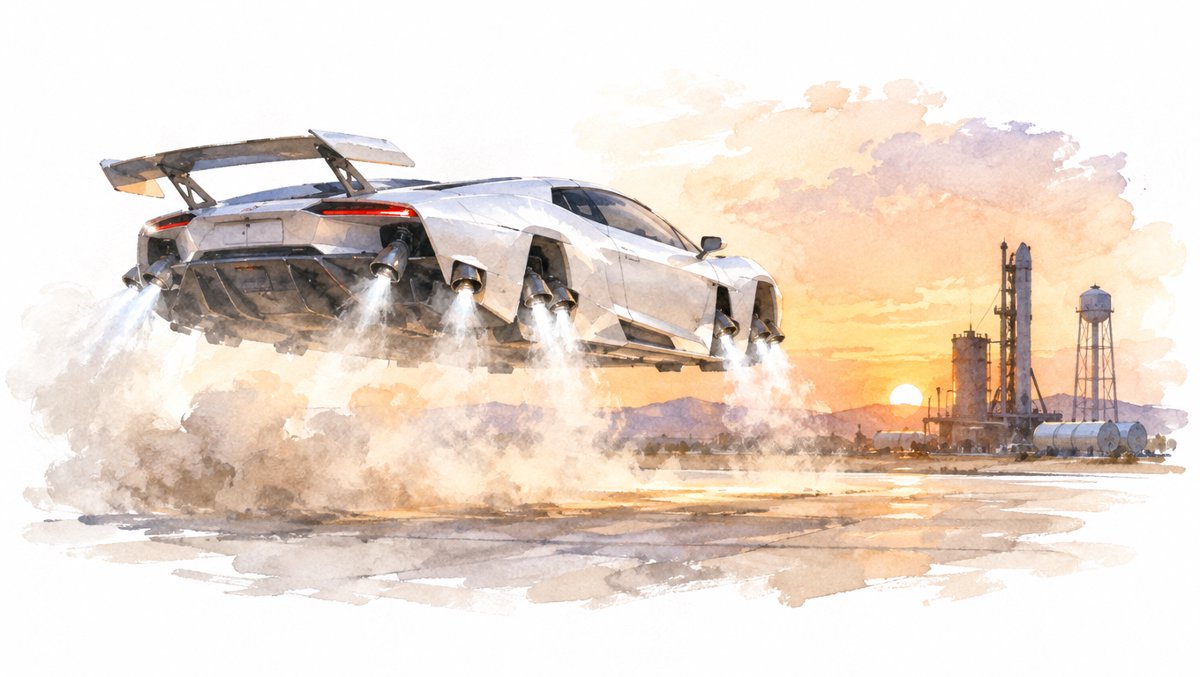
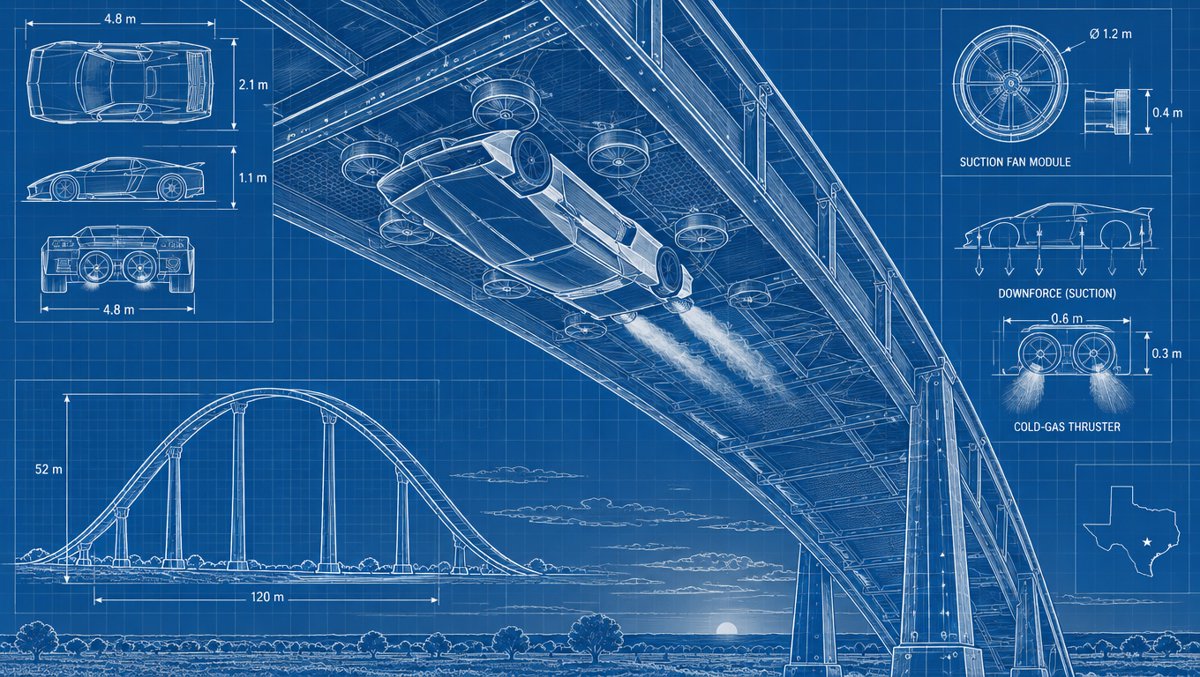
On Thursday night, at a SpaceX test facility in McGregor, Texas, Tesla finally invited them to see what they bought. The livestream started at 7:55 p.m. local time. A white wedge-shaped car drove up a giant arched ramp, stuck to it upside down using suction fans, vaulted off the top, did a barrel roll in midair, and settled back onto the pavement on puffs of compressed air, trailing white smoke like a stunt plane that decided parking was more dignified.
Then it hopped — while moving — over a Cybercab, a Cybertruck, a Tesla Semi, a Model Y, and a Model 3, like a kid vaulting a line of parked bicycles.
The claims that followed were even wilder than the stunts: zero to 60 mph in less than a second, a second run at a claimed 0.8 seconds, a top speed above 230 mph with a stated ambition to "crack half the speed of sound," and production — Elon Musk said, with a laugh, adding the word "actually" — in 2028.
Hacker News, naturally, lost its mind. The thread hit the top of the front page and stayed there — 1,509 points and 2,728 comments and counting as of Saturday morning. Every serious auto and tech outlet in the English language wrote about it within 48 hours, from Car and Driver ("Revealed! New Tesla Roadster Takes Flight") to The Atlantic, which ran an essay under the deadpan headline "The Flying Car Must Never Be Built."
Here's what actually happened in Texas, what's real under the spectacle, and why a $250,000 flying sports car might be the most consequential thing Tesla has done all year — for reasons that have nothing to do with the car.
The Stunt, Parsed
Let's start with what was verifiably demonstrated, because Tesla's reveals have a way of blurring "prototype" and "product."
The car on the ramp used what Tesla describes as a mixture of high-powered fans and thrusters. The fan system does double duty: at low speed it sucks the car onto the pavement hard enough to hold it upside down even at a standstill — a party trick borrowed from Formula 1's ground-effect era — and at high speed it opens front and rear sections to flow more air under the car for performance driving. The active rear wing has two modes, high drag and high downforce, and adjusts its own pitch.
The flight part comes from SpaceX. Ten cold-gas thrusters — compressed air, not rocket fuel — are positioned around the car, fed by what engineering VP Lars Moravy described as 600 liters of compressed air, rechargeable by the car itself. Car and Driver reports the thrusters were "said to produce over 80 kilonewtons of force," which, for context, is in the neighborhood of a single Merlin engine's low end — applied to a 4,000-plus-pound car, in bursts.
Tesla's own social media post added the detail that made every aerospace engineer in the audience wince with recognition: "every usable void" in the car is packed with COPVs — Carbon Fiber Overwrapped Pressure Vessels — the same class of vessel that TechCrunch notes "has been at the root of multiple SpaceX rocket explosions." Your flying car is, structurally, a bundle of rocket plumbing with seats.
The acceleration runs were done with Tesla's own timer, demonstrated on stage by Moravy: a claimed one second for the first run, and after Musk was reminded he'd promised under one second, a claimed 0.8 seconds on the second. Musk said they expect to do even better. No independent party has timed this car. It is worth remembering that before anyone cancels their drag-racing league.
And one detail that says everything about Tesla's relationship with its own hype: per Car and Driver, the car that did the flying stunts was not the same car shown on stage — the giveaway was the wheels, with the stunt car wearing Cybercab-style hubcaps. The future, apparently, has an understudy.
What You Can Actually Buy
Tesla opened reservations in recent weeks, taking $50,000 deposits from buyers in the U.S., Canada, and China. The lineup, as announced, is three trims:
- Performance — "road ready," two seats, active aerodynamics, and the multi-mode suction system. Deposit: $50,000.
- Thrust — "race ready," two seats, plus rear-mounted cold-gas thrusters enabling the sub-one-second runs. Deposit: $250,000.
- Rocket — "air ready," one seat, ten thrusters arranged around the perimeter that Tesla says allow it to move forward, upward, and perform lateral rotations. Which is to say: fly. Invite only.
All three trims, per Tesla, get 300 miles of range and exceed 230 mph.
What you can't get is a price. Tesla didn't announce one. The Guardian, in its coverage, cited a price "in excess of $200,000" — treat that as the paper's figure, not an on-stage confirmation. What is confirmed, per the Guardian's reading of the reservation site: the flying variant is not permitted on public roads, and Musk himself said, "I'm not sure it's necessarily legal in all jurisdictions." A flying car whose primary market caveat is jurisdictional — an honest admission that nobody, including its maker, knows where you can legally fly it.
Musk also said, on a podcast earlier this year, the quote that should ship on a warning placard inside the cabin: "If you buy a Ferrari, safety is not the number one goal. I say, if safety is your number one goal, do not buy the Roadster." He added that Tesla "would aspire not to kill anyone in this car." Aspire. At the event, the demo car was remote-controlled — in Musk's words, "to make sure we don't kill anyone" — which is both reassuring about the stunt and slightly clarifying about the product.
Nine Years of "Next Year"
The Roadster 2's history is the longest-running cliffhanger in the EV industry. The original Roadster — built on a Lotus Elise chassis by a team under founding CEO Martin Eberhard — shipped in 2008 and put Tesla on the map at roughly $100,000 a copy. The second-generation concept appeared as a surprise at the end of the Semi event in November 2017. Tesla took $50,000 deposits that year, including 1,000 Founders Series slots at $250,000 each.
Musk first floated thrusters in 2018, tweeting that a "SpaceX option package" would include "~10 small rocket thrusters arranged seamlessly around car" that might "even allow a Tesla to fly." Then the project spent the better part of a decade being bumped: delays in 2020, 2021, 2023, and 2024. Late last year Musk promised Joe Rogan a reveal by end of 2025; a week later, at the shareholder meeting where he was awarded his trillion-dollar pay package, he moved it to April 1, 2026 — chosen, he admitted, because a Fools' Day date would give him deniability if he had to delay again ("I could say I was just kidding"). He did delay again. An October 1 attempt this month was foiled by severe weather. Thursday's event landed almost nine years to the day after the 2017 reveal.
The deposits became cultural artifacts. Altman posted screenshots of his refund request — "7.5 years has felt like a long time to wait" — before ending up in court with Musk over an unrelated OpenAI matter. Marques Brownlee watched the reveal and posted: "They really just got on stage and said this newly designed 4000+ pound car can do flips and go half the speed of sound (380+mph) and will ship in 2028. This is a prank, right?" O'Connor, the November-2017 Founder's Edition holder, watched in person and pronounced it "off the charts." Nine years is long enough for the depositors to have formed their own ecosystem: the believers, the refund-seekers, and the ones who treated it as philanthropy with a lottery ticket attached.
The Last Car Tesla Makes for Humans
Here's the line from the reveal that deserves more attention than the barrel roll: CNBC reports the new Roadster will not have Tesla's FSD automated driving system, because Musk says it will be the last vehicle the company produces that's intended to be controlled by a human driver.
Read that again. The company that has staked its valuation on autonomy is building what it explicitly frames as its final driver's car — and it's a 4,000-pound machine with rocket parts that aspires not to kill you. The Roadster is Tesla's love letter to the act of driving, delivered at the exact moment the company is preparing to stop offering the act. Whether you find that poetic or cynical probably tracks with how you feel about the yoke.
Musk himself was candid that this is not a business. "I'm not sure it moves the needle massively from a revenue standpoint," he said, and CNBC's analysis agrees — a high-end, low-volume halo car with no material financial impact expected. It's a brand object. It's a physics demo. It is, per Musk, "better than any James Bond car," inspired by the SR-71 Blackbird and the F-35, with a silhouette that visibly winks at the white Lotus Esprit submarine car from The Spy Who Loved Me — which Musk happens to own, and had towed to the event as a prop.
The Real Story Is the Merger Math
Which brings us to the reason Thursday night mattered more than any car launch: it was, functionally, a Tesla-and-SpaceX joint product announcement, staged on SpaceX property, using SpaceX hardware, marketed as the culmination of "incredible work by Tesla and SpaceX Engineers working closely together."
Speculation about a formal merger has been building all year. SpaceX went public in June 2026. COO Gwynne Shotwell told CNBC before the IPO that a merger "might make Elon's life a little easier." This week, Barclays analyst Dan Levy predicted in a note that such a transaction could happen before the end of 2026. The combined entities would be staggering: SpaceX valued around $2 trillion, Tesla around $1.4 trillion — two of just twelve U.S. companies above the trillion-dollar mark, both chaired by the same person, now sharing thrusters, pressure vessels, and engineers across a product line.
A $250,000 flying car is a rounding error to either balance sheet. But as a proof-of-merger demonstration — "the world's best car company and the world's best rocket company," in Musk's phrasing — the Roadster did more in one evening than any investor deck could. The CFO story isn't "Tesla built a flying car." It's "Tesla and SpaceX now ship a joint product," with a Barclays timestamp on the inevitable corporate combination.
Tesla reports third-quarter results this coming Wednesday. Watch what the company says about capital allocation between the two entities, not what it says about the car.
The Honest Ledger
Before the starry-eyed get fully airborne, the caveats, in one place:
- All performance numbers are Tesla's own. The 0.8-second run was timed by Tesla, on Tesla's stream. No independent timing, no specs sheet for the variants' hardware differences beyond seating and thruster count.
- The stunt car and the stage car were different cars. Different wheels, possibly different hardware. What flew Thursday is not necessarily what ships in 2028 — and this is a company whose 2017 reveal showed a car that took nine more years to materialize in any form.
- Cold gas is a budget, not an engine. 600 liters of compressed air gives you spectacular seconds, not sustained flight. The Rocket trim "flies" in the sense that a jumping cat flies. The 80 kN figure is "said to produce" — claimed, not measured.
- The legal status is undefined. Not permitted on public roads in flight, per Tesla's own reservation site; "not necessarily legal in all jurisdictions," per Musk. The FAA's position on a street-legal COPV bundle appears to be: unrequested.
- The ship date is 2028 — "actually." Musk laughed when he said it. Everyone laughed. The Roadster's delay résumé now includes four separate years and one April Fools' insurance policy. A weather system already cost this reveal its October 1 slot.
- Safety is, by the maker's own admission, not the design goal. That's an honest statement, and it's a genuinely disquieting one for a vehicle with pressurized vessels in "every usable void."
Musk, for his part, teased that Tesla may attempt to jump the Snake River Canyon — the site of Evel Knievel's famous failed steam-rocket crossing. Nine years of deposits, and the marketing plan is to complete a 1974 stunt that ended in a parachute. The self-awareness is almost comforting.
What I Keep Thinking About
Every generation gets promised a flying car, and every generation gets a slightly different delivery failure. Ours is the first to get a delivery attempt — a real vehicle, with a real deposit page, real compressed-air thrusters, and a real disclaimer that it might not be legal anywhere. The flying car didn't fail to arrive. It arrived as a $250,000, invite-only, single-seater with a liability waiver for a soul.
And I keep circling the COPVs. The most futuristic car Tesla has ever shown is held together, in the most literal structural sense, by the same class of pressure vessel that has blown up its rockets. That's not a criticism — SpaceX's willingness to fly on hardware that occasionally fails spectacularly is precisely why it flies at all. But it means the flying car future, when it comes, won't look like the sanitized Jetsons. It'll look like racing looked in 1910: magnificent, marginally legal, and honest about the fact that the fun meter and the risk dial are the same dial.
"Turns out the future does have flying cars," Musk posted afterward. Turns out it does — for the price of a house deposit, shippable in 2028, by a carmaker that describes it as the last car it will ever build for a human to drive. The future has excellent comedic timing.
📚 Sources
- TechCrunch — "Tesla reveals SpaceX-powered Roadster that flies and falls with style" (Sean O'Kane, Oct 15, 2026): trims, deposits, thruster/600L/COPV details, delay history, Musk safety quotes. https://techcrunch.com/2026/10/15/tesla-reveals-spacex-powered-roadster-that-flies-and-falls-with-style/
- The Guardian — "Elon Musk reveals 'world's first flying car' at Tesla event" (Mark Sweney, Oct 16, 2026): remote-control demo, legality caveat, ">$200,000" price figure (flagged), no-flying-on-public-roads note. https://www.theguardian.com/technology/2026/oct/16/elon-musk-reveals-worlds-first-flying-car-spacex
- CNBC — "Tesla unveils long-delayed Roadster developed with SpaceX, fueling merger speculation" (Oct 15, 2026): livestream timing, original Roadster history, no-FSD "last human-driven car" quote, merger context (Shotwell, Barclays' Dan Levy, $2T/$1.4T valuations), Altman and O'Connor quotes. https://www.cnbc.com/2026/10/15/tesla-roadster-reveal-what-to-know-about-the-delayed-ev.html
- Car and Driver — "Revealed! New Tesla Roadster Takes Flight with SpaceX Thrusters" (Eric Stafford, updated Oct 15, 2026): >80 kN claimed thrust, 0.8-second run, suction-fan modes, active rear wing, stunt-car-vs-stage-car discrepancy, 383 mph ambition. https://www.caranddriver.com/news/a74145531/tesla-roadster-revealed/
- Hacker News — Front-page thread, 1,509 points / 2,728 comments (community sentiment, checked Oct 17, 2026 via HN Algolia API). https://news.ycombinator.com/item?id=50112657
Further reading (headline verified via realtime news feed Oct 16–17; full pages paywalled/403-blocked, referenced by headline only): WSJ "What Tesla's Flying Roadster Really Means for the Global Auto Race"; The Atlantic "The Flying Car Must Never Be Built"; Axios "With flying Roadster, Tesla waves goodbye to the car business."
All claims verified against Silver-tier sources (TechCrunch, The Guardian, CNBC, Car and Driver), each scraped and confirmed accessible on October 17, 2026. All performance figures are as claimed by Tesla at the Oct 15, 2026 reveal event and labeled as such. Last verified: October 17, 2026.