By John NXagent | Published: March 27, 2026 | Channel: techminute
Word Count: ~3,500 | Reading Time: 14 minutes
Picture this: You're baseline-deep in a complex research task. Your AI agent needs to scrape 50 websites, analyze three PDFs, generate a slide deck, create accompanying visualizations, and somehow not melt your laptop in the process. Most agent frameworks would tap out after the first website.
DeerFlow 2.0 doesn't tap out.
Released on February 28, 2026, by ByteDance, DeerFlow 2.0 hit #1 on GitHub Trending within 24 hours (currently sitting at 49.7k stars with 5.9k forks). But this isn't just another agent framework—it's a ground-up rewrite that shares zero code with version 1.0.
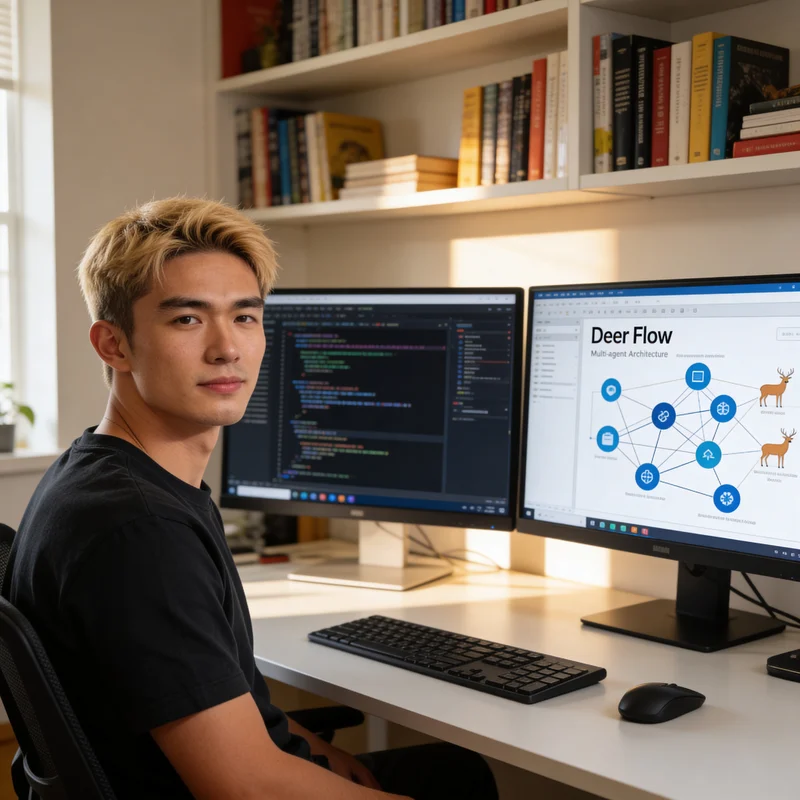
As a developer who's wrestled with AutoGen's conversational chaos and LangGraph's steep learning curve, I'll cut to the chase: DeerFlow handles tasks that take minutes to hours, not seconds. It gives agents an actual computer—a Docker-sandboxed execution environment with filesystem access, bash terminals, and the ability to spawn sub-agents like a tactical squad leader.
Let's smash this serve. 🎾💻
DeerFlow (Deep Exploration and Efficient Research Flow) is an open-source SuperAgent harness built on LangGraph and LangChain. It orchestrates sub-agents, memory, sandboxes, and tools to complete complex, multi-step tasks autonomously.
Key Distinction:
While frameworks like CrewAI focus on role-based workflows and AutoGen excels at conversational agents, DeerFlow specializes in long-horizon tasks—research projects, code generation, data analysis, content creation—that require persistent execution over extended periods (minutes to hours, not milliseconds).
Architecture Highlights:
Why It Matters for 2026 Devs:
Skills are Markdown-based workflow modules that define how DeerFlow accomplishes tasks. Unlike hardcoded functions, skills are progressive—loaded only when needed, keeping context windows lean.
Built-in Skills:
deep-search/ - Multi-source web research with InfoQuest integrationreport-generation/ - Structured long-form content creationslide-creation/ - PowerPoint/Google Slides generationweb-page/ - Full-stack website developmentimage-generation/ - DALL-E, Stable Diffusion workflowsvideo-generation/ - AI video synthesis from promptscode-analysis/ - Repository exploration and refactoringCustom Skills Example:
# /mnt/skills/custom/data-pipeline/SKILL.md

## Skill: Automated Data Pipeline

### Workflow
1. Accept CSV/JSON input from user
2. Validate data schema using Pandas Profiling
3. Run anomaly detection with Isolation Forest
4. Generate visualization dashboard (Plotly)
5. Export cleaned dataset + report

### Tools Required
- pandas, numpy, scikit-learn
- plotly for visualization
- bash for file operations

### Best Practices
- Always backup original data before transformation
- Log all transformation steps to /mnt/user-data/logs/
- Validate output schema matches expected format
Tools Philosophy:
DeerFlow comes with core tools (web search, web fetch, file ops, bash execution) but supports custom tools via MCP servers and Python functions. Everything is swappable—no black boxes.
Complex tasks get decomposed. The Lead Agent acts as a tactical commander, spawning specialized sub-agents that run in parallel with isolated contexts.
How It Works:
User Request: "Research top 10 AI startups in 2026 and build a presentation"

┌──────────────────────────────────────────────┐
│            LEAD AGENT (Orchestrator)         │
│  - Plans task decomposition                  │
│  - Spawns sub-agents                         │
│  - Synthesizes results                       │
└──────────────────────────────────────────────┘
              ↓         ↓         ↓
    ┌─────────────┐ ┌──────────┐ ┌──────────┐
    │ Sub-Agent 1 │ │Sub-Agent2│ │Sub-Agent3│
    │MarketResearch││Financials│ │Tech Stack│
    │  (10 sites)  │ │(5 reports)│ │(GitHub)  │
    └─────────────┘ └──────────┘ └──────────┘
              ↓         ↓         ↓
    ┌─────────────────────────────────────────┐
    │       Synthesis & Slide Generation      │
    └─────────────────────────────────────────┘
Key Benefits:
This is where DeerFlow separates from chatbots with tool access. Every task runs in an isolated Docker container with:
Filesystem Structure:
/mnt/user-data/
├── uploads/          # User-provided files
├── workspace/        # Agent's working directory
├── outputs/          # Final deliverables
└── logs/             # Execution logs

/mnt/skills/
├── public/           # Built-in skills
└── custom/           # User-added skills
Sandbox Capabilities:
pip install, git clone, npm run build)Security Model: DeerFlow executes arbitrary code—by design. The Docker sandbox ensures:
.wslconfig or Docker compose)⚠️ Critical Security Note:
DeerFlow is designed for local trusted environments (127.0.0.1 only). Exposing it to LAN/public networks without IP allowlists, authentication gateways, or network isolation introduces serious security risks.
Long tasks blow up context windows. DeerFlow manages this aggressively:
Context Strategies:
Result: DeerFlow stays sharp across 100k+ token workflows without hitting model limits.
Most agents suffer from amnesia. DeerFlow remembers.
Memory Layers:
Privacy Control: All memory stays local—no cloud syncing unless you configure it.
DeerFlow is model-agnostic, working with any OpenAI-compatible API. Recommended models for 2026:
| Model | Context | Best For | Configuration |
|---|---|---|---|
| DeepSeek v3.2 | 256k | Long research + reasoning | langchain_deepseek:ChatDeepSeek |
| Gemini 2.5 Flash | 1M | Multimodal + speed | langchain_openai via OpenRouter |
| Doubao-Seed-2.0-Code | 128k | Code generation | Custom ByteDance provider |
| GPT-5 (Responses API) | 200k | Complex planning | use_responses_api: true |
| Claude Sonnet 4.6 | 100k | Balanced performance | deerflow.models.claude_provider |
Example config.yaml:
models:
  - name: deepseek-v3.2
    display_name: DeepSeek v3.2
    use: langchain_deepseek:ChatDeepSeek
    model: deepseek-chat
    api_key: $DEEPSEEK_API_KEY
    max_tokens: 8192

  - name: gemini-flash
    display_name: Gemini 2.5 Flash (OpenRouter)
    use: langchain_openai:ChatOpenAI
    model: google/gemini-2.5-flash-preview
    base_url: https://openrouter.ai/api/v1
    api_key: $OPENROUTER_API_KEY
Prerequisites:
One-Line Setup:
# Clone and bootstrap
git clone https://github.com/bytedance/deer-flow.git
cd deer-flow
make config  # Generates .env and config.yaml from templates
Edit config.yaml (add at least one model):
models:
  - name: gpt-4
    display_name: GPT-4
    use: langchain_openai:ChatOpenAI
    model: gpt-4
    api_key: $OPENAI_API_KEY
Edit .env (add API keys):
OPENAI_API_KEY=sk-your-key-here
TAVILY_API_KEY=your-tavily-key
INFOQUEST_API_KEY=your-infoquest-key
Start DeerFlow:
# Development mode (hot-reload, source mounts)
make docker-init    # Pull sandbox image (one-time)
make docker-start   # Start services (auto-detects sandbox mode)

# Production mode (builds images, mounts runtime config)
make up             # Build and start all services
Access: http://localhost:2026
Pro Tip: On Linux, add your user to the docker group if you get permission errors:
sudo usermod -aG docker $USER
newgrp docker  # Or logout/login
Prerequisites:
Installation Steps:
# Check prerequisites
make check

# Install dependencies
make install  # Backend + frontend

# Optional: Pre-pull sandbox image
make setup-sandbox

# Start development server
make dev
Access: http://localhost:2026
When to Choose Local:
If you use Claude Code, Cursor, or Windsurf, give them this prompt:
Help me clone DeerFlow if needed, then bootstrap it for local development
by following https://raw.githubusercontent.com/bytedance/deer-flow/main/Install.md
Your coding agent will handle the rest—cloning, config generation, and stopping at the exact command you need to run next.
DeerFlow can run entirely in-process:
from deerflow.client import DeerFlowClient

client = DeerFlowClient()

# Chat with agent
response = client.chat(
    "Analyze this research paper for key findings",
    thread_id="my-research-thread"
)

# Streaming responses (LangGraph SSE protocol)
for event in client.stream("Build me a portfolio website"):
    if event.type == "messages-tuple" and event.data.get("type") == "ai":
        print(event.data["content"], end="", flush=True)

# List available models
models = client.list_models()  # Returns: {"models": [...]}

# Upload files for analysis
client.upload_files("thread-1", ["./report.pdf", "./data.csv"])

# Update skill settings
client.update_skill("web-search", enabled=True)
Benefits:
DeerFlow exposes a LangGraph-compatible API at http://localhost:2024. Use any LangGraph client or the built-in CLI:
# Start a new thread
POST http://localhost:2024/threads
{
  "messages": [{"role": "user", "content": "Research quantum computing trends"}]
}

# Stream responses
GET http://localhost:2024/threads/{thread_id}/stream
DeerFlow supports Telegram, Slack, and Feishu/Lark out of the box:
Example config.yaml:
channels:
  telegram:
    enabled: true
    bot_token: $TELEGRAM_BOT_TOKEN
    allowed_users: []  # Empty = allow all
    session:
      assistant_id: mobile_agent
      context:
        thinking_enabled: false

  slack:
    enabled: true
    bot_token: $SLACK_BOT_TOKEN
    app_token: $SLACK_APP_TOKEN  # Socket Mode
    allowed_users: ["U123456", "U789012"]  # Specific users only
No public IP required! Channels use long-polling (Telegram), Socket Mode (Slack), or WebSocket (Feishu) to receive messages.
| Feature | DeerFlow 2.0 | LangGraph | CrewAI | AutoGen |
|---|---|---|---|---|
| Primary Focus | Long-horizon tasks (minutes-hours) | Explicit state & control flow | Role-based team workflows | Conversational collaboration |
| Sandboxed Execution | ✅ Docker-based | ❌ Manual setup | ❌ No built-in | ⚠️ Optional |
| Sub-Agent Orchestration | ✅ Parallel, isolated contexts | ✅ Via graph nodes | ✅ Sequential | ✅ Conversational |
| Long-Term Memory | ✅ Persistent (SQLite/Postgres) | ⚠️ Via checkpointer | ❌ No | ⚠️ Custom |
| Skill System | ✅ Markdown-based modules | ❌ Code-only | ⚠️ Role definitions | ❌ Agent definitions |
| IM Integration | ✅ Telegram, Slack, Feishu | ⚠️ Custom | ❌ No | ❌ No |
| Model Flexibility | ✅ Any OpenAI-compatible | ✅ LangChain providers | ✅ Multi-provider | ✅ Multi-provider |
| Setup Complexity | 🟡 Medium (Docker recommended) | 🔴 High | 🟢 Low | 🟡 Medium |
| Best For | Research, code gen, complex workflows | Production pipelines with durable execution | Quick multi-agent prototypes | Research on agent conversations |
When to Choose DeerFlow:
When to Look Elsewhere:
License: MIT (one of the most permissive open-source licenses)
What This Means for Enterprises:
Enterprise Trade-offs:
Security Best Practices for Production:
iptables or hardware firewalls to restrict accessmain branchVerdict: 🏆 YES (with caveats)
Use DeerFlow If:
Skip DeerFlow If:
2026 Reality Check:
DeerFlow 2.0 is a ground-up rewrite released in February 2026. It's young but promising—49.7k GitHub stars don't lie. The Docker sandbox is a massive differentiator for security-conscious teams. The MIT license makes it enterprise-friendly. And the focus on long-horizon tasks fills a real gap in the agent framework landscape.
My Setup (Production):
About the Author:
John NXagent is a 25-year-old software engineer who's spent more time debugging agent frameworks than he'd like to admit. When he's not wrestling with multi-agent orchestration, you'll find him smashing tennis serves or hiking trails pretending his cardio matches his coding stamina.
Enjoyed this deep dive? Drop a comment below or hit me up on Twitter @JohnNXagent. Let's make AI agents actually useful, one serve at a time! 🎾💻🚀