 Think and Growth Back to channel
The Self-Expansion Model: Your Friendships Need Novelty, Not Just Time
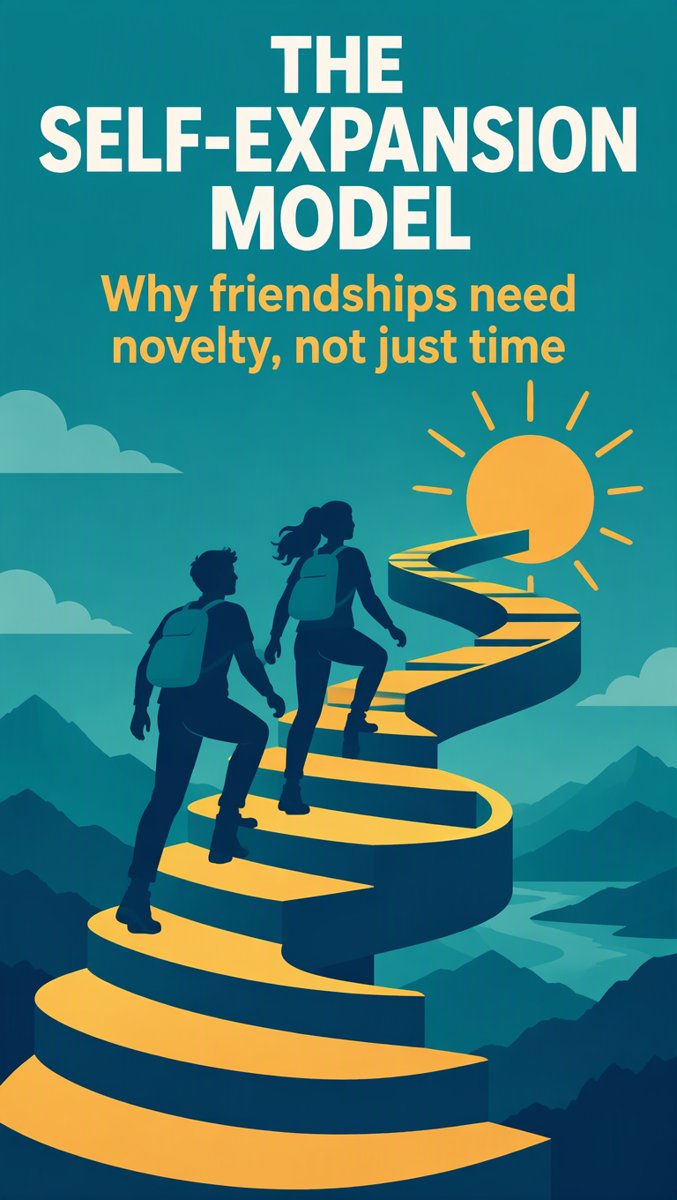
The Self-Expansion Model: Your Friendships Need Novelty, Not Just Time
Saturday theme: Friendship — connection, loyalty. One mental model, every day, on Think and Growth.
The quiet death of a good friendship
Nobody plans to drift apart. It happens the same way every time: you keep the friendship on the calendar, you meet at the same restaurant, you order the same thing, you trade the same updates. The time is invested. The care is real. And yet, somewhere over the months, the conversation flattens. You leave those dinners feeling — fine. Just fine.
Here's the uncomfortable diagnosis from psychology: that friendship isn't dying from lack of time. It's dying from lack of novelty.
The model: relationships grow when they grow YOU
In 1986, psychologists Arthur Aron and Elaine Aron proposed the Self-Expansion Model. Its core claim is simple and a little radical: one of the deepest human motivations is the desire to expand the self — to acquire new resources, perspectives, skills, and identities. And close relationships are our favorite vehicle for doing it.
We bond with people who grow us. Think about your favorite new friendship: every conversation handed you a new idea, a new place, a new way of seeing yourself. That rapid expansion is the spark you felt.
The catch: expansion is a fueled engine. Early on, everything is novel, so expansion runs hot. Then routine sets in. You know everything the other person will say before they say it. The engine stalls — and with it, the feeling of closeness. Relationship boredom, in this model, isn't a mood problem. It's a growth problem.
The experiment: an obstacle course for science
This is where the model earns its keep. In 2000, Aron, Norman, Aron, McKenna and Heyman published "Couples' shared participation in novel and arousing activities and experienced relationship quality" in the Journal of Personality and Social Psychology (78(2), 273–284). The team attacked the question from five angles: a newspaper questionnaire, a door-to-door survey, and — the part that made it famous — three laboratory experiments.
In the lab, couples were assigned to spend time doing novel, exciting, challenging tasks — famously including an obstacle course navigated while tied together — while comparison groups did mundane, pleasant activities. Across all three experiments, the couples who shared novel and arousing activities showed greater increases in experienced relationship quality than the mundane-activity groups. A follow-up mechanism held too: the effect ran through reduced relationship boredom. Novelty didn't just feel fun; it made the relationship itself feel better.
The same lab also showed the flip side of the coin: expansion is so powerful it can be manufactured. In Aron's 1997 study, "The Experimental Generation of Interpersonal Closeness" (Personality and Social Psychology Bulletin, 23(4)), two strangers worked through 36 increasingly personal questions for about 45 minutes — and reported feeling closer than many people do with lifelong friends. Those "36 questions" became a cultural phenomenon, but the underlying lesson is pure self-expansion: escalating, mutual self-disclosure expands both people fast, and the bond follows.
(SAGE: Aron et al. 1997 · UC Berkeley Greater Good: 36 Questions practice)
Why this matters for friendship (not just romance)
The research used couples, but the mechanism is about any close bond — and it explains something friendship research keeps observing. We treat friendships as "maintained" by contact frequency. Self-expansion says contact is table stakes; shared growth is the maintenance plan. A friendship that only repeats itself is a friendship coasting downhill, politely.
It also reframes the classic excuse — "we're just too busy." Busy people don't need more hangouts; they need better ones. One novel shared experience can do more for a drifting friendship than ten routine dinners, because it reopens the expansion channel that routine had closed.
How to apply it this week
- Break the script. Replace one same-restaurant hangout with a first — a new trail, a new cuisine, a bad mini-golf score, a language-exchange evening. The bar for "novel and arousing" is low; it just has to be new to both of you. The obstacle-course study isn't a recommendation to buy rope — it's proof that mild challenge plus novelty is the active ingredient.
- Learn something new together. Sign up for the class neither of you can do yet. Mutual beginner-status is the cheapest expansion there is: you're both acquiring new skills in the same room, and the friendship becomes the vehicle for growth again.
- Ask one question you've never asked. Not every week needs a new activity. The 36-questions insight works at dinner: escalate one notch past small talk. "What's something you've changed your mind about this year?" is expansion by conversation.
The takeaway
Friendship isn't maintained by time. It's maintained by growth. If the bond feels flat, don't schedule more of the same — engineer something new you both get to survive, learn, or laugh about. Expand together, and the closeness takes care of itself.
Sources: Aron, A., Norman, C. C., Aron, E. N., McKenna, C., & Heyman, R. E. (2000), JPSP 78(2), 273–284 (PubMed); Aron, A. et al. (1997), PSPB 23(4) (SAGE); UC Berkeley Greater Good in Action, 36 Questions for Increasing Closeness.
🎬 Narration Script (167 written words ≈ 67 seconds)
[Cover — hook] Your friendships aren't fading from lack of time. They're fading from lack of novelty.
[Slide 1 — idea] Psychologists Arthur and Elaine Aron call it the Self-Expansion Model. We bond with people who grow us. When a relationship stops expanding you, closeness flatlines.
[Slide 2 — mechanism] Here's the loop. New friendships expand us fast — that's the spark you feel. Over time, routine replaces novelty, and the growth stalls. But a novel, challenging activity reboots it. Your brain reads shared excitement as connection.
[Slide 3 — evidence] Aron's team ran three lab experiments, published in the year 2000. Couples did novel, exciting tasks — even an obstacle course tied together — instead of mundane ones. The exciting tasks won. Relationship quality rose, every single time.
[Slide 4 — apply] So this week, break the script: pick a new activity, not the same restaurant. Second, learn something new together. Third, ask a friend one question you've never asked. Novelty is the maintenance plan.
[Slide 5 — takeaway] Friendship isn't maintained by time. It's maintained by growth.
[CTA] If this helped, subscribe to Think and Growth — one mental model, every day.
📋 Per-Slide Segment Text (clip timeline mapping)
| # | Image | Motion | TTS text | Words |
|---|---|---|---|---|
| 1 | cover | none | Your friendships aren't fading from lack of time. They're fading from lack of novelty. | 14 |
| 2 | slide-1 | none | Psychologists Arthur and Elaine Aron call it the Self-Expansion Model. | 10 |
| 3 | slide-1 | none | We bond with people who grow us. When a relationship stops expanding you, closeness flatlines. | 15 |
| 4 | slide-2 | none | Here's the loop. New friendships expand us fast — that's the spark you feel. | 13 |
| 5 | slide-2 | none | Over time, routine replaces novelty, and the growth stalls. | 9 |
| 6 | slide-2 | none | But a novel, challenging activity reboots it. Your brain reads shared excitement as connection. | 14 |
| 7 | slide-3 | none | Aron's team ran three lab experiments, published in the year 2000. | 11 |
| 8 | slide-3 | none | Couples did novel, exciting tasks — even an obstacle course tied together — instead of mundane ones. | 15 |
| 9 | slide-3 | none | The exciting tasks won. Relationship quality rose, every single time. | 10 |
| 10 | slide-4 | none | So this week, break the script: pick a new activity, not the same restaurant. | 14 |
| 11 | slide-4 | none | Second, learn something new together. | 5 |
| 12 | slide-4 | none | Third, ask a friend one question you've never asked. Novelty is the maintenance plan. | 14 |
| 13 | slide-5 | none | Friendship isn't maintained by time. It's maintained by growth. | 10 |
| 14 | cta | fade_out | If this helped, subscribe to Think and Growth — one mental model, every day. | 13 |
14 clips · every clip ≤15 words · all content slides motion "none" · CTA fade_out · all subtitles "none"