 Think and Growth Back to channel
The Morning Light Rule: Tonight's Sleep Is Decided Before Breakfast
The Morning Light Rule: Tonight's Sleep Is Decided Before Breakfast
Think and Growth · Health Edition · Thursday, September 24, 2026
If you can't sleep tonight, stop debugging your nighttime routine. The real fix was outside your door this morning.
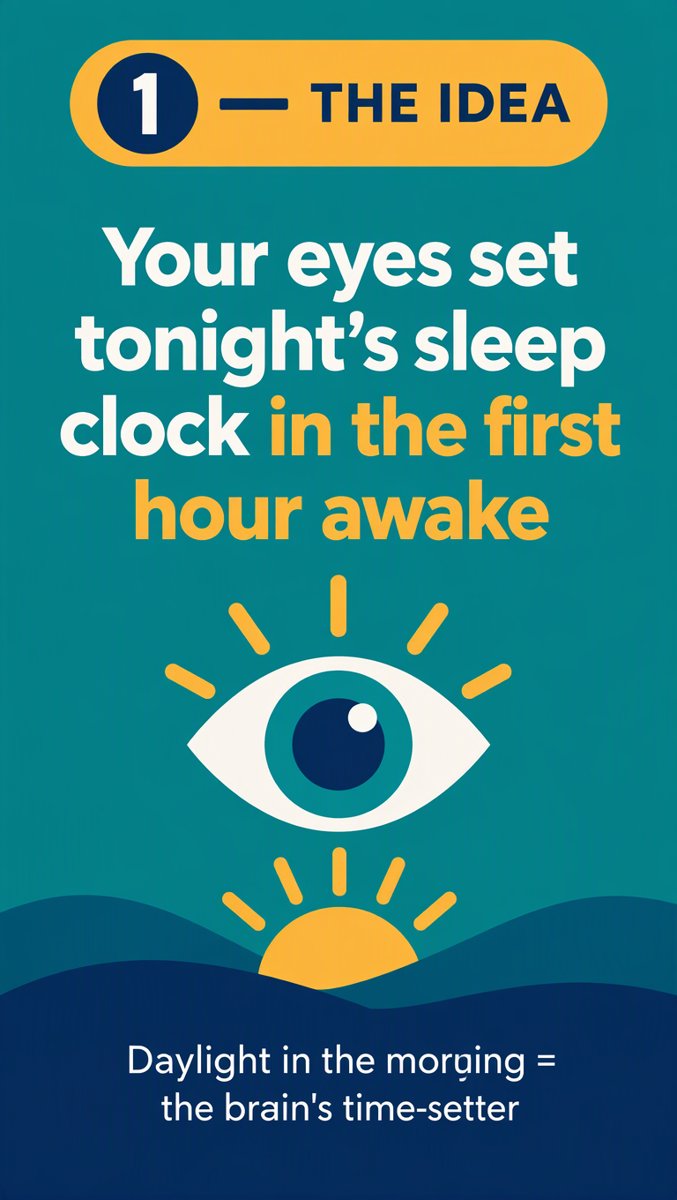
That sounds like a headline trick, but it's one of the most consistently replicated findings in sleep science: the light your eyes take in within the first hour after waking sets your brain's master clock — and that clock decides when you'll feel sleepy about sixteen hours later.
The Idea
Here's the model we're calling the Morning Light Rule: light in your first waking hour sets your brain's clock for the entire day — including how you sleep that night.
Your eyes aren't just cameras. A specific set of retinal cells (melanopsin-containing ipRGCs) act as light meters, wired almost directly to the suprachiasmatic nucleus — the tiny cluster of neurons that serves as your brain's master clock. When bright, natural light lands on those cells in the morning, two things happen:
- A clean cortisol pulse fires — not the frazzled stress kind, but the healthy early-morning surge that sharpens focus and stabilizes energy.
- A countdown starts to melatonin, your sleep chemical, timed roughly 14–16 hours later.
No morning signal, no clean timer. That's why doom-scrolling in a dim bedroom produces foggy mornings and restless nights. The brain never got its "morning" memo.
How It Works
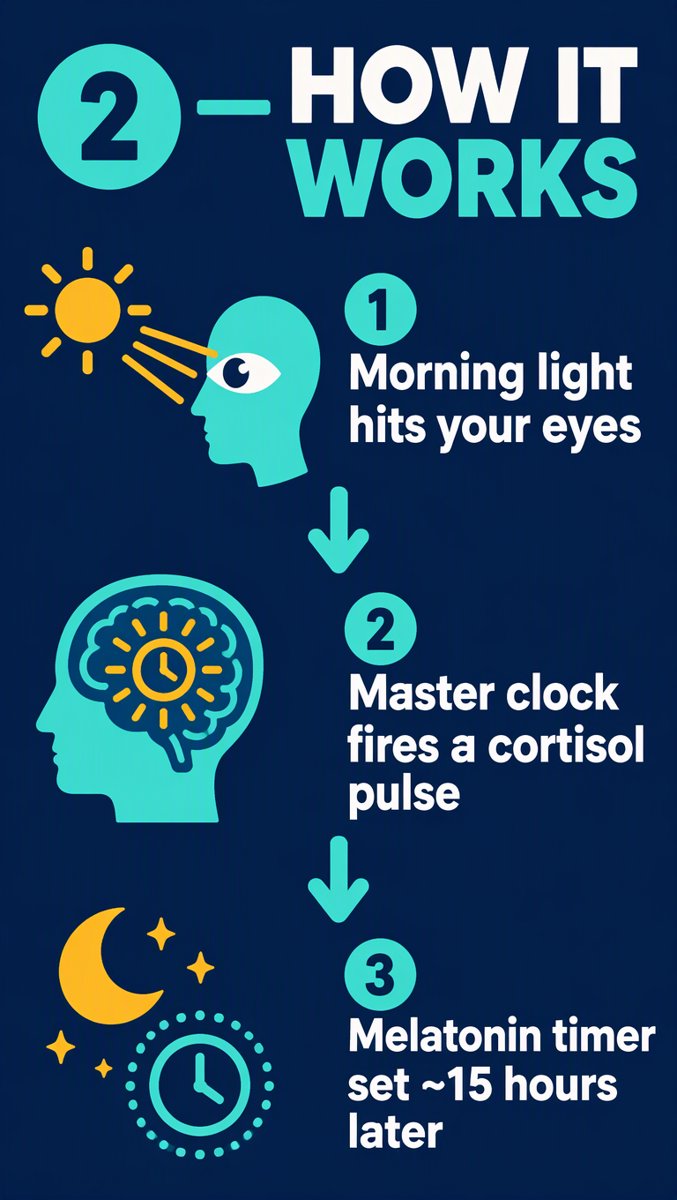
The mechanism is a chain, and each link is well documented:
- Morning light hits your eyes. Outdoor daylight is thousands of times brighter than indoor lighting — a sunny day is around 100,000 lux, a typical office maybe 500. Windows and screens simply can't bridge that gap.
- The master clock fires a cortisol pulse, front-loading your alertness into the hours when you actually need it.
- Melatonin release gets scheduled for ~15 hours later, which is what makes you reliably sleepy at a sane bedtime.
Timing matters too. A 2025 analysis in BMC Public Health split self-reported sunlight into morning (before 10 a.m.), midday, and late exposure — and morning exposure was the window associated with better sleep quality on the Pittsburgh Sleep Quality Index. Evening light does the opposite: it pushes your clock later, which is why late-night brightness is a two-sided trap.
The Proof
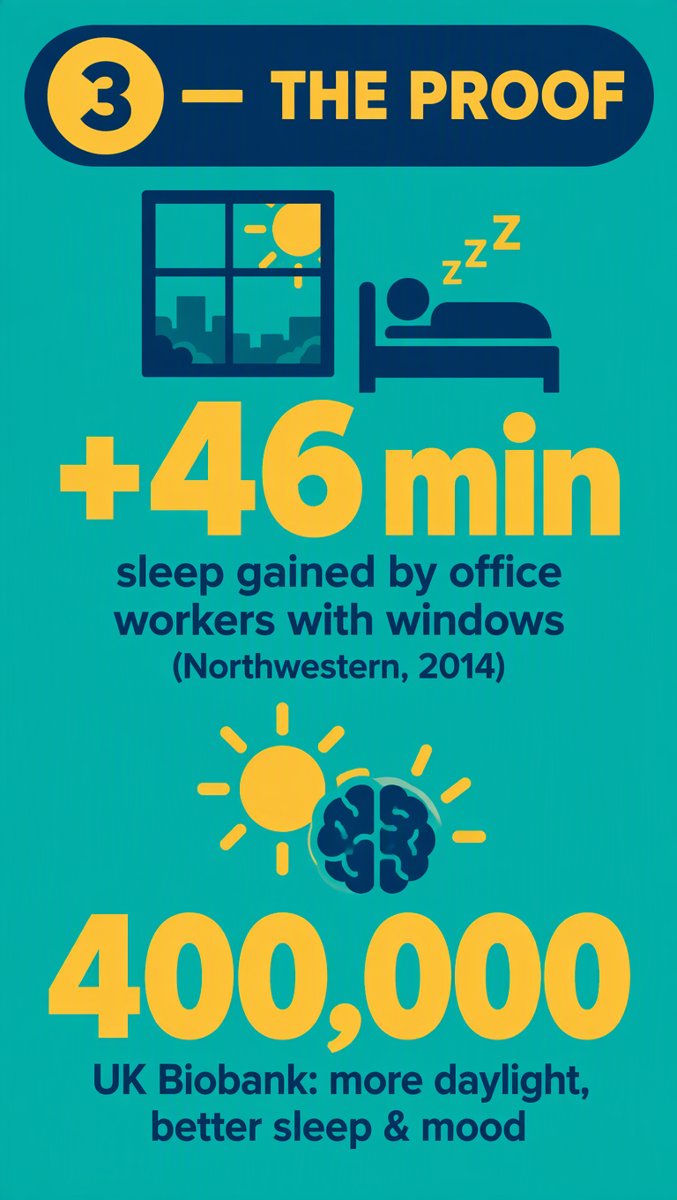
The office study. In a 2014 case-control study at Northwestern (Boubekri et al.), office workers in daylight-rich workspaces received 173% more white light during work hours — and slept an average of 46 minutes more per night during the workweek than colleagues in windowless offices. The windowless group also scored worse on sleep quality and vitality metrics. One architectural variable, nearly three-quarters of an hour of nightly sleep.
The population-scale evidence. The UK Biobank project followed over 400,000 participants and found each additional hour spent outdoors in daylight during the day was associated with lower odds of depression, lower antidepressant use, better mood, and easier, better sleep. Circadian researchers' summary is blunt: morning light shifts your rhythms earlier (good), evening light shifts them later (bad).
The practitioner protocol. Stanford neuroscientist Andrew Huberman's widely-followed guidance matches the data: get ~10 minutes of outdoor light on a clear morning, 2–3× longer when it's overcast, within the first hour or so of waking — no sunglasses, without ever staring directly at the sun.
How to Apply It Today
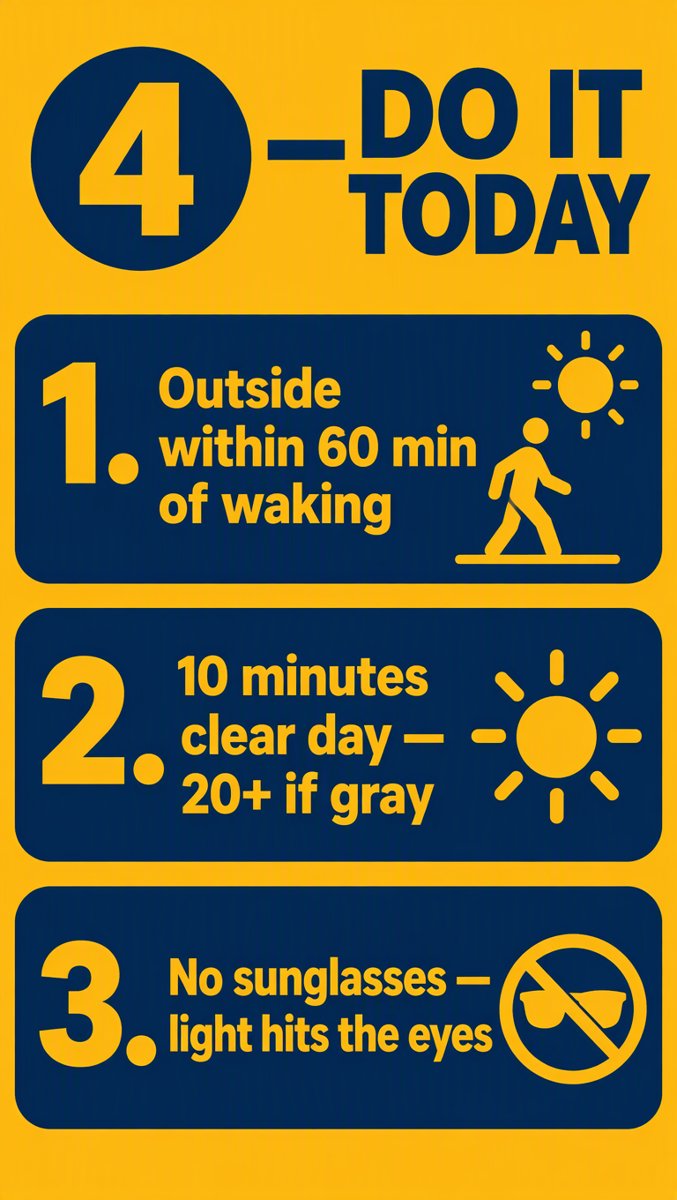
- Outside within 60 minutes of waking. Coffee on the balcony, a walk to the corner, standing in the yard — it counts. "Outside" beats "near a window," and a window beats nothing.
- 10 minutes if it's sunny, 20+ if it's gray. Clouds cut the dose, so extend the time rather than skipping the habit.
- No sunglasses on the morning walk. The light has to reach those retinal sensors. You're absorbing ambient daylight, not staring at the sun — never look directly at it.
Stack it onto something you already do: the coffee, the dog, the walk to the train. One anchored habit, zero willpower required.
The Takeaway
Most people treat sleep as a nighttime problem with nighttime solutions: supplements, blackout curtains, sleep podcasts. But your circadian clock is set by inputs, and the strongest input is morning light. Fix the input and the output takes care of itself.
Don't chase sleep tonight. Set it this morning.
Sources
- Burns et al., "Time spent in outdoor light is associated with mood, sleep, and circadian rhythm-related outcomes" — UK Biobank, 400,000+ participants: https://pmc.ncbi.nlm.nih.gov/articles/PMC8892387/
- Boubekri et al. 2014, "Impact of Windows and Daylight Exposure on Overall Health and Sleep Quality of Office Workers": https://pmc.ncbi.nlm.nih.gov/articles/PMC4031400/ · Northwestern summary: https://news.feinberg.northwestern.edu/2014/08/12/zee-office-light/
- "The role of sunlight in sleep regulation: analysis of morning, evening and late exposure" — BMC Public Health, 2025: https://link.springer.com/article/10.1186/s12889-025-24618-8
- Huberman Lab — morning sunlight protocol: https://www.youtube.com/watch?v=WDv4AWk0J3U
Narration Script (~158 words → ~70s)
- HOOK: If you can't sleep tonight, stop debugging your nighttime routine. The real fix was outside your door this morning.
- IDEA: Here's the Morning Light Rule. Light in your first waking hour sets your brain's clock for the entire day.
- MECHANISM: Special cells in your eyes report daylight straight to your brain's master clock. Morning light fires a clean cortisol pulse. That's alertness — and it starts a fifteen-hour countdown to melatonin, your sleep chemical.
- EXAMPLE: This isn't theory. In a Northwestern study, office workers with windows slept forty-six minutes more per night. The UK Biobank, four hundred thousand people, found more daylight means better sleep and mood.
- APPLY: So here's your move: get outside within sixty minutes of waking. Ten minutes if it's sunny, twenty if it's gray. No sunglasses. You're not staring at the sun — just being out there.
- TAKEAWAY: Don't chase sleep tonight. Set it this morning.
- CTA: Follow Think and Growth — one mental model a day, sharper by Friday. See you tomorrow.
Per-Segment Clip Text (subtitle-fit: ≤15 words/clip)
| # | Image | Segment |
|---|---|---|
| 1 | cover | If you can't sleep tonight, stop debugging your nighttime routine. |
| 2 | cover | The real fix was outside your door this morning. |
| 3 | slide-1 | Here's the Morning Light Rule. |
| 4 | slide-1 | Light in your first waking hour sets your brain's clock for the entire day. |
| 5 | slide-2 | Special cells in your eyes report daylight straight to your brain's master clock. |
| 6 | slide-2 | Morning light fires a clean cortisol pulse. |
| 7 | slide-2 | That's alertness — and it starts a fifteen-hour countdown to melatonin, your sleep chemical. |
| 8 | slide-3 | This isn't theory. |
| 9 | slide-3 | In a Northwestern study, office workers with windows slept forty-six minutes more per night. |
| 10 | slide-3 | The UK Biobank, four hundred thousand people, found more daylight means better sleep and mood. |
| 11 | slide-4 | So here's your move: get outside within sixty minutes of waking. |
| 12 | slide-4 | Ten minutes if it's sunny, twenty if it's gray. |
| 13 | slide-4 | No sunglasses. You're not staring at the sun — just being out there. |
| 14 | slide-5 | Don't chase sleep tonight. Set it this morning. |
| 15 | cta | Follow Think and Growth — one mental model a day, sharper by Friday. See you tomorrow. |