 Think and Growth Back to channel
Temptation Bundling: Stop Fighting Your Cravings — Hire Them
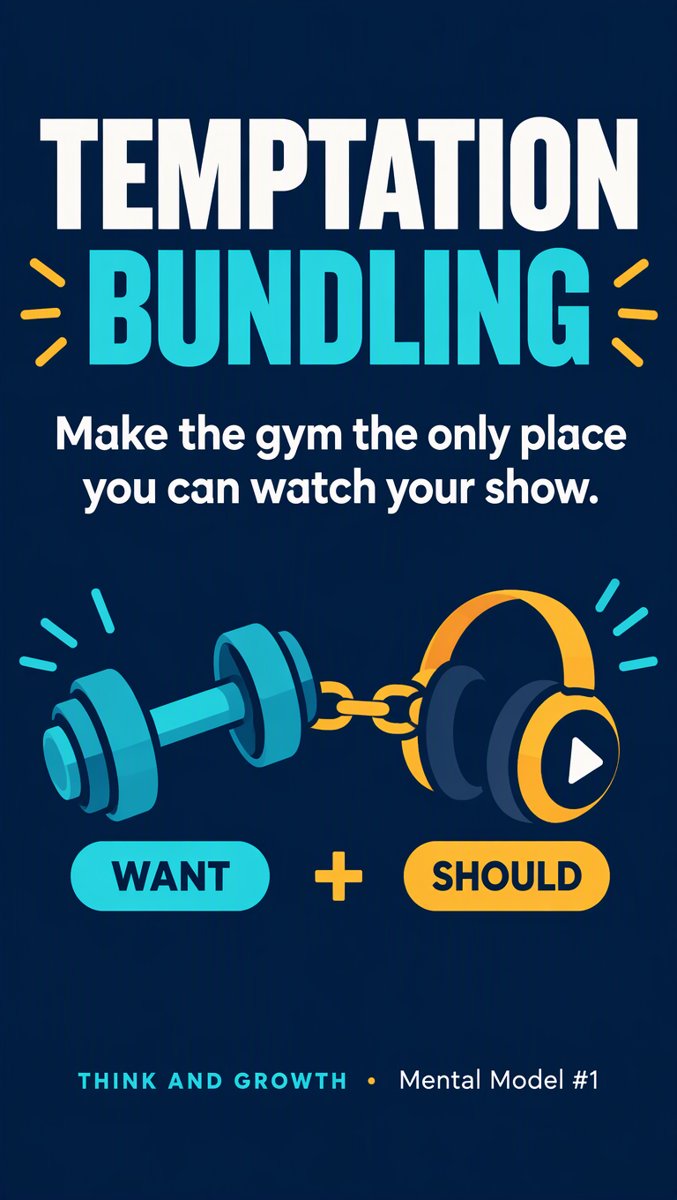
Temptation Bundling: Stop Fighting Your Cravings — Hire Them
Think and Growth · Mental Model # — Health & Habits edition · 2026-10-01
The Problem With Willpower
Every January, millions of people make a promise to themselves: this year, I'll go to the gym. By March, most have quietly stopped. The failure isn't a character flaw. It's a design flaw. We keep asking willpower to do a job it was never built for.
Willpower is a finite resource. It depletes under stress, fatigue, and a long day. So when the choice comes down to the hard thing that pays off later versus the easy thing that feels good right now, the easy thing usually wins — and then we feel guilty about it.
Behavioral scientists call these two forces "wants" and "shoulds." Wants are instantly gratifying: the next episode, the podcast, the game, the scroll. Shoulds are valuable but costly: exercising, deep work, the difficult conversation, the vegetables. Most productivity advice tells you to grit your teeth and pick the should. That advice fails for the same reason every time — it's fighting biology with good intentions.
There's a smarter move. It doesn't ask you to resist the want at all. It hires the want.
What Is Temptation Bundling?
Temptation bundling is the practice of coupling an instantly gratifying "want" activity with a "should" behavior that provides long-term benefits but requires willpower. In plain terms: you make a guilty pleasure available only while you're doing the hard thing.
The term was coined by Katy Milkman at The Wharton School, working with Julia Minson (Harvard Kennedy School) and Kevin Volpp (Wharton). Milkman's own origin story is refreshingly human: as a graduate student, she restricted her most escapist novels — The Hunger Games — to the gym, and nothing else. She found herself craving workouts just to get to the next chapter. She turned that personal hack into a formal research program.
The elegance of the idea is that it solves two self-control problems at once:
- It makes the beneficial behavior more attractive, so you actually do it.
- It confines the indulgence to a moment when it isn't stealing time or energy from anything else — which strips away the guilt.
That double win is the whole appeal. You're not choosing between pleasure and discipline. You're collapsing the two into a single activity.
The Evidence: What a Wharton Experiment Actually Found
This isn't a self-help aphorism. It's a tested intervention.
In 2011, Milkman, Minson, and Volpp ran a randomized controlled trial with 226 students, faculty, and staff at a large northeastern U.S. university. The study lasted ten weeks. Participants were randomly assigned to one of three groups:
- Full treatment: participants received an iPod loaded with four page-turner audio novels of their choice, but the iPod was locked in a monitored locker at the gym. They could only listen while working out.
- Intermediate treatment: participants got the same audio novels on their personal iPods, available anytime, but were encouraged to self-impose the rule of only listening at the gym.
- Control: participants received a $25 gift card and standard encouragement to exercise.
The results, published in Management Science:
- The full treatment group visited the gym 51% more frequently than the control group. The intermediate group visited 29% more — proof that even just knowing the technique helps, but that enforcement helps more.
- In regression terms, the full treatment added roughly 0.31 gym visits per week in the pre-Thanksgiving period (p = 0.026).
- And here's the number that tells you people genuinely value this: after the study ended, 61% of participants opted to pay for one month of gym-only access to an iPod they could otherwise have used freely. They paid to restrict themselves — a decision that makes no sense under the old "rational actor" model, and perfect sense under behavioral science.
The honest caveat: the effects decayed over time, and dropped sharply after the Thanksgiving break closed the gym. Temptation bundling is not magic. It's a launch mechanism — a way to build momentum and a habit. If the structure disappears, so does the effect. Which is exactly why you should pair it with the habit-building tools you already know.
Why It Works
Three mechanisms explain the lift:
- Complementarity. Listening to a great story while exercising can feel better than doing either alone — the pleasure distracts from the discomfort, and the exercise makes the pleasure feel earned.
- Cliffhangers create pull. Serialized, habit-forming content (a show, a novel, a podcast) leaves you wanting the next installment. If the next installment is only available at the gym, you go to the gym to get it.
- Guilt evaporates. The indulgence is no longer "wasted time." It's the reward for a should. That reframe alone makes the healthy behavior stickier.
How to Apply It
- Name the craving. Be specific. Not "I like relaxing" — but "I really want to watch the next episode of that show" or "I can't stop listening to that podcast."
- Choose the should. Pick one willpower-heavy behavior with a long-term payoff: the gym, deep work on a hard project, meal prep, the paperwork you keep dodging.
- Chain them — and make it exclusive. That pleasure happens only during that task. No exceptions, or the pull collapses. Milkman's finding on enforcement is the key detail: the locked-locker group beat the honor-system group, so add a little structure where you can.
The Takeaway
Most people treat cravings as the enemy to be defeated. Temptation bundling flips the script: cravings are fuel you can redirect. You don't have to become someone with iron discipline. You just have to build a rule that makes the hard thing the only way to get the fun thing.
Stop fighting your cravings. Hire them.
Narration Script (~70s, ≤200 words)
What if the gym was the only place you were allowed to watch your favorite show? This is temptation bundling. It pairs something you crave with something you keep putting off. The guilty pleasure becomes the reward, and the hard habit becomes the price of admission. Pick a want you genuinely love — a show, a podcast, a game. Then bolt it to a should, and make it exclusive: that pleasure only happens there. Wharton ran this with two hundred and twenty six people. The bundled group hit the gym fifty one percent more often. The encouraged group gained twenty nine percent. And sixty one percent paid to keep the restriction when the study ended. Start small. Choose the craving, choose the task, then chain them together. No exceptions — the moment it leaks outside, the pull disappears. Stop fighting your cravings. Hire them. If you want to think sharper and grow faster, hit subscribe to Think and Growth. New mental models, every single day. See you tomorrow.
Per-Slide Segment Text
| # | Card | Segment text |
|---|---|---|
| 0 | Cover | What if the gym was the only place you were allowed to watch your favorite show? |
| 1 | The Idea (a) | This is temptation bundling. It pairs something you crave with something you keep putting off. |
| 2 | The Idea (b) | The guilty pleasure becomes the reward, and the hard habit becomes the price of admission. |
| 3 | How It Works (a) | Pick a want you genuinely love. A show, a podcast, a game. |
| 4 | How It Works (b) | Then bolt it to a should, and make it exclusive. That pleasure only happens there. |
| 5 | Real-World Test (a) | Wharton ran this with two hundred and twenty six people. The bundled group hit the gym fifty one percent more often. |
| 6 | Real-World Test (b) | The encouraged group gained twenty nine percent. And sixty one percent paid to keep the restriction when the study ended. |
| 7 | How to Apply It (a) | Start small. Choose the craving, choose the task, then chain them together. |
| 8 | How to Apply It (b) | No exceptions. The moment it leaks outside, the pull disappears. |
| 9 | Takeaway | Stop fighting your cravings. Hire them. |
| 10 | CTA | If you want to think sharper and grow faster, hit subscribe to Think and Growth. New mental models, every single day. See you tomorrow. |
Sources
- Milkman, K.L., Minson, J.A., & Volpp, K.G.M. (2014). Holding the Hunger Games Hostage at the Gym: An Evaluation of Temptation Bundling. Management Science, 60(2), 283–299. https://pmc.ncbi.nlm.nih.gov/articles/PMC4381662/
- NBER, An Evaluation of Temptation Bundling — https://www.nber.org/roybal/6418-evaluation-temptation-bundling
- Knowledge at Wharton, Using 'The Hunger Games' to Encourage Healthier Choices — https://knowledge.wharton.upenn.edu/article/researchers-used-hunger-games-encourage-healthier-choices/
Think and Growth publishes one mental model every day. Subscribe to build your decision-making toolkit.