 Think and Growth Back to channel
Functional Fixedness: The Box Was Never the Obstacle — The Label Was
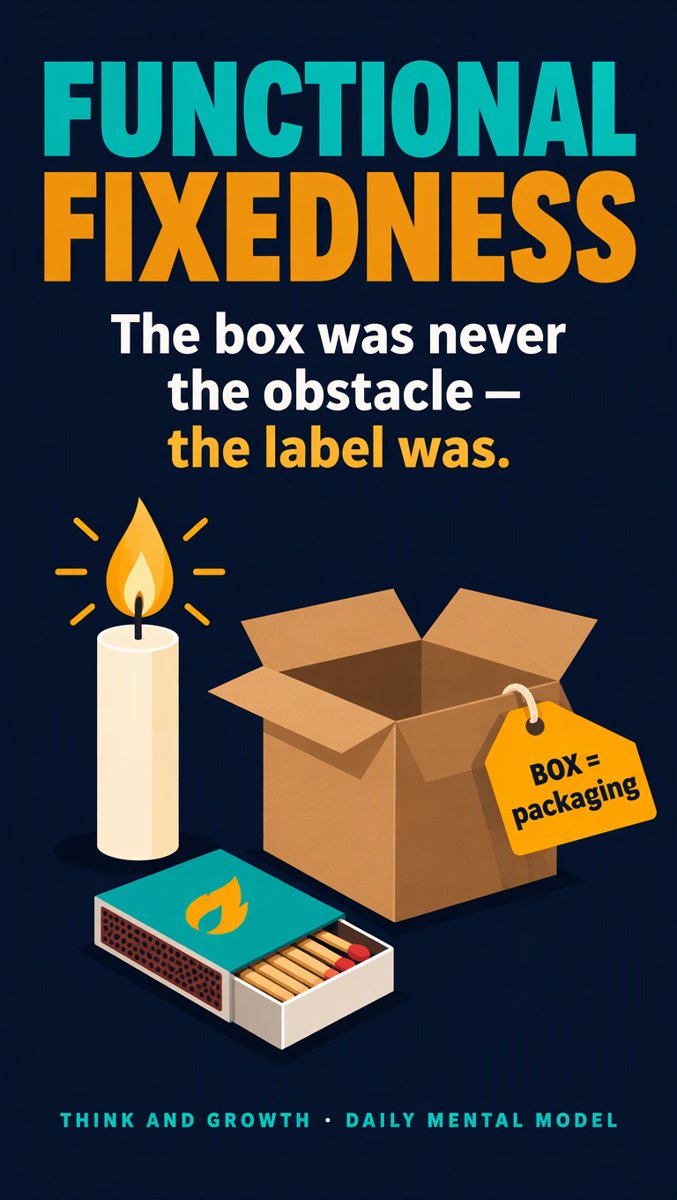
Functional Fixedness: The Box Was Never the Obstacle — The Label Was
Think and Growth · Daily Mental Model · Sunday, October 4, 2026 · Innovation
Here's a candle, a box of thumbtacks, and some matches. Your job: mount the lit candle on the wall so the wax doesn't drip on the table below. Sounds simple. In Karl Duncker's original experiments, most people failed — not because they lacked tools, but because of what they believed about one of them.
That belief has a name: functional fixedness.
The Idea
Functional fixedness is a cognitive bias — the tendency to see an object only in terms of its usual function. Your brain hands every object a single job description: a box is packaging, a candle is light, a hammer is for nails. That label feels like a fact about the world. It isn't. It's a shortcut your memory takes, and it quietly deletes every alternative use from your search space.
The constraint is never in the object. It's in the label.
The Proof: Duncker's Candle Problem
In 1945, Gestalt psychologist Karl Duncker introduced the task that made this bias famous. Participants received a candle, a box of thumbtacks, and matches, and were told to mount the burning candle on a wall. The typical attempts: try to tack the candle directly to the wall (it crumbles), or melt wax onto the wall as glue (the candle slides off). The actual solution requires a reframe: empty the tacks out of the box, tack the box to the wall, and set the candle inside it — the box isn't packaging; it's a shelf.
The tell came in 1952, when psychologist Robert Adamson ran the problem two ways. When the tacks sat inside the box, only 41% of participants solved it. When the box was presented empty and neutral, 86% solved it. Same objects. Same wall. The only variable was the label — "box of tacks" versus just "a box." (Sources: Wikipedia — Candle problem; Wikipedia — Functional fixedness)
What Blunts the Breakthrough: Rewards
In 1962, Sam Glucksberg ran a now-famous variant: he told one group that the fastest solvers would earn cash. If creativity were just effort, that group should have won easily. Instead, they were slower. The reward narrowed attention onto the obvious, label-bound strategy — and narrow attention is exactly what functional fixedness feeds on. Pressure doesn't unlock recombination; it locks the label tighter. (Source: Behavioral Scientist — How Incentives Hinder Innovation)
The Real-World Breakthrough: Apollo 13
In April 1970, an oxygen tank exploded 200,000 miles from Earth. Carbon dioxide — exhaled by three astronauts — began climbing toward lethal levels inside the lunar module. The spare CO₂ scrubbers were square lithium-hydroxide canisters; the lunar module's ports were round. Square peg, round hole, and a hardware store 200,000 miles away.
So flight controllers in Houston did the one thing functional fixedness forbids: they dumped the capsule's contents — plastic bags, cardboard, suit hoses, tape, covers — onto a table and told the engineering team to stop seeing products and start seeing parts. The result was the famous "mailbox" adapter, built from those humble components, taped together, and radioed up to the crew as step-by-step instructions. It fit. The air stayed breathable. All three astronauts came home. (Sources: NASA — Putting a Square Peg in a Round Hole; Space Center Houston — CO₂ Scrubber)
Nobody invented anything new that night. They unlabeled what they already had.
How to Apply It
- Name the parts, not the products. When you're stuck, list the components in front of you — "cardboard rectangle, adhesive strip, flexible tube" — instead of "Lego brick, Post-it, garden hose." Research on the generic-parts technique shows that stripping names down to material and shape reopens the solution space (Carnevale, 1998; see also NN/g — Functional Fixedness).
- Ask what else each part could do. Run a quick alternate-use pass, judgment-free: every part gets at least three non-obvious jobs before you reject it.
- Define the function you need — not the object you want. "I need something flat that holds weight at height" beats "I need a shelf." Framing the problem as a function invites substitutes; framing it as a product excludes them. Awareness plus simplification is the documented first step (see The Decision Lab; Ness Labs).
And one bonus for teams: stop bribing the breakthrough. Glucksberg's reward experiment is a standing warning that pressure and prizes tighten the very mental grip you're trying to loosen.
The Takeaway
Objects have no fixed purposes. Labels do. The box in Duncker's lab could hold tacks or hold a candle — the difference was never in the cardboard. It was in the story the solver had accepted about what the box was for.
So the next time you're stuck — in a project, a business, a budget — don't ask "what tool do I need?" Ask "what is the thing in front of me, besides what it says on the label?"
Break the label. The solution was sitting in the room the whole time.
🎬 Narration Script (video, ~185 written words ≈ 74s)
[COVER] Candle, box of tacks, matches. Mount the candle on the wall. Most people fail.
[SLIDE 1 — The Idea] Psychologists call this functional fixedness — the brain gives every object one job. / A box is packaging. That label feels obvious. It's also the cage.
[SLIDE 2 — The Proof] In Duncker's classic experiment, the tacks sat inside the box. Only forty-one percent solved it. / Show an empty box instead, and eighty-six percent see it: the box is the shelf.
[SLIDE 3 — Real-World Breakthrough] Apollo thirteen. CO2 rising, and the spare filters were square, with round holes. / No new parts existed. So ground control dumped the capsule's contents on a table. / They saw parts, not products — and built the adapter that brought three astronauts home.
[SLIDE 4 — How to Apply It] Use it today. One: name the parts in front of you, not the products. / Two: ask what else each part could do. Three: define the function you need. / And skip the pressure — Glucksberg found cash rewards made creative solvers slower, not faster.
[SLIDE 5 — Takeaway] Objects have no fixed purposes — labels do. Break the label, and ideas appear.
[CTA] That's today's mental model. Follow Think and Growth for one sharp idea every morning, and I'll see you tomorrow. Stay curious.
Sources
- Wikipedia — Candle problem
- Wikipedia — Functional fixedness (Adamson 1952: 41% → 86%)
- Behavioral Scientist — How Incentives Hinder Innovation (Glucksberg 1962)
- NASA — Putting a Square Peg in a Round Hole
- Space Center Houston — Apollo 13 CO₂ Scrubber
- NN/g — Functional Fixedness Stops You From Having Innovative Ideas
- The Decision Lab — Functional Fixedness
- Ness Labs — Functional fixedness: when we stick to what we know