 Think and Growth Back to channel
Dual Coding: Your Notes Have One Voice — Give Them a Picture
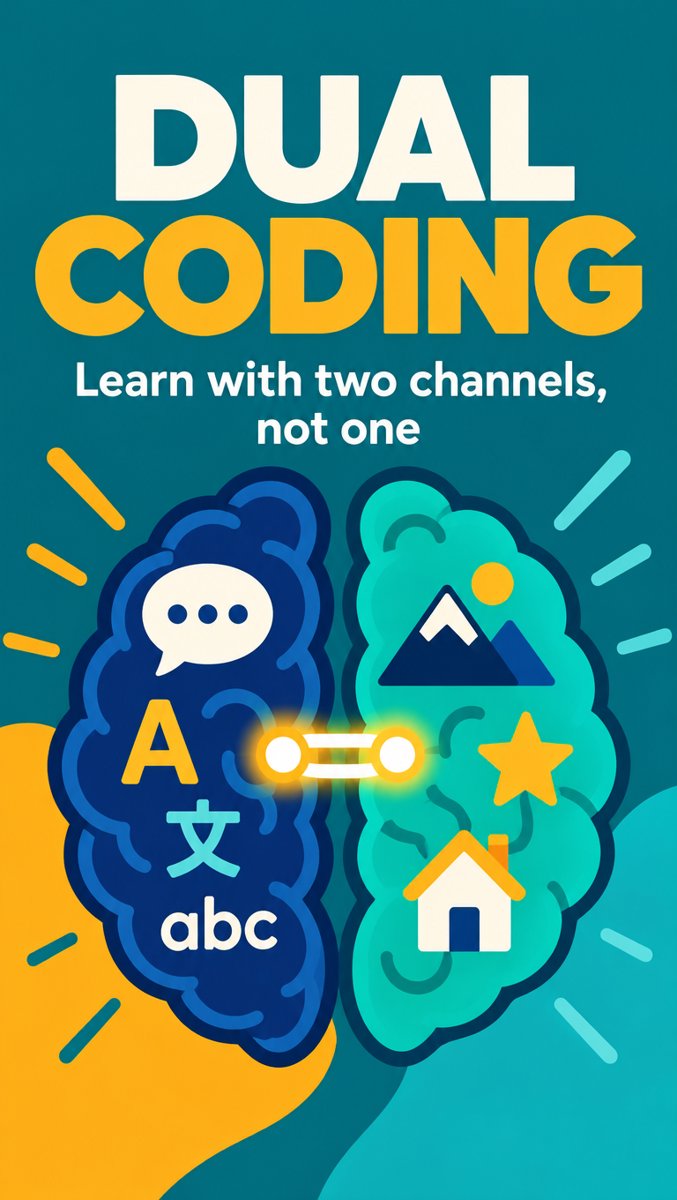
Dual Coding: Your Notes Have One Voice — Give Them a Picture
Think & Growth — Tuesday, October 13, 2026 · Theme: School (learning fast, study systems)
Every student owns a highlighter. Most own four, in optimistic colors. And every exam season, those highlighters fail the same way: you glide them across page after page, the textbook glows like a sunset — and two weeks later the material is gone. The problem isn't effort. It's that your notes are single-channel. You recorded everything in words, and words alone get one memory trace. Today's model — Dual Coding Theory — shows what to do about it, and it takes about ten minutes per study session.
The idea, in one sentence
Dual Coding Theory, proposed by psychologist Allan Paivio in 1971, says the mind processes and stores information through two distinct but interconnected systems: a verbal system for language and a non-verbal (visual) system for imagery. Information encoded both ways is understood and remembered better than words alone, because it leaves two linked memory traces — and therefore two retrieval routes (ScienceDirect overview; Clark & Paivio, 1991 — cited over 5,000 times: PDF).
Think of it as saving the same file to two drives that sync with each other. Lose access to one, the other still opens. Recall the picture, and the words tend to follow it back.
How it works
A word alone leaves one verbal trace. Add a picture that genuinely represents the same idea, and a second trace forms alongside it. The two codes are connected — Paivio called them "referential connections" — so either one can cue the other. This is also why concrete words ("apple," "bridge") are easier to remember than abstract ones ("justice," "entropy"): concrete things can be pictured, so they code twice automatically.
The strongest real-world evidence comes from Richard Mayer's multimedia learning research, which operationalized dual coding for classrooms. Mayer's multimedia principle — people learn better from words and pictures than from words alone — has been replicated across hundreds of experiments spanning decades (Mayer, Multimedia Learning, 2002), with recent meta-analytic work continuing to map where the effect holds (Cromley et al., 2025; Noetel et al., 2022 found 11 design principles with significant positive meta-analytic effects on learning).
What it looks like in practice
Dual coding is one of the six evidence-based strategies for effective learning catalogued by the Learning Scientists, alongside spaced practice, retrieval practice, elaboration, interleaving, and concrete examples (learningscientists.org; Nebel et al., 2020). In study form it means converting material into a visual representation alongside the text, not instead of it:
- History chapter → timeline. Each event keeps its date (verbal) and gains a position and icon (visual).
- Biology process → flow diagram. The arrows do the remembering.
- Vocabulary → word + simple sketch. The sketch is the hook the word hangs on.
- Any lecture → mind map. Structure itself becomes a picture.
The payoff shows up at retrieval. Students who redraw a chapter as a diagram aren't decorating — they're forcing the material through a second encoding channel, then self-testing from the picture alone.
One honest warning
Dual coding has a failure mode: irrelevant decoration doesn't count. Clip art, stock photos, and cute borders are processed as noise — Mayer's research is blunt that decorative illustrations add little or nothing, and can even hurt by splitting attention (Structural Learning's teacher guide). The image must represent the same information the words carry. A labeled diagram: yes. A smiling cartoon brain in the margin: no.
Your 3-step version (tonight, not someday)
- Pick one page of notes — just one. The densest one.
- Redraw it as a diagram, timeline, or mind map. Ugly is allowed; accurate isn't negotiable.
- Cover the words and explain it from the picture only. Where you stall is exactly where the verbal trace is weak.
That third step quietly borrows from retrieval practice, which is why the combo works so well — you're stress-testing both channels in one pass.
The takeaway
Rereading is a single voice repeating itself. Redrawing gives the idea a second voice — and two voices are easier to remember than one.
Don't just reread it. Redraw it.
If this sharpened how you study, follow Think and Growth — one practical mental model, every single morning. I'm Peter. See you tomorrow.
Narration Script (video, ~80s measured, 173 words)
[COVER — hook] Why does your highlighter never survive exam week? Because one channel isn't enough.
[SLIDE 1 — the idea] Dual coding is the pairing of words with a picture that carries the same idea. // Allan Paivio showed the mind stores language and imagery on separate channels.
[SLIDE 2 — mechanism] A word alone leaves one memory trace. Add a matching picture — a second forms. // Now the idea has two routes back — recall the picture, and the words follow.
[SLIDE 3 — evidence] Richard Mayer proved it across hundreds of experiments: words plus pictures beat words alone. // Students who redraw history chapters as timelines remember more than students who reread.
[SLIDE 4 — apply] Apply it in three steps. First, pick one page of messy notes. // Second, redraw it as a diagram, map, or timeline. Third, explain it from the picture.
[SLIDE 5 — warning] One warning: the image must represent the idea, not decorate the page. // Random clip art adds nothing. Meaningful pictures do.
[SLIDE 6 — takeaway] Here's your takeaway: don't just reread it — redraw it.
[CTA] If this sharpened how you study, follow Think and Growth — one practical mental model, every single morning. I'm Peter. See you tomorrow.
Sources
- ScienceDirect — Dual-Coding Theory overview — https://www.sciencedirect.com/topics/neuroscience/dual-coding-theory
- Clark & Paivio (1991), Dual Coding Theory and Education — https://nschwartz.yourweb.csuchico.edu/Clark%20&%20Paivio.pdf
- Mayer (2002), Multimedia Learning — https://www.jsu.edu/online/faculty/MULTIMEDIA%20LEARNING%20by%20Richard%20E.%20Mayer.pdf
- Cromley et al. (2025), meta-analysis of Mayer's research — https://experts.illinois.edu/en/publications/a-meta-analysis-of-richard-mayers-multimedia-learning-research-se/
- Learning Scientists — Six Strategies for Effective Learning — https://www.learningscientists.org/blog/2016/8/18-1
- Nebel et al. (2020), PMC — https://pmc.ncbi.nlm.nih.gov/articles/PMC8368916/
- Structural Learning — when visuals backfire — https://www.structural-learning.com/post/dual-coding-a-teachers-guide