 Think and Growth Back to channel
Desirable Difficulties: If Studying Feels Easy, You're Doing It Wrong

Desirable Difficulties: If Studying Feels Easy, You're Probably Doing It Wrong
Every student has felt it: you reread a chapter, the sentences glide by, everything looks familiar — and you walk into the exam feeling ready. Then the questions hit, and the knowledge isn't there.
Psychologists Robert A. Bjork and Elizabeth L. Bjork of UCLA have a name for what fooled you: the fluency illusion. Familiarity is not understanding. And their remedy is one of the most counterintuitive, best-supported ideas in learning science — desirable difficulties.
The Idea
Some conditions make practice feel harder in the moment — and reliably produce more durable, more transferable learning than smooth, easy practice.
The Bjorks distinguish two kinds of memory strength. Retrieval strength is how easily something comes to mind right now. Storage strength is how well it's retained over time. Easy practice — rereading, highlighting, blocked drills — inflates retrieval strength fast. It feels like learning. But storage strength barely moves. The result is what Bjork called an "illusion of comprehension": high confidence today, blank page tomorrow.
Why Struggle Works
- Easy practice feels fluent — that's the fluency illusion. Rereading creates perceptual fluency; we misread that smoothness as mastery. When you recognize the words on the page, your brain files it under "known." Recognition is not recall.
- Hard practice forces real retrieval. Closing the book and pulling knowledge out of memory is uncomfortable — and that discomfort is the mechanism. Each effortful retrieval strengthens the memory's storage, re-anchors it, and makes it easier to access in new contexts.
- Slow today, remembered next month. Effortful practice produces worse performance during the session and better performance on the delayed test. That inversion is exactly why it's "desirable": you're trading a comfortable rehearsal for a durable memory.
The Baseball Experiment
Need proof that messy practice beats smooth practice? Look at the batter's box.
In 1994, Kellie Green Hall, Derek Domingues, and Richard Cavazos ran a study with skilled baseball players. Every hitter faced the same 45 pitches — 15 fastballs, 15 curveballs, 15 changeups. One group practiced blocked: all 15 fastballs, then all 15 curveballs, then all 15 changeups. Timing clicks into rhythm; the cage feels great. The other group practiced random: all three pitch types shuffled, never knowing what was coming. Every swing felt like a guess.
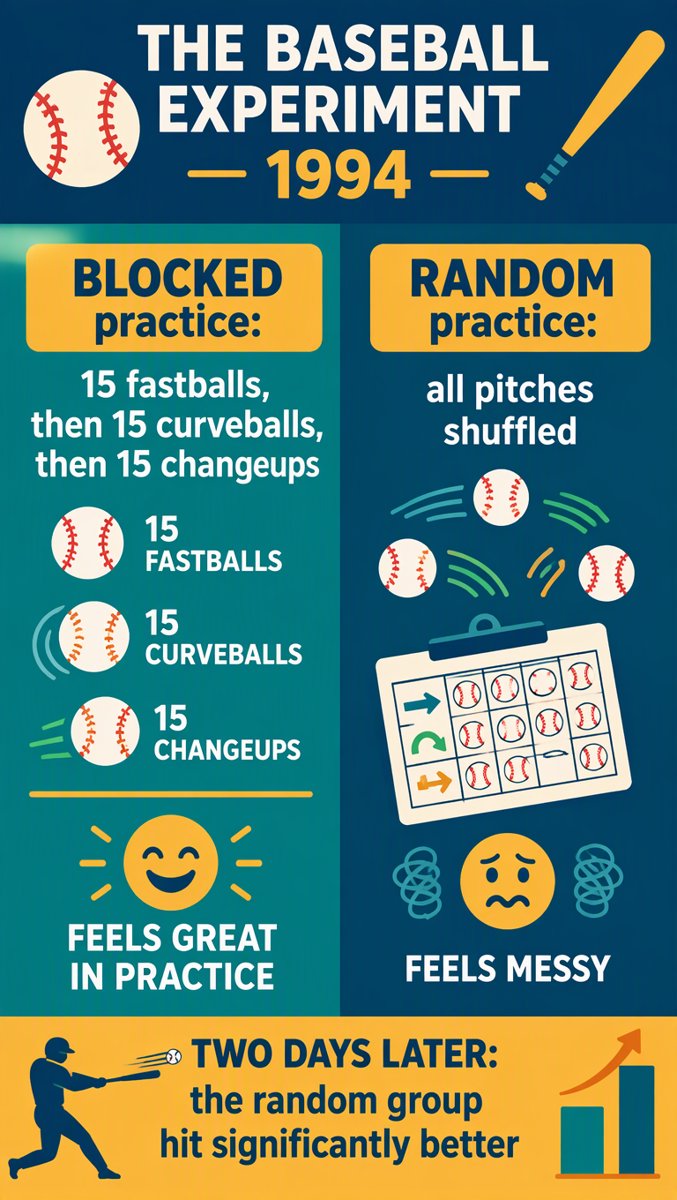
On the delayed test two days later, the random group performed significantly better than the blocked groups. The group that looked worse in practice became the better hitters in the game.
That's the pattern across decades of research. The Bjorks and their collaborators point to five evidence-backed desirable difficulties: spacing (review across days, not in one marathon), interleaving (mix topics instead of grinding one), retrieval practice (test yourself instead of rereading), generation (attempt an answer before you're told), and varied practice (change conditions so skills flex instead of fossilize).
How to Apply It
- Close the book. After each study chunk, recall what you just learned before you reread anything. Retrieval first, review second.
- Mix your topics. One session with three subjects beats three sessions of the same subject — even though the mixed session feels worse.
- Space it out. Move reviews to tomorrow, then next week. Forgetting a little between sessions is not failure; it's the workout.
The Takeaway
Stop grading your studying by how it feels. Smooth is suspicious. Struggling is the signal that your brain is doing the real work — retrieving, connecting, storing.
Struggle is the feeling of your brain getting stronger.
🎬 Narration Script (163 words · ~75-85s measured)
| # | Slide | Segment text |
|---|---|---|
| 1 | Cover | If studying feels easy, you might be learning nothing. Here's the fix. |
| 2 | Slide 1 | UCLA psychologists Robert and Elizabeth Bjork call the solution Desirable Difficulties. |
| 3 | Slide 1 | The idea: learning that feels harder in the moment sticks longer, and transfers better. |
| 4 | Slide 2 | Easy practice creates a fluency illusion. Familiar words feel like real understanding. |
| 5 | Slide 2 | Hard practice forces your brain to retrieve, and retrieval builds lasting storage strength. |
| 6 | Slide 3 | In 1994, researchers tested skilled baseball hitters with two kinds of batting practice. |
| 7 | Slide 3 | The blocked group felt smooth. The random group struggled through every shuffled pitch. |
| 8 | Slide 3 | Two days later, the random group hit significantly better. The struggle paid off. |
| 9 | Slide 4 | So tonight, close the book and recall what you learned before rereading. |
| 10 | Slide 4 | Mix different topics in one session, and space your reviews across days. |
| 11 | Slide 5 | If it feels uncomfortable, you're doing it right. That struggle is growth. |
| 12 | CTA | If this made you think differently, subscribe to Think and Growth. One practical mental model every morning, so your hardest days compound into your best year. |
Sources
- Bjork, R. A., & Bjork, E. L. — Introducing Desirable Difficulties Into Practice and Instruction (UNH Teaching & Learning Resource Hub PDF): https://www.unh.edu/teaching-learning-resource-hub/sites/default/files/media/2023-06/itow-introducing-desirable-difficulties-into-practice-and-instruction-bjork-and-bjork.pdf
- Hall, K. G., Domingues, D. A., & Cavazos, R. (1994). Contextual Interference Effects with Skilled Baseball Players. Perceptual and Motor Skills, 78, 835–841: https://doi.org/10.1177/003151259407800331 (PDF: https://www.krigolsonteaching.com/uploads/4/3/8/4/43848243/1994-hall.pdf)
- Durrington Research School — Bjork's Desirable Difficulties: https://researchschool.org.uk/durrington/news/bjorks-desirable-difficulties
- Glasp — Desirable Difficulties: Why Effortful Learning Outlasts Easy Learning: https://glasp.co/articles/desirable-difficulties
- Structural Learning — Robert Bjork: A Teacher's Guide to Desirable Difficulties: https://www.structural-learning.com/post/robert-bjork-teachers-guide-desirable