 Think and Growth Back to channel
Cognitive Reframing: That Pounding Heart Isn't the Problem — It's Fuel
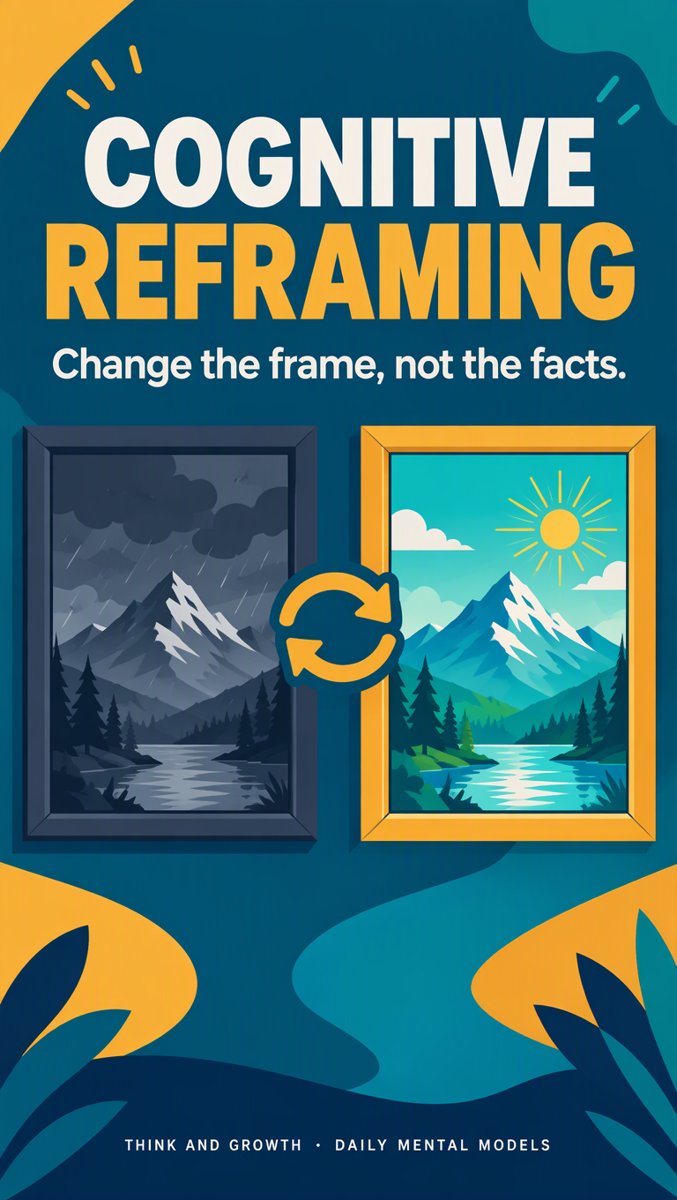
Cognitive Reframing: That Pounding Heart Isn't the Problem — It's Fuel
Think and Growth · Daily Mental Models · Friday, September 25, 2026 Theme: Mental Health — resilience, focus, clarity
Your heart is pounding before the big meeting. Palms sweaty, mind racing. Most people treat that feeling as a malfunction — a signal to panic, suppress, or white-knuckle through. The research says something different: that pounding is your body mobilizing resources. And whether it helps you or wrecks you depends almost entirely on one thing — the story you tell about it.
That's cognitive reframing, and it's one of the most validated tools in modern psychology.
The Idea
Cognitive reframing — the everyday name for what researchers call cognitive reappraisal — is the practice of reinterpreting the meaning of a situation to change its emotional impact. As emotion researcher James Gross defines it, reappraisal is "a strategy for regulating emotions in which individuals reinterpret the meaning of stimuli to modify their emotional response" (PMC / Frontiers in Behavioral Neuroscience, 2023; see also the ScienceDirect overview and Wikipedia: Cognitive reframing).
Notice what it is not: it is not denying reality, and it is not forced positivity. The facts stay the same. The deadline is still real. The exam is still hard. What changes is the meaning you assign — and meaning is where emotion is generated. In Gross's process model of emotion regulation, reappraisal works early, reshaping how a situation is understood before the emotional reaction has fully taken over (Gross's process model via Wikipedia).
The core principle in one line: Event → Story → Emotion. You can't always edit the event, but the story in the middle is always editable.
How It Works
Three moves, practiced in under a minute:
- CATCH the automatic thought. Name the story you're telling yourself. "I'm telling myself I'm going to blow this presentation." Naming it turns a fog into an object you can examine.
- ASK: is there another honest way to read this? Not a fantasy version — a true version the evidence still supports. This is exactly the skill therapists use as the backbone of CBT; practitioners describe cognitive restructuring and reframing as "the same core skill at different levels of formality" (CBT Los Angeles; see also therapist Kyira Wackett's explainer, YouTube).
- CHOOSE the interpretation that helps you act. Between two defensible readings of reality, pick the one that moves you forward.
The Proof: Stress as Fuel
This isn't armchair philosophy — it has lab numbers behind it.
In a Harvard-affiliated study led by Jeremy Jamieson and colleagues — published under the unforgettable title "Turning the knots in your stomach into bows" — test-takers facing the GRE math section were taught to reinterpret their racing hearts and quickened breath not as anxiety but as the body delivering fuel and oxygen to the brain for peak performance (ERIC full-text citation, J. Exp. Social Psychology).
The result: reappraisal participants outperformed the control group on the actual GRE-math section — and follow-up work measured the physiology directly. In Jamieson's 2012 study "Mind over matter," people who reappraised arousal showed healthier cardiovascular responses under stress — the pattern associated with challenge rather than threat (Harvard DASH; Jamieson Lab, University of Rochester).
Same exam. Same pounding hearts. Different frame — measurably different outcomes.
Try It Today
Run the drill once, today, on one negative story:
- NAME the story. Write it down word for word: "I'm telling myself I'll fail."
- WRITE a second story the evidence still supports. "I've prepared for this. The nerves mean my body is ready."
- ASK: which story helps me act? Then act on that one.
You're not lying to yourself. You're choosing between two honest interpretations of the same facts — and choosing the one with better returns.
The Takeaway
You can't always control the event. You can always choose the frame.
The event is what happened. The frame is what it means — and meaning is where your performance lives. Master that distinction and you've built a portable resilience machine: it weighs nothing, costs nothing, and it works on the hardest days.
🎬 Narration Script (video, ~70s)
[Hook — cover] Your heart's pounding before the big meeting. Good news: that pounding isn't the problem.
[The Idea] Cognitive reframing means reinterpreting a situation to change its emotional impact. Same facts — new meaning. Psychologist James Gross found it works early — before the emotion fully takes over.
[How It Works] Step one: catch the automatic thought. Name the story you're telling yourself. Step two: ask — is there another honest way to read this? Step three: choose the interpretation that helps you act — then act.
[Real-World Example] Here's the proof. In a Harvard-led study, students faced the GRE math section. One group reinterpreted their racing hearts as fuel — oxygen delivered for peak thinking. They outperformed everyone. Same stress — different frame, different results.
[Apply It] Today, catch one negative story and write it down word for word. Then write a second story the evidence still supports. Ask: which story helps you act? Then act on it.
[Takeaway] You can't always control the event. You can always choose the frame.
[CTA] If this reframed your day, subscribe to Think and Growth — one mental model, every morning. See you tomorrow.
(173 words · ~69 seconds at TTS pace)
Sources
- Gross, J. J. — cognitive reappraisal definition: PMC (Frontiers in Behavioral Neuroscience, 2023) · ScienceDirect Topics · Wikipedia — Cognitive reframing
- Jamieson, J. P., Mendes, W. B., Blackstock, E., & Bhasin, T. (2010). Turning the knots in your stomach into bows: Reappraising arousal improves performance on the GRE. Journal of Experimental Social Psychology, 46, 208–212 — ERIC citation · Harvard DASH · Jamieson Lab, Univ. of Rochester
- Kyira Wackett, MS, LPC — Cognitive Reframing: The Mind Trick Therapists Use to Combat Negative Thinking — YouTube