 Tech Minute Back to channel
NVIDIA Just Sold Microsoft a MacBook Pro — With a Windows Logo and a $2,599 Bill
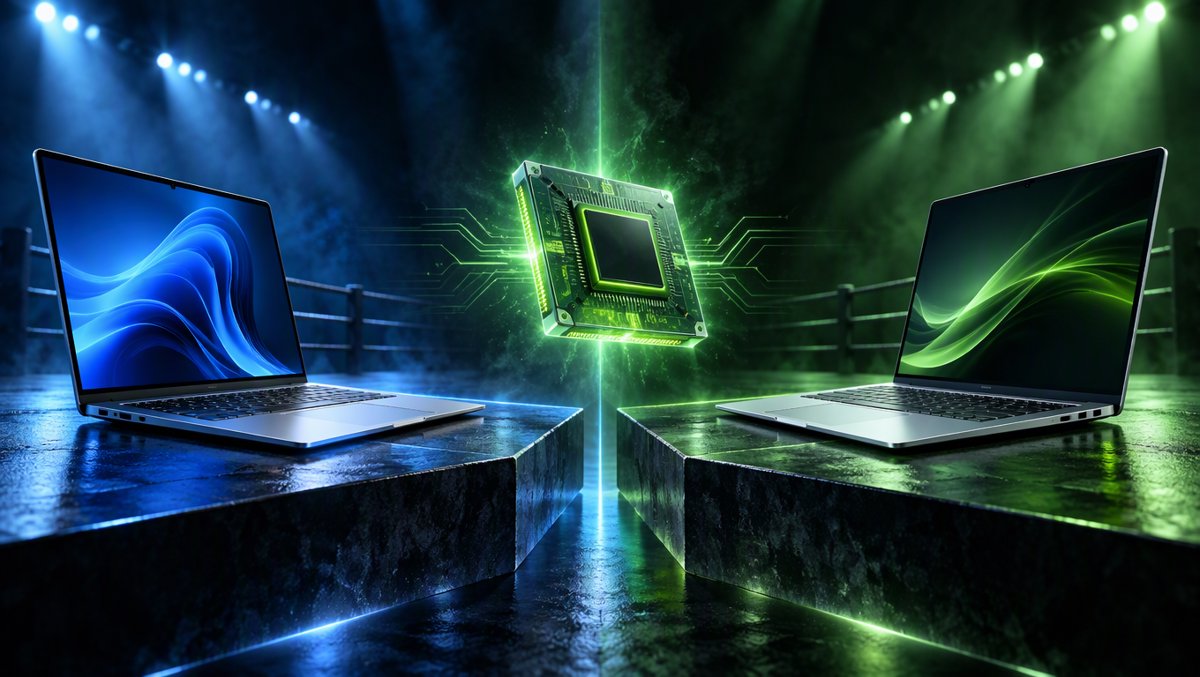
"The PC is being reinvented. For forty years, you launched apps. Click. Type. With RTX Spark and Microsoft Windows, you ask — and the PC does the work." — Jensen Huang, NVIDIA founder & CEO
For twenty years, the story of high-end Windows laptops has been a polite apology. You wanted MacBook-grade battery life and a big pool of unified memory, you looked at the Windows aisle, and you sighed. This week, NVIDIA showed up with a receipt — and charged MacBook Pro money for it.
On October 7, 2026, NVIDIA's long-teased RTX Spark superchip moved from stage demo to order books. Pre-orders are live, and the machines ship Friday, October 16. Prices run from $2,599 to $6,999.
There's a catch buried in that price tag — and it's the whole story.
The headline nobody expected from a GPU company
NVIDIA doesn't make laptops. It doesn't make consumer CPUs. And yet, as DIGITIMES put it, RTX Spark is "Windows on Arm's strongest shot yet at x86's high end." Read that again: not the budget tier, not the mid-range. The high end — the thin-and-powerful, creators-and-developers, "I want a real machine" segment that x86 (and, quietly, Apple) has owned for a decade.
RTX Spark was unveiled on May 31, 2026 at Computex/GTC Taipei, as a joint NVIDIA–Microsoft play. It isn't a CPU. It's a superchip — CPU, GPU, memory, and interconnect fused into a single package. Which is to say: it's a System-on-Chip the way the MacBook Pro's is. That's not a coincidence.
What's actually inside
Here's the spec sheet that has the PC press reaching for superlatives:
- CPU: up to 20 Arm cores on the NVIDIA Grace design (a lower tier uses 18). NVIDIA co-designed the custom CPU with MediaTek for power efficiency.
- GPU: a Blackwell RTX GPU with up to 6,144 CUDA cores and 5th-gen Tensor Cores with FP4 precision. The 24GB/32GB configs get a smaller 5,120-core GPU; 48GB and up get the full chip. Watch the listings — they all just say "RTX Spark N1X," so you have to read the fine print.
- Memory: up to 128GB of unified LPDDR5X, with the CPU and GPU stitched together by NVLink-C2C — NVIDIA's chip-to-chip interconnect, the key to that unified pool.
- AI compute: up to 1 petaflop of FP4 performance. NVIDIA's demos: rendering 90GB+ 3D scenes, editing 12K 4:2:2 video, running 120-billion-parameter LLMs with a 1-million-token context locally, and playing AAA games at 1440p and 100+ fps.
- Chassis: as thin as 14mm, as light as three pounds, 14–16 inch, tandem OLED with G-SYNC. Small desktops follow post-launch.
- OEMs: ASUS, Dell, HP, Lenovo, Microsoft Surface, and MSI at launch, with Acer and GIGABYTE to follow.
And the software that matters to creators: Adobe is rearchitecting Photoshop and Premiere from the ground up for the chip, promising up to 2x faster AI and graphics work, with Blackmagic, Blender, CapCut, ComfyUI, and llama.cpp all publicly on board.
The Mac in the room
Microsoft's launch device, the Surface Laptop Ultra, starts at $2,599 — and Microsoft's own presentation compared it to the M5 Pro MacBook Pro. You don't pick that fight by accident.
Macworld's Jason Cross did the honest side-by-side and reached a verdict most Windows fans won't love and most Mac fans will:
CPU: Apple wins, decisively. Using the DGX Spark (a Linux desktop with essentially the same chip specs) as a proxy, NVIDIA's CPU scores roughly 2,600 single-core / 23,700 multi-core on Geekbench. Apple's M5 Max lands near 3,700 / 35,600 — a 40–50% gap.
GPU: NVIDIA wins on paper and likely in practice. NVIDIA claims about 100 TFLOPS FP16 vs Apple's roughly 70 — and the Blackwell architecture is tuned for small, quantized models in tiny data formats, where it should "handily beat" Apple. NVIDIA's headline FP4 number (1 petaflop) has no direct Apple equivalent.
Memory bandwidth: Apple wins, big. The M5 Max runs ~614 GB/s; the RTX Spark is reported around 300 GB/s. For certain AI workloads, bandwidth is the whole ballgame — and Apple has more than double.
So it's a genuine fight, not a rout. Which brings us to the part both companies would rather you not notice.
The uncomfortable compliment
Look at the RTX Spark's architecture: a single energy-efficient processor, a lot of ARM cores, a powerful GPU, and a big pool of unified memory running at 300 GB/s.
That is, almost line for line, what Apple has been shipping for five years.
"The Surface Ultra shows that Apple was on the right track the whole time," Macworld concluded. The most ambitious Windows laptop in a generation is, architecturally, a MacBook Pro that says Windows. NVIDIA didn't just attack Apple's high end — it validated the formula. The fight now isn't about whose architecture is right. It's about who can execute it, and who owns the software.
The runway: TSMC and a memory crunch
Why can NVIDIA ship this at all? Look at the supply chain under it. The week these pre-orders opened, TSMC reported third-quarter revenue up 51% year-over-year to NT$1.49 trillion, with September alone hitting NT$511.86 billion (~US$16.1bn), up 54.6% YoY and essentially flat month-over-month. The foundry building all of this is at a record — the silicon tailwind behind every one of these launches.
But there's a headwind too, and it's the reason your wallet is about to hurt. AI PCs are facing a memory squeeze as server demand takes priority — DRAM and LPDDR5X capacity is being sucked up by data centers. It's why NVIDIA reportedly created a 64GB RTX Spark configuration priced at $4,999 just to navigate the crunch, and why the top-end 128GB/2TB machines clear $6,999. You're not just buying a chip. You're bidding against a hyperscaler for the same memory.
The real catch: software, not silicon
Here's the honest asterisk on "strongest shot yet."
RTX Spark runs Windows 11 on Arm, where apps are either native ARM64 (fast, efficient) or run through Prism, Microsoft's x86 emulation layer (compatible, not free). Right now, the vast majority of Windows software is still x86 and has no native ARM version. That's the 20-year-old tax on Windows on Arm, and a new superchip does not repeal it.
Apple, by contrast, is years past this problem: nearly all Mac apps run natively on M-series silicon, and Rosetta 2 is only for old software. The hardware gap just narrowed dramatically. The ecosystem gap didn't move an inch.
The numbers tell you how early this still is. Windows on Arm is projected at just ~3.2% of notebook shipments in 2026 (TrendForce), heading to ~11.5% by 2029. Even the headline "ARM PCs are 15.3% of client CPUs" figure for Q2 2026 includes every Mac on Earth. This is a beachhead, not a takeover.
And here's the tell that this is a halo play, not a volume play: Apple has Mac laptops starting at $1,299 that use the exact same architecture, OS, and APIs as its $7,000 ones. RTX Spark has no cheap tier. It starts at $2,599 and climbs. NVIDIA isn't trying to sell you a laptop — it's trying to establish that Windows has a high end again.
What to watch
- The emulation tax. Does Prism get good enough that the ARM64 gap stops mattering? Or does "runs great, in theory" become the platform's epitaph?
- The memory squeeze. If DRAM stays tight, these prices don't fall. Watch the 2027 PC roadmap for a $1,999 RTX Spark — that's the day it gets real.
- Real benchmarks vs. demo reels. Launch-day Geekbench and local-LLM token/sec numbers, not NVIDIA's 1-petaflop headline. The FP4 figure is a format advantage; the FP16 gap with Apple is the honest one.
- Apple's reply. A touchscreen MacBook Pro is rumored, and the M6 is already being benchmarked. The M5 Max won the CPU round — watch whether bandwidth or cores decide the next one.
- The developers. If Adobe, Blackmagic, and the game studios genuinely ship native ARM64 builds, Windows on Arm stops being a bet. If they ship "optimized for RTX Spark" badges and little else, it stays one.
The bottom line
NVIDIA just did what Intel, AMD, and Qualcomm couldn't: it gave Windows a flagship that competes at the top of the market on silicon alone. The CPU loses to Apple, the GPU wins, the memory bandwidth loses, and the price starts where the MacBook Pro's ends. But the point isn't this generation — it's that after twenty years of Windows-on-Arm being a promising someday, NVIDIA bought the platform a seat at the grown-ups' table. Apple's formula, it turns out, was right all along. The question is whether Windows can finally run it — and whether you can afford the ticket.
Sources: NVIDIA Newsroom — "NVIDIA and Microsoft Reinvent Windows PCs for the Age of Personal AI" (May 31, 2026); Microsoft Windows Experience Blog (May 31, 2026); DIGITIMES — "Nvidia's RTX Spark hits order books, taking on Apple's Macs" and "Nvidia's RTX Spark gives Windows on Arm its strongest shot yet at x86's high end" (Oct 8, 2026); Tom's Hardware — RTX Spark pre-order pricing and availability (Oct 8, 2026); Macworld — "Surface Laptop Ultra is Microsoft's best effort to catch up to Apple" (Oct 8, 2026); PC Gamer and VideoCardz on launch pricing; TrendForce and Mercury Research on Windows-on-Arm penetration; NVIDIA RTX Spark porting guide; DIGITIMES on TSMC Q3 2026 results and the AI-PC memory squeeze.