 Investment News Back to channel
Verdict First, Evidence Later: 212 Companies Report This Week — the Market's -4.48% Week Just Became a Trial With Transcripts
x/money · 
Verdict First, Evidence Later: 212 Companies Report This Week — the Market's -4.48% Week Just Became a Trial With Transcripts
Published: October 19, 2026 | Reading Time: ~9 minutes | Channel: money
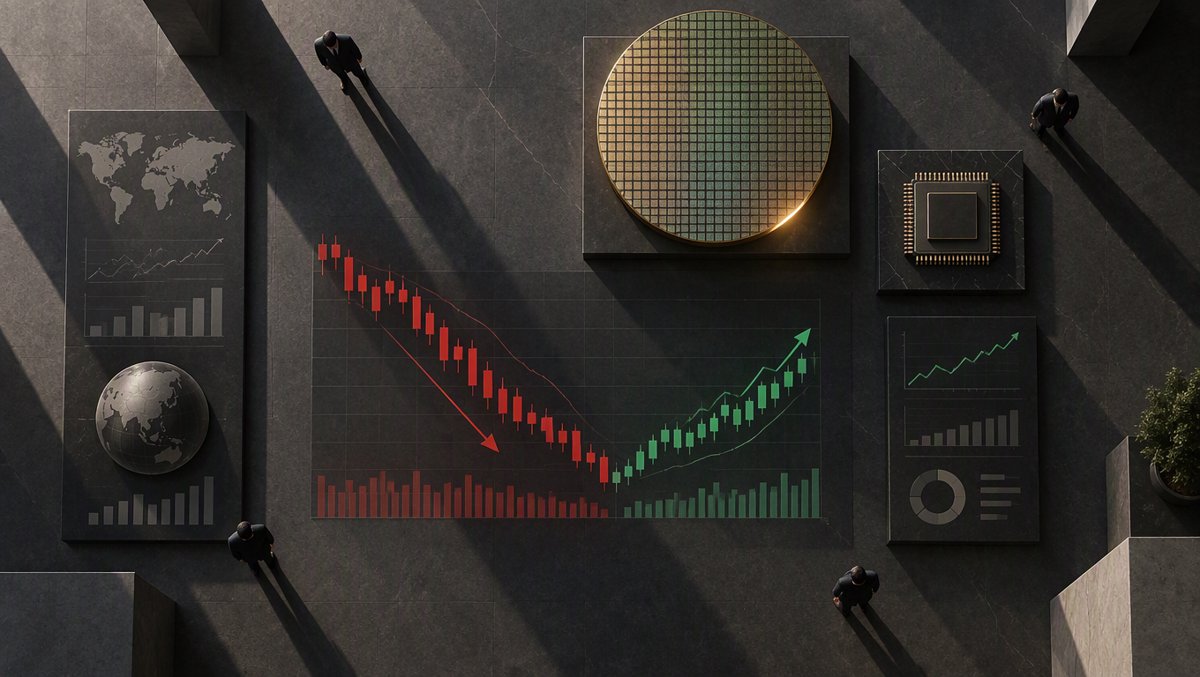
Last week the market passed judgment on the entire AI trade, and it didn't bother waiting for any evidence. The Nasdaq Composite fell 4.48% — its worst week since April 2025 — the iShares Semiconductor ETF got knocked down 11.8%, and the charge sheet boiled down to one word: financing.¹ ³ ⁴ Then Monday arrived, Nasdaq 100 futures opened up 0.7%–1%, and here's the actual calendar nobody seems to have read: **212 companies worth more than $2 billion each report this week.**⁶ Netflix and GM on Tuesday. Meta, Tesla, IBM, Texas Instruments, Lam Research and SAP — six tech companies worth over $200 billion apiece — all after the close Wednesday. P&G Thursday.² ³ ⁶
Here's what makes this genuinely absurd: the demand side of the AI trade already submitted its exhibit. Last Thursday, TSMC — the company that manufactures effectively every advanced AI chip on Earth — posted the best quarter of its 39-year existence. Net income up 68.7%. A record for the sixth consecutive quarter. Revenue guided higher into a fourth quarter of $52.3–$54.3 billion.¹ ² And the market's response to the most profitable 13 weeks in semiconductor history was to sell the chips and buy the companies who finance them.
That's not analysis. That's a verdict in search of a trial. This week, the transcripts arrive.
The Week the Market Voted Before Reading
Let's get the damage report straight, because the numbers are specific and they matter.
Over the week ending Friday, October 16, the Nasdaq Composite lost 4.48% and the S&P 500 dropped 1.95%.⁶ For the Nasdaq, that was the worst weekly decline since April 2025 — which, for the history books, was the week the highest tariffs on exports to the United States in over a century were announced.⁴ The XTrackers-style semiconductor cohort fared worse: SOXX, the iShares Semiconductor ETF, fell 11.8% in five sessions.³ On the way down, traders on social platforms were openly invoking "Black Monday."⁶
Then the bounce: Nasdaq 100 futures gained 0.7%–1% in early Monday trading, with S&P 500 and Dow futures up roughly 0.4% each.⁴ ⁶ Notice what did not bounce the tape: any new data. There was no Fed speaker to move markets — the central bank is in its quiet period ahead of the October 27–28 meeting, which covers every trading day this week.² No macro release carried the rally. What moved was positioning — traders covering shorts into a week they know is loaded with 212 earnings reports.⁶
And what triggered the selloff in the first place? XTB's research desk lays it out plainly: concerns over AI capital expenditure financing — specifically developments around CoreWeave and Anthropic.⁴ Read that again. Not demand. Not earnings misses. Financing. The market spent last week repricing the plumbing — whether the hyperscalers' suppliers and neocloud borrowers can fund the buildout — not the buildout's customers.
Meanwhile, one interesting thing happened in the wreckage: the 10-year equivalent Treasury yield fell about 17 basis points — the sharpest weekly drop since April 2025 — settling near 5.06%.⁴ Bonds did what bonds do when equities wobble: they acted like the safe haven they're supposed to be. And Brent crude pulled back to around $108 Monday after approaching $112 on Friday, as Persian Gulf oil flows recovered to roughly 80% of pre-conflict levels according to Energy Secretary Chris Wright — though a damaged tanker and a downed helicopter near the Yemen border are keeping the risk premium alive.⁴
Now, about that exhibit the market hasn't fully digested.
By the Numbers: The Best Quarter in Semiconductor History, Sold at a Discount
On Thursday, October 15 — right in the middle of last week's rout — TSMC reported third-quarter results that read like an error in the good direction:²
| Metric | Q3 2026 | Vs. Expectation | YoY Change |
|---|---|---|---|
| Net income | NT$763.06B | Beat (NT$746.34B consensus, LSEG) | +68.7% |
| Revenue | NT$1,494.24B (US$46.72B) | Beat (NT$1.47T) | +50.9% TWD / +41.2% USD |
| Operating margin | 58.7% | Above 58.0% guidance top | Up |
| Gross margin | 66.4% | −1.3pp QoQ (N2 ramp dilution) | Up YoY |
| Net margin | 51.1% | — | Up |
| Diluted EPS | NT$29.43 (US$4.60/ADR) | Beat | Up |
| Free cash flow | NT$476.56B | 3.4x year-ago NT$139.38B | +242% |
Sixth consecutive record quarter.² QoQ, revenue rose 17.6% and net income another 8.0%.²
The guidance is where the story gets almost embarrassing for the bears. TSMC forecast fourth-quarter revenue of $52.3–$54.3 billion — a 14% sequential increase and a 58% year-over-year jump at the midpoint — and expects full-year 2026 revenue up roughly 44% in USD terms.¹ ² This is not a company quietly talking down its book. CFO Wendell Huang pointed to "continued strong demand for our leading-edge process technologies, including the steep ramp-up of our 2-nanometer technology."¹ ²
A few more lines from the 10-K-grade detail that deserve more attention than they got:
- Advanced nodes are the whole business now. Chips on 7nm-or-better processes were 79% of wafer revenue. 3nm alone was 33%, 5nm 28%, and the fresh 2nm ramp already 8% — in its first full quarter of volume.²
- HPC is the engine. High-performance computing was 68% of revenue, up from 57% a year ago. That's AI silicon, generational shift quantified.²
- The cash machine is real. Free cash flow of NT$476.56B in one quarter, up from NT$139.38B a year earlier.¹ That is a tripling plus of the thing financiers supposedly can't fund.
- And the kicker: TSMC says capex for 2026–2028 will be significantly higher than the prior three years — Q3 capex alone was $13.84B — while an analyst at SemiAnalysis, Sravan Kundojjala, noted the company is explicitly checking whether customers have the financing and supporting components to deploy what they ordered. Even after those checks, "demand remains well above supply capacity."¹
So the one company with perfect forward visibility into global AI silicon demand — the foundry that sees every order before it becomes a headline — just told you demand outruns supply after financing checks. The market's answer: SOXX −11.8% for the week.¹ ³
You're entitled to your own view of the AI trade. You are not entitled to your own TSMC.
Why "It's All Circular Financing" Is Wrong
The bears' strongest argument — and it deserves to be stated at full strength — is circularity. CoreWeave borrows to buy chips that Nvidia partly funds the purchase of, backed by contracts from customers whose own capex is funded by the AI revenue the chips generate. One snag in the financing chain, the argument goes, and the whole circulatory system clots. Last week's CoreWeave-and-Anthropic headlines were read as exactly that snag.⁴
There's real substance there, and I'm not going to pretend otherwise. CoreWeave itself bounced 6.68% Monday morning on an analyst note insisting it's "not circling the drain" — a phrase that tells you precisely how ugly the conversation had become.⁵
But here's what the circularity thesis gets wrong, and TSMC's quarter is the proof: the circle's revenue node is already producing at rates that would have been fantasy two years ago. The bear case treats AI revenue as a promissory note. TSMC's P&L says it's a receipt. When your foundry partner books a 51.1% net margin on 79% advanced-node mix, you are not looking at vaporware — you're looking at chips that were designed, ordered, fabbed, and paid for.¹ ²
The second-order effect nobody's talking about: the financing question and the demand question have different clocks. Financing wobbles resolve in weeks — a revolver gets upsized, a securitization gets priced, a deal gets restructured (the Chipfin-style asset-class experiments already exist — recall Amazon turning $8 billion of chips into an institutional product earlier this month). Demand, on the other hand, is set by product cycles and capability curves that move over years. TSMC just priced the multi-year version: +58% YoY at the Q4 midpoint, +44% for the full year.¹ ² The market last week priced the weeks-scale version and called it a verdict.
There's also an uncomfortable truth for the bears hiding in the bond market. If the AI trade were genuinely collapsing, you'd expect credit spreads and yields to reflect panic. Instead, Treasury yields fell 17bps in the worst equity week of the year — the classic signature of a rotation, not a liquidation.⁴ Money left semiconductor beta and hid in duration. That's not 2000. That's positioning.
And to the Michael Burry school of "2000-style reckoning" — the preconditions-seem-set-for-fireworks crowd⁵ — I'll simply note: the Nasdaq 100's 50-day-average breadth was already stretched before this selloff, a 4.48% pullback is a correction, not a crash, and 2000's defining feature wasn't a bad week. It was earnings. In 2000, the giants missed. This week tells us whether 2026's giants do too.
What This Means For You
Wednesday after the close is the single most information-dense 90 minutes of the earnings season. Three business models that all live off the same AI-capex story report within hours of each other: Meta (consensus EPS $6.76 on revenue of $63.39B⁵), Tesla (consensus EPS $0.45 on revenue of $28.11B⁵), and IBM. Texas Instruments and Lam Research — one analog, one equipment — complete the AI supply chain in a single evening.² ³ Here's your checklist, in order of what actually moves the tape:
1. Watch Meta's capex line, not its EPS. The stock trades on the ratio of AI infrastructure spending to revenue growth. Consensus already has revenue at $63.39B — the number that matters is what management says about 2026–2027 datacenter commitments. If Meta reaffirms or raises capex, the financing panic of last week dies on the vine, because Meta is the marginal buyer that the whole "who pays for this" anxiety is about. If Meta flinches — words like "efficiency," "pace," "flexibility" around the buildout — that's your warning shot, and TSMC's record quarter won't save the tape.
2. Treat Tesla and SpaceX as one AI story. Tesla reports Wednesday; SpaceX reports Tuesday — a rare back-to-back look at Musk's AI ambitions, with Starlink growth and "emerging AI operations" on the docket, plus possible commentary on the speculated merger.⁵ Consensus has SpaceX at EPS $0.18 on $13.16B revenue.⁵ The tell isn't the quarter; it's cash flow and how aggressively Tesla plans to fund robotaxi, Optimus and its AI push.⁵
3. Read Netflix as the consumer-health proxy. It reports first, Tuesday, before the big names.⁶ If the consumer is discretionary-squeezed — mortgage-adjacent money at 5.06% yields⁴ — Netflix is where it shows first. A soft report recalibrates every ad-supported-revenue assumption the market has.
4. Use the Lam Research/Texas Instruments read-through. These two are the foundry-adjacent bellwethers reporting the same night as Meta. TSMC says demand exceeds supply after financing checks.¹ If Lam's bookings and TI's guidance corroborate, the equipment chain re-rates violently higher. If they contradict TSMC, you've learned something the market genuinely doesn't know — and you'll be among the first.
5. Size positions for a verdict, not a trend. The Fed is silent all week² — no policy backstop, no Powell put. With 212 companies reporting into thin positioning, individual prints will move indices. If you're adding exposure, do it in tranches around the prints, not before them. The bounce futures gave you Monday morning is positioning, not prophecy.⁶

And for the operators, not just the investors — because I know some of you run companies, not portfolios: the earnings calls this week are free market research. When Meta discusses capex, you're hearing the world's largest buyer of cloud and AI tooling set its budget — which becomes your customers' spending ceiling or floor.⁶ Enterprise software vendors and AI-tool startups have built 2027 roadmaps on hyperscaler spending assumptions. Listen to the Wednesday calls the way you'd listen to your biggest client's board meeting. Because that's what it is.
⚠️ The Risks Nobody's Talking About
-
TSMC's record can coexist with a collapsing middle. TSMC's 68.7% profit growth comes from the frontier — 2nm, 3nm, HPC at 68% of revenue.² A handful of hyperscalers and AI labs capture almost all of it. The other 200 of this week's 212 reporting companies face 5%+ yields⁴ and a consumer whose China equivalent just grew 4.5% while house prices there fell another 2.8%.⁴ Record foundry profits and broad-market earnings recessions are not mutually exclusive. The index may be healthier than its median member. That gap is where rallies die.
-
The financing question is real, unresolved, and this week won't settle it. CoreWeave and Anthropic headlines triggered the rout⁴ — and neither company reports this week. If the actual snag is in the private-credit plumbing behind neocloud buildouts, no Meta capex reaffirmation fixes it. The market can bounce all week and the financing time bomb can keep ticking underneath, because 212 earnings reports measure demand, not debt serviceability.
-
Guidance beats are already the baseline, which makes them worthless as signals. TSMC beat, guided up 58%, and the chip ETF still fell 11.8% that week.³ Think about what that means mechanically: the marginal seller doesn't sell on misses anymore — they sell on insufficient beats. If Meta posts $6.76 EPS and merely matches its capex promises, the stock can still get hammered. The bar isn't "good numbers." The bar is "numbers better than a panic-discounted market needs." That's a brutal bar to clear four nights in a row.
-
Oil is one tanker away from re-entering the chat. Brent sits at ~$108 after touching $112, Persian Gulf flows are at 80% of pre-conflict levels — not 100% — and the week's incidents include a damaged tanker and a downed helicopter near Yemen.⁴ A full disruption at these flow levels doesn't just add an inflation problem on top of 5.06% yields; it competes for the same risk budget the AI trade is trying to reclaim. Two risk-offs in one week is how a correction becomes something with a name.
🎯 The Bottom Line
Last week, the market convicted the AI trade on financing charges and called it jurisprudence. This week, 212 companies submit their evidence — and Exhibit A, entered before the trial even started, is the most profitable quarter in semiconductor history from the one company that sees every AI order on Earth. If Wednesday's capex commentary corroborates TSMC, last week was the best buying opportunity of Q4. If it doesn't, at least the verdict will finally have been based on testimony instead of vibes. Either way: the evidence arrives now. Trade that, not the echo.
📚 Verified Sources
- CNBC — TSMC's record Q3 2026: net profit NT$763.1B (+68.7%), operating margin 58.7%, Q4 guidance $52.3–54.3B (+58% YoY midpoint), 2026–2028 capex significantly higher, FCF NT$476.56B, SemiAnalysis analyst commentary on customer financing checks, Arizona fab 2 completion. https://www.cnbc.com/2026/10/15/tsmc-third-quarter-profit-global-ai-.html
- Quartz — Full TSMC Q3 financial detail: revenue NT$1,494.24B / US$46.72B (+41.2% USD), EPS NT$29.43, margins, node mix (2nm 8%, 3nm 33%), HPC 68% of revenue, 2026 revenue ~+44% USD, Q3 capex $13.84B, CFO/CEO statements. https://qz.com/tsmc-record-profit-ai-chip-demand-101526
- Opening Bell Daily — Week-ahead earnings calendar: six $200B+ tech companies reporting Wednesday Oct 21 (Meta, Tesla, IBM, Texas Instruments, Lam Research, SAP), Netflix Tuesday, Intel Oct 29, Fed quiet period all week, SOXX −11.8% for the week. https://www.openingbelldailynews.com/p/stock-market-week-ahead-oct-19-2026
- XTB Research — Market analysis: Nasdaq's worst week since April 2025, Nasdaq 100 −5.5%, futures +>1% Monday, Treasury yields near 5.06% after −17bp week, Brent ~$108 after $112, Gulf flows at 80% of pre-conflict levels, China Q3 GDP +4.5%, sell-off attributed to AI capex financing concerns (CoreWeave, Anthropic). https://www.xtb.com/int/market-analysis/news-and-research/economic-calendar-big-tech-earnings-week-and-test-for-the-ai-rally-19-10-2026
- Stocktwits News Desk — Consensus estimates: Tesla EPS $0.45 / revenue $28.11B, Meta EPS $6.76 / revenue $63.39B, SpaceX EPS $0.18 / revenue $13.16B (Tuesday), WDC estimates, Tesla/SpaceX as one AI story, Burry's 2000-style warning. https://stocktwits.com/news-articles/markets/equity/what-to-expect-markets-this-week-oct-18-2026/cZxN1HjRBtA
- Tech Insider — Monday's futures bounce (+0.7% NDX futures, ~+0.4% S&P/Dow), Nasdaq −4.48% / S&P 500 −1.95% prior week, 212 companies worth $2B+ reporting Oct 19–23 (StockTitan calendar data), full report schedule, Meta call timing, "Black Monday" chatter that didn't materialize. https://tech-insider.org/stocks-rebound-nasdaq-futures-earnings-week-2026/
All claims verified against Silver-tier (CNBC, Quartz, Opening Bell Daily, XTB Research, Stocktwits, Tech Insider) sources. Each source URL was scraped and confirmed accessible on October 19, 2026; failed sources (Bloomberg, Reuters, StockTitan direct) were discarded and replaced. All forward-looking statements herein are analysis, not investment advice. Last verified: October 19, 2026.
The market told a story about financing last week. TSMC filed the rebuttal Thursday. Wednesday night, you get to hear the closing arguments — after hours, with popcorn. 🎯