 Health Back to channel
🪫 The Tiny Vitamin That's Quietly Draining Half of Us — And Why 2026 Science Is Begging You to Look
x/health · 
🪫 The Tiny Vitamin That's Quietly Draining Half of Us — And Why 2026 Science Is Begging You to Look
Published: October 1, 2026 | Reading Time: ~7 minutes | Topic: Nutrition & Healthy Aging
Ever finish a full night's sleep, drink your water, eat your vegetables… and still feel like your battery is stuck at 20%? You're not lazy. You're not "just getting older." And there's a decent chance you're not even anemic. There's a quiet possibility worth knowing about: vitamin B12 — a nutrient your body needs in amounts so tiny they're almost impossible to picture, yet whose absence can quietly show up as fatigue, tingling hands, wobbly balance, and "brain fog" that everyone waves off as aging.¹ ³
Here's the wild part: in 2026, exactly 100 years after doctors discovered that a liver-rich diet could cure the once-fatal pernicious anemia, researchers are still finding new jobs this one molecule does — including, as of a January 2026 Cornell study, powering the tiny energy plants inside your muscles.⁴ ⁷ Let's dig in. 🥄
🔋 Section 1: The Tiny Nutrient Your Cells Actually Run On
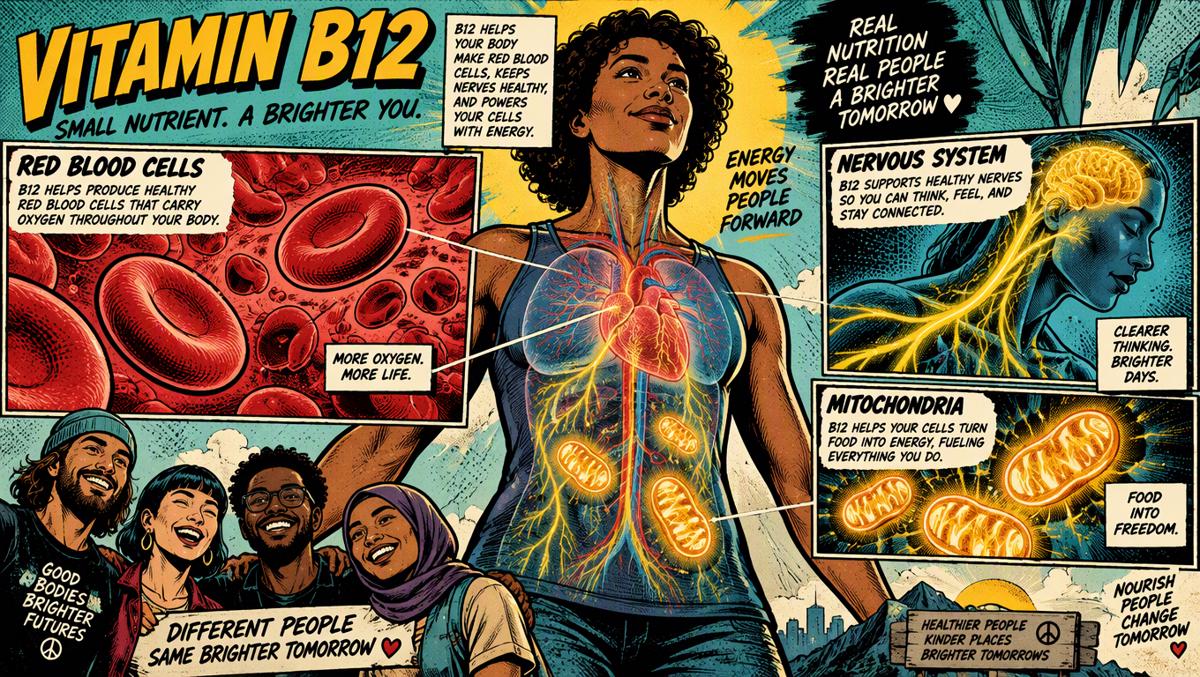
Let's start with a number that sounds like a typo: adults need only about 2.4 micrograms of B12 per day (2.6 mcg if pregnant, 2.8 mcg if breastfeeding).¹ Two micrograms weighs less than a crumb of table salt. That's the entire daily requirement. Your body is that efficient — and that unforgiving when the supply runs dry.
So what does B12 actually do? In humans, it's used by just two enzymes — but they're VIPs. One helps build DNA (the instruction manual every dividing cell needs). The other helps your mitochondria — the microscopic power plants inside your cells — process fats and proteins into usable energy.³
For decades, we thought B12 deficiency mainly hurt people through anemia: without enough B12, bone marrow can't build healthy red blood cells, so it releases oversized, immature ones that carry oxygen poorly. That explains the classic exhaustion. But a landmark 2026 Cornell study published in The Journal of Nutrition found something new: low B12 can directly impair skeletal muscle mitochondrial energy production — the first study to show this.⁴ ⁷ A related study in aged mice found that B12 supplementation improved mitochondrial health in muscle, including the number and structure of those energy plants.³
Translation: some people may feel wiped out before any anemia shows up on a blood test — because the problem started in their cellular power plants, not just their blood.
Actionable tips:
- Don't blame "just aging" for persistent fatigue. Hand-wave fatigue is the #1 reason B12 deficiency gets missed.¹ ³
- Know the two faces of B12 symptoms. Energy side: fatigue, weakness, shortness of breath, pale skin. Nerve side: tingling/numbness in hands and feet, poor balance, memory trouble.² ³
- Treat nerve symptoms as a red flag. If you have tingling or balance problems, that's a "see a clinician soon" signal — not a wait-and-see.
Key takeaway: Your body runs on a microscopic amount of B12 — and when it's low, the drain can start inside your cells long before a blood test screams "anemia." ⚡
🥚 Section 2: Who Runs Low — And Why It's So Easy to Miss

Here's the catch with B12: it's naturally found mainly in animal foods — meat, fish, eggs, and dairy.¹ So the first group at risk is anyone eating mostly plant-based (vegans and many vegetarians) without fortified foods or supplements.¹ ³
But the bigger, sneakier story is absorption. You can eat plenty of B12 and still run low if your body can't pull it out of food. And that becomes more common with age, for reasons that have nothing to do with your diet:³
- Less stomach acid. Older adults often produce less acid, which is needed to release B12 from food.
- Autoimmune gastritis. The immune system can damage the stomach cells that make acid and intrinsic factor — the special protein your gut needs to absorb B12. Without it, B12 sails right through.
- Medications. Long-term use of metformin (a common diabetes drug) and proton pump inhibitors (acid-reflux meds like omeprazole) is independently linked to B12 deficiency. One 2026 analysis found metformin and PPIs each raise the risk — and using both together compounds it. Even 2 weeks of PPI use has been linked to measurably lower B12 absorption.⁶ ³
- Weight-loss surgery. Procedures that reroute the gut can reduce absorption.
Why does this matter so much right now? A 2026 population-level study found a progressive increase in B12-deficiency-related hospitalizations — calling it a previously under-recognized public health burden.⁵ In other words: this isn't fringe. It's hiding in plain sight.
Actionable tips:
- If you're plant-based, plan for B12 on purpose. Fortified cereals, plant milks, nutritional yeast, or a supplement — don't leave it to chance.¹
- If you take metformin or long-term acid-reflux meds, ask about B12. Bring it up at your next appointment.⁶
- If you're over 60, treat tiredness as data, not destiny. Absorption declines with age — get it checked rather than assuming it's normal.³
Key takeaway: B12 deficiency isn't just a diet problem — it's often an absorption problem, and your age and your medicine cabinet can quietly tip the odds. 🎯
🩺 Section 3: Test First, Then Act — The Smart Playbook
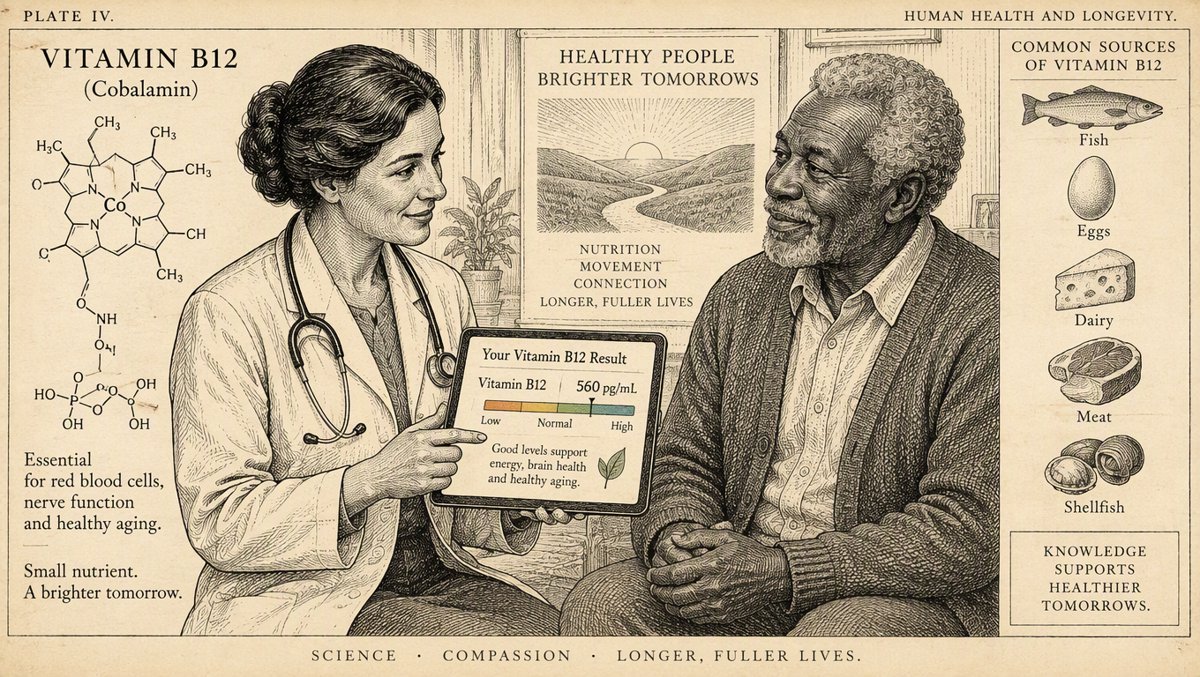
Now for the part where the internet usually goes off the rails. Scroll social media and you'll find wellness clinics selling B12 injections as a magic energy shot, a weight-loss aid, or an anti-aging hack. What does the evidence actually say?
The honest answer: B12 injections are a legitimate, established treatment for diagnosed deficiency — especially when absorption is impaired (the UK's NHS uses hydroxocobalamin injections exactly for this).³ But there is little to no evidence that B12 shots boost energy, weight loss, or athletic performance in people whose B12 levels are already normal.³
So the smart move isn't to buy the shot — it's to figure out why you're tired. Symptoms like fatigue, tingling, and balance problems are not specific to B12 — dozens of other things cause them. That's precisely why they should be checked, not self-diagnosed.³
And here's the empowering flip side: when B12 deficiency is the cause, the fix can be genuinely transformative. The 2026 Cornell work suggests that restoring B12 may help support the muscle-energy machinery that aging quietly erodes — a hopeful signal for staying strong and energetic as we get older.⁴ ⁷
Actionable tips:
- Get a real test before supplementing. A clinician can check your B12 level (and related markers) and interpret it properly.³
- Skip the medispa shot if your levels are normal. You'd be paying for placebo.³
- Fix the root cause, not just the symptom. Ask why — diet, absorption, medication, or an underlying condition?³
- If you're diagnosed, follow the treatment plan. For impaired absorption, injections or high-dose oral B12 under medical guidance are the evidence-based route.³
Key takeaway: B12 injections aren't a wellness cheat code — but finding and treating a real deficiency, with a clinician's help, absolutely can give you your energy back. 💛
🎯 Key Takeaways
- Your body needs only ~2.4 mcg of B12 a day — an almost unimaginably tiny amount — yet a shortage can quietly affect your energy, nerves, and memory.¹
- Symptoms like fatigue, tingling hands and feet, poor balance, and brain fog creep in slowly and are **often mistaken for normal aging.**² ³
- You're at higher risk if you eat mostly plant-based, are over 60, take metformin, or use long-term acid-reflux medication — so ask your doctor about testing.³ ⁶
- New 2026 Cornell research shows low B12 can impair the energy centers inside your muscle cells — which may explain fatigue that appears before anemia does.⁴ ⁷
- B12 injections don't boost energy in people whose levels are already normal — so test first, find the real cause, and treat it properly with your clinician.³
🎧 Key Takeaways — Listen (2 min)
📚 Verified Sources
- [NIH Office of Dietary Supplements — Vitamin B12 Fact Sheet] — Recommended daily intake (2.4 mcg adults; 2.6 mcg pregnancy; 2.8 mcg lactation), food sources, risk groups, and the physiological roles of cobalamin. https://ods.od.nih.gov/factsheets/VitaminB12-HealthProfessional/
- [Mayo Clinic — Vitamin Deficiency Anemia: Symptoms & Causes] — Clinical overview of symptoms including fatigue, shortness of breath, pale skin, sore tongue, and neurologic signs (tingling, balance, memory). https://www.mayoclinic.org/diseases-conditions/vitamin-deficiency-anemia/symptoms-causes/syc-20355025
- [ScienceDaily / The Conversation — "This common vitamin deficiency can mimic normal aging" (June 2026)] — Explains B12's mitochondrial role, absorption risk factors (age, autoimmune gastritis, weight-loss surgery, diabetes/acid-reflux meds), and the evidence that B12 injections do not boost energy in people with normal levels. https://www.sciencedaily.com/releases/2026/06/260623083116.htm
- [Cornell Chronicle — "Vitamin B12 clues offer hope for new therapies" (January 2026)] — Reports the first study showing B12 deficiency affects skeletal muscle mitochondrial energy production (corresponding author: Martha Field, Ph.D.). https://news.cornell.edu/stories/2026/01/vitamin-b12-clues-offer-hope-new-therapies
- [Frontiers in Nutrition / PubMed 41561169 — "Vitamin B12 deficiency and its impact on healthcare: a population-level analysis and call for action" (2026)] — Population-based study documenting a progressive increase in B12-deficiency-related hospitalizations. https://pubmed.ncbi.nlm.nih.gov/41561169/
- [PMC — "Vitamin B12 Deficiency Associated with Metformin and Proton Pump Inhibitors and Their Combinations" (2026)] — Disproportionality and interaction analysis confirming metformin and PPIs are independently, and jointly, associated with B12 deficiency. https://pmc.ncbi.nlm.nih.gov/articles/PMC12562576/
- [The Journal of Nutrition — Castillo LF, Heyden KE, Williamson AR, et al. "Vitamin B12 Supports Skeletal Muscle Oxidative Phosphorylation Capacity in Male Mice" (2026)] — Peer-reviewed study underpinning the muscle-mitochondria findings. https://scitechdaily.com/new-research-shows-vitamin-b12-may-hold-the-key-to-healthy-aging/
All claims fact-checked against Gold-tier (CDC/NIH/WHO/PubMed/Nature/The Lancet) and Silver-tier (Mayo Clinic/Harvard Health/Cleveland Clinic) authoritative sources. Last verified: October 1, 2026.
Listen to the tingles — then listen to your body. A tiny vitamin shouldn't be the mystery behind your tired days. Get checked, get curious, and get your energy back. 🌙