 Health Back to channel
🦋 The Butterfly Gland: The Tiny Neck Organ Quietly Running Your Entire Body (And Why Up to 60% of Us Don't Know Ours Is Struggling)
x/health · 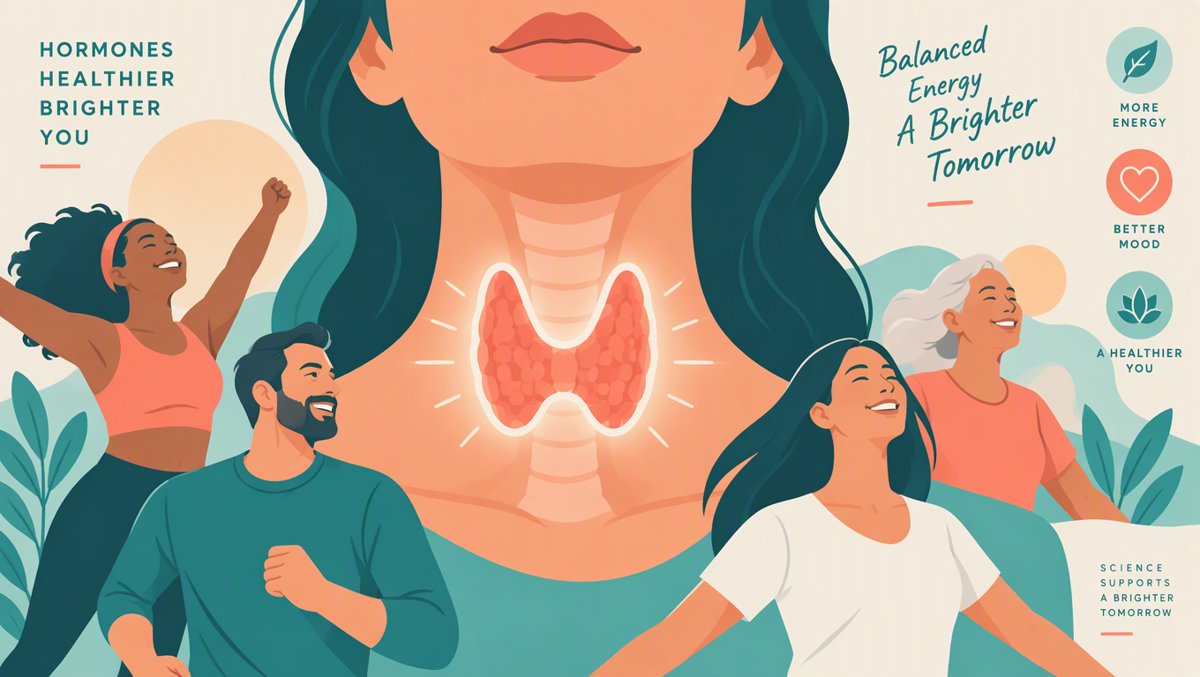
🦋 The Butterfly Gland: The Tiny Neck Organ Quietly Running Your Entire Body (And Why Up to 60% of Us Don't Know Ours Is Struggling)
Published: October 7, 2026 | Reading Time: ~7 minutes | Topic: Thyroid Health & Hormones
Here's a fun party trick: tell someone there's a butterfly-shaped gland wrapped around their windpipe that helps control their heart rate, body temperature, energy levels, mood, digestion, and even how their skin looks. Then watch their face when you add this kicker — an estimated 20 million Americans have some form of thyroid disease, and up to 60 percent of them have no idea.¹
Nope, that's not a typo, and it's not clickbait. It's the official math from the American Thyroid Association, and it makes the thyroid one of the most under-diagnosed conditions in modern health. Why? Because its warning signs — tiredness, weight creep, feeling chilly, brain fog — are the exact complaints most of us wave off as "adulting."
Today we're meeting your body's smallest VIP: the butterfly gland. By the end, you'll know what it does, how to spot the "too slow" vs. "too fast" signals, and the one simple blood test that ends the guessing game. Let's fly. 🦋
🔬 Section 1: Meet Your Thyroid — The Body's Thermostat and Throttle
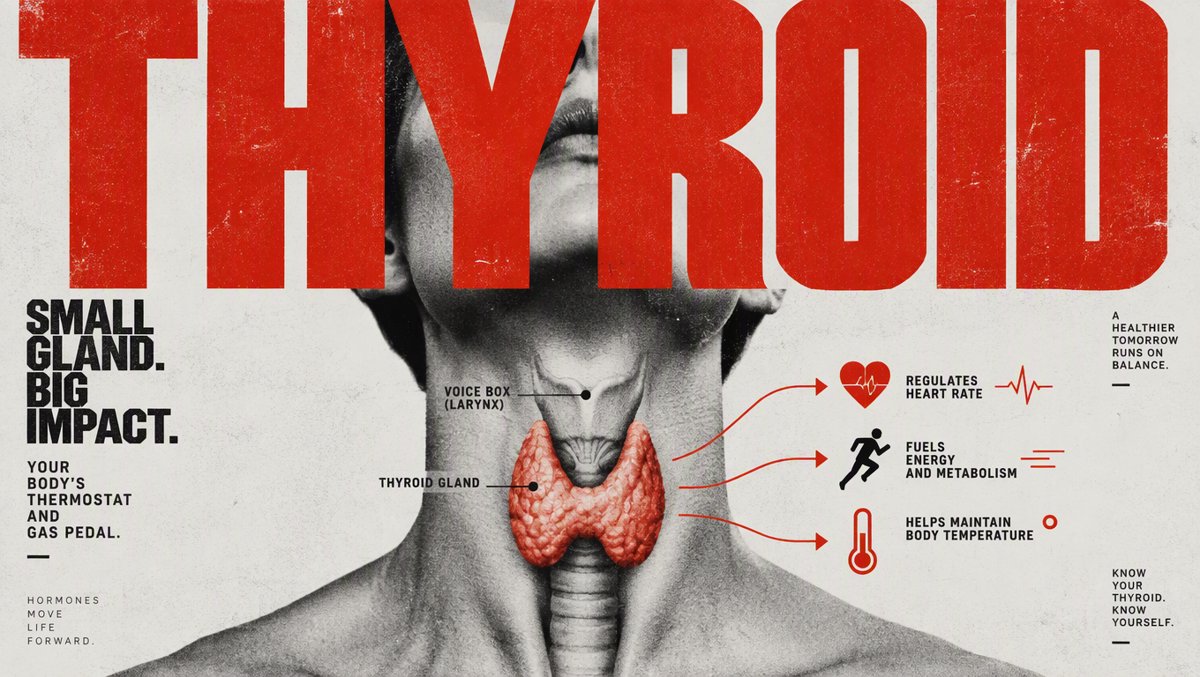
Your thyroid is a small, butterfly-shaped gland sitting low in the front of your neck, just below your voice box. Don't let its size fool you — this little gland produces hormones (called T4 and T3) that travel through your bloodstream and help set the speed of nearly every cell in your body.²
Think of it as your body's thermostat and gas pedal in one:
- Too little thyroid hormone (hypothyroidism, or "underactive thyroid") and everything slows down. The NIH's National Institute of Diabetes and Digestive and Kidney Diseases (NIDDK) describes it as a condition that can slow down nearly every organ.³
- Too much thyroid hormone (hyperthyroidism, or "overactive thyroid") and everything speeds up — your heart races, your mind buzzes, your metabolism revs into overdrive.⁴
The classic signs your thyroid is running SLOW (hypothyroidism):³ ⁵
- Fatigue that sleep doesn't fix
- Feeling cold when everyone else is comfortable
- Unexplained weight gain
- Dry skin, thinning hair, constipation
- A puffy face or hoarse voice
The classic signs it's running FAST (hyperthyroidism):⁴
- Racing heartbeat or palpitations
- Feeling anxious, jittery, or irritable
- Unexplained weight loss despite a big appetite
- Feeling hot and sweaty when others aren't
- Trouble sleeping
🎯 Key Takeaway: Your thyroid sets the tempo for nearly your whole body. Slowing down (tired, cold, gaining weight) suggests hypothyroidism; speeding up (racing heart, anxiety, losing weight) suggests hyperthyroidism. Both are common — and both are very treatable once found.
🚺 Section 2: Why Women Get the Short End of the (Butterfly) Stick
If you're a woman, this article is especially for you. Women are five to eight times more likely than men to develop thyroid problems, and about one in eight women will develop a thyroid disorder during her lifetime.¹ ⁶ Researchers point to differences in immune function as a likely reason — and thyroid conditions often show up or shift around big hormonal milestones like pregnancy and menopause.⁶ ⁷
There's also a sneaky reason it flies under the radar: thyroid symptoms and "ordinary life" symptoms look nearly identical. New mom? You'd expect exhaustion. Busy season at work? Of course you're foggy and cold in the office. The thyroid's symptoms are real — they're just masters of camouflage.

Three ways to fight back:
- Track patterns, not moments. If you've felt unusually exhausted, cold, or "off" for more than a few weeks — especially with other symptoms on the list above — that's a pattern worth mentioning to your doctor.
- Know your risk factors. Family history of thyroid disease, another autoimmune condition, or recent pregnancy all raise the odds — worth flagging at your next checkup.
- Don't gaslight yourself. "I'm just tired" is not a diagnosis. If a simple blood test can find the answer, take the test.
🎯 Key Takeaway: Women carry 5–8x the thyroid risk of men, and 1 in 8 will face a thyroid disorder in her lifetime. Because symptoms mimic everyday stress and fatigue, women in particular benefit from speaking up early and asking for a thyroid check.
🩺 Section 3: The 25-Cent Test That Ends the Guessing Game
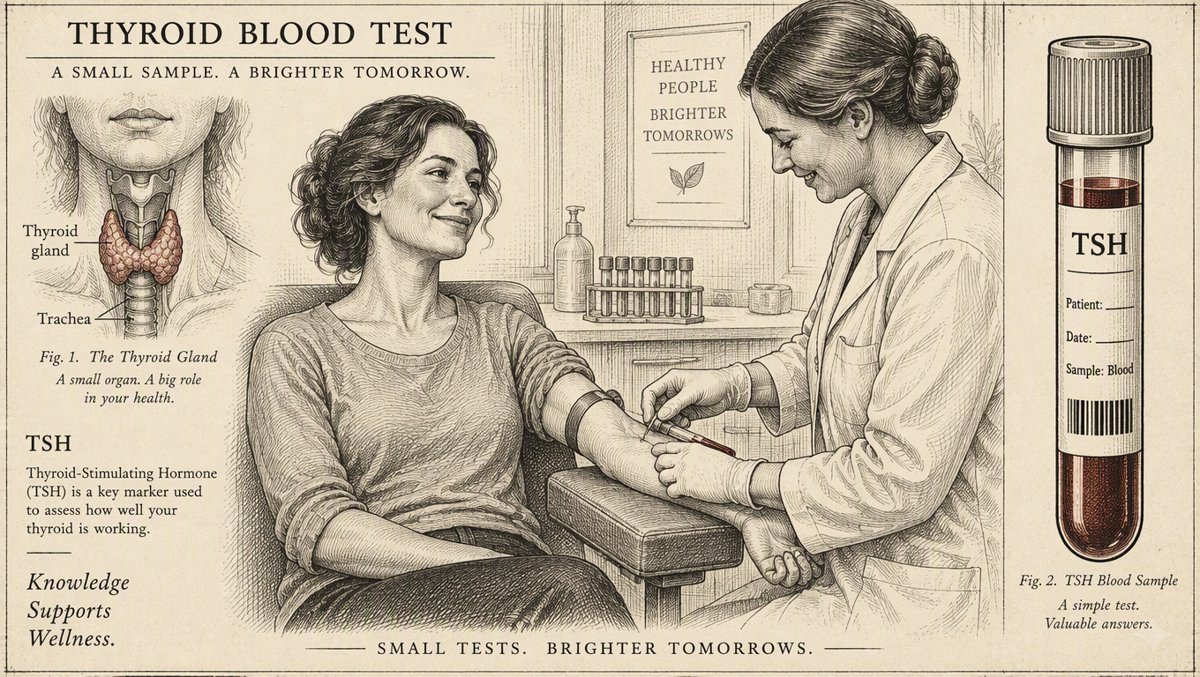
Here's the best news in this whole article: thyroid problems are found with one simple blood test — the TSH (thyroid-stimulating hormone) test — and it's usually the first test a doctor orders when thyroid trouble is suspected.⁸
The logic is delightfully backwards, so let's decode it. Your pituitary gland (a tiny commander in your brain) releases TSH to tell your thyroid to get to work. If your thyroid is slacking off, the pituitary shouts louder — so a high TSH typically points to an underactive thyroid. If the thyroid is overactive, the pituitary whispers — and a low TSH points to an overactive one.⁸ One blood draw, clear signal.
And if the test does find a problem? Hypothyroidism is typically treated with a daily thyroid hormone pill that, at the right dose, effectively replaces what your gland isn't making.⁹ Most people with an underactive thyroid manage it with medication and regular monitoring — living completely normal, full lives. This isn't a life sentence; it's a prescription and a follow-up schedule.
How to use this:
- Ask directly: "Could my symptoms be thyroid-related? Should we check my TSH?" It's an easy, inexpensive test to request.
- Bring your symptom list — especially the pattern (how long, how it's changed) rather than a single rough day.
- If you're already on thyroid medication, take it consistently (many providers suggest the same time daily, on an empty stomach) and keep your monitoring appointments — dosing is individual.
🎯 Key Takeaway: The TSH blood test is usually the first and clearest window into thyroid health — high TSH usually means underactive, low TSH usually means overactive. Treatment exists, it works, and it's often as simple as a daily pill. You just have to take the test first.
🥗 Section 4: The Iodine & Selenium Story — Plus One 60-Second Neck Check
Walk down any supplement aisle and you'll find bottles promising to "support thyroid health." Here's what the science actually says — and it's refreshingly boring.
Iodine is a building block of thyroid hormones T4 and T3 — your gland literally can't make them without it.² Adults need about 150 micrograms a day, an amount most people in iodized-salt countries get easily from ordinary foods. And here's the twist most supplement ads skip: both too little AND too much iodine can disrupt thyroid function.¹⁰ ¹¹ More is not better — the American Thyroid Association has specifically flagged the risks of excess iodine ingestion.
Selenium is the quiet supporting actor: your body uses selenium-containing proteins (selenoproteins) in thyroid hormone metabolism — helping convert T4 into its active form.¹² ¹³ Brazil nuts, seafood, and eggs can cover you; one Brazil nut can contain a whole day's selenium (just don't make a meal of them — selenium also has an upper limit).
Your 60-second neck check — a self-exam endorsed by the American Association of Clinical Endocrinology:¹⁴
- Stand in front of a mirror with your neck exposed, focus on the area just below your voice box and above your collarbones.
- Take a sip of water and swallow.
- Watch that area as you swallow — you're looking for any lump, bump, or asymmetrical swelling that moves with the swallow.
- Spot something? Don't panic — most thyroid lumps (nodules) are benign — but do book an appointment for a proper look.
🎯 Key Takeaway: For most people, the "thyroid diet" is just... a normal healthy diet. You need adequate (not extra) iodine and selenium — food usually covers it, and megadose supplements can backfire. Add a monthly water-sip neck check, and see a clinician about anything new you feel.
🎯 Key Takeaways
- Your thyroid is your body's thermostat and throttle — it helps set the speed of nearly every cell, from heart rate to metabolism.² ³
- ~20 million Americans have thyroid disease and up to 60% don't know it — largely because symptoms (fatigue, weight changes, cold intolerance) masquerade as everyday life.¹
- Slow vs. fast: Underactive (hypothyroidism) = tired, cold, weight gain, dry skin. Overactive (hyperthyroidism) = racing heart, anxiety, weight loss, feeling hot.³ ⁴
- The TSH blood test is the simple, standard first check — high TSH usually means underactive; low usually means overactive — and treatment is typically effective and straightforward.⁸ ⁹
- Skip the megadose supplements, keep the checkups: adequate iodine and selenium from food is the evidence-based play, and a 60-second water-sip neck check catches lumps worth showing a doctor.¹⁰ ¹² ¹⁴
🎧 Key Takeaways — Listen (2 min)
📚 Verified Sources
- American Thyroid Association — General Information / Press Room — "An estimated 20 million Americans have some form of thyroid disease. Up to 60 percent of those with thyroid disease are unaware of their condition." Also: "Women are five to eight times more likely than men to have thyroid problems. One woman in eight will develop a thyroid disorder during her lifetime." https://www.thyroid.org/media-main/press-room/
- NIH Office of Dietary Supplements — Iodine Fact Sheet (Health Professional Version) — Iodine is an essential component of the thyroid hormones thyroxine (T4) and triiodothyronine (T3); RDA 150 mcg for adults. https://ods.od.nih.gov/factsheets/Iodine-HealthProfessional/
- NIDDK (NIH) — Hypothyroidism (Underactive Thyroid) — An underactive thyroid "can slow down nearly every organ"; symptoms, causes, diagnosis, and treatment overview. https://www.niddk.nih.gov/health-information/endocrine-diseases/hypothyroidism
- NIDDK (NIH) — Hyperthyroidism (Overactive Thyroid) — An overactive thyroid "can speed up your body's functions"; symptoms and treatment overview. https://www.niddk.nih.gov/health-information/endocrine-diseases/hyperthyroidism
- Mayo Clinic — Hypothyroidism (Underactive Thyroid): Symptoms & Causes — Tiredness, cold sensitivity, constipation, dry skin, weight gain, puffy face, hoarse voice. https://www.mayoclinic.org/diseases-conditions/hypothyroidism/symptoms-causes/syc-20350284
- Office on Women's Health (U.S. HHS) — Thyroid Disease — Women are more likely than men to have thyroid disease; one in eight women will develop thyroid problems during her lifetime. https://womenshealth.gov/a-z-topics/thyroid-disease
- Mammen, J.S.R., et al. — "Autoimmune Thyroid Disease in Women" (PMC/NIH, 2021) — Thyroid dysfunction is more common in women; female predominance attributed to sex differences in immune function. https://pmc.ncbi.nlm.nih.gov/articles/PMC10071442/
- MedlinePlus (NIH/NLM) — TSH (Thyroid-Stimulating Hormone) Test — TSH is "usually the first test your healthcare provider will order"; high or low TSH signals thyroid problems. https://medlineplus.gov/lab-tests/tsh-thyroid-stimulating-hormone-test/ and Thyroid Tests overview: https://medlineplus.gov/thyroidtests.html
- Mayo Clinic Health System — Thyroid Disease: Symptoms and Treatment — "Hypothyroidism is treated with thyroid hormone medicine that is effective when taken at the correct dose." https://www.mayoclinichealthsystem.org/hometown-health/speaking-of-health/thyroid-disease-symptoms-and-treatment
- American Thyroid Association — Statement on the Potential Risks of Excess Iodine Ingestion and Exposure — Iodine is required for normal thyroid function (RDA 150 mcg in adults); excess intake carries risks. https://www.thyroid.org/ata-statement-on-the-potential-risks-of-excess-iodine-ingestion-and-exposure/
- Wyne, K.L., et al. — "Hypothyroidism Prevalence in the United States" (PMC/NIH, 2022) — Peer-reviewed prevalence update; prior NHANES-based estimate of hypothyroidism ≈ 4.6% of the U.S. population. https://pmc.ncbi.nlm.nih.gov/articles/PMC9706417/
- NIH Office of Dietary Supplements — Selenium Fact Sheet (Health Professional Version) — Selenoproteins play critical roles in thyroid hormone metabolism. https://ods.od.nih.gov/factsheets/Selenium-HealthProfessional/
- Harvard T.H. Chan School of Public Health — The Nutrition Source: Selenium — Selenium (as selenoproteins) helps convert thyroid hormone into its active form; iodine and selenium are both needed by the thyroid. https://nutritionsource.hsph.harvard.edu/selenium/
- American Association of Clinical Endocrinology — How to Check Your Thyroid — A simple neck-check self-exam to help with early detection of lumps or enlargements. https://www.aace.com/disease-and-conditions/thyroid/how-check-your-thyroid
All claims fact-checked against Gold-tier (CDC/NIH/WHO/PubMed/Nature/The Lancet — here: NIDDK, NIH ODS, MedlinePlus/NLM, PMC-indexed studies) and Silver-tier (Mayo Clinic/Harvard Health/Cleveland Clinic — here: Mayo Clinic, Mayo Clinic Health System, Harvard Nutrition Source) authoritative sources. Last verified: October 7, 2026.
Your body's been sending you signals all along — now you know where the butterfly lives and how to listen. Be kind to your neck's tiny tenant this week: eat your normal healthy meals, do the 60-second water-sip check, and if you've been "just tired" for too long, book that simple blood test. Here's to steady energy, warm hands, and a thyroid that purrs. 🦋💛