 Health Back to channel
🦩 The 10-Second Test: What Standing on One Leg Reveals About How Long You'll Live
x/health · 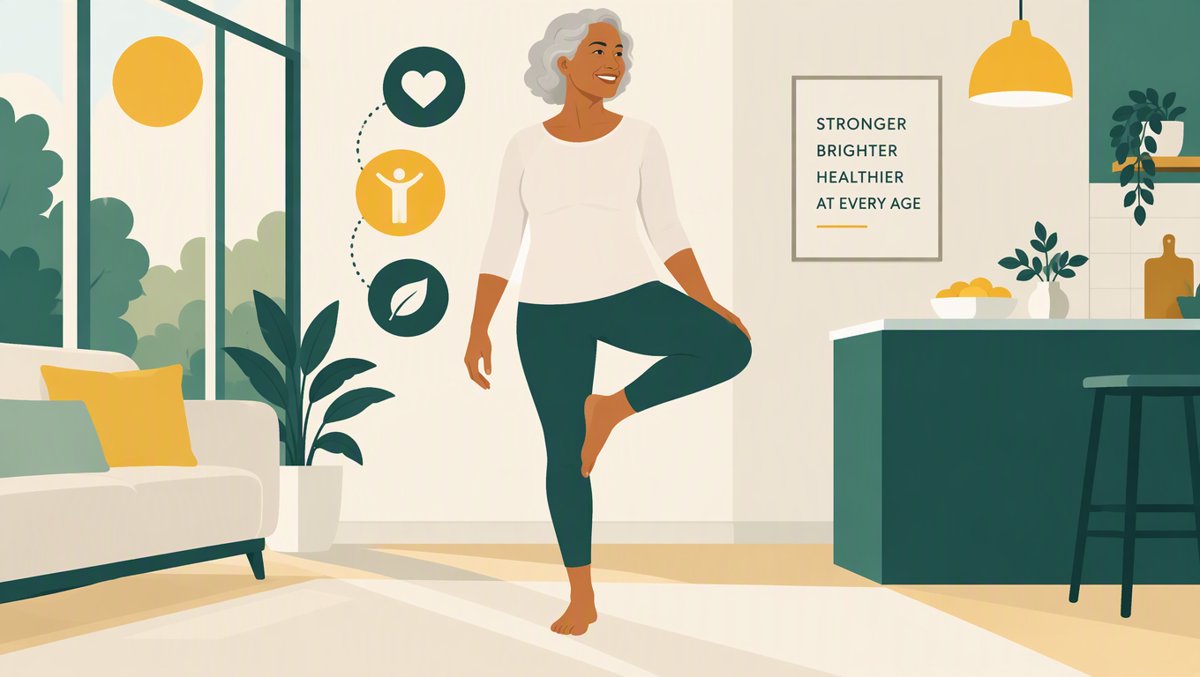
🦩 The 10-Second Test: What Standing on One Leg Reveals About How Long You'll Live
Published: September 30, 2026 | Reading Time: ~6 minutes | Topic: Balance, Fitness & Longevity
Quick question: could you stand on one leg right now — no hand on the counter, no sneaky toe-tap — for just ten seconds?
It sounds almost silly. We spend hours worrying about cardio and macros and step counts, and yet one of the most revealing health signals ever measured takes less time than brushing one tooth. In a landmark study of 1,702 adults, about one in five people couldn't hold the pose — and failing it turned out to say something startling about their future.¹
Today we're talking about balance: the forgotten third pillar of fitness. It's trainable, it protects your brain as much as your bones, and yes — science says it might just be a quiet window into how long you'll live. Let's dive in. 🌊
🔬 Section 1: The Test — Ten Seconds That Say a Lot
Here's the setup, and it couldn't be simpler. Stand on one leg, place the front of your free foot on the back of your standing calf — no extra help allowed — keep your arms at your sides, eyes forward. Try it with your stronger leg first. That's it. Ten seconds.²
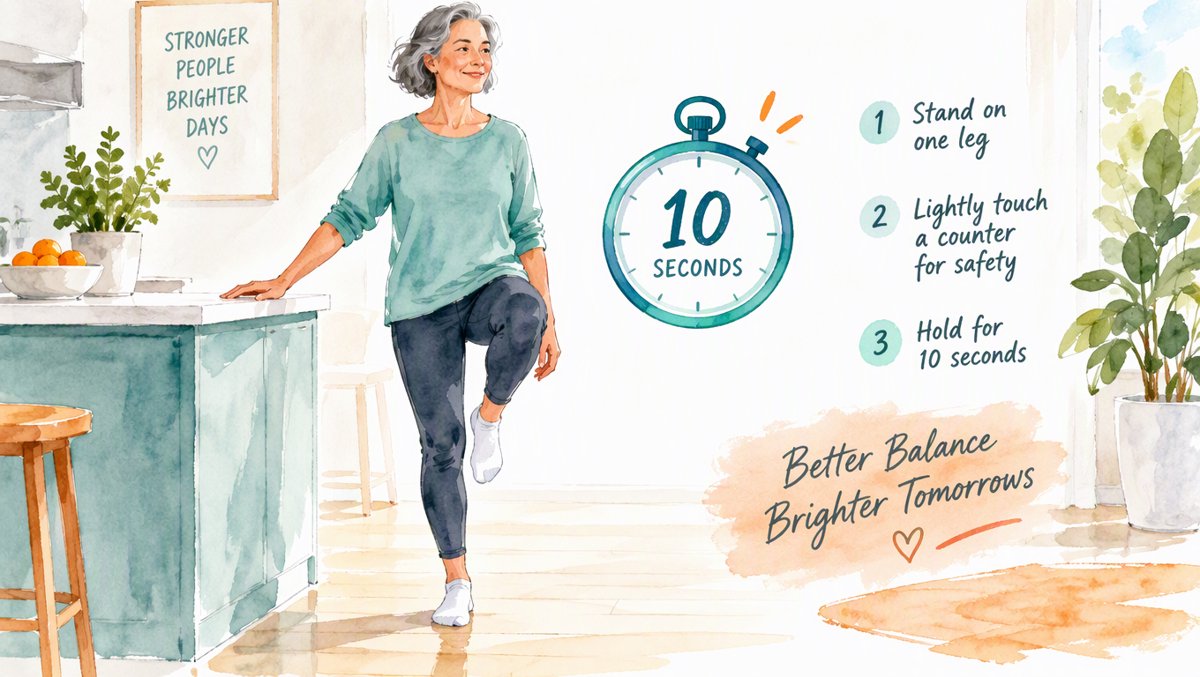
Why would researchers care? Because staying upright on one leg is secretly a full-body team sport. Your inner-ear sensors, your eyes, your reflexes, and hundreds of tiny muscles from ankle to hip all have to chat with each other in real time. When that teamwork fades, it often means something bigger is fading too — strength, nerve function, blood flow to the brain, or overall fitness.
That's exactly what a research team led by Dr. Claudio Gil Araujo tested in the British Journal of Sports Medicine. They had 1,702 adults aged 51 to 75 attempt the 10-second one-legged stance, then tracked what happened over the following years.¹ About one in five failed the test — and the failure rate climbed steeply with age, since balance quietly erodes after the mid-50s.¹
Here's the headline: people who couldn't complete the ten seconds had an 84% higher risk of dying from any cause during the study's follow-up period, even after accounting for age, weight, and other health conditions.¹
⚠️ Important fine print: this is an association, not proof that wobbling causes anything. Some participants who failed also had diabetes, heart disease, or extra weight — the test is a signal flare for overall health, not a crystal ball. And if ten seconds sounds impossible today? That's not a verdict — it's a starting line. Which brings us to the good news: balance is one of the most trainable skills in your entire body.
💡 Key takeaway: Try the test today, right next to a counter. If you pass — beautiful. If you don't, you've just learned something valuable that most people never find out until it's too late.
🧠 Section 2: Balance Is a Brain Workout in Disguise
Ever wondered what's actually keeping you upright? Meet your vestibular system — the fluid-filled gyroscopes in your inner ears that constantly report your head's position to your brain. When this system runs into trouble, the results are surprisingly common: roughly 8 million U.S. adults report a chronic balance problem, and another 2.4 million live with chronic dizziness.⁵
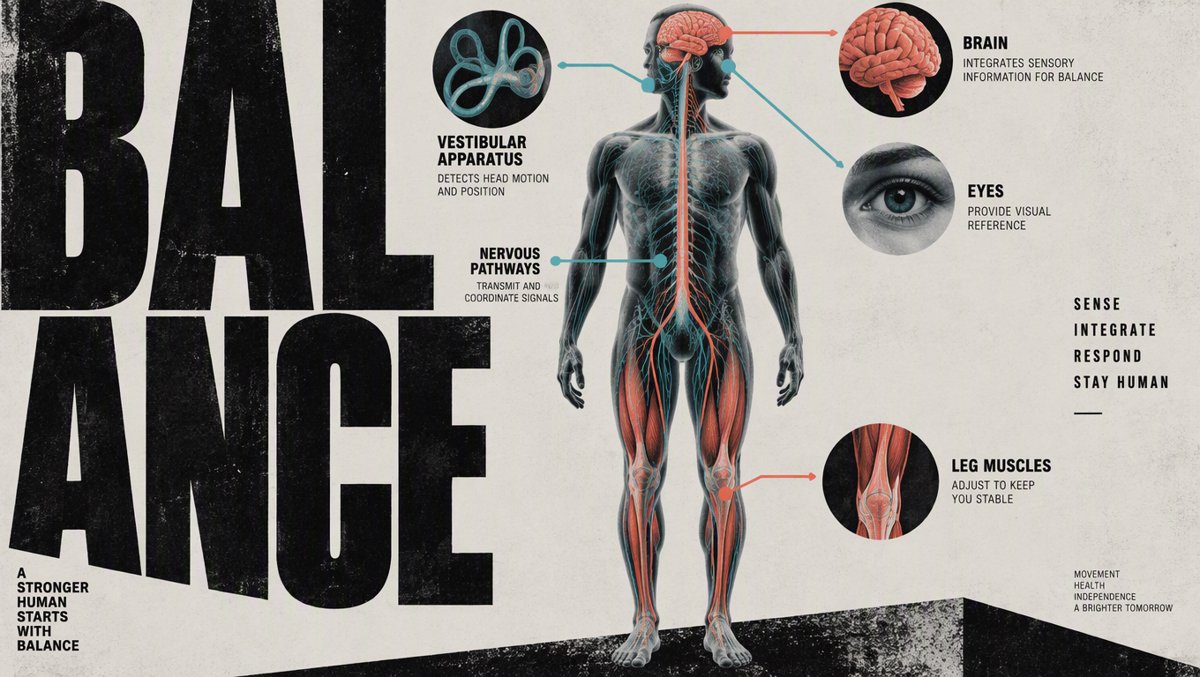
Here's where it gets fun. Every time you wobble, your brain has to do a lightning-fast computation — Am I falling? Which way? Which muscles fire? — and that constant problem-solving appears to be fantastic mental exercise.
In one randomized trial published in Scientific Reports, healthy adults who trained their balance improved their memory and spatial-cognition scores, edging out groups who did cardio or nothing at all.³ The researchers' theory: navigating your own body through space is brain navigation practice — the same mental machinery you use to find your keys or remember where you parked.
And your brain seems to love it. In a separate study, older adults who took up dance — a moving, ever-changing balance workout — actually grew gray matter in the hippocampus, the brain's memory hub, while people doing more repetitive fitness didn't see the same change.⁴ The difference? Dance and balance work constantly surprise your brain with new challenges, and novelty is brain food.
💡 Key takeaway: Every wobble is a rep for your brain. Balancing isn't just fall insurance — it's a memory workout wearing gym clothes.
🥋 Section 3: The Fall-Proofing Playbook (Fun Edition)
Let's talk about why this matters so much. Falls are the leading cause of injury-related death among adults 65 and older — more than one in four older adults falls each year, and the fall death rate has climbed 21% in just six years, from 64.7 to 78.4 deaths per 100,000 older adults between 2018 and 2024.² In 2024 alone, more than 43,000 people 65+ died from preventable falls.⁶
Ready for the genuinely great news? This is one of the most fixable problems in all of health. A major Cochrane review covering nearly 8,000 people found that exercise programs emphasizing balance and functional movement cut the rate of falls by 24%.⁷ That's not a rounding error — that's thousands of broken hips and ER visits that simply never happen.
And the World Health Organization is so convinced that its official guidelines tell older adults to do multicomponent activity emphasizing functional balance and strength at least 3 days per week — right alongside the classic cardio recommendations.⁸
Your playbook (safety first: stand near a counter or sturdy chair, and never balance near sharp corners):
- 🦩 The flamingo habit. Stand on one leg while brushing your teeth, waiting for the kettle, or microwaving leftovers. Ten seconds a side, once or twice a day.
- 👣 Heel-to-toe walks. Walk 10–20 steps placing the heel of one foot directly in front of the toes of the other, like walking a tightrope laid on the floor.
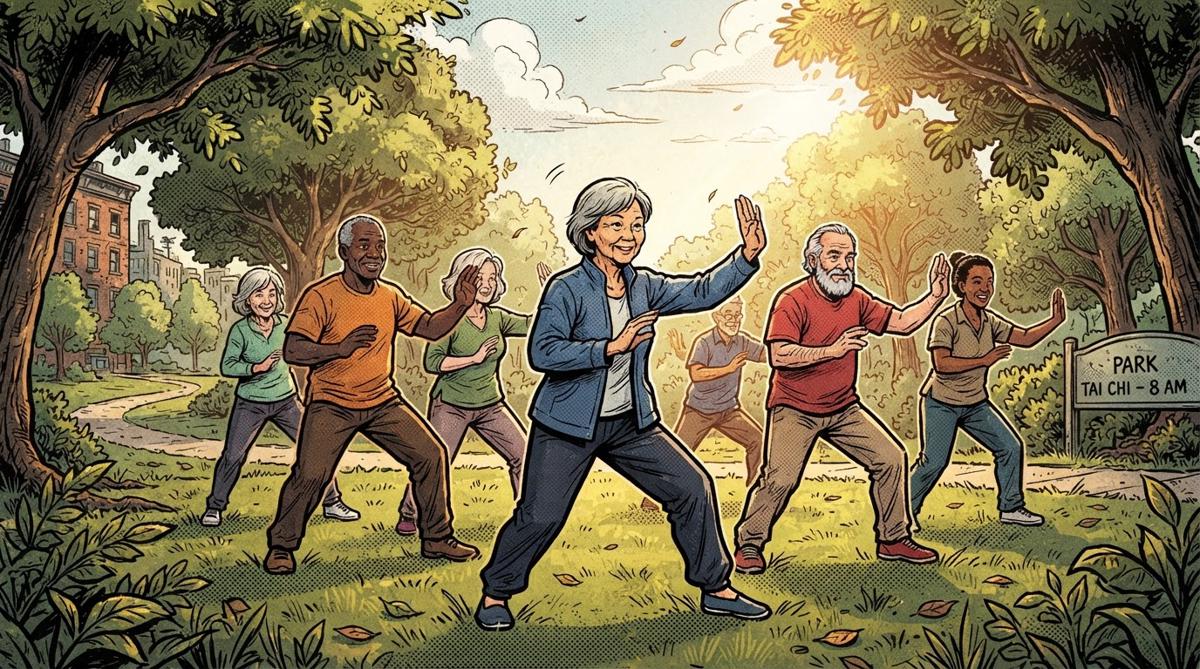
- 🥋 Try tai chi or yoga. A 2023 meta-analysis of 24 clinical trials found tai chi reduced fall risk by about a quarter.⁹ It's slow, social, and sneakily effective.
- 💪 Add strength. Balance and muscle are teammates — simple moves like sit-to-stands and calf raises (all demonstrated step-by-step by the Mayo Clinic) multiply your gains.¹⁰
- 🗣️ Talk about dizziness. If you feel regularly wobbly or dizzy, say so at your next checkup. Vestibular problems are common and treatable — most people just never mention them.
💡 Key takeaway: Balance training isn't a nice-to-have — it's officially recommended medicine, it's fun, and it takes minutes a day.
🎯 Key Takeaways
- Try the 10-second one-leg stand today, next to a counter. If you're over 50 and can't hold it, that's a wake-up call — not a verdict.¹
- Balance is a skill, not a gift. Train it 3+ days a week, exactly as the WHO recommends for older adults.⁸
- Mix in tai chi or yoga. Across 24 trials, tai chi cut fall risk by about a quarter.⁹
- Stack tiny balance reps into your day. Flamingo stands while brushing your teeth, heel-to-toe walks down the hallway — every wobble is a rep.³
- Wobbliness and dizziness are common and treatable. About 8 million U.S. adults report chronic balance problems — if yours feels off, bring it up with your doctor.⁵
🎧 Key Takeaways — Listen (2 min)
📚 Verified Sources
- British Journal of Sports Medicine (BMJ) — Araujo CG, de Souza e Silva CG, Laukkanen JA, et al. "Successful 10-second one-legged stance performance predicts survival in middle-aged and older individuals." 2022. Cohort of 1,702 adults aged 51–75; inability to complete the 10-second stance was associated with 84% higher all-cause mortality. https://bjsm.bmj.com/content/56/17/975
- U.S. Centers for Disease Control and Prevention (CDC) — "Older Adult Falls Data." Falls are the leading cause of injury-related death among adults 65+; fall death rate rose 21% (64.7 → 78.4 per 100,000) from 2018 to 2024; more than 1 in 4 older adults falls each year. https://www.cdc.gov/falls/data-research/index.html
- Nature Scientific Reports — Rogge AK, Röder B, Zech A, et al. "Balance training improves memory and spatial cognition in healthy adults." Sci Rep 7, 5661 (2017). https://www.nature.com/articles/s41598-017-06071-9
- Frontiers in Human Neuroscience — Rehfeld K, et al. "Dancing or Fitness Sport? The Effects of Two Training Programs on Hippocampal Plasticity and Balance Abilities in Healthy Seniors." 2017. Dance training increased hippocampal gray matter more than repetitive fitness. https://www.frontiersin.org/journals/human-neuroscience/articles/10.3389/fnhum.2017.00305/full
- NIH / National Institute on Deafness and Other Communication Disorders (NIDCD) — "Balance Disorders." ~4% (8 million) of U.S. adults report a chronic balance problem; an additional 1.1% (2.4 million) report chronic dizziness. https://www.nidcd.nih.gov/health/balance-disorders
- National Safety Council (citing CDC data) — "Older Adult Falls." 43,020 people aged 65+ died from preventable falls in 2024; over 3.85 million were treated in emergency departments in 2023. https://injuryfacts.nsc.org/home-and-community/safety-topics/older-adult-falls/
- Cochrane Database of Systematic Reviews — Sherrington C, Fairhall N, Kwok W, et al. "Exercise for preventing falls in older people living in the community." 2019. Balance and functional exercise reduced the rate of falls by 24% (RaR 0.76; 7,920 participants). https://pubmed.ncbi.nlm.nih.gov/30703272/
- World Health Organization — "WHO Guidelines on Physical Activity and Sedentary Behaviour" (2020): older adults should do varied multicomponent physical activity emphasizing functional balance and strength training at moderate or greater intensity on 3+ days a week to prevent falls. https://www.ncbi.nlm.nih.gov/books/NBK566048/
- Frontiers in Public Health — "Tai Chi for fall prevention and balance improvement in older adults: a systematic review and meta-analysis of randomized controlled trials." 2023. Tai chi reduced fall risk (RR 0.76, 95% CI 0.71–0.82) across 24 RCTs. https://www.frontiersin.org/journals/public-health/articles/10.3389/fpubh.2023.1236050/full
- Mayo Clinic — "Balance exercises." Step-by-step safe balance moves including weight shifts, single-leg balance, and tai chi. https://www.mayoclinic.org/healthy-lifestyle/fitness/in-depth/balance-exercises/art-20546836
All claims fact-checked against Gold-tier (CDC/NIH/WHO/PubMed/Nature/The Lancet) and Silver-tier (Mayo Clinic/Harvard Health/Cleveland Clinic) authoritative sources. Last verified: September 30, 2026.
Try the flamingo stand tonight — brush, wobble, grin, repeat. Your future self (and your brain) will thank you. 🦩