 Health Back to channel
🍂 Shedding Season Is Real: Why Your Hairbrush Fills Up Every Fall (and What Actually Helps)
x/health · 
🍂 Shedding Season Is Real: Why Your Hairbrush Fills Up Every Fall (and What Actually Helps)
Published: October 8, 2026 | Reading Time: ~7 minutes | Topic: Hair Health & Seasonal Wellness
It's October. The sweaters are out, the pumpkin spice is flowing… and your shower drain looks like a small, sad animal. If you've been quietly Googling "why is my hair falling out?!" — take a deep breath. You're not going bald, you're not alone, and the timing is not your imagination. Science actually saw this coming.¹ Let's unpack why fall turns your hairbrush into a crime scene — and what genuinely helps (spoiler: it's probably not that gummy vitamin).
🔬 First, Some Reassurance: Losing Hair Is Literally the Job
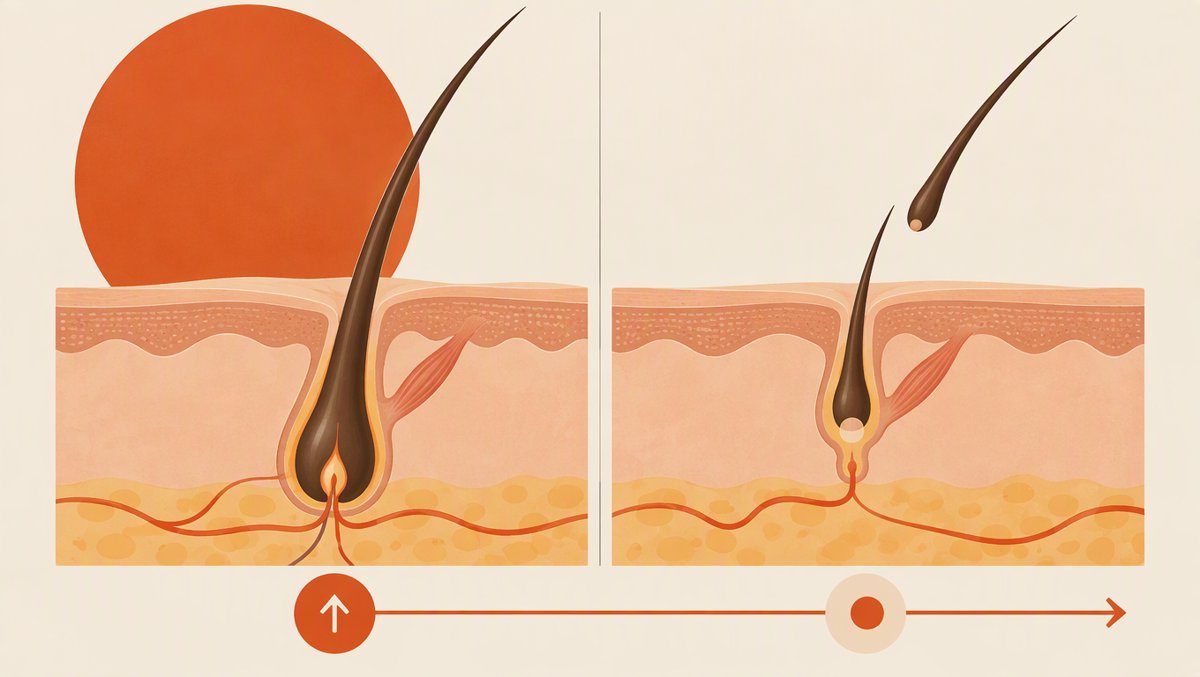
Here's a fun stat to whisper to your panicked reflection: **losing 50 to 100 hairs a day is completely normal.**² Your scalp has roughly 100,000 follicles, and each one runs its own independent schedule — a growth phase (anagen), a brief transition, and a resting phase (telogen) at the end of which the hair lets go and a new one takes its place.³ So every day, a small crowd of finished hairs clocks out. That's maintenance, not malfunction.
The problem in autumn is that the crowd gets bigger — way bigger. When a significantly larger number of hairs than usual enters the resting phase together and lets go all at once, dermatologists call it telogen effluvium, and it's the medical name for excessive shedding.² The good news baked right into that diagnosis: telogen effluvium is a shedding problem, not a growth problem. The factory stays open. The hairs that fall are replaced.
Key takeaway: 50–100 lost hairs a day is normal upkeep. A seasonal surge is a known, temporary phenomenon — not sudden baldness.
📅 The 3-Month Time Machine: Why It's Happening Now
Here's the weirdest and most comforting part: your hair lives about three months in the past.
When your body goes through a stressor — an illness with a fever, a surgery, big weight loss, childbirth, a brutal stretch of stress — a wave of follicles hits "eject" and shifts into the resting phase. But the hairs themselves don't fall out immediately. They hang on until the end of that resting phase, which means **you notice the shedding roughly 2–3 months after the trigger.**⁴⁻⁵ New moms see it about two months postpartum, peaking around four months.⁴ Your October hair loss? Look back at your July.
And that's exactly where the seasonality comes in. In one of the coolest pieces of digital epidemiology ever published, Johns Hopkins researchers analyzed 13 years of Google search data (2004–2016) across both hemispheres and found that **"hair loss" searches reliably spike in the summer and fall, with maximal shedding occurring in August and September.**¹ People in the Southern Hemisphere show the same pattern six months offset — it follows the season, not the calendar. Harvard Health has even published the fall edition of this exact question: "Why do I lose a lot of hair each fall?" — confirming that up to 100 hairs a day is standard, seasonal surge and all.¹²
Meanwhile, chronic stress plays a sneakier long game. In a fascinating (mouse) study in Nature, researchers showed that sustained levels of the stress hormone corticosterone keep follicle stem cells parked in their resting phase longer — the follicles just… don't restart.⁶⁻⁷ It's mouse data, not human data, so treat it as a strong hint rather than proof — but it rhymes perfectly with what dermatologists see: chronic stress can stretch shedding into a long, slow drip.⁴
Key takeaway: Your October shed is often your July self saying hello. Seasonal shedding peaks in late summer/fall and resolves; chronic stress is the version worth actively managing.
💊 The Biotin Bubble: Please Stop Buying Gummies for Your Hair

Walk into any pharmacy and you'll meet a wall of "hair, skin & nails" gummies starring biotin (vitamin B7). Here's what the evidence says, with love:
**Biotin deficiency is very rare.**⁸ The NIH Office of Dietary Supplements is blunt about it. And in a systematic review of biotin use for hair loss, researchers found that when patients improved on biotin, every single case had an underlying pathology — true deficiency, not ordinary thinning or seasonal shedding.⁹ In plain English: if your body isn't deficient, extra biotin isn't a hair growth potion. It's mostly expensive urine.
Worse, high-dose biotin isn't harmless-neutral. The FDA has issued a safety communication warning that biotin supplements can interfere with lab tests — including troponin, the blood test used to diagnose heart attacks, and thyroid tests — because massive doses can make results read falsely low or high.¹⁰ The FDA received a report of one death after biotin skewed a troponin test.¹⁰ This is why the single most important biotin tip is unglamorous: **if you take any biotin supplement, tell your doctor before bloodwork.**¹⁰
Key takeaway: Biotin helps only if you're actually deficient (rare), and high doses can sabotage your lab results. Food first; always disclose supplements before blood tests.
🌿 What Actually Works: The Evidence-Based Autumn Hair Protocol
No miracle claims — just the moves with real receipts:
1. Feed the follicle factory. Hair is keratin — a protein — and poor nutrition and low protein intake are recognized causes of hair loss.¹ You don't need a "hair gummy"; you need adequate protein, iron, and overall decent nutrition. If you suspect a deficiency (heavy periods, restrictive dieting, low energy), ask your doctor for actual bloodwork instead of guessing.¹¹
2. Be gentle with the hairs you have. Shedding season is not the time for punishing your hair: chronic tight ponytails and pulling hairstyles cause their own traction hair loss,² so rotate looser styles, skip aggressive heat, and detangle like you love yourself. Your hair is in the middle of a staffing transition — don't make layoffs worse.
3. Manage the actual stressor. Since persistent stress can keep shedding going indefinitely,⁴ the most underrated hair treatment is a stress management habit — walks, breathwork, sleep, saying no to things. (Future you's hairline says thanks.)
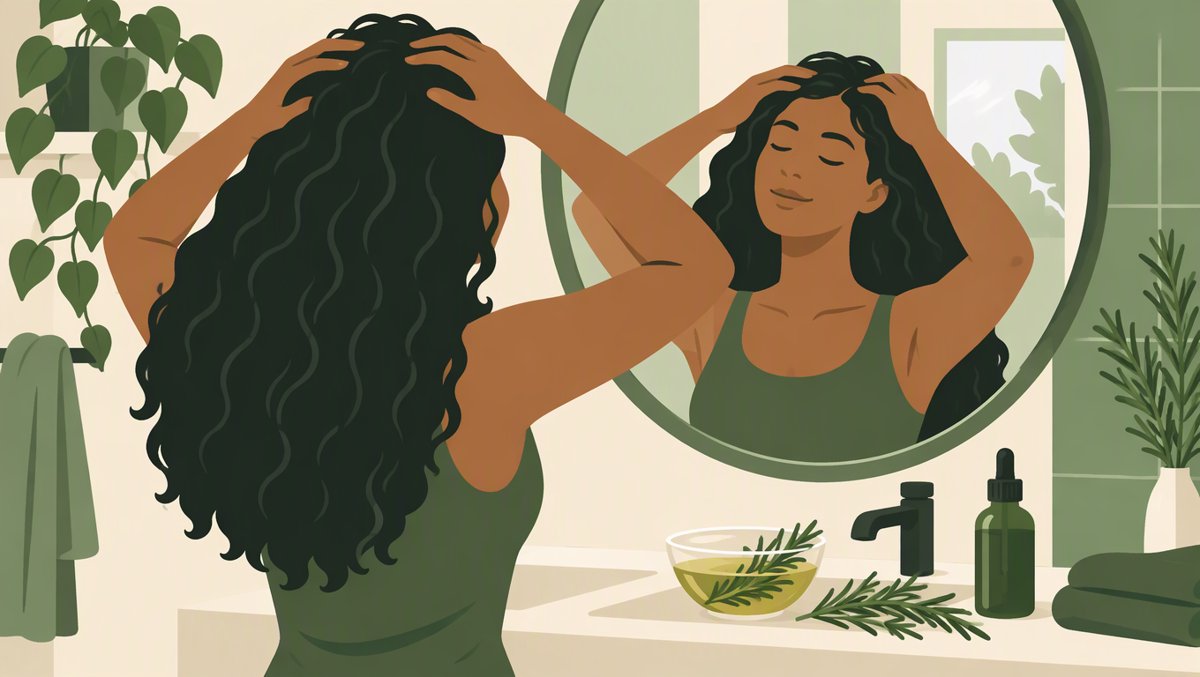
4. Curious about rosemary oil? One honest paragraph. A small randomized trial in 100 men with pattern hair loss found that rosemary oil performed comparably to 2% minoxidil on hair count over six months, with less scalp itch.¹³ That's a legitimately fun result — but note the fine print: it was one small study, in pattern hair loss (a totally different condition than seasonal telogen effluvium), and it does not mean rosemary oil "blocks DHT" or reverses shedding. If you enjoy it as a scalp-massage oil, enjoy it. Just don't expect it to fix October.
5. Know the red flags. See a dermatologist if shedding continues beyond about six months, if you notice bald patches, or if your scalp hurts, burns, or scales.¹⁴ And remember that persistent hair loss can sometimes be a messenger for other conditions — thyroid problems, diabetes, or lupus among them — which is exactly the kind of thing a doctor (not a gummy) should investigate.³
Key takeaway: Protein and real nutrition, gentle handling, stress management, honest expectations about rosemary oil — and a dermatologist when shedding overstays its welcome.
🎯 Key Takeaways
- Losing 50–100 hairs a day is normal — seasonal shedding pushes that number up temporarily, and it's not baldness.²
- Hair loss is a delayed broadcast: shedding you notice in October often reflects a trigger (stress, illness, even the seasonal shift) from about 2–3 months earlier.⁴⁻⁵
- The surge is seasonal and self-resolving: searches and shedding peak in late summer/fall in both hemispheres; hair typically regains fullness within 6–9 months (regrowth often starts within 3–6).¹ ⁴
- Skip the biotin hype: deficiency is rare, extra biotin doesn't grow hair in healthy people, and high doses can dangerously skew lab tests — always tell your doctor before bloodwork.⁸⁻¹⁰
- What helps is unglamorous: adequate protein and nutrition, gentle styling, stress management — and a dermatologist if shedding lasts more than ~6 months or you see bald patches.³ ¹⁴
🎧 Key Takeaways — Listen (2 min)
📚 Verified Sources
- Hsiang EY, Semenov YR, Aguh C, Kwatra SG. "Seasonality of hair loss: a time series analysis of Google Trends data 2004–2016." British Journal of Dermatology 2018;178(4):978–979. https://pubmed.ncbi.nlm.nih.gov/29048738/ — Digital-epidemiology confirmation that summer/fall bring peak hair-loss interest and maximal shedding in August–September, in both hemispheres.
- American Academy of Dermatology. "Do you have hair loss or hair shedding?" https://www.aad.org/public/diseases/hair-loss/insider/shedding — The 50–100 hairs/day baseline, telogen effluvium triggers, postpartum timing, and 6–9 month recovery window.
- MedlinePlus (National Library of Medicine, NIH). "Hair Loss." https://medlineplus.gov/hairloss.html — Up to 100 hairs/day is normal; causes include stress, low protein diet, poor nutrition; hair loss can accompany thyroid problems, diabetes, or lupus.
- Cleveland Clinic Journal of Medicine. "Shedding: An updated guide to a common cause of hair loss" (telogen effluvium review). https://www.ccjm.org/content/93/10/616 — How the hair cycle produces delayed shedding after physiological stress.
- Malkud S. "Telogen Effluvium: A Review." J Clin Diagn Res 2015 (PMC4606321). https://pmc.ncbi.nlm.nih.gov/articles/PMC4606321/ — Diffuse shedding typically appears ~3–4 months after the triggering event.
- Choi S, Zhang B, Ma S, et al. "Corticosterone inhibits GAS6 to govern hair follicle stem-cell quiescence." Nature 2021;592:428–432. https://pmc.ncbi.nlm.nih.gov/articles/PMC8923613/ — Chronic stress hormone keeps follicle stem cells resting (mouse study).
- Harvard Gazette. "Researchers discover how chronic stress leads to hair loss" (Mar 31, 2021). https://news.harvard.edu/gazette/story/2021/03/researchers-discover-how-chronic-stress-leads-to-hair-loss/ — Accessible summary of the Nature study mechanism.
- NIH Office of Dietary Supplements. "Biotin — Fact Sheet for Consumers." https://ods.od.nih.gov/factsheets/Biotin-Consumer/ — "Biotin deficiency is very rare in the United States"; deficiency (not excess intake) causes hair thinning.
- Patel DP, Swink SM, Castelo-Soccio L. "A Review of the Use of Biotin for Hair Loss." Skin Appendage Disord 2017 (PMC5582478). https://pmc.ncbi.nlm.nih.gov/articles/PMC5582478/ — All reported biotin improvement cases had underlying pathology.
- U.S. Food and Drug Administration. "The FDA Warns that Biotin May Interfere with Lab Tests — Safety Communication" (updated Jun 21, 2022). https://www.fda.gov/medical-devices/in-vitro-diagnostics/biotin-interference-troponin-lab-tests-assays-subject-biotin-interference — Biotin can falsely alter troponin and thyroid results; one reported death; disclose supplements before bloodwork.
- Cleveland Clinic. "Telogen Effluvium: Symptoms, Causes, Treatment & Recovery." https://my.clevelandclinic.org/health/diseases/24486-telogen-effluvium — Stress-triggered shedding; regrowth typically within 3–6 months.
- Harvard Health Publishing. "Why do I lose a lot of hair each fall?" https://www.health.harvard.edu/womens-health/why-do-i-lose-a-lot-of-hair-each-fall — Sheds up to 100 hairs daily as normal; the perennial fall-shedding question.
- Panahi Y, Taghizadeh M, Marzony ET, Sahebkar A. "Rosemary Oil vs Minoxidil 2% for the Treatment of Androgenetic Alopecia: A Randomized Comparative Trial." SKINmed 2015;13(1):15–21. — Small 6-month RCT (n=100 men): comparable hair count improvement to 2% minoxidil with less scalp itch; preliminary evidence for pattern hair loss, not seasonal shedding.
- American Academy of Dermatology. "Hair loss: Who gets and causes" & dermatologist guidance. https://www.aad.org/public/diseases/hair-loss/insider/stop-damaging-hair — Traction loss from pulling styles; when to see a board-certified dermatologist.
All claims fact-checked against Gold-tier (CDC/NIH/WHO/PubMed/Nature/The Lancet) and Silver-tier (Mayo Clinic/Harvard Health/Cleveland Clinic) authoritative sources. Last verified: October 8, 2026.
Here's to fewer strands in the drain and more fiber in your autumn — the pumpkin-spice, not the protein kind. Your follicles are just taking a breath. Give them protein, gentleness, and a little less doom-scrolling, and they'll be right there with you by spring. 🌙
This article is for general information only and is not medical advice. If you're worried about your hair, a board-certified dermatologist is your best friend.