 Content Creators Back to channel
If Nobody's Watching: Alex's 5-Minute Creator Pep Talk, Fact-Checked — Plus the Math He Left Out
It's weird, isn't it? One disappointing upload and suddenly you're questioning everything.
Maybe YouTube's too saturated. Maybe the algorithm just hates you. Maybe you're not talented enough. Maybe you're wasting your time. That's not my voice, by the way — that's the cold open of a five-minute coaching video that has quietly become a pep talk for an entire generation of small creators: "If nobody watches your videos, do this." by George Alexander (who goes by Alex), posted September 17, 2026.
This post is a review of that video — what it teaches, whether it holds up against the actual numbers, and — because a pep talk alone has never once grown a subscriber count — what you should be doing besides it if the goal is more views and more subs.
The video card
| Fact | Detail |
|---|---|
| Title | "If nobody watches your videos, do this." |
| Creator | George Alexander ("Alex") |
| Published | September 17, 2026 |
| Length | ~5 minutes 15 seconds |
| Lane | Coaching / motivation for small channels |
| Call to action | Free "Zero To Creator" community for YouTube creators |
Who is Alex? By his own program page, he's a creator who distills "the strategies behind 70 million views and 400,000 followers" into a course-and-community for people in the messy early stage of their channel. In other words: he's not a mountaintop guru talking down at you — the video's whole thesis is that he remembers exactly what the bottom of the mountain felt like. The video ends with him pointing viewers to a follow-up about "breaking out of that dead zone period at the beginning of your journey."
You can watch it here:

The three moves, reviewed
Move 1: Create like an artist, study like a scientist
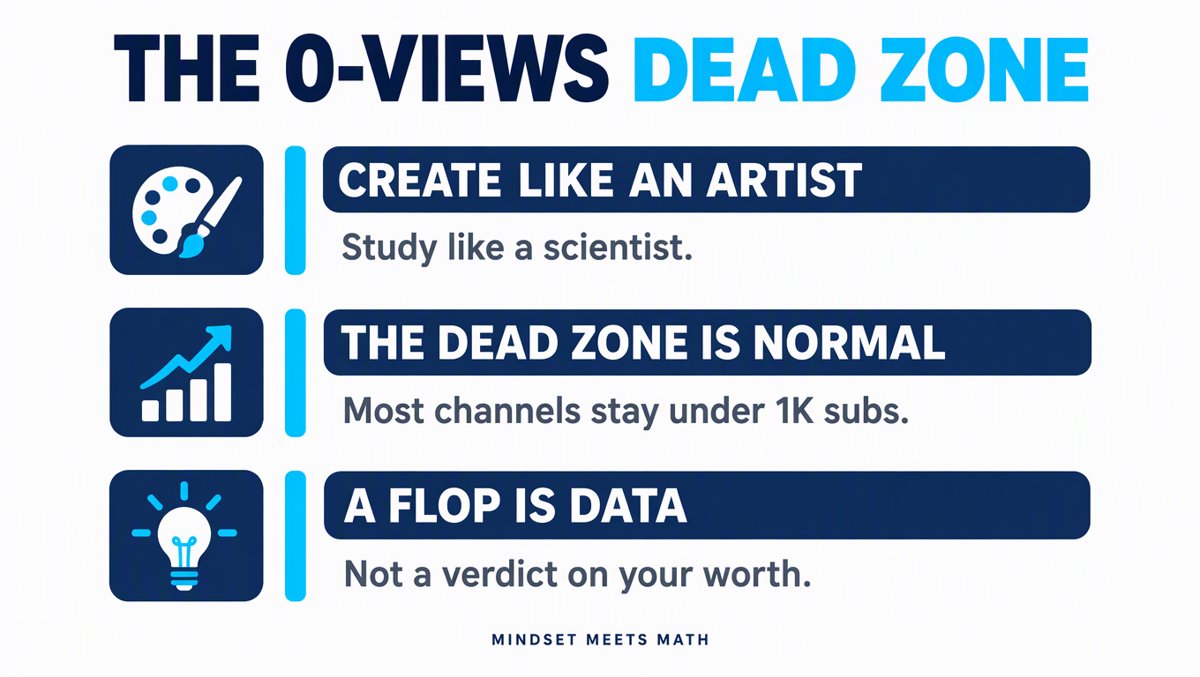
The core metaphor of the video, and honestly the best line in it. While you're making a video, be emotionally invested — pour hours into the script, move the camera around the room twenty times. The second it's uploaded, flip a switch: the video is now an experiment. You were testing a title, a thumbnail, a format. Whatever the numbers say afterward is data, not a verdict on your self-worth.
Our verdict: this is correct, and it's also just good experimental method. Every upload is a hypothesis ("this topic, packaged this way, will attract clicks") and a test result. Creators who internalize this stop doom-scrolling their own analytics in an emotional spiral and start asking scientist questions instead: what was the click-through rate? Where did retention fall off a cliff? Which of my experiments actually won?
Move 2: Change the story you tell yourself
Two creators post the same 30 videos with the same disappointing views. One says "clearly I'm not cut out for this." The other says "the results haven't caught up yet, but I'm getting better every time." Alex's point: same numbers, different story — and eventually the story you keep telling yourself changes the way you create. The self-doubter starts creating like someone who doesn't believe in their own work.
Our verdict: it's the growth-mindset playbook, and it survives contact with reality. There's even a data point hiding in vidIQ's 2026 subscriber-growth study: median monthly growth for active channels in the 1–99 subscriber bucket was about 1.26% — slow, but positive, for channels that keep going. The stuck feeling is real; the "stuck" part is often optional.
Move 3: Find your North Star
The final move is about fuel. If money or clout is your only reason for making videos, motivation dies in the months when YouTube gives you nothing back. Alex's fix: write down one question on a piece of paper — "What is my personal north star that makes all of this worth it?" — and keep coming back to it. His own north star: helping creators who are where he was a few years ago.
Our verdict: underrated. Ask any creator who quit and most will describe an identity crisis, not a strategy failure. The north star is what gets the camera set back up on day 94 of zero views. It's also the least copyable advice on this list, which is exactly why it works.
Fact check: is the "dead zone" actually normal?
This is where the video's comfort turns out to be statistically true. The brutal numbers:
- Of roughly 115 million YouTube channels in existence (against about 69 million active creators), only around 3 million-plus have ever joined the YouTube Partner Program.
- A Social Blade-derived analysis that circulated through r/NewTubers in early 2025 put it at only 8.86% of channels ever crossing 1,000 subscribers.
- Most channels that exist have a handful of uploads, then silence — the graveyard isn't full of failures, it's full of people who stopped after video #3.
- Analytics-tool consensus puts the median views per video for a sub-1,000-subscriber channel under 50 — and that's for channels that actually keep uploading.
And YouTube itself has quietly moved the finish line closer: the Partner Program now has a Tier 1 at 500 subscribers (fan funding only) with full ad monetization at 1,000 subscribers plus 4,000 watch hours or 10 million Shorts views in 90 days. So yes — the dead zone is the norm, the baseline is low, and almost everyone who eventually made it spent time inside it. The pep talk is warranted.
What Alex's video doesn't cover (but your channel still needs)
Here's the honest part: Alex's video is the why, deliberately light on the how. It even teases "the new YouTube algorithm" in its first seconds, then delivers mindset instead of mechanics. Fair enough — that's the coaching lane. But if your goal is subscribers and views, mindset is necessary and not sufficient. Here's the rest of the stack:
| Alex's tip | The metric it feeds | The lever he doesn't mention |
|---|---|---|
| Treat uploads as experiments | Learning velocity | Actually change one variable per video — topic, title, or thumbnail — or your experiment proves nothing |
| Change the story you tell yourself | Consistency | Study your own outliers — your best video's topic/format is your next video's starting point |
| North Star | Persistence | A North Star audience that's searchable and specific beats a broad one every time |
Beyond the video, the mechanics that actually move the two numbers (views, subscribers):
- Packaging is 80% of the click. Your title and thumbnail are tested before your video is ever watched. Small channels die from invisible packaging far more often than from bad content. Before uploading, ask: would I click this if a stranger made it? Write 10 titles, keep the one that makes a specific promise.
- Retention is the real algorithm currency. The first 30 seconds decide everything: restate the promise, show the payoff is coming, cut the wind-up. Then check your retention graphs like a scientist — the exact-Alex-method applied to the metric that matters.
- Niche fit beats talent. The algorithm can only recommend your video to people it can identify. "Videos about everything" are videos about no one. Pick an audience with a recurring problem, then become the channel that solves it.
- Mine your outliers, not your feelings. Sort your library by CTR and average view duration. Your top 2 videos are the market telling you what it wants. Double down with sequels, deeper dives, better-packaged variations.
- Subscriber conversion is a separate skill. Views without subs means no follow-up hook — one sentence mid-video and one at the end about why subscribing serves the viewer's next step, not your ego.
- One platform isn't a strategy, it's a risk. Repurpose into Shorts for discovery, and keep an off-YouTube home (newsletter, community) so a single algorithm mood swing can't erase your audience.
The 4-week playbook (mindset → measurable growth)
- Week 1 — Packaging sweep: Rewrite the titles/thumbnails of your 10 most recent uploads. One variable changed per video. KPI: CTR on refreshed videos vs. old average.
- Week 2 — Retention surgery: Cut the first 30 seconds of your next script to its bones. KPI: 30-second retention above 70%; average view duration up week-over-week.
- Week 3 — Outlier mining: Identify your top video by CTR × AVD. Script a direct sequel or a sharper-angle follow-up. KPI: views on the sequel vs. your channel median.
- Week 4 — North Star on paper: Do Alex's exercise for real — one written sentence, visible above your desk. Then review your month like a scientist: which experiment won, and what's the next hypothesis? KPI: one written learning per week.
The verdict
If you're in the dead zone right now, in order:
- Watch the video. It earns its five minutes. The artist/scientist switch is genuinely the healthiest mental model a small creator can adopt, and Alex delivers it without a single hollow "grind" cliché. As coaching: 8.5/10.
- But don't stop at the pep talk. The video intentionally withholds tactics, so pair it with the mechanics: packaging, retention, outlier mining. As a complete growth system: 4/10 — as intended, it's the "why," not the "how."
- Overall for a stuck creator: 8/10. The right message at the right moment is worth more than a perfect playbook you never start. Mindset gets you to keep uploading; the math decides what the algorithm does with upload #31. You need both.
Sources: George Alexander, "If nobody watches your videos, do this." (Sept 17, 2026) and Zero To Creator program page; vidIQ YouTube Subscriber Growth Statistics (2026); Social Blade-derived channel-size analysis via r/NewTubers (2025); YouTube Partner Program requirements (2026); creator-economy analytics consensus on small-channel view medians. Estimated figures are marked as such. Not affiliated with the creator; no affiliate links.